MSCI Considers Downgrading Indonesia, What Impact Will This Have on the IHSG?
2026-10-16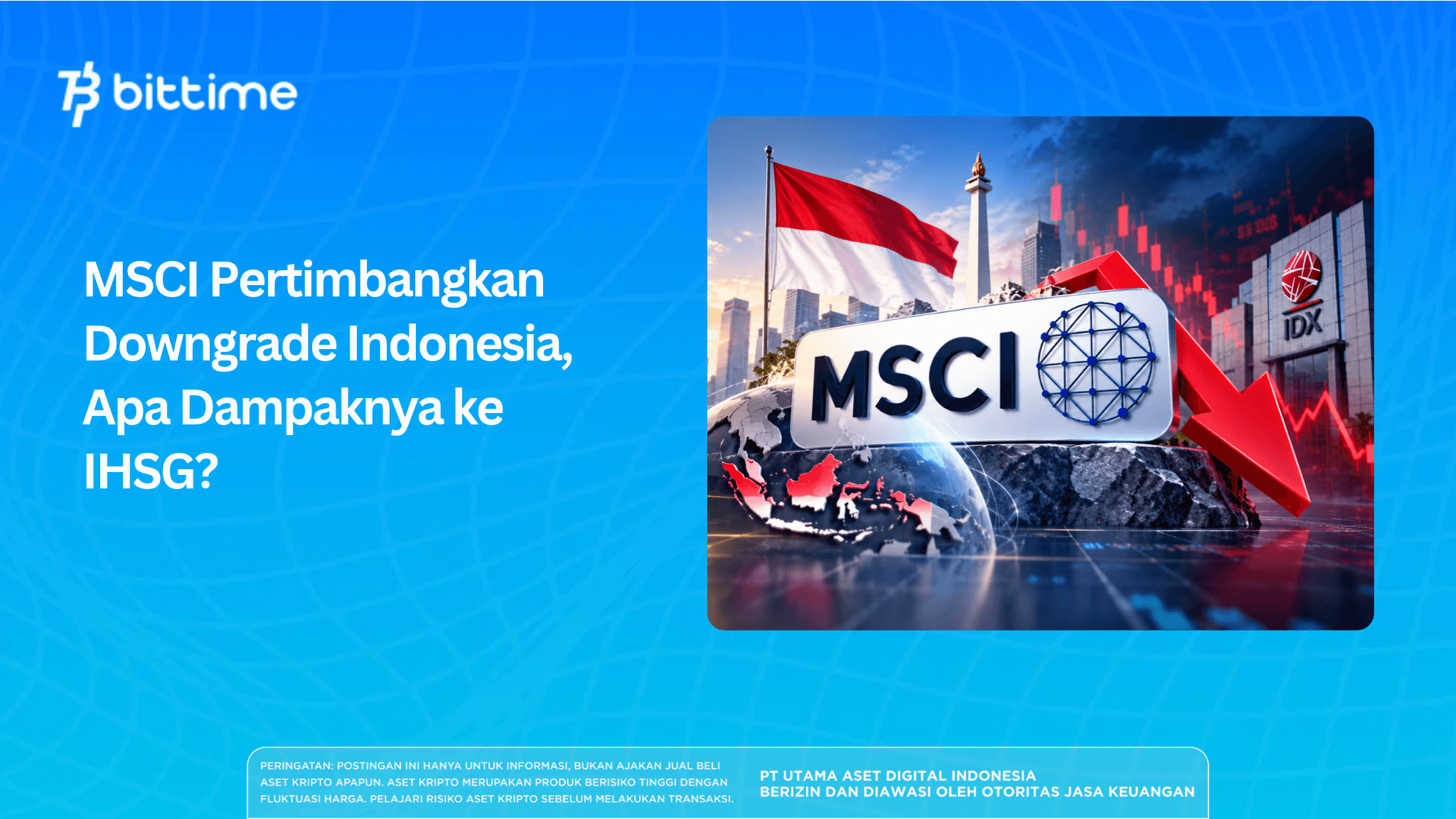
MSCI is considering a downgrade of Indonesia through a consultation on reclassifying the country from an emerging market to a standalone market. The move could affect global investment allocations, but it is not yet a final decision that would immediately remove Indonesian stocks from the relevant indices.
For readers following the Jakarta Composite Index (JCI, or IHSG), the central question is how a change in classification could affect demand for equities, liquidity, and market sentiment. The market's reaction to the announcement must be distinguished from portfolio adjustments if the reclassification is actually implemented.
Key Takeaways
- MSCI's consultation is not the same as a final decision or an implementation date for a downgrade.
- The potential impact on the JCI could come from index-tracking fund adjustments, capital flows, and changes in risk perceptions.
- The extent of the pressure will depend on the scope of the decision, investment mandates, stock liquidity, and market participants' responses.
What Is MSCI Proposing for Indonesia?
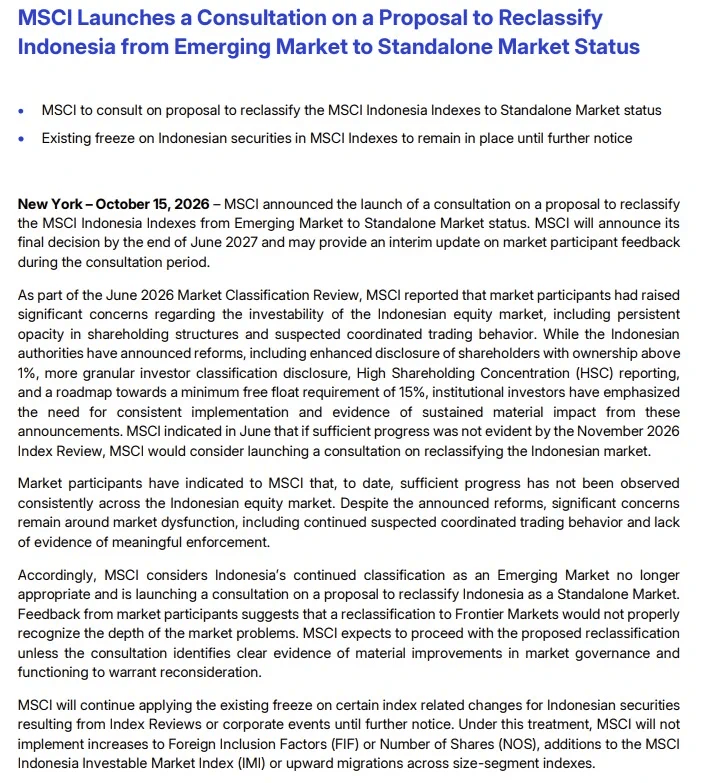
On October 15, 2026, MSCI launched a consultation on a proposal to reclassify Indonesia as a standalone market. This makes a potential change in status a concrete matter under review rather than mere market speculation.
However, announcing a consultation does not automatically change the existing classification. The decision and its implementation are separate stages that must be considered individually.
MSCI is an index provider whose benchmarks are used by various investment products. Changes to its classifications can affect portfolio construction, although MSCI itself is not the fund manager buying or selling the shares.
Read also: Do National Security Conditions Affect the JCI? Here's an Explanation
What Does Standalone Market Mean?
Under MSCI's framework, a standalone market is a market classification whose country indices are not included in either the emerging market or frontier market index groups. It does not mean that all stocks in the country stop trading.
In simple terms, the distinctions are as follows:
- Emerging market: a group of markets that meet MSCI's criteria for emerging market status.
- Frontier market: a group of markets that meet separate criteria for market size, liquidity, and accessibility.
- Standalone market: a market treated separately from both of those groups.
These terms describe market classification under an index methodology. They are different from sovereign debt ratings, which assess credit risk.
Reclassification would also not eliminate the JCI. The JCI (IHSG) is Indonesia's stock market index, distinct from MSCI indices, although some stocks may be included in both.
Read also: IDX Stock Notation Update: What's Changing?
Why Is MSCI Considering a Downgrade of Indonesia?
MSCI has highlighted concerns about the transparency of share ownership structures, suspected coordinated trading, and the lack of consistently demonstrated, adequate improvements in governance and market functioning. Market participants also indicated that a move to frontier market status would not sufficiently reflect the issues under review.
These issues matter because institutional investors need to estimate how many shares are genuinely available for trading. Ownership structures that are difficult to understand can complicate assessments of free float and portfolio construction.
Free float refers to the portion of shares available to public investors under the applicable definition. It differs from the total number of listed shares because some holdings may be strategic or otherwise unavailable for unrestricted trading.
Authorities had previously announced disclosure of shareholders holding more than 1%, more detailed investor classifications, reporting of highly concentrated ownership, and plans to raise the minimum free float to 15%. The next challenge is consistent implementation and its effect on investors' experience.
Potential Impact of an MSCI Downgrade of Indonesia on the JCI
1. Portfolio Adjustments by Index-Tracking Funds
Passive funds seek to replicate the composition of their benchmark indices. If Indonesian stocks are removed from an index they track, managers would need to adjust their exposure according to their mandates and replication methods.
Such adjustments could create selling pressure on the affected stocks. However, the timing and size of the transactions would depend on the final decision, implementation schedule, and how each investment product manages its portfolio.
Active funds have greater discretion. Their managers may retain, reduce, or increase stock positions according to their mandates, valuations, and risk assessments.
It is therefore inaccurate to say that 'all foreign investors must sell.' Each investment product's relationship to the index must be examined individually.
2. Changes in Capital Flows and Liquidity
A decline in demand from certain investor groups could reduce buying support for stocks. If selling pressure exceeds the market's capacity to absorb it, prices may move more sharply.
Liquidity matters because it determines how easily transactions can occur without large price changes. Stocks with limited market depth may be affected differently from actively traded shares.
Nevertheless, stock sales by foreign investors do not always mean that capital immediately leaves Indonesia. Proceeds may be moved into other instruments or held as cash, so stock transactions and cross-border capital flows must be distinguished.
3. Sentiment and Volatility Before the Decision
Market participants may change their positions before a final decision. Such reactions reflect expectations about the consultation's outcome, not proof that reclassification has already occurred.
Volatility may rise when new information changes expectations. Conversely, credible evidence of improvements could also influence risk assessments.
The direction of the JCI is still influenced by other factors, including corporate earnings, interest rates, exchange rates, and global conditions. Attributing every move in the index to a single announcement would oversimplify market conditions.
Read also: Bitcoin Price After the September 2026 US CPI: What Is the Impact?
Which Stocks Could Be Affected?
Initial attention may focus on stocks included in the relevant MSCI indices . However, constituent lists and weights must be checked against the latest available period.
To assess exposure, consider:
- Whether a stock is included in an index that could change.
- The stock's weight in that index.
- Foreign investor ownership.
- Daily trading value and market depth.
- The size of index-tracking fund positions relative to the stock's liquidity.
Stocks outside MSCI indices may also be affected by changes in overall market sentiment. However, that effect differs from selling directly driven by changes in index composition.
A stock's weight in the JCI also determines how much its price movement affects the composite index. The same percentage decline in two different stocks will not necessarily have the same impact on the JCI.
Read also: Legal Crypto Trading in Indonesia 2026: 28 OJK-Licensed Traders
Will the JCI Definitely Fall if Indonesia Becomes a Standalone Market?
There is no basis for predicting the size or direction of the JCI's movement solely from a change in classification. The market may price in some of the risks before a decision is announced.
From an analytical perspective, several scenarios should be distinguished:
- The proposal is implemented: funds tracking the affected indices adjust their portfolios, with consequences depending on the scope and timetable.
- The proposal is reconsidered: evidence of improvements could change the assessment, but the outcome would still depend on MSCI's decision.
- The market has already anticipated the change: the reaction on the decision date could differ from the initial reaction when the risk first became known.
These three scenarios are neither forecasts nor probability estimates. They help readers understand that market outcomes depend on new information and investors' existing positions.
Purchases by domestic investors could provide one source of demand. However, there is no guarantee that their buying would be sufficient to absorb all potential selling.
Read also: Rp21.83 Trillion in BLBI Debt Repaid: What Is the Impact After 30 Years?
Consultation Timeline and Interim Policy
The deadline for submitting feedback is April 30, 2027, while the decision is scheduled to be announced no later than June 30, 2027. Neither date should be treated as the automatic effective date of reclassification.
Meanwhile, the freeze on certain index adjustments for Indonesian securities will remain in place until further notice. The restrictions include increases in FIF/NOS, additions of constituents to the MSCI Indonesia IMI, and moves into higher size segments.
A freeze on index adjustments is not a suspension of stock trading on the Indonesia Stock Exchange. They concern different activities and have different consequences.
Five Developments Investors Should Monitor
Rather than relying on headlines alone, monitor these five developments:
- Consultation documents: review the proposal's scope and any changes to its provisions.
- Evidence of reforms: look for implementation of ownership transparency and trading oversight measures.
- Foreign trading data: distinguish daily net selling, cumulative flows over a period, and estimates of future sales.
- Liquidity of affected stocks: assess the market's ability to absorb transactions.
- Decision announcements: distinguish the review outcome from the implementation schedule.
Estimates of capital outflows should also be read alongside their underlying assumptions. The value of assets that use an index as a benchmark does not automatically equal the amount of money that must be sold.
To assess the authorities' response, prioritize official statements and actions that can be verified. Commitments to change carry greater weight when followed by implementation and consistent results.
If you would also like to learn about the crypto market, consider registering with Bittime after understanding its services and risks. An MSCI classification change is not, by itself, a reason to move investments from stocks into crypto.
Conclusion
The potential MSCI downgrade of Indonesia should be understood as a consultation process with possible consequences for demand for stocks and perceptions of risk. The extent of any impact on the JCI will depend on the final decision, implementation rules, and market conditions when adjustments take place.
Focus on evidence of reforms, the exposure of index-tracking funds, and subsequent official announcements. Use that information to understand the risks without treating a decline in the JCI or the departure of all foreign investment as inevitable.

Bittime is a licensed Digital Financial Asset Trader (PAKD) platform regulated and supervised by Indonesia's Financial Services Authority (OJK) — where you can buy Bitcoin in Indonesia and hundreds of other crypto assets starting from Rp10,000. Registration is quick and secure, and you can get started today.
Track the USDT-to-IDR exchange rate and the price movements of your favorite crypto assets in real time. Everything is available in one crypto investment app that you can download for free from the Play Store.
Ready to get started? Sign up for Bittime now and put your investment strategy into action on a platform trusted by millions of users in Indonesia.
FAQ
Has MSCI Officially Downgraded Indonesia?
The announcement discussed here opens a consultation on a proposed change in market classification. It is not the same as a final decision or the implementation of a downgrade.
What Does Standalone Market Mean in MSCI's Classification?
A standalone market is treated separately from MSCI's emerging and frontier market index groups. This status does not mean the domestic stock exchange is closed or that shares cease trading.
Why Is MSCI Considering a Downgrade of Indonesia?
MSCI has raised concerns about ownership transparency, suspected coordinated trading, and the effectiveness of market improvements. Its assessment relates to the market's accessibility and suitability for international institutional investors.
What Impact Could an MSCI Downgrade of Indonesia Have on the JCI?
Potential effects include portfolio adjustments by index-tracking funds, changes in liquidity, and shifts in investor sentiment. However, the JCI is also influenced by economic conditions and company performance, so its direction cannot be determined by one factor alone.
When Will MSCI Announce Its Decision on Indonesia?
The decision is scheduled to be announced by June 30, 2027, following the end of the consultation period on April 30, 2027. The decision date must be distinguished from the date on which any change would take effect.
Disclaimer: The views expressed belong exclusively to the author and do not reflect the views of this platform. This platform and its affiliates disclaim any responsibility for the accuracy or suitability of the information provided. It is for informational purposes only and not intended as financial or investment advice.

.png)