The Jakarta Composite Index (IHSG) Weakens Today, Consider Investment Sentiment and Strategies
2026-07-27
The IHSG today, Monday, July 27, 2026, is trading lower despite earlier expectations of a limited rebound. As of 1:35 p.m. WIB, the index stood at 6,177.58, down 0.30% from the previous close.
At the end of the first session, the IHSG was down 0.36% to 6,173.94. This data is intraday and is subject to change until the end of trading.
Key Takeaways
- The IHSG temporarily weakened by around 0.30% despite pre-market predictions pointing to limited strengthening.
- Uncertainty over Bank Indonesia's leadership, foreign investor outflows, geopolitics, oil prices, and import tariffs are the main sentiments.
- Investors can prioritize risk management, gradual purchases, and stock selection based on fundamentals and transaction volume.
IHSG Movement Today: Strengthening or Weakening?
The answer is,The movement of the IHSG today is still weakening until the beginning of the second session.
The IHSG closed trading on Friday, July 24, 2026, at 6,196.43, after a 1.88% decline. At the start of the week, the index failed to stage a strong recovery and instead continued to decline, reaching 6,173.94 in the first session.
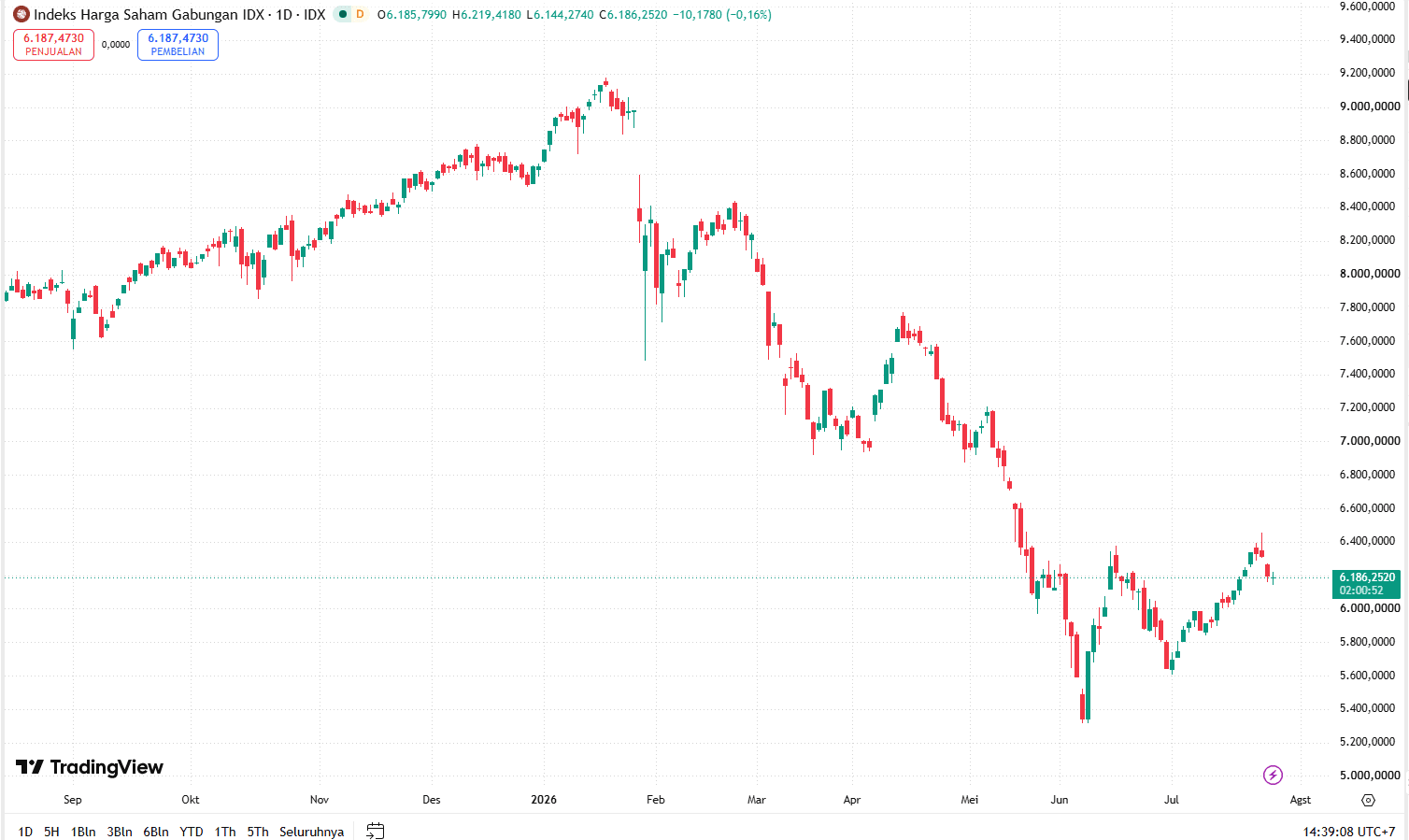
Source: TradingView | IHSG
Transaction value in the first session reached approximately Rp7.10 trillion, with a trading volume of 17.3 billion shares. Foreign investors recorded net selling of approximately Rp293.4 billion, indicating that global market sentiment toward Indonesian assets remains cautious.
Large-cap banking stocks also failed to provide strong support. BMRI fell around 0.48%, while BBCA declined around 0.40% in the first session. Because large bank stocks carry significant weight, their decline could hold back the IHSG, even though several other stocks are in the green.
It should be noted that intraday conditions do not necessarily reflect final trading results. The index could still rebound or weaken further before the close, particularly if new developments emerge that affect the rupiah exchange rate and investor confidence.
Read also:Is the IHSG Still Vulnerable to Corrections Today? Check Out the Latest Analysis
Why is the IHSG Prediction Today Different from the Actual?
Before the market opened, several analysts predicted that the IHSG had limited upside potential. This projection was based on the possibility of a technical rebound after the index experienced several days of correction.
One technical scenario places IHSG support at around 6,125 and resistance at 6,223. Another scenario predicts the index will move in the range of 6,154–6,310.
Different analyses place support at 6,137 and resistance at 6,268. As long as the index remains above support, a rebound is still possible, but volatility is expected to remain high.
However, market projections always have limitations. Predictions are based on information available before trading begins. When new information emerges, investors can quickly change their positions.
In trading on July 27, 2026, new uncertainty emerged following news of the resignation of the Governor of Bank Indonesia. This development heightened market attention regarding the continuity of monetary policy, the stability of the rupiah, and the independence of the central bank.
Thus, predictions of limited upside aren't necessarily entirely wrong. A rebound scenario is still possible as long as support holds, but new sentiment has market participants opting to reduce risk.
Read also:The Right Stock Recommendations for Today's IHSG Movement
Domestic IHSG sentiment
Uncertainty over Bank Indonesia's Leadership
The most noteworthy domestic sentiment is the change in Bank Indonesia leadership. Financial markets are highly sensitive to information regarding the central bank, as the institution plays a crucial role in maintaining the stability of the rupiah, inflation, and the financial system.
The resignation of the central bank governor, which comes amid rupiah pressure, may raise several questions:
- Will the direction of interest rate policy change?
- How does the leadership change process take place?
- Is monetary policy independence maintained?
- How does the government respond to maintain market confidence?
- Will the pressure on the rupiah continue?
Uncertainty doesn't always mean immediate deterioration in fundamental conditions. However, markets tend to minimize risk when available information is incomplete. This can encourage investors to hold off on purchases or shift funds to assets perceived as more defensive.
Release of First Semester 2026 Financial Report
Investors are also awaiting the issuer's financial report for the first half of 2026. This performance can be a significant catalyst, demonstrating the company's ability to navigate economic changes, funding costs, rupiah fluctuations, and commodity price volatility.
Some aspects that need to be considered in financial reports include:
- Income growth.
- Margin of profit.
- Loads of flowers.
- Operational cash flow.
- Debt changes.
- Capital expenditure.
- Management guide.
- Impact of exchange rates.
Stocks that post above-expected performance can still strengthen even if the IHSG weakens. Conversely, stocks with disappointing reports can experience deeper corrections than the index.
Keep an eye on other stock tokens like AMZON, AMDON, TSLAX and NFLXON, as well as MSFTON, and then you can start trading on the most comprehensive crypto exchange, Bittime.
Foreign Investor Fund Flow
Foreign investors recorded net selling of approximately Rp 293.4 billion in the first session. BMRI, TPIA, BULL, ANTM, and BUMI were among the stocks with the largest foreign net sales during the period.
However, foreign flows did not move in one direction across all stocks. EMAS, BBCA, RAJA, KOTA, and PTRO still recorded net foreign buying. This indicates that global investors are not completely abandoning the Indonesian market but are instead selecting and rotating their portfolios.
Global Sentiment Influencing IHSG Analysis
Geopolitical Tensions and Oil Prices
The conflict in the Middle East is one factor suppressing global risk appetite. When tensions escalate, oil prices can rise due to market concerns about disruptions to energy production or distribution.
High oil prices can have different impacts on Indonesian issuers:
- Positive for some oil producers and energy services.
- Negative for companies with large fuel consumption.
- Increases the risk of inflation.
- Increase the burden of subsidies or import costs.
- Limiting the room for interest rate cuts.
In previous trading, the rise in Brent crude prices to over US$100 per barrel was one of the factors driving sell-offs in large-cap stocks.
United States Import Tariff Policy
The additional 10% import tariff on Indonesian products has also attracted market attention. This policy could impact companies with significant export exposure to the United States.
The impact is not always the same for every issuer. Investors need to check:
- Portion of revenue from the United States market.
- Ability to increase selling prices.
- Potential for export market shift.
- Use of imported raw materials.
- Risk of decreasing sales volume.
- Indonesia's position compared to competing countries.
Issuers with diversified markets tend to be better able to cope with changes in trade policies than companies that rely on a single destination country.
Global Interest Rate Policy
The market is also closely monitoring the US Federal Reserve meeting and the monetary policy direction of other developed countries. Rising energy prices could further increase inflation risks and reduce the likelihood of interest rate cuts.
Persistently high global interest rates could impact:
- Strengthening of the US dollar.
- Pressure on the rupiah.
- Rising bond yields.
- Outflows from emerging markets.
- Increased corporate funding costs.
- The decline in stock valuations is growing.
Read also:Why Does the IHSG Fluctuate? These Are the Driving Factors
IHSG Support and Resistance Levels for July 27, 2026
Based on several available technical scenarios, the important areas for the IHSG today are:
- Nearest support: 6,137–6,154.
- Next support: 6.125.
- Initial resistance: 6,198–6,223.
- Further resistance: 6,268–6,310.
Bullish Scenario
Opportunities for recovery can open up when the IHSG:
- Holding above the 6,137–6,154 area.
- Back to breaking through 6,198.
- Get support from banking stocks.
- Recorded an increase in purchase volume.
- Experiencing a decrease in foreign selling pressure.
- Supported by rupiah stabilization.
A breakout of the 6,223 resistance level could open the door to a move towards the 6,268 area. However, any increase without increased volume should be approached with caution as it could be a temporary rebound.
Bearish Scenario
The risk of further correction increases if the IHSG:
- Drop below 6.154.
- Breaking through support at 6,137 and 6,125.
- Experiencing increasingly large foreign net sell.
- Under pressure from big bank stocks.
- Accompanied by the weakening of the rupiah.
- Influenced by negative geopolitical developments.
Some analysts even predict that the IHSG could test the 6,000–6,100 area if oil prices remain high and global sentiment worsens.
Read also:5 Recommended Stocks Worth Buying in July 2026
Today's Stock Recommendations for Watchlist
The following list should be understood as today's preferred stocks to watch, not a buy order. Every investor still needs to conduct independent analysis and set risk limits.
BIPI
BIPI is on the watchlist with an indicative target range of IDR 175–IDR 200. This stock is suitable for traders who understand the volatility of energy and infrastructure stocks.
Check whether the price increase is supported by consistent volume. Avoid chasing the price when the stock has risen too quickly without a consolidation phase.
BKSL
BKSL is attracting attention with an indicative target range of IDR 75–IDR 82. Low-priced property stocks can experience large percentage movements, but they also carry the risk of high volatility.
Investors need to assess liquidity, trend structure, and financial statements before opening a position.
DEWA
DEWA was listed on the stock list for trading on July 27, 2026.
Before buying, consider volume, nearby support areas, and the risk of a correction after a rally. Don't use a single daily recommendation as the basis for a long-term investment.
RAJA
RAJA has an indicative target range of IDR 980–IDR 1,090 and still recorded net foreign buying of around IDR 10.48 billion in the first session.
The combination of technical momentum and foreign capital inflows can be a positive signal, but investors still need to assess whether the price has moved too far from support.
JPFA
JPFA is one of the stocks being watched closely with an indicative target of IDR 2,250–IDR 2,300.
The poultry sector can be affected by feed prices, purchasing power, exchange rates, and supply imbalances. Investors should not only use charts but also examine company margin developments.
CPIN
CPIN has an indicative target range of Rp3,500–Rp3,800.
As a major poultry issuer, CPIN can be a valuable resource for monitoring the consumption sector. However, pressure from raw material costs and fluctuations in chicken prices still require attention.
BULL, MMIX, and SIMP
BULL, MMIX, and SIMP also appear as preferred stocks in the July 27, 2026 trading analysis.
BULL warrants careful attention, as it was among the stocks with significant foreign net sales, around Rp41.82 billion, in the first session. This doesn't automatically mean a price drop, but rather indicates distribution pressures that need to be considered.
Read also:US Stock Tokenization: Hold Your Favorite US Stocks and Earn 7% Daily
Investment Strategy When the IHSG Weakens
1. Don't Jump for the Lowest Price
A falling index doesn't always immediately bottom. Waiting for signs of stabilization can reduce the risk of buying when selling pressure is still strong.
Confirmation can be:
- Price holds above support.
- Sales volumes are starting to decrease.
- Higher lows appear.
- Large-cap stocks are starting to recover.
- The rupiah is moving steadily.
- Foreign flows are improving.
2. Use Incremental Purchases
Long-term investors can divide their funds into several tranches. This strategy reduces the risk of investing all of their capital at one price.
For example, allocations can be split when the stock:
- Approaching first support.
- Testing the next support.
- Shows confirmation of rebound.
- Publish solid financial reports.
3. Differentiate between Trading and Investing
Trading positions require clear entry levels, targets, and stop-losses. Meanwhile, long-term investment decisions should be based on fundamentals, valuation, management quality, and industry prospects.
Don't hold on to a losing trading position by turning it into an “investment” without new analysis.
4. Prioritize Stocks with Healthy Fundamentals
When uncertainty increases, companies with strong balance sheets tend to be better able to weather the pressure.
Some characteristics to look for include:
- Positive operating cash flow.
- Manageable debt levels.
- Margins are relatively stable.
- Diversified income.
- Trading liquidity is adequate.
- Valuation is not too expensive.
5. Limit Position Size
Don't invest all your funds in one stock just because an analyst has a price target. Limit your allocation based on volatility and the maximum loss you can afford.
6. Monitor Rupiah and Foreign Flows
The IHSG is often influenced by fluctuations in exchange rates and global investor capital flows. A weakening rupiah accompanied by net foreign selling can increase pressure on large-cap stocks.
7. Avoid Decisions Due to FOMO
Stocks that rise when the IHSG weakens can attract attention. However, buying after a significant rise without understanding the catalyst can increase the risk of a correction.
Read also:7 Best Investments of 2026 Worth Considering Now
Monitor Asset Diversification through Bittime
For those of you who follow global stock markets, cryptocurrencies, blockchain, and digital assets, Bittime can be used to explore the various instruments available, including cryptocurrencies and certain tokenized stocks.
Tokenized stocks provide digital exposure to the value of global company stocks, but their characteristics differ from buying Indonesian stocks through a brokerage firm.
Investors need to understand the issuer’s structure, tokenholder rights, liquidity, price risk, and product terms before trading. Bittime offers a selection of tokenized stocks and ETFs that can be traded on its platform.
Sign up on Bittime to explore the available asset options, then stay updated on the latest market and technology news through the Bittime Blog. Use this information as research material, not as the sole basis for decision-making.
Conclusion
The IHSG is currently down, not up. As of 1:35 p.m. WIB on July 27, 2026, the index stood at 6,177.58, down about 0.30%. In the first session, the IHSG closed down 0.36% at 6,173.94, with foreign net selling of approximately Rp293.4 billion.
This movement indicates that predictions of limited gains must contend with new domestic sentiment, particularly uncertainty surrounding Bank Indonesia’s leadership. On the global front, the Middle East conflict, oil prices, U.S. import tariffs, and the direction of interest rates remain key factors.
Investors should not merely speculate on the index’s direction. Pay attention to the support levels of 6,137–6,154, resistance levels of 6,198–6,223, foreign capital flows, the rupiah, trading volume, and issuers’ financial reports.
Use a phased buying approach, limit position size, and separate trading strategies from investment strategies. Also, monitor market updates via the Bittime Blog and study the characteristics of each instrument before allocating funds.

Bittime is a licensed and regulated Digital Financial Asset Trader (PAKD) supervised by Indonesia’s Financial Services Authority (OJK) — where you can buy Bitcoin in Indonesia and hundreds of other crypto assets starting from just Rp10,000. The registration process is fast, secure, and you can get started today.
Track USDT to IDR conversions and monitor your favorite crypto assets in real time. Everything is available in one crypto investment app that you can download for free on the Play Store
Ready to start? Register now on Bittime and execute your investment strategy with a platform trusted by millions of users in Indonesia.
FAQ
Is the IHSG strengthening or weakening today?
As of 1:35 PM WIB on July 27, 2026, the IHSG had weakened by around 0.30% to 6,177.58. This movement is still subject to change until the end of trading.
Why did the IHSG fall today?
The weakening was influenced by domestic uncertainty, foreign selling pressure, rupiah movements, and global sentiment. The resignation of the Governor of Bank Indonesia was one of the most closely watched developments in the market.
What is the support for the IHSG today?
The support areas to watch are around 6,137–6,154, followed by 6,125. If these levels are breached, the risk of a correction to lower levels could increase.
What stocks can be monitored today?
Some stocks on the analyst watchlist include BIPI, BKSL, DEWA, RAJA, JPFA, CPIN, BULL, MMIX, and SIMP. This list is not a guarantee of profits and requires independent analysis.
What is the strategy when the IHSG weakens?
Investors can buy gradually, selecting stocks with sound fundamentals, and limiting position size. Traders should determine entry, target, and stop-loss orders before opening a position.
Disclaimer: The views expressed belong exclusively to the author and do not reflect the views of this platform. This platform and its affiliates disclaim any responsibility for the accuracy or suitability of the information provided. It is for informational purposes only and not intended as financial or investment advice.

.png)