Ripple BI-FAST Returns to API, Transfer Limit IDR 100 Million
2026-11-12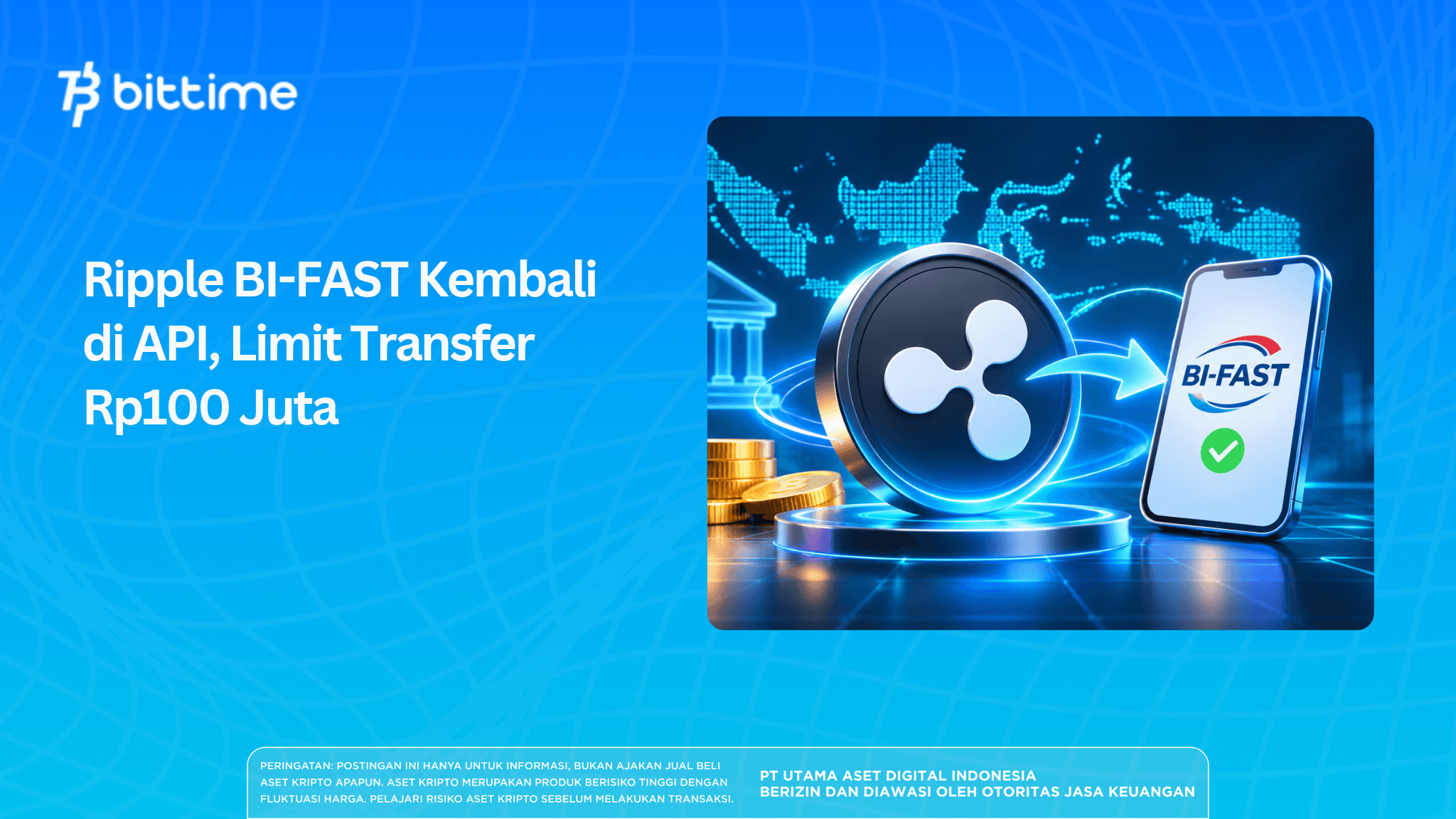
Ripple BI-FAST is back in the spotlight after Ripple updated its Payments Direct specifications on November 10, 2026. The update restores support for payments in Indonesian rupiah (IDR) through BI-FAST, with a transaction limit of up to Rp100 million. These changes appear in API specification version 2026.03 and also cover several software development tools.
The inclusion of BI-FAST in Ripple's infrastructure creates opportunities for financial service providers to connect international payments with bank accounts in Indonesia. However, this technical update does not mean the service is immediately available to all users. So, what exactly has changed, and what could it mean for Indonesia's payment system and the XRP ecosystem?
Key Takeaways
- Ripple has restored support for BI-FAST and the Indonesian rupiah in its Payments Direct API specifications through the November 10, 2026 update.
- The Indonesian payment corridor has a limit of Rp100 million per transaction and supports real-time domestic payouts.
- The update creates opportunities to develop cross-border payment services but does not automatically indicate that XRP is being used.
Ripple BI-FAST Returns to the Payments API
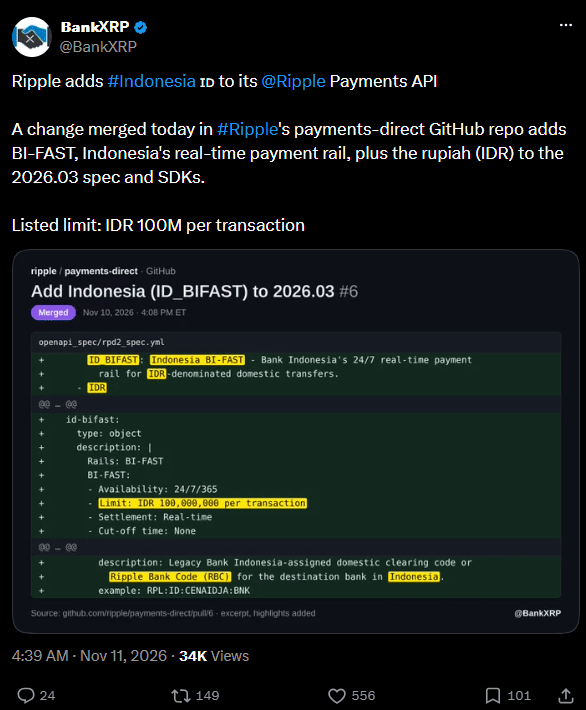
On November 10, 2026, an update to Ripple's Payments Direct GitHub repository was officially merged into specification version 2026.03.
The changes restore support for Indonesia through the code ID_BIFAST, which refers to the BI-FAST payment rail. The rupiah is also listed as a supported currency, enabling the system to recognize payouts denominated in IDR.
For developers and payment service providers, this change provides technical guidance for integrating transactions destined for Indonesian bank accounts.
Although widely discussed as a new step for Ripple in Indonesia, this support actually has a prior history.
Ripple's documentation shows that ID_BIFAST was available in July 2026, then removed in September. The payment rail was added back in the November update.
Therefore, this latest development is more accurately described as the restoration of support for Indonesia in the Payments Direct specifications.
What Does the GitHub Update Mean for Users?
GitHub is a platform developers use to store, manage, and update software code.
When a change is officially merged into the main repository, it means the update has been accepted as part of the system's development.
In Ripple's case, this update provides technical information on how the payment service identifies BI-FAST as a rupiah payout rail.
Nevertheless, a change to the specifications does not automatically prove that all Ripple customers can already use the corridor.
Commercial availability still depends on system readiness, payment partners, and applicable operating requirements.
Read also: Free XRP for RLUSD Holders: Requirements and How to Get It
What Is the Ripple Payments Direct API?
Ripple Payments Direct is part of Ripple's payment services, allowing businesses to connect their systems to infrastructure for sending and disbursing funds.
Integration takes place through an API, or Application Programming Interface, a technology that allows two software systems to exchange information.
Imagine a remittance company that wants to offer money transfers from overseas to bank accounts in Indonesia.
The company needs a system to process payment instructions, verify recipient information, and send funds through an available payment rail.
This is where a payment API comes in.
Rather than building all the infrastructure from scratch, service providers can use existing integrations to manage specific payment functions.
Why Does Indonesia Need Dedicated Support?
Every country has its own currency, payment networks, and banking requirements.
To disburse funds in Indonesia, a payment system must recognize the destination account, receiving bank details, and the rupiah transfer rail being used.
Adding ID_BIFAST helps specify those requirements in Ripple's documentation.
This gives developers clearer guidance when preparing payment applications that send funds to Indonesian bank accounts.
Understanding BI-FAST and the ID_BIFAST Code
BI-FAST is a retail payment infrastructure developed by Bank Indonesia to support fast domestic fund transfers around the clock.
Through this service, eligible participants can process rupiah transfers without being restricted by conventional banking hours.
Meanwhile, ID_BIFAST is the code Ripple's system uses to identify payments routed through BI-FAST. The code is not a new currency, a crypto token, or a blockchain network.
Its function is simpler: to tell the system which payment instrument is being used when funds are disbursed to a recipient's bank account in Indonesia.
Therefore, support for BI-FAST in Ripple Payments does not mean BI-FAST has become a blockchain-based system. The domestic infrastructure continues to operate under Indonesia's existing payment mechanisms.
Read also: US$20 Million in XRP Stolen From 6,678 Accounts as D'CENT App Wallet Is Attacked
What Has Changed in the Ripple Payments API?
The Payments Direct version 2026.03 update involves more than simply adding Indonesia's name. It includes several adjustments that help the system recognize and process payment instructions through BI-FAST.
1. Support for the ID_BIFAST Financial Instrument
The ID_BIFAST code is once again available as a payment instrument type in the API specifications. This identifier allows the system to distinguish BI-FAST payments from other payout rails. Developers can also adapt validation processes to the requirements of the selected instrument.
2. Added Support for the Rupiah
The update also lists IDR as a destination payment currency. This support allows the system to identify transactions to be paid out in rupiah, including payments originating from cross-border services.
However, currency conversion still follows the mechanism used by each payment provider.
3. Adjustments to Transaction Parameters
Ripple's specifications include information on transaction limits, service availability, and BI-FAST processing characteristics. These details help determine whether a payment instruction meets the requirements of the available rail.
4. SDK Updates for Developers
These changes also include SDK support for Java, Go, Python, and TypeScript. An SDK, or Software Development Kit, is a collection of tools that helps developers connect applications to a particular service.
With a suitable SDK, integration can be more straightforward because developers do not need to handle every aspect of technical communication manually.
Even so, companies still need to test the integration before using it in live payment operations.
Read also: Why Are Major Investors Selling XRP but Still Choosing Bitcoin?
What Is the Ripple BI-FAST Transfer Limit?
One of the most notable details in this update is the Rp100 million transaction limit. This is the maximum amount specified for the BI-FAST payout rail in the Ripple Payments Direct documentation. In addition to the maximum, Ripple specifies a minimum transaction amount and a daily compliance limit for each recipient.
Here are the details.
These limits apply within the context of Ripple's payment corridor and remain subject to service requirements and compliance checks.
Why Is the Limit Rp100 Million Instead of Rp250 Million?
BI-FAST has a general maximum limit of up to Rp250 million per transaction for certain interbank customer transfers. Ripple, meanwhile, sets a Rp100 million limit within the parameters of its supported payout corridor. The two figures are not contradictory because they apply to different scopes.
Bank Indonesia sets the rules for the BI-FAST infrastructure, while payment service providers may impose lower limits based on operational needs and risk management.
In other words, the Rp100 million figure does not represent a change to the national BI-FAST limit.
How Does Ripple Process Rupiah Payments?
To understand the benefits of BI-FAST support, imagine a company overseas wanting to send a payment to a business partner in Indonesia.
The funds are sent through a payment service provider with access to the relevant infrastructure. The system then processes the transfer instructions, checks the recipient's information, and prepares the payout in rupiah.
If all requirements are met, the payment can be routed through an available domestic rail, including BI-FAST.
In general, the process involves five steps:
- The sender creates a payment instruction through their chosen service provider.
- The system checks the transaction information, including the recipient's identity and details.
- Funds are prepared in the destination currency through the applicable funding or conversion mechanism.
- The instruction is routed to an Indonesian payment rail based on the services available.
- The funds are disbursed to the recipient's account through eligible domestic infrastructure.
This flow is a general illustration, not a statement that all Ripple transactions always follow an identical process. Settlement times can also vary, particularly when payments involve currency conversion or additional checks.
Read also: XRP Mentioned 101 Times in BIS Research: What Was Actually Tested?
What Impact Could Ripple BI-FAST Have on Indonesia?
Support for Indonesia in Payments Direct is noteworthy because it addresses growing payment needs, particularly among companies conducting cross-border transactions.
If implemented commercially, this update could benefit several sectors.
New Opportunities for Banks and Fintech Companies
Fintech companies handling international payments need access to multiple banking networks and currencies. With BI-FAST support, service providers can consider integrating payouts to rupiah-denominated bank accounts through Ripple's infrastructure.
For businesses developing payment applications, the availability of API specifications and SDKs also makes technical preparation easier.
However, these capabilities must still be backed by service agreements, operational readiness, and regulatory compliance.
Potential to Simplify Remittances
Sending money from overseas to Indonesia is an important part of international payment services. Recipients may include migrant workers' families, businesses, or companies receiving payments from global customers.
In this process, disbursement to a local bank account is one of the steps that shapes the user experience. BI-FAST support could help providers speed up domestic payouts once the preceding processes have been completed.
The actual benefits can only be assessed when real-world data on transaction times, costs, and service usage becomes available.
Supporting Payment System Connectivity
This development also highlights the growing need to connect global payment infrastructure with domestic systems.
Each country has its own payment rules and standards, so integrating different networks requires technical adjustments. The availability of a rupiah payout rail in Ripple Payments could be one component supporting the development of such services.
For Indonesia, the opportunities extend beyond remittances to business payments and digital financial services.
Read also: Ripple Adds Korean Banking Partners: What Could It Mean for XRP's Price?
Are International Transfers Through Ripple Instantly Processed in Real Time?
The term real-time in the BI-FAST update can lead to misunderstandings. BI-FAST does support fast domestic transfer processing. However, international payments involve more steps than simply moving funds between two Indonesian bank accounts.
Before funds are disbursed, providers may need to verify identities, conduct compliance checks, and convert currencies. Fund availability and the readiness of payment partners can also affect settlement times.
Therefore, BI-FAST's real-time support does not mean that every cross-border transaction through Ripple will be completed in seconds. What the specifications describe is the capability of the domestic payout rail.
Does the Ripple BI-FAST Integration Use XRP?
News about the expansion of Ripple Payments is often linked to XRP because the two belong to related parts of the same ecosystem.
Nevertheless, Ripple as a company, XRP as a digital asset, and the XRP Ledger as a blockchain network are three distinct things.
Ripple develops payment technology for institutional needs, while XRP can be used in certain mechanisms involving digital assets.
Not all Ripple Payments transactions require XRP.
Therefore, adding BI-FAST and rupiah support to the API specifications is not sufficient to confirm that payments through the Indonesian corridor will use XRP as an intermediary asset.
Could This Update Affect XRP's Price?
From a market perspective, developments in Ripple's infrastructure may attract investor attention because they demonstrate an expansion of its service capabilities. However, interest in the news does not necessarily translate into greater use of XRP.
To assess the impact on the asset more clearly, information is needed about payment implementation and whether XRP is actually used to settle transactions.
Without that data, any conclusion that the BI-FAST integration will drive up XRP's price remains speculative. Investors should view this update as a development in payment technology, not a guarantee of a rise in the crypto asset's value.
What Challenges Does Ripple Payments Face in Indonesia?
Support in the API specifications is an important technical step, but implementing it still presents challenges.
Companies seeking to use cross-border payment services must consider licensing requirements, transaction security, and financial regulations in the countries involved.
Several areas need to be addressed:
- Regulatory compliance: Services must comply with payment system regulations and the requirements of the relevant authorities.
- User verification: Identity checks and anti-money laundering policies must be implemented as required.
- Currency conversion: Payment providers must account for exchange rates, fees, and liquidity needs.
- Partner readiness: The payout process requires support from parties with access to the relevant payment infrastructure.
- System reliability: API integration must be able to handle status changes, failed transactions, and payment recordkeeping.
Successful implementation depends on more than technology alone.
Partner availability, service costs, and user experience also help determine whether a payment system can achieve widespread adoption.
What Should You Watch After Ripple's Update?
With ID_BIFAST support restored, the next development to watch is how this capability is implemented in actual payment services.
Announcements about service activation, participating partners, and feature availability for business customers could provide a clearer picture.
If Ripple or related providers later publish transaction data, that information could also help assess the level of adoption in Indonesia.
For developers, important updates to monitor include changes to the specifications, recipient data requirements, and SDK releases.
Meanwhile, XRP investors should look for evidence that developments in the payment infrastructure are accompanied by verifiable use of the XRP asset.
If you want to stay informed about Ripple, XRP, and blockchain payment technology, you can sign up for Bittime to access the latest crypto news, market information, and analysis.
Conclusion
Ripple BI-FAST is once again included in the Payments Direct specifications following the official update on November 10, 2026.
The changes cover support for ID_BIFAST, the Indonesian rupiah, and payment limits of up to Rp100 million per transaction. The domestic payout rail supports real-time processing and is available around the clock.
For Indonesia, this development creates opportunities to connect international payments with rupiah transfer infrastructure, particularly for remittances, banking, and fintech services.
Nevertheless, there is still a distinction between technical support in an API and commercial service availability. The update also does not establish a direct partnership with Bank Indonesia or prove that XRP is used in every transaction.
Its real impact will become clearer when more information is available about service deployment, participating partners, and payment activity through the corridor.
Bittime is a licensed Digital Financial Asset Trader (PAKD) platform regulated and supervised by Indonesia's Financial Services Authority (OJK) — where you can buy Bitcoin in Indonesia and hundreds of other crypto assets starting from Rp10,000. Registration is quick and secure, and you can get started today.
Track the USDT to IDR conversion rate and real-time price movements of your favorite crypto assets. Everything is available in one crypto investment app that you can download for free from the Play Store.
Ready to get started? Sign up for Bittime now and put your investment strategy into action on a platform trusted by millions of users in Indonesia.
FAQ
What Is Ripple BI-FAST?
Ripple BI-FAST refers to support for Indonesia's BI-FAST payment rail within the Ripple Payments Direct infrastructure. Through the ID_BIFAST code, the system can identify rupiah payout instructions that use this domestic payment rail.
How Does the Ripple Payments API Work in Indonesia?
The Ripple Payments API allows service providers to integrate payment instructions, recipient information, and fund disbursement processes. Support for ID_BIFAST helps the system recognize the appropriate rupiah payment rail, but service access remains subject to applicable operating requirements.
What Is the Ripple Transfer Limit Through BI-FAST?
Ripple's documentation specifies a maximum of Rp100 million per transaction and a minimum of Rp50,000 for the Indonesian BI-FAST corridor. There is also a daily compliance limit of Rp750 million per recipient, which differs from the general BI-FAST limit for certain customer-to-customer bank transfers.
Does Ripple Have a Direct Partnership With Bank Indonesia?
The Payments Direct update shows support for BI-FAST infrastructure, not evidence of a direct partnership between Ripple and Bank Indonesia. An institutional or commercial partnership would require a separate official announcement.
Does the BI-FAST Integration Use XRP and Affect Its Price?
The API update does not confirm that every transaction through BI-FAST uses XRP. Its effect on XRP's price also cannot be determined solely from added payment-rail support, because it depends on implementation and the asset's actual use in practice.
Disclaimer: The views expressed belong exclusively to the author and do not reflect the views of this platform. This platform and its affiliates disclaim any responsibility for the accuracy or suitability of the information provided. It is for informational purposes only and not intended as financial or investment advice.

.png)