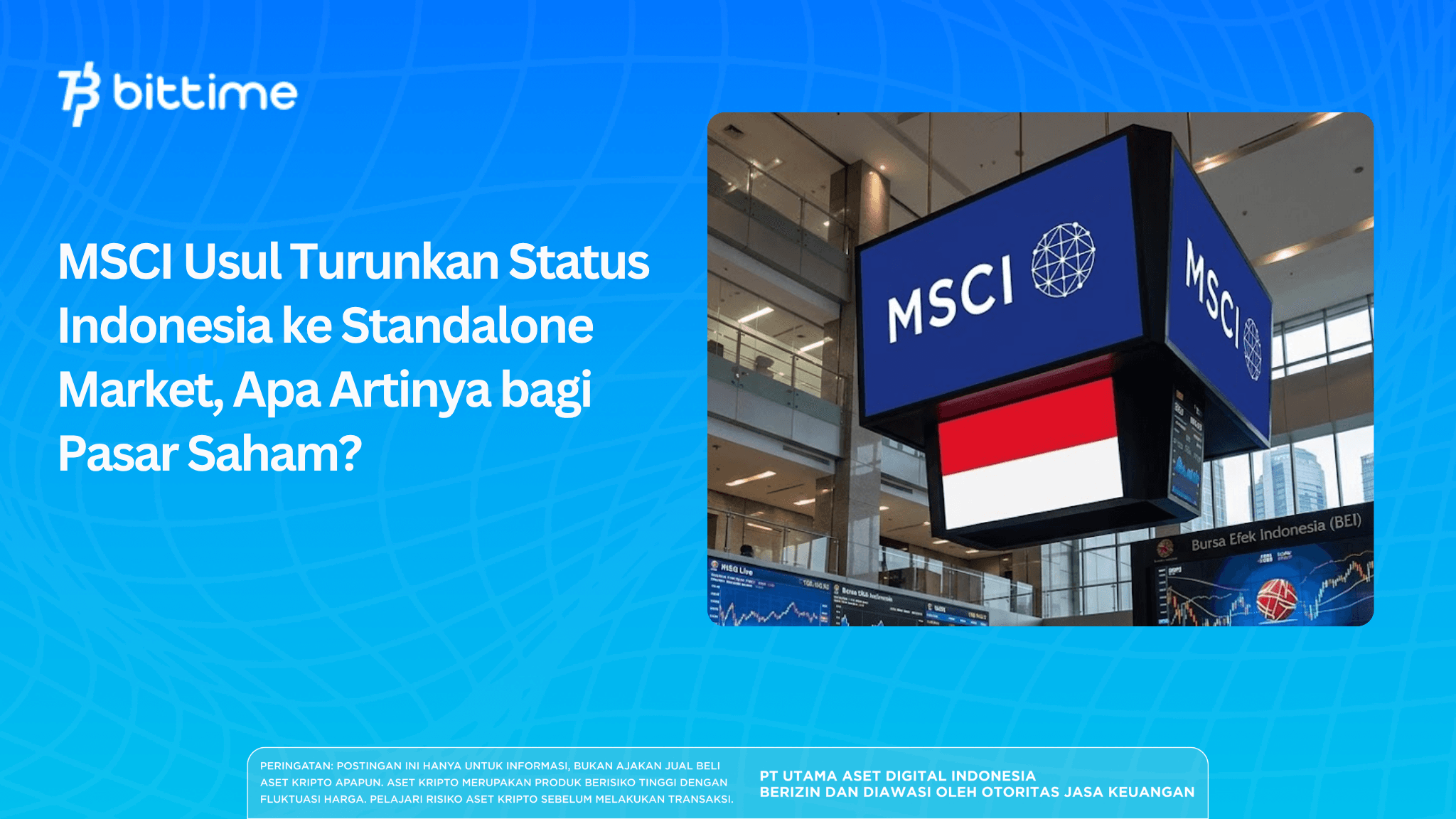
Reasons for the JCI's Plunge to 4,900: MSCI and 6 Stocks to Watch
2026-10-19
The Jakarta Composite Index (IHSG) fell into the 4,900 range during morning trading on Monday, October 19, 2026, amid market concerns over MSCI's proposed reclassification of Indonesia. A morning report recorded the index down approximately 4.31% at 4,961. This was an intraday reading and should not be interpreted as that day's closing value.
For investors, the issues include the direction of fund flows, the market's ability to absorb selling pressure, and the condition of the companies whose shares they hold. Understanding all three helps you assess whether a stock's decline is driven more by market sentiment or changes in its business outlook.
Key Takeaways
- Concerns over MSCI's proposed reclassification are one of the main sources of pressure on the IHSG.
- TINS, NCKL, INCO, AADI, CPIN, and TAPG are analyst picks, not official MSCI recommendations.
- Price declines need to be assessed alongside business conditions, trading liquidity, and investment risk limits.
Why the IHSG Fell into the 4,900 Range
Pressure on the market increased as investors faced uncertainty over Indonesia's place in global investment market classifications. On October 15, 2026, MSCI opened a consultation on a proposed reclassification of Indonesia's index from an emerging market to a standalone market. A final decision is scheduled no later than June 30, 2027.
The main issues raised include transparency in share ownership structures, suspected coordinated trading, and consistent progress in governance improvements. Institutional investors want to see measurable results from reform implementation, not just policy announcements.
Uncertainty of this kind can prompt investors to reduce exposure before the outcome is known. Market prices reflect expectations about the future, so selling pressure does not have to wait for rule changes to take effect.
However, a decline in the index does not fully explain the condition of every company. Stocks with larger weights can have a greater influence on index movements, while other listed companies may experience different price changes.
Market analysis therefore needs to separate two questions: what is putting pressure on the IHSG, and what is changing the business value of a listed company? The answers may be related, but they are not always the same.
Read also: IDX Changes the Stock ARB Limit to 7%: What Does It Mean for Investors?
How Does MSCI-Related Sentiment Affect Indonesian Stocks?
MSCI provides indexes used as benchmarks by various investment products. When an index's composition or coverage changes, fund managers tracking that benchmark may need to adjust their portfolios.
In general, the impact can emerge through two channels:
- Passive fund adjustments. Products that track an index adjust their holdings according to its methodology and the change schedule.
- Active fund manager decisions. Investment managers reassess exposure based on their mandates, risk, valuations, and market outlook.
These two channels operate differently. The potential scale of selling is not automatically equivalent to outflows that have already occurred.

What Does Standalone Market Mean?
In this context, a standalone market means a market is treated separately from the relevant composite index groupings. The concern is reduced access to funds whose mandates track those index groups.
This status does not mean that all Indonesian companies stop operating or that all foreign investors are prohibited from buying shares. Its consequences need to be understood in light of the decision's scope and the rules governing each investment product.
A change in a country's classification also differs from the removal of an individual stock from an index. Therefore, the phrase “stocks affected by MSCI-related sentiment” does not automatically mean that the issuer is the subject of specific MSCI findings or assessments.
Read also: MSCI Proposes Downgrading Indonesia to Standalone Market Status: What Does It Mean for Stocks?
Why Do Regional Stock Markets Still Matter?
Indonesian market movements need to be compared with regional exchanges at the same observation time. This comparison helps distinguish broad regional pressure from issues more specific to Indonesia.
For example, simultaneous declines across several markets may indicate reduced appetite for risk assets. By contrast, a much steeper decline in Indonesia calls for further examination of domestic factors.
This comparison must use consistent data. Combining another country's market close with an intraday IHSG reading can produce misleading conclusions.
Exchange rates, funding costs, and commodity movements are also worth examining because they affect companies differently. Exporters, raw material importers, and companies with foreign-currency debt do not face identical consequences.
Read also: SEC Proposes New Crypto Custody Rules: Key Points
6 Stocks to Watch as the IHSG Weakens
Analyst Fanny Suherman's picks for trading on October 19, 2026, include six stocks: TINS, NCKL, INCO, AADI, CPIN, and TAPG. This list reflects an analyst's view on a specific date and should be reassessed as prices and market conditions change.
The six listed companies are:
- TINS: PT Timah Tbk.
- NCKL: PT Trimegah Bangun Persada Tbk.
- INCO: PT Vale Indonesia Tbk.
- AADI: PT Adaro Andalan Indonesia Tbk.
- CPIN: PT Charoen Pokphand Indonesia Tbk.
- TAPG: PT Triputra Agro Persada Tbk.
The strategy accompanying the list is buy on weakness, which means considering purchases when prices weaken into previously analyzed areas. This strategy has price conditions and loss limits, so it is not the same as buying whenever a stock falls.
To assess its relevance, you can examine three layers of information. First, whether current prices still fit the context of the analysis; second, whether there is new company information; and third, whether the trade fits your capacity to absorb losses.
The stock list also needs to be assessed as a portfolio. Holding several tickers does not necessarily provide adequate diversification if their price drivers are related.
This article does not set new price targets for the six stocks. Establishing buying areas, targets, and loss limits requires current trading data and a verifiable analytical basis.
Read also: CFTC Crypto Rules: 5 Key Points in the New US Proposal
Stock Investment Risks in a Falling Market
1. Assuming a Lower Price Means a Cheap Valuation
A lower price does not necessarily make a stock more attractive. If earnings forecasts fall faster than the share price, its valuation may remain expensive.
The assessment should include cash flow, debt, earnings capacity, and capital requirements. Historical prices provide a comparison, not a guarantee that prices will return to previous levels.
2. Difficulty Selling at the Planned Price
A loss limit helps structure decisions, but it does not guarantee execution at that exact price. When buyers are scarce or prices move quickly, execution may differ from the plan.
Therefore, pay attention to trading value and order book depth. A position that is too large relative to the stock's liquidity can be difficult to sell.
3. Adding to a Position Without Reassessing the Original Investment Rationale
Additional purchases can lower the average purchase price, but they also increase the amount of capital exposed. This becomes risky if the original reason for buying no longer holds.
Before adding to a position, identify the information supporting that decision. Separate a data-based assessment from the desire to recover losses quickly.
4. Using Money You Will Need Soon
Market recoveries have no fixed timetable. Money needed in the near term may have to be withdrawn before prices improve.
Match your investment horizon to the intended use of the funds. Personal liquidity needs remain important even when a stock looks attractive based on analysis.
Read also: SEC Updates Its Rules: Are Blockchain-Based Digital Stocks Coming Soon?
What Should Investors Monitor Next?
Use the following checklist to keep your assessment focused:
- Official MSCI announcements. Check consultation developments, schedule changes, and decision details.
- Trading data with clear timestamps. Distinguish between opening prices, intraday readings, and closing prices.
- Foreign fund flows. Compare multiple periods and the market coverage used.
- Issuer disclosures. Look for material changes in the business, financing, or corporate actions.
- Portfolio condition. Assess holding concentration, funding needs, and loss limits.
Recovery signals also need to be assessed comprehensively. A brief rise in the index is not enough to confirm that pressure has ended if market breadth and trading activity do not support the move.
If you also want to learn about the crypto market, you can sign up for Bittime after understanding its characteristics and risks. That decision should be based on your own investment objectives, not simply a reaction to the IHSG's decline.
Conclusion
The IHSG's fall into the 4,900 range needs to be understood through uncertainty over MSCI classification, investor responses, and trading conditions. The six analyst-picked stocks may serve as a watchlist, but trading decisions still require checks of current prices and each company's condition.
Start with data that has a clear date and context. Then align the analysis with your funding needs and the risks you can afford to take.

Bittime is a Digital Financial Asset Trader (PAKD) platform licensed and supervised by Indonesia's Financial Services Authority (OJK), where you can buy Bitcoin in Indonesia and hundreds of other crypto assets starting from IDR 10,000. Registration is fast and secure, and you can get started today.
Track the USDT to IDR exchange rate and the price movements of your favorite crypto assets in real time. Everything is available in one crypto investment app that you can download for free from the Play Store.
Ready to get started? Sign up for Bittime now and put your investment strategy into action on a platform already trusted by millions of users in Indonesia.
FAQ
Why did the IHSG fall into the 4,900 range?
One of the main pressures is concern over MSCI's proposed reclassification of Indonesia. A morning report on October 19, 2026, recorded the IHSG at around 4,961 after a 4.31% decline; this was not a closing figure.
Has Indonesia officially become a standalone market?
The announcement reviewed was still a consultation on a proposed reclassification. MSCI has scheduled a decision no later than June 30, 2027.
Which stocks are being watched as the IHSG weakens?
TINS, NCKL, INCO, AADI, CPIN, and TAPG were analyst picks for trading on October 19, 2026. This list does not indicate that MSCI recommends buying those six stocks.
Do all stocks fall when the IHSG drops sharply?
Not always, because the IHSG reflects aggregate market movements. Individual stocks can move differently due to business conditions, company information, and trading demand.
Is buying stocks when the IHSG falls the right decision?
The answer depends on valuation, company condition, investment horizon, and risk tolerance. A price decline alone is not a sufficient basis for buying.
Disclaimer: The views expressed belong exclusively to the author and do not reflect the views of this platform. This platform and its affiliates disclaim any responsibility for the accuracy or suitability of the information provided. It is for informational purposes only and not intended as financial or investment advice.

.png)