Volatile Crypto Market: How Traders Can Capitalize on Long and Short Positions
2026-09-02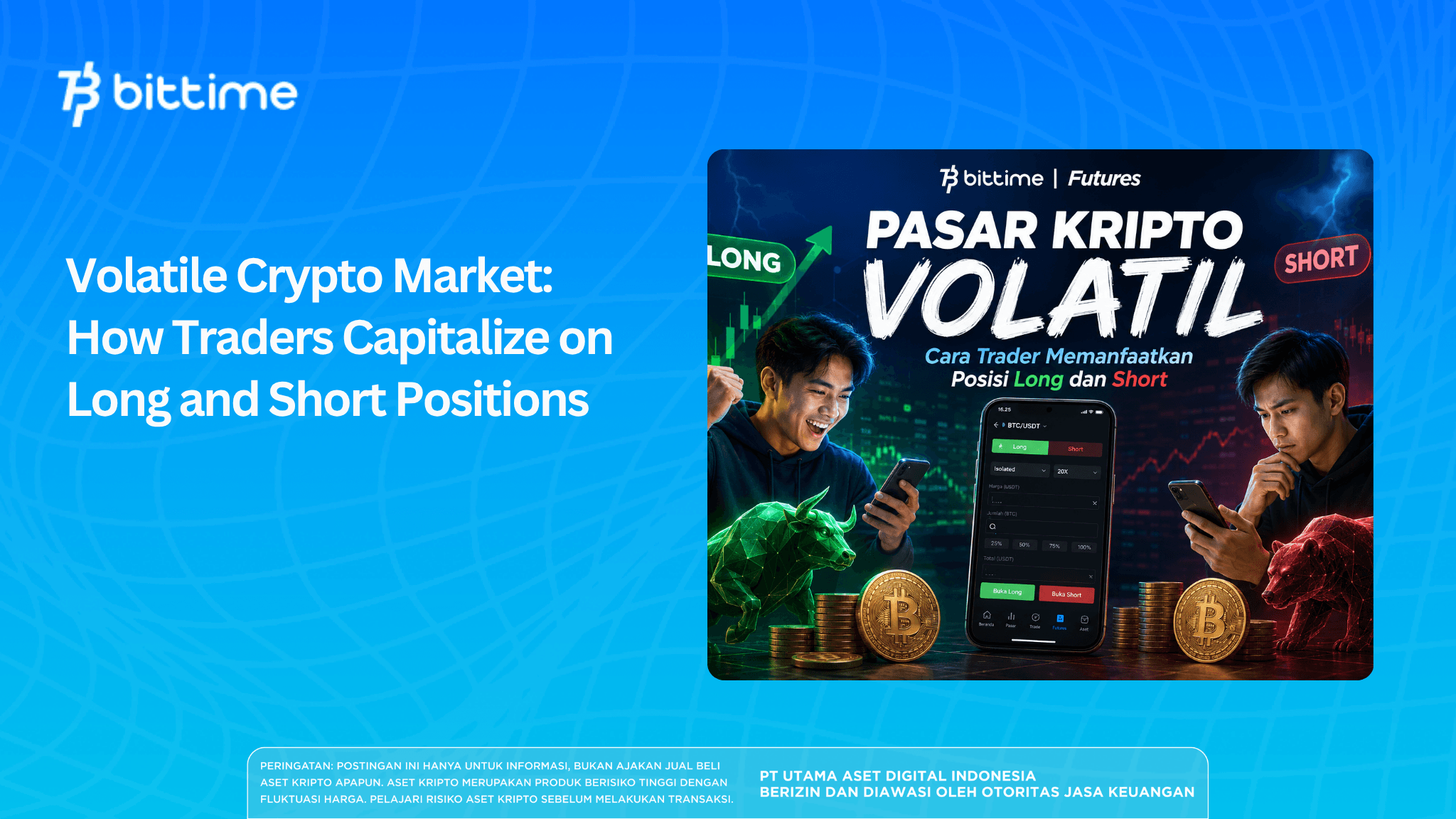
The crypto market entered September 2026 with volatility once again drawing traders' attention. After Bitcoin recorded a strong rally throughout August, BTC came under renewed pressure in early September and traded around US$77,000–US$78,000.
At the same time, rising U.S. Treasury yields and growing expectations of Federal Reserve interest rate hikes added pressure on risk assets.
For spot traders, conditions like these usually mean waiting for prices to stabilize before buying. However, futures traders have more flexibility because they can take long and short positions in crypto trading.
Understanding the difference between long and short crypto positions is an important foundation before using futures. The strategy is simple: long seeks to profit from rising prices, while short seeks opportunities from falling prices.
Key Takeaways
- Long is used when traders expect a crypto asset's price to rise, while short is used when they expect the price to fall.
- Leverage can amplify both potential profits and losses, while liquidation can occur when the margin is no longer sufficient to maintain a position.
- Bittime Futures provides futures trading with long and short options, leverage of up to 25x, as well as Cross Margin and Isolated Margin modes.
What Are Long and Short in Crypto Futures?
Simply put, long and short in crypto futures are two position directions that traders can use to speculate on price movements.
Long means a trader opens a position expecting the price to rise. If the price moves according to the prediction, the position generates a profit. Conversely, if the price falls, the trader incurs a loss.
Short is the opposite. A trader opens a position expecting the price to fall. If the price actually drops, the short position can generate a profit. However, if the price rises instead, the position incurs a loss.
In futures trading, traders do not have to directly buy and hold crypto assets as they do in spot trading. Instead, traders trade contracts whose value follows the price movement of the underlying asset.
Therefore, long and short crypto strategies can be used to navigate both bullish and bearish markets.
Read Also: Long vs Short Crypto Futures Strategy: When to Buy and Sell?
How Does a Long Position Work?
For example, Bitcoin is priced at US$77,000. A trader expects BTC to rise again after a correction.
The trader then opens a Long position at US$77,000.
If BTC rises to US$80,000, the price difference is US$3,000. For a position size of 0.1 BTC, the simple gross profit is:
(US$80,000 - US$77,000) × 0.1 = US$300
Conversely, if BTC falls to US$75,000, the simple loss becomes:
(US$75,000 - US$77,000) × 0.1 = -US$200
Actual futures calculations may differ because they take into account transaction fees, funding fees, and contract characteristics.
So, when should you use long and short positions in crypto? A long position is generally considered when a trader's analysis indicates an opportunity for an upward move, such as after a resistance breakout, the emergence of bullish momentum, or a positive catalyst.
Maximize opportunities in both bullish and bearish markets with Bittime Futures. Sign Up for Bittime and start trading now!
How Does a Short Position Work?
A short position is used when a trader expects the price to fall.
For example, BTC is at US$77,000 and a trader expects selling pressure to remain strong. The trader opens a Short position of 0.1 BTC.
If the price falls to US$74,000, the simple gross profit is:
(US$77,000 - US$74,000) × 0.1 = US$300
However, if Bitcoin instead rises to US$79,000, the position incurs a loss:
(US$77,000 - US$79,000) × 0.1 = -US$200
This is why short is not simply about “selling Bitcoin.” In futures, traders take a contract position that profits when the price moves downward.
The risks of short positions also need to be considered. A sharp rise in price can cause losses quickly, especially when the position uses high leverage.
Convert 1 BTC to IDR - Bitcoin to Rupiah Exchange Rate
Leverage and Liquidation: Why Are Futures Risks Greater?
One of the key differences between spot and futures is the use of leverage.
Leverage allows traders to control positions worth more than the margin provided. For example, Rp1 million in capital with 10x leverage can, in simple terms, provide position exposure of up to Rp10 million.
However, leverage does not mean that traders receive ten times the profit without risk. Price movements in the opposite direction also have a greater impact on margin.
The higher the leverage, the smaller the price movement that can be tolerated before the position approaches liquidation.
On Bittime Futures, leverage is available up to 25x. Bittime also explains that the combination of leverage and position size determines potential profit as well as the liquidation distance.
Liquidation occurs when losses on a position cause the margin to become insufficient according to the system requirements. The position may then be closed automatically to prevent greater losses.
Therefore, leverage should not be determined solely by how much profit a trader wants to pursue. Position size, stop-loss, account balance, and risk tolerance should all be considered together.
Read Also: Understanding Leverage Strategies in Crypto Futures for Safer Trading
How to Use Long and Short Positions in Crypto Trading
Traders can determine their position direction based on a combination of price action, volume, support and resistance, trends, and macroeconomic conditions.
For example, when Bitcoin fails to break through resistance and selling volume increases, bearish traders may consider a short position with a stop-loss above the invalidation area.
Conversely, if BTC successfully breaks through resistance with supporting momentum and volume, traders may consider a long position with a stop-loss below an important level.
What traders need to understand is that making a profit from long and short crypto positions is not about always predicting the market direction correctly. The key is maintaining a reasonable risk-to-reward ratio and limiting losses when the analysis proves to be wrong.
Bittime itself emphasizes the importance of position sizing. Position size should be adjusted according to the balance, stop-loss distance, and amount of capital the trader is willing to risk in a single transaction.
Start trading BTC Futures on Bittime and take advantage of opportunities from Bitcoin price movements. Trade now!
Can Long and Short Positions Be Opened at the Same Time?
In futures trading, traders can use long and short positions simultaneously as a form of hedging, depending on the features and account mode available.
For example, a trader may have a long-term bullish outlook on Bitcoin but expect a short-term correction. A specific position can be used to reduce the impact of a temporary decline.
However, opening long and short positions of the same size does not automatically result in profits from both directions. If the price moves in only one direction, one position gains while the other loses. Transaction costs and funding can also make the final result negative.
Therefore, a simultaneous long-short strategy is better viewed as a risk management or hedging tool, rather than a simple way to generate risk-free profits.
Read Also: Futures Trading: Explaining Contracts, Leverage, and Long Short
Bittime Futures for Long and Short Trading

Bittime Futures is a crypto derivatives trading service that allows users to take long or short positions based on their expectations of price movements.
When launched, Bittime Futures provided 49 trading pairs, leverage of up to 25x, as well as Cross Margin and Isolated Margin options. Users are also required to complete a knowledge test before accessing the futures feature.
With Cross Margin, the available margin balance can be used to help maintain positions. Meanwhile, Isolated Margin allocates margin specifically to a particular position, allowing risk exposure to be more separated.
Bittime also states that its futures service was launched after receiving approval from PT Central Finansial X (CFX), within the framework of digital financial asset supervision by OJK.
For Indonesian traders, access to futures like this provides an alternative for navigating a market that moves in both directions.
However, the ease of opening long or short positions does not eliminate risk. Leverage of up to 25x can amplify losses and accelerate liquidation when the market moves against the position.
Read Also: Bittime Secures First Futures Trading License in the Era of OJK Crypto Supervision
Conclusion
In volatile crypto market conditions, the flexibility of long and short positions can be an advantage of futures trading.
However, volatility that creates opportunities also increases risk. Leverage, liquidation, funding fees, position size, and stop-loss must be understood before opening a trade.
Bittime Futures offers access to derivatives trading with 49 pairs, leverage of up to 25x, as well as Cross Margin and Isolated Margin options.
These features can help traders develop strategies according to market conditions, but trading decisions should still be based on disciplined analysis and risk management.

Ready to trade with opportunities in both directions? Try Bittime Futures and start trading crypto derivatives directly from the Bittime app
Bittime is a licensed Digital Financial Asset Trader (PAKD) platform supervised by the Financial Services Authority — where you can buy Bitcoin in Indonesia and hundreds of other crypto assets starting from Rp10,000. Registration is fast, secure, and can be started today.
Track USDT to IDR conversions and your favorite crypto asset prices in real time. Everything is available in one crypto investment app that can be downloaded for free from the Play Store.
Ready to get started? Sign Up for Bittime Now and execute your investment strategy with a platform trusted by millions of users in Indonesia.
FAQ
What is the difference between long and short crypto?
Long profits when the price rises, while short profits when the price falls. Both can be used in futures trading.
What are long and short in crypto futures?
Long is a futures position that profits when the asset price rises. Short is a position that profits when the asset price falls.
When should you use long and short crypto positions?
Long can be considered when analysis indicates an opportunity for an upward move. Short can be considered when there are indications of a decline. Both should be accompanied by a stop-loss and appropriate position sizing.
Does leverage make futures profits larger?
Leverage increases the value of exposure relative to the capital used. Therefore, potential profits can increase, but losses and liquidation risks also increase.
What is liquidation in crypto futures?
Liquidation is the automatic closing of a position when the margin is no longer sufficient to maintain the position according to the platform's requirements.
What is Bittime Futures?
Bittime Futures is a crypto derivatives trading service that allows users to open long and short positions. Bittime Futures provides 49 trading pairs, leverage of up to 25x, as well as Cross Margin and Isolated Margin.
Disclaimer: The views expressed belong exclusively to the author and do not reflect the views of this platform. This platform and its affiliates disclaim any responsibility for the accuracy or suitability of the information provided. It is for informational purposes only and not intended as financial or investment advice.
.png)