Cross Margin vs Isolated Margin in Bittime Futures
2026-08-19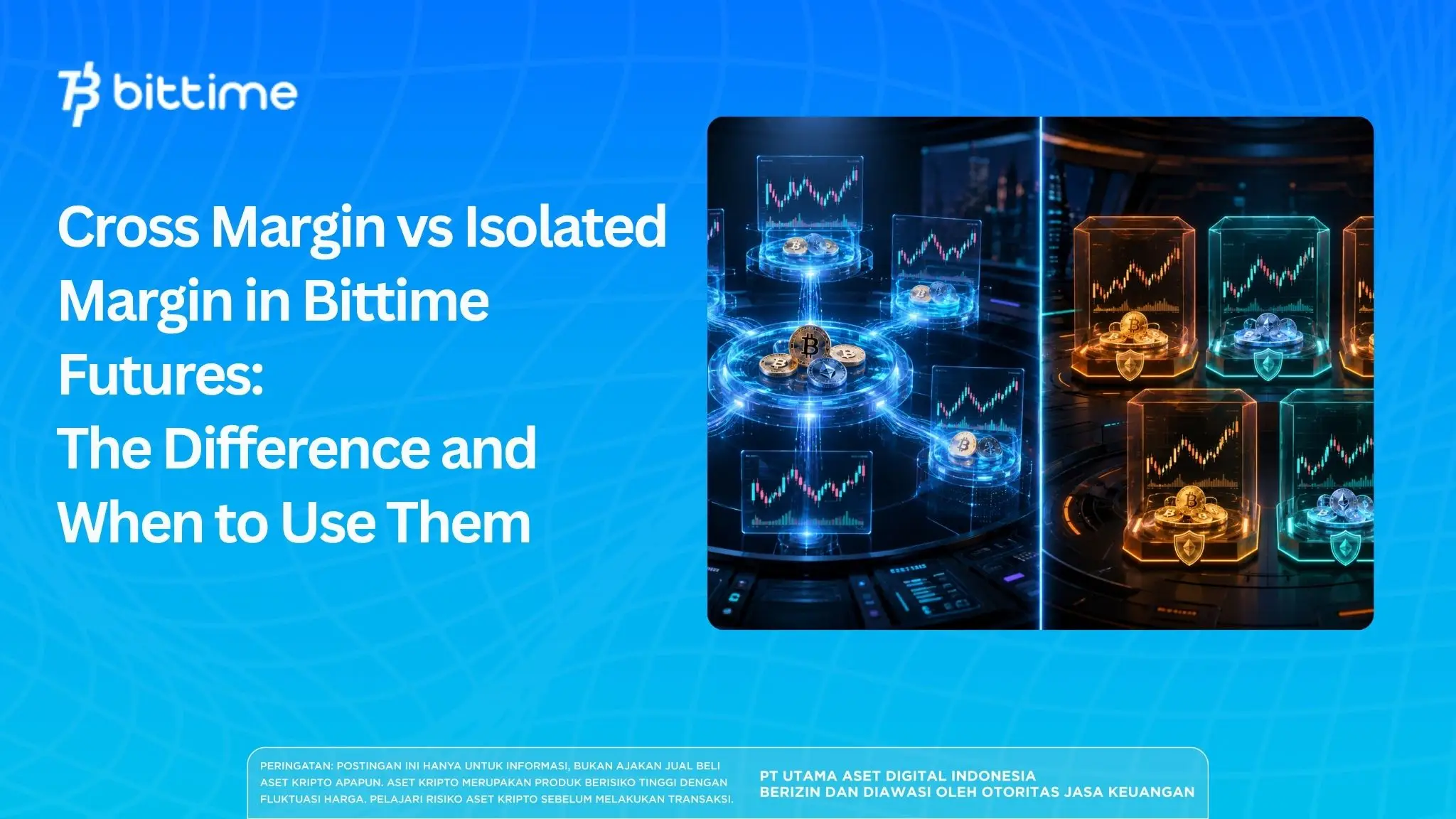
When opening a position perpetual futures, the decision doesn't stop at Long or Short and the amount of leverage.
Traders also need to determine mode margin futures which will be used.
This option determines how much balance can support a position when the price moves against the prediction.
At Bittime Futures, users can chooseCross Margin or Isolated Margin.
At Cross,funds available in the futures account are used as joint collateral.
In Isolated, margin is separated for each position so that losses from one transaction do not automatically use up funds from other positions.
The difference seems simple, but its impact on liquidation price and risk is significant.capital can be large.
Therefore, understanding cross margin vs isolated margin is important before using leverage.
Key Takeaways
Cross margin futures using the available balance as collateral, positions have a wider cushion, but losses can affect more funds in the account.
Isolated margin futures separating margin per position so that traders can more easily determine how much capital they want to expose.
Bittime sets Cross Margin as the default mode for new positions, and the margin mode cannot be changed while there are still active orders.
What is Margin Mode in Futures?
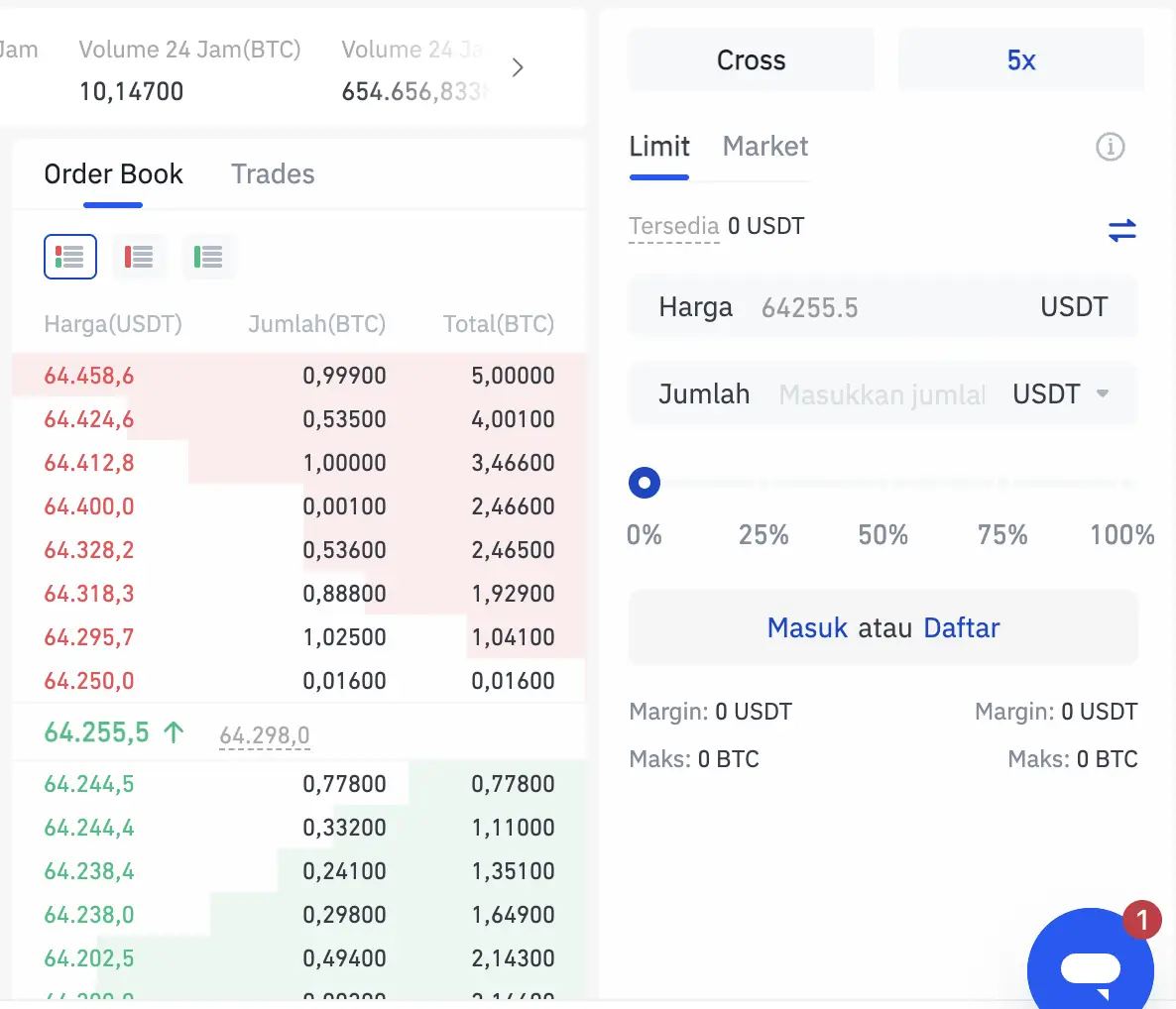
Source: bittime.com/futures/btc
Margin is a collateral fund used to open and maintain leveraged futures positions.
When the price moves against a trader's position, margin acts as a cushion before the position reaches liquidation conditions.
Mode margin futures determine where the bearings come from.
With Cross Margin, funds available in the account can be used collectively. In contrast, Isolated Margin allocates funds specifically for a single position.
So, choosing Cross or Isolated does not determine whether the market will go up or down.
The settings determine how position risk is charged to a trader's capital.
What is Bittime Cross Margin?
In cross margin Bittime, all funds available in the futures account serve as joint collateral for open positions.
If a position's margin falls close to the maintenance margin, the system can use the remaining available balance to support the position.
Its main advantage is capital efficiency.
Positions have a greater cushion against fluctuations because they do not rely solely on a set amount of margin set aside at the outset.
However, this mechanism has consequences.
Losing positions can continue to absorb the available balance, so that the loss of one transaction has the potential to affect the capital supporting other positions.
The same concept also becomes the fundamental difference between Cross Margin on futures platforms in general.
Read Also: Analysis and Case Examples of MC (Margin Call) in Crypto
What is Isolated Margin Bittime?
On isolated margin Bittime, the margin for each position is separated.
Funds from other positions or unallocated balances are not automatically used to rescue a losing position.
For example, a trader has a futures balance of 1,000 USDT but only allocates 100 USDT to a position using Isolated Margin.
The position's margin exposure is limited to the allocated funds, unless the trader decides to add margin manually.
If the margin is not increased and the position condition reaches the liquidation limit, the system can close the position.
Bittime explains that adding margin in Isolated mode is done manually, unlike Cross which can use the available balance automatically.
Read Also: How to Choose Leverage for Beginners and the Risks
Cross Margin vs Isolated Margin: What's the Difference?
The main difference lies in the scope of the funds that bear the risk.
The definition is consistent with other industry explanations and references: Cross offers greater flexibility, while Isolated provides clearer risk limits for each position.
When Should You Use Cross Margin?
Cross margin futures can be considered when traders understand the relationship between multiple positions and want to use capital more efficiently.
For example, a trader may have several positions managed as a single portfolio.
Free balance can act as a buffer when one position experiences a floating loss while another position performs better.
Bittime also explains that in an integrated futures account, profits and losses from different positions on Cross Margin can affect each other at the account level.
However, this flexibility does not mean less risk.
Precisely because the joint balance can be used, traders must be more disciplined with leverage, position size, stop losses, and total account exposure.
If you want to try this feature, you can register on Bittime, complete the KYC and Knowledge Test, then access Bittime Futures.
When Is Isolated Margin More Suitable?
Isolated margin futures more suitable when traders want to set the risk of each transaction separately.
This mode is also useful when trying new strategies or trading volatile assets.
For beginner futures margin, Isolated is often easier to understand because the relationship between allocated capital and position risk is more clearly visible.
Indodax's educational references also position Isolated as an easier option to use when the primary goal is to limit losses on a single position.
But isolated does not mean risk-free.
Too small a margin, especially when combined with high leverage, can cause a position to reach the liquidation price more quickly.
Read Also:Bittime Futures: A Complete Guide to Crypto Derivatives Trading in Indonesia
Which is Safer, Cross or Isolated?
If the question is which is safer cross or isolated, the answer depends on definition of “safe”.
To limit the amount of capital yis exposed to a single transaction, Isolated Margin provides clearer risk control.
Cross Margin can provide a greater distance before a particular position is liquidated due to the additional balance available.
However, this is achieved by opening up position access to a wider range of funds in the account.
Therefore, do not judge security solely based on how far away the liquidation price is.
The real risk is also necessary consider how much capital can be lost if the analysis is wrong.
Read Also:Differences Between Crypto Spot and Futures for Beginner Traders
How to Change Cross to Isolated in Bittime Futures
Bittime provides Cross Margin and Isolated Margin settings when traders define transaction parameters.
On the Futures page, select the perpetual pair to be traded, then specify Cross or Isolated mode along with the leverage and margin amount before opening a position.
There are important provisions: Bittime does not allow switching between Cross and Isolated when there are active orders.
Leverage also cannot be changed under such conditions.
So, if the option how to change cross to isolated is not available, first check if there are still active orders on the related pair.
Always double check the margin mode before confirming an order.
Cross or Isolated, Which One Should You Choose?
There is no mode that is automatically more profitable.
Cross is more suitable when traders intentionally want to manage capital together and understand account-level risk, while Isolated is more suitable when the priority is limiting exposure per position.
For traders new to futures, a conservative approach usually makes sense: use small position sizes, low leverage, Isolated Margin to limit exposure, and set a stop-loss before opening a trade.
Bittime itself emphasizes the importance of using leverage conservatively and not placing all capital on a single transaction.
Bittime is a licensed and regulated Digital Financial Asset Trader (PAKD) supervised by Indonesia’s Financial Services Authority (OJK) — where you can buy Bitcoin in Indonesia and hundreds of other crypto assets starting from just Rp10,000. The registration process is fast, secure, and you can get started today.
Track USDT to IDR conversions and monitor your favorite crypto assets in real time. Everything is available in one crypto investment app that you can download for free on the Play Store
Ready to start? Register now on Bittime and execute your investment strategy with a platform trusted by millions of users in Indonesia.
FAQ
What is the difference between Cross Margin and Isolated Margin?
Cross Margin uses the available balance as collateral for open positions. Isolated Margin separates the margin for each position so that risk isn't automatically spread across the entire balance.
Which is safer for beginner futures traders?
To limit risk per trade, Isolated Margin is generally easier to control. However, using high leverage can still lead to rapid liquidation.
Can Cross Margin drain the futures balance?
Losses on Cross Margin can use the available balance to maintain the position. Therefore, loss exposure can be greater than with Isolated Margin.
Is Isolated Margin guaranteed to be free from liquidation?
No. Positions can still be liquidated when their margin no longer meets maintenance margin requirements. Isolation only limits the funds supporting the position, not eliminates the risk of liquidation.
Can Cross Margin be changed to Isolated in Bittime?
It can be selected as a margin mode, but Bittime states that users cannot switch between Cross and Isolated when there are active orders.
Is the leverage different between Cross and Isolated?
Both modes on Bittime allow for leverage adjustment. Leverage changes will recalculate margin requirements and may affect liquidation prices.
Disclaimer: The views expressed belong exclusively to the author and do not reflect the views of this platform. This platform and its affiliates disclaim any responsibility for the accuracy or suitability of the information provided. It is for informational purposes only and not intended as financial or investment advice.

.png)