KOSPI Plunges 8.95% as Tech Stock Selloff Leads
2026-07-14
South Korean stock index (KOSPI) experienced one of the deepest daily corrections inthe last few years after closing down 8,95% or down 669.01 pointslevel of6.806,93on Monday's trading (13/7).
However, this weakening did not occur suddenly. The KOSPI opened down around0,85%, even turned around to strengthen 0,71% at the start of trading before selling pressure increases until the index breaks through the psychological level 7.000 and touched the intraday point at 6.783,43.
The extremely high volatility made the South Korean Stock Exchange activatesell-side sidecarand campUdiancircuit breaker, a step that is rarely done and usually onlyappears when the market experiences extreme pressure.
Then, what is actually driving the KOSPI's fall, and is this correction just temporary or a signal of a trend change?
Key Takeaways
KOSPI down 8.95%mainly due to the massive sell-off in semiconductor stocks such as Samsung Electronics and SK Hynix.
Market pressure is triggered by a combination ofgeopolitical uncertainty And concerns that chip sector profit growth is starting to slow.
After a sharp correction, investors need to monitorforeign capital flows, AI industry prospects, and financial reports of technology issuers.
KOSPI Falls 669 Points, but Selling Pressure Not Widespread
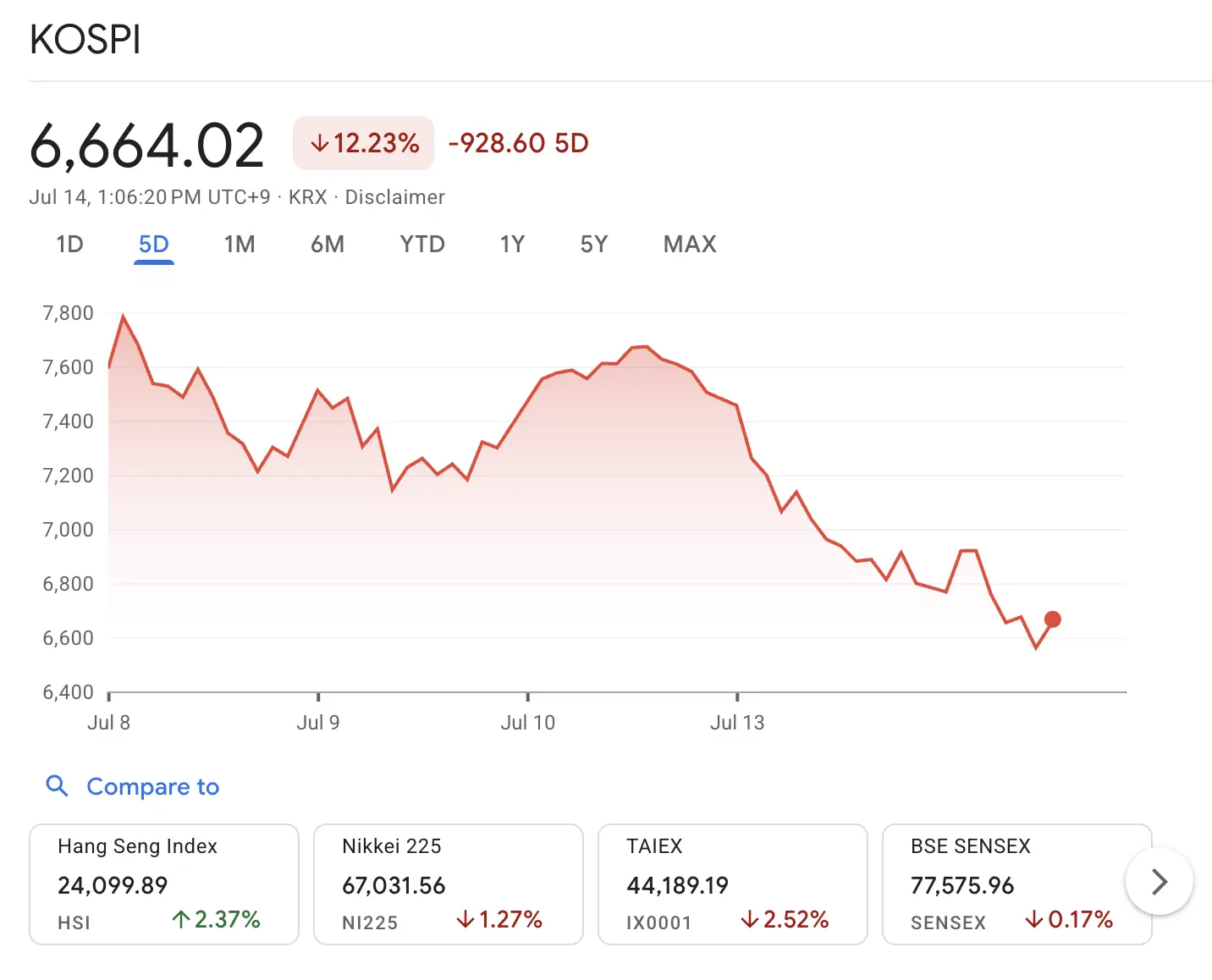
Source: Google Finance
At first glance, the nearly 9% drop might seem like the entire South Korean stock market is in a panic. However, the data tells a different story.
StocksSamsung Electronicsdown10,70%, temporary SK Hynixloss15,37%deepone trading day.
In contrast, the weakening in other sectors was much more limited.Hyundai Motorjust go down 2,95%, even LG Energy Solutionstill able to strengthen 0,77%, whereas Samsung Biologics go on 0,36%.
Read Also: Samsung, SK Hynix, and Micron Face Lawsuits Over Alleged RAM Supply Manipulation
This difference shows that selling was mainly concentrated in the semiconductor sector.
Since Samsung Electronics and SK Hynix are the two largest listed companies on the KOSPI, their declines in share prices immediately dragged down the overall index.
For investors, this is important because it shows that this correction is more of arepricing of the technology sectorcompared to the fundamental weakening of the entire economy South Korea.
Why not start investing in and trading Tokenized asset in Bittime? Register to Bittime – it’s quick, secure and easy.
Why Are Semiconductor Stocks a Top Target for Investors?
Over the past few months, semiconductor stocks have been the main driver of the KOSPI's rise, driven by optimism about the growth of the artificial intelligence (AI) industry.
Demand for chips for data centers and AI is driving expectations that profits at companies like Samsung Electronics and SK Hynix will continue to rise.
However, the stock market always moves based on future expectations, not just current performance.
Although Samsung Electronics previously reported strong second-quarter profit projections, investors are starting to question whether that growth can be sustained.
Concerns that the semiconductor industry's profit cycle is nearing its peak have led some market participants to opt to take profits after a long rally.
In other words, this correction does not necessarily indicate that Samsung or SK Hynix's business is deteriorating, but rather reflects a change in investor expectations regarding future growth prospects.
Read Also: Leveraged ETFs in the Spotlight After KOSPI Plunge
Geopolitics Worsens Sentiment, but It's Not the Only Cause
At the same time, the market is also faced with rising tensions between the United States and Iran, including concerns to potential disruptions in Strait of Hormuz, trackimportant in world oil trade.
Geopolitical uncertainty like this typically prompts investors to reduce their exposure to risky assets.
However, if geopolitical factors were the sole cause, selling pressure should be more evenly distributed across sectors.
The fact that semiconductor stocks experienced a much deeper correction indicates a combination of two sentiments at once: increasing global risk aversion and valuation adjustments in the technology sector.
This combination is what makes the pressure on the KOSPI much greater than just a normal market correction.
Read Also: South Korea Lifts Corporate Crypto Ban, Launches New Crypto Regulation in 2026
Circuit Breaker Shows How Quickly Panic Can Happen
The intense selling pressure prompted the South Korean Stock Exchange to activate two market safety mechanisms.
On theinitial essay,sell-side sidecaris enforced after the KOSPI futures contract moves more than 5%for at least one minute, so that the program trading is temporarily suspended for five minutes.
As the index weakens further and exceeds 8%for more than a minute, the exchange then activatescircuit breaker, which halted all stock trading for20 minutes.
Share inInvestors, the activation of these two mechanisms is more important to understand as an indicator of high volatility than a cause of market declines. This measure is designed to give market participants time to evaluate the situation before trading resumes.
Foreign Investors Sell, Retail Investors Buy
Behind the sharp correction, the behavior of market players also showed interesting differences.
Foreign investors dInstitutions were recorded as carrying out net selling, particularly in semiconductor stocks. Conversely, retail investors took advantage of the price decline to conductbargain huntingor buy shares that are considered much cheaper.
This difference is mreflect different investment horizons. Institutional investors tend to reduce risk more quickly when uncertainty increases, while retail investors often see sharp corrections as an opportunity to accumulate quality stocks.
However, the strategy of buying when prices fall will only yield results if the pressure is temporary and not followed by a decline in the company's fundamentals.
Keep tracking other stock tokens such as AMZON, AMDON, and NFLXON as well as MSFTON, then you can start trading on the trusted exchange, only on Bittime.
What Should Investors Watch After This Correction?
The 8.95% drop is certainly a major concern, but investors should not dwell on that figure.
Some of the more important indicators to watch in the coming weeks include:
Are foreign investors still continuing their selling actions?
The development of global demand for AI chips
The next semiconductor issuer's financial report
Developments in geopolitical conflict in the Middle East
Global market response to the technology sector
If selling pressure begins to ease and the chip industry outlook remains strong, this correction could potentially become a consolidation phase after a long rally.
Conversely, if earnings expectations continue to be revised downward, volatility in Korean tech stocks could continue.
Read Also: Can You Buy U.S. Stocks with Just IDR 10,000? Here's the Difference Between Tokenized Stocks
Conclusion
Decline of KOSPI by 8.95% not just due to a momentary sell-off, but rather the result of a combination of pressure on the semiconductor sector and increasing global uncertainty.
Sharp correction on Samsung Electronics (-10,70%) And SK Hynix (-15,37%)be the main factor that drags down the index, while activation sell-side sidecar And circuit breaker shows that selling pressure is taking place at a very fast pace.
For investors, the focus should not only be on the magnitude of the index decline, but also on whether this correction reflects a fundamental change in the semiconductor industry or simply a valuation adjustment after a long rally.

Gain exposure to shares in leading technology companies through tokenised stocks like AAPLX, MSFTON or GOOGLX only on Bittime!
Bittime is a licensed and regulated Digital Financial Asset Trader (PAKD) supervised by Indonesia’s Financial Services Authority (OJK) — where you can buy Bitcoin in Indonesia and hundreds of other crypto assets starting from just Rp10,000. The registration process is fast, secure, and you can get started today.
Track USDT to IDR conversions and monitor your favorite crypto assets in real time. Everything is available in one crypto investment app that you can download for free on the Play Store
Ready to start? Register now on Bittime and execute your investment strategy with a platform trusted by millions of users in Indonesia.
FAQ
Why did KOSPI drop almost 9%?
Due to a major sell-off in semiconductor stocks, particularly Samsung Electronics and SK Hynix, which have large weightings in the index, coupled with rising global negative sentiment.
Why did Samsung Electronics and SK Hynix fall deeper?
Investors are starting to question the sustainability of the semiconductor industry's profit growth after a long rally driven by AI optimism.
What is a circuit breaker in the Korean Stock Exchange?
A circuit breaker is a mechanism that temporarily halts trading when an index moves extremely to reduce market panic.
Why are foreign investors selling but retail investors buying?
Institutional investors tend to reduce risk when volatility increases, while retail investors often use corrections as an opportunity to buy stocks at lower prices.
Is the KOSPI correction an investment opportunity?
This depends on the cause of the correction. If it's only driven by short-term sentiment, there's still a chance for recovery. However, if the semiconductor industry outlook truly weakens, pressure on technology stocks could persist for a longer period.
Disclaimer: The views expressed belong exclusively to the author and do not reflect the views of this platform. This platform and its affiliates disclaim any responsibility for the accuracy or suitability of the information provided. It is for informational purposes only and not intended as financial or investment advice.

.png)