Hyundai Uses Avalanche Blockchain, USDT Transfers Completed in 7 Minutes
2026-07-14
Hyundai tests cross-border payments using stablecoin USDT on the Avalanche blockchain, a US$20,000 treasury transfer between Hyundai units in the United States and Mexico was completed and verified in approximately seven minutes.
Key Takeaways
- Hyundai Motor America sent US$20,000 worth of USDT to Hyundai Motor de México via Avalanche-based settlement infrastructure.
- The entire process of conversion, transfer, verification, and reconversion was completed in about seven minutes, faster than previous banking flows.
- This trial proves technical feasibility, but it doesn't mean Hyundai has replaced its entire cross-border payment system with a stablecoin.
What is Hyundai Using the Avalanche Blockchain for?
Usage blockchain Avalanche Hyundai's trial is part of a proof of concept (PoC) for cross-border treasury payments. The trial involved Hyundai Motor America as the sender and Hyundai Motor de México as the recipient.
In the initial phase, Hyundai Motor America converted US$20,000 into USDT. The stablecoin was then sent through the payment infrastructure running on the Avalanche network.

Sumber: AI Generated Image
Once received in Mexico, the USDT is converted back into US dollars. The entire process includes:
- Convert US dollars to USDT.
- Asset transfer via blockchain.
- Transaction verification.
- Operational compliance checks.
- Receipt of funds by the target entity.
- Convert USDT back to US dollars.
The end-to-end process is completed in an average of about seven minutes. In comparison, the interbank transfers Hyundai previously used could take three to four hours or more.
It's important to note that the seven-minute figure doesn't just indicate the blockchain's finality speed. This timeframe includes fiat conversion, stablecoin sending, verification, and other settlement processes.
Read Also: How to Buy Avalanche (AVAX): A Complete Guide for Beginners in Indonesia
How Does Hyundai Transfer USDT Across Borders?
Hyundai's USDT transfer flow can be explained through several simple steps.
1. Treasury Funds Prepared
Hyundai Motor America has set aside US$20,000 in corporate funding to test whether stablecoins can be implemented in treasury systems that already have accounting, governance, and compliance requirements.
Testing isn't simply about transferring assets from one wallet to another. The system must ensure that each step is recorded and verified according to company procedures.
2. US Dollars Converted to USDT
The funds are then converted into USDT. This stablecoin is designed to mirror the value of the US dollar, making it more suitable for payments than crypto assets, whose prices can fluctuate dramatically.
The use of stablecoins allows value to be sent over a blockchain network without having to wait for all the processing steps in a traditional correspondent banking system.
3. USDT Sent via Avalanche
USDT was sent to Hyundai entities in Mexico via the Axiym settlement infrastructure built on Avalanche.
Blockchain serves as a pathway for transferring value and recording transactions. Every transfer can be verified through network data, while the payment services layer handles integration, identity, and compliance processes.
4. Transaction Verified
The parties involved verify that the amount, recipient, and transaction status are correct. This process is crucial because company payments require proof of transaction that can be used for reconciliation and audits.
5. USDT Converted Back to US Dollars
Once the USDT is received, the assets are converted back into US dollars. The first phase has not yet finalized settlement in Mexican pesos.
Thus, the transaction represents a dollar-based transfer of value from the United States to Mexico via a stablecoin. The next phase is planned to evaluate settlements using local currencies and additional payment corridors.
Convert 1 USDT to IDR - Tether to Indonesian Rupiah Exchange Rate
Why Does Hyundai USDT Transfer Only Take 7 Minutes?
The speed of the trial comes from the combination of blockchain, stablecoins, and integrated payment infrastructure.
Blockchain Operates Without Bank Closing Hours
Blockchain networks can process transactions around the clock. Sending money doesn't have to wait for bank operating hours, cut-off times, or the next business day.
This advantage is relevant for global companies that manage liquidity across multiple time zones.
Not Dependent on Many Correspondent Banks
Conventional cross-border transfers can involve the sending bank, correspondent bank, payment messaging system, and receiving bank. Each layer can add time for verification and reconciliation.
In a stablecoin-based model, digital assets move through a blockchain network. Service providers still need to handle fiat processing and compliance, but the value transfer path can be made more direct.
Avalanche Offers Fast Finality
Avalanche is designed to finalize transactions quickly. Finality means transactions are confirmed and no longer require lengthy additional validation processes.
However, blockchain finality isn't the only component of enterprise payments. The seven-minute process also includes onboarding, asset conversion, verification, and operational recordkeeping.
Infrastructure Built for Corporate Needs
Axiym provides a settlement infrastructure that bridges fiat assets, USDT, blockchain, and enterprise processes. Hyundai Card led the design of the remittance structure while reviewing regulatory, compliance, accounting, and operational aspects.
Without this layer, fast blockchain transactions may not be immediately usable in a company's treasury system.
Read Also:AVAX One Debuts on Nasdaq, Bringing Avalanche Treasury Strategy to Wall Street
USDT's Role in Hyundai's Cross-Border Payments
USDT serves as a digital representation of dollar-based value. Because its value is pegged to the US dollar, companies can avoid the volatility typically associated with Bitcoin, Ethereum, or AVAX.
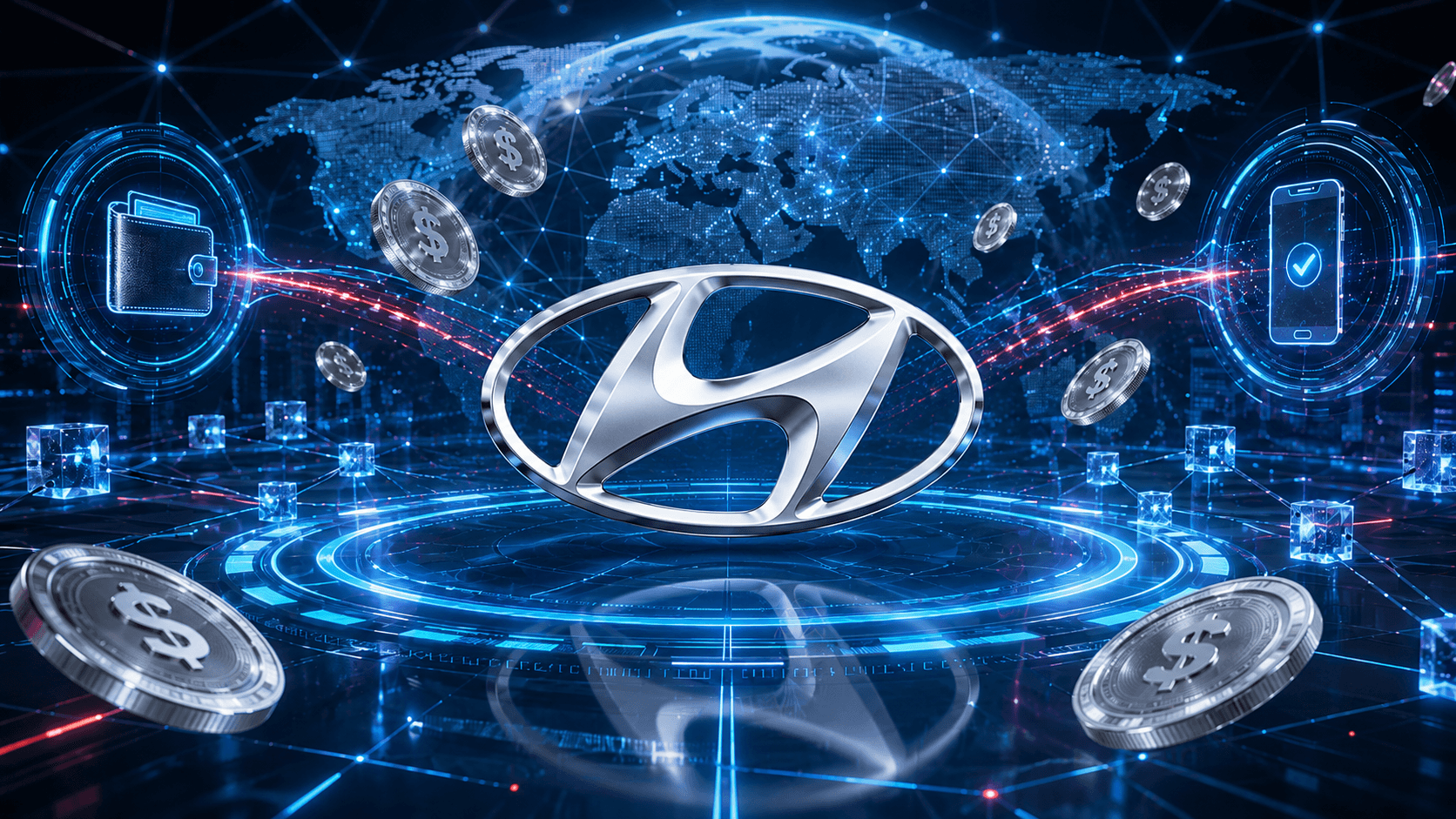
In this transaction, USDT acts as the settlement asset. Dollars are converted into USDT, sent via the blockchain, and then converted back into dollars.
Sumber: AI Generated Image
The model can provide several benefits:
- Speed up the transfer of funds.
- Supports transactions outside banking hours.
- Makes it easier to track payment status.
- Reduces reliance on long correspondence flows.
- Increase treasury visibility.
- Enables automation of reconciliation.
- Supporting global payment corridors.
However, stablecoins don't completely eliminate dependence on the traditional financial system. Companies still need services to convert fiat money into USDT and convert it back into locally usable currencies.
Read Also: How to Buy and Transfer USDT
Avalanche's Role in Hyundai's Stablecoin Trial
Avalanche is the blockchain infrastructure that transports USDT from sending entities to recipients. The network offers compatibility with the Ethereum Virtual Machine, relatively low transaction fees, and fast finality.
For companies, choosing a blockchain doesn't just depend on the number of transactions per second. Several other requirements must also be considered:
- Network security.
- Finality of the transaction.
- Operating costs.
- Stablecoin support.
- Integration with enterprise systems.
- Availability of custodian providers.
- Transaction monitoring capabilities.
- Compliance control.
- Scalability.
- Technical support.
Avalanche also provides a Layer 1 architecture that can be configured to meet institutional needs. Companies can build environments with customized validator rules, access permissions, gas assets, and operational controls.
However, it's not yet clear whether Hyundai will build its own Avalanche network. This trial uses Avalanche-based payment infrastructure to test cross-border USDT settlement.
What is the Role of Axiym, Hyundai Card, and Tether?
The success of the test doesn't just depend on Hyundai and Avalanche.
Axium
Axiym provides a settlement infrastructure that supports USDT transfers, transaction authentication, and enterprise payment integration. The platform bridges traditional treasury needs with blockchain solutions.
Hyundai Card
Hyundai Card led the design of the remittance structure in the proof-of-concept. Their role included evaluating regulatory, compliance, accounting requirements, and operational frameworks.
This involvement demonstrates that the trial isn't solely focused on speed. Hyundai is also assessing whether stablecoin payments can be integrated into existing corporate governance.
Tether
Tether is the issuer of USDT and supports the development of stablecoins for corporate payments. The company also has a strategic investment in Axiym.
The combination of stablecoin issuers, technology providers, and corporate finance divisions allows for testing from the initial conversion process to receipt of funds.
Start trading USDT/IDR with Bittime here!
Benefits of Cross-Border Payments with Blockchain
Faster Liquidity Available
Multinational companies frequently move funds between entities to pay suppliers, meet operational needs, or balance cash.
Faster settlement allows funds to be used more immediately and reduces the time that capital is held up in the transfer process.
24/7 Treasury Operations
Blockchain doesn't follow bank holidays or branch hours. This feature can help treasury teams managing companies in the Americas, Asia, Europe, and other regions simultaneously.
Transaction Status Transparency
Blockchain transactions have a verifiable record. Finance teams can determine whether funds have been sent, confirmed, or received without waiting for manual updates from multiple parties.
More Efficient Reconciliation
On-chain transaction data can be linked to accounting and enterprise resource planning systems. Proper integration can reduce manual reconciliation work.
Potential Cost Efficiency
More direct payment channels have the potential to reduce intermediary costs. However, actual savings must account for fiat conversion fees, custodianship, compliance, stablecoin spreads, and technology providers.
Read also: Tether (USDT) is in danger of disappearing from European exchanges. What's the reason?
Is Blockchain Faster than Bank Transfers?
In Hyundai's trials, the stablecoin process was completed in about seven minutes, compared to previous methods that took three to four hours or more. These results demonstrate significant speed improvements across the tested corridors and configurations.
However, this comparison shouldn't be overly generalized. Domestic bank transfers in some countries can be completed in seconds, while blockchain payments can be delayed due to onboarding, compliance checks, or fiat conversion issues.
Actual speed is affected by:
- Sending and receiving countries.
- The currency used.
- On-ramp provider operating hours.
- AML audits and sanctions.
- Stablecoin liquidity.
- Custody provider.
- Infrastructure bank.
- Company policy.
- Blockchain network conditions.
The main advantage of stablecoins lies in the ability to move value globally and continuously, rather than simply comparing blockchain confirmation times to bank transfer times.
Start trading AVAX/IDR with Bittime here!
Hyundai's Test Impact on Avalanche
Hyundai's trial adds to Avalanche's use cases beyond crypto trading. The network is increasingly used for payments, real-world assets, and capital markets infrastructure.
Another development comes from Progmat, a Japanese digital securities platform that is moving all of its active tokenized securities projects to Avalanche Layer 1. The value of assets covered has reached over ¥452 billion.
The migration includes real estate-backed security tokens and corporate bonds. Internal testing also shows that title transfers can be three to five times faster than the previous system.
These two developments demonstrate two paths to institutional adoption of Avalanche:
- Hyundai tests stablecoin for treasury payments.
- Progmat uses Avalanche for its tokenized asset infrastructure.
While positive for the ecosystem, enterprise adoption doesn't automatically translate to an increase in the AVAX price. The impact on the token depends on transaction volume, fee structure, AVAX usage as gas, network growth, and overall crypto market conditions.
Will Hyundai Use USDT Permanently?
There's no certainty yet that Hyundai will implement USDT across its global operations. The trial is still a proof-of-concept with a value of US$20,000.
Proof of concept aims to answer several initial questions:
- Can transactions be completed faster?
- Is the process verifiable?
- Can the system meet compliance standards?
- Can accounting records be made?
- Can the technology be integrated without replacing the entire system?
- Can the model be expanded?
The next phase will evaluate additional payment corridors and settlement in local currencies. The results of this testing will determine whether the stablecoin model is feasible on a larger scale.
To monitor the development of stablecoins, Avalanche, and blockchain adoption by global companies, you can register at Bittime and regularly follow the latest crypto news. Always conduct your own research before purchasing digital assets, as technology adoption doesn't always directly correlate with token price performance.
Risks of Treasury Transfer Using Stablecoins
Stablecoin Issuer Risks
The value of USDT depends on the issuer's ability to maintain reserves and the redemption process. Companies need to assess the quality of the reserve assets, governance, and counterparty risk.
Depeg Risk
Stablecoins are designed to track the value of the dollar, but their prices can deviate temporarily on secondary markets. Depegs can affect transaction values and conversion fees.
Regulatory Risk
Stablecoin regulations vary by country. Companies must comply with regulations governing payments, money transfers, digital assets, taxes, reporting, and capital controls.
Custody and Private Key Risks
Access to blockchain assets depends on the security of your wallet and private keys. Mismanagement can result in funds being lost or sent to the wrong address.
Risiko Smart Contract
USDT and its settlement infrastructure use software and smart contracts. Technical vulnerabilities could lead to disruptions or loss of funds.
On-Ramp and Off-Ramp Risks
Blockchain transfers can be fast, but fiat conversions still depend on banks and payment providers. Delays at this stage can diminish the benefits of instant settlement.
Compliance Risk
Corporate transactions are subject to identity, source of funds, sanctions, and anti-money laundering checks. Failure to comply with these requirements could result in funds being frozen or legal sanctions.
Read also: BIS 2026 Warning: Stablecoin Risks for Developing Countries
What Does Hyundai's Trial Mean for the Industry?
This trial shows that stablecoins are starting to be considered as treasury tools, not just assets for crypto trading.
Global companies face the need to move funds quickly between countries, maintain cash visibility, and reduce capital contingency. Stablecoins can provide an alternative settlement layer, provided the system meets regulatory and governance requirements.
This development also suggests that enterprise blockchain adoption is likely taking place through infrastructure that is not directly visible to users. Employees or suppliers may continue to accept traditional currencies, while stablecoins are used behind the scenes to expedite settlements.
Conclusion
Hyundai tested a US$20,000 cross-border treasury transfer using USDT via the Avalanche blockchain. The funds were sent from Hyundai Motor America to Hyundai Motor de México, and the entire process was completed in an average of about seven minutes.
The trial demonstrated that stablecoins could accelerate cross-border payments while integrating compliance, accounting, and corporate governance processes. However, the results are still limited to a proof of concept and do not yet demonstrate full implementation within Hyundai's operations.
The next stage will be crucial. If testing in other corridors and local currency settlements is successful, a similar model could potentially be used more widely in global corporate cash management.
Interested in trading Avalanche? As well as the AVAX/IDR pair, Bittime also offers AVAX/USDT to support your trading and investment strategies.
Bittime is a licensed and regulated Digital Financial Asset Trader (PAKD) supervised by Indonesia’s Financial Services Authority (OJK) — where you can buy Bitcoin in Indonesia and hundreds of other crypto assets starting from just Rp10,000. The registration process is fast, secure, and you can get started today.
Track USDT to IDR conversions and monitor your favorite crypto assets in real time. Everything is available in one crypto investment app that you can download for free on the Play Store
Ready to start? Register now on Bittime and execute your investment strategy with a platform trusted by millions of users in Indonesia.
FAQ
How much USDT did Hyundai transfer?
Hyundai Motor America converts and sends US$20,000 worth of USDT to Hyundai Motor de México. Upon receipt, the USDT is converted back into US dollars.
How long does it take for a Hyundai USDT transfer to complete?
The entire transfer and verification process takes an average of about seven minutes to complete. This timeframe includes more than just blockchain transaction confirmation.
Why Does Hyundai Use Avalanche?
Avalanche offers fast finality, relatively low fees, and support for blockchain-based payment applications. The network can also be integrated with enterprise infrastructure and stablecoins.
Does Hyundai already use USDT for all payments?
Not yet. The transaction is still a proof of concept with limited value to test speed, compliance, accounting, and operational feasibility.
Will Hyundai's trials raise the price of AVAX?
There are no guarantees. Enterprise adoption can strengthen the ecosystem's fundamentals, but AVAX's price remains influenced by market conditions, network volume, token demand, and investor sentiment.
Disclaimer: The views expressed belong exclusively to the author and do not reflect the views of this platform. This platform and its affiliates disclaim any responsibility for the accuracy or suitability of the information provided. It is for informational purposes only and not intended as financial or investment advice.

.png)