US$214,000 in Crypto Allegedly Stolen in Bali Kidnapping Case, What Happened?
2026-07-13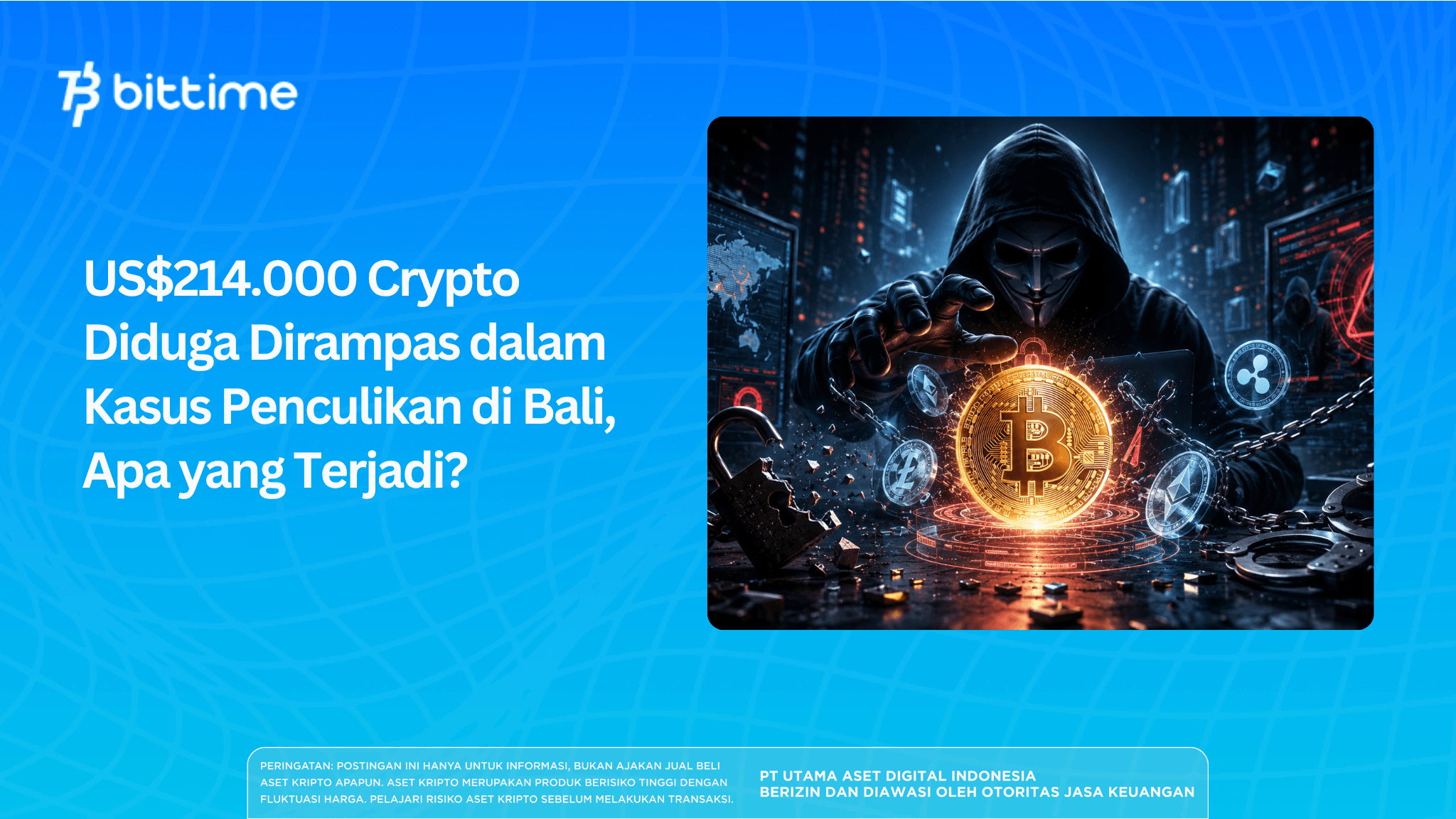
The crypto kidnapping case in Bali shows that threats to digital asset investors do not always come in the form of hacking. In this case, the victim was allegedly kidnapped, assaulted, and forced to transfer crypto assets worth approximately US$214,429, or roughly Rp3.4 billion.
Key Takeaways
- A Ukrainian citizen was reportedly the victim of a kidnapping and crypto robbery in Bali on December 15, 2024.
- The perpetrator allegedly used violence to force the victim to open an account and transfer digital assets, a method known as wrench attack.
- Cold wallets alone aren't enough to counter physical threats; investors need to combine wallet security, identity privacy, and personal protection.
What Happened in the Bali Crypto Case?
The incident reportedly occurred on December 15, 2024, in the South Kuta area of Badung Regency. The victim, a Ukrainian citizen, was traveling with his driver in a BMW when their vehicle was blocked by two other cars.
Four masked men then reportedly approached the victim's vehicle carrying several weapons. The victim and the driver were allegedly handcuffed, blindfolded, and taken to a villa in the South Kuta area.

Sumber AI Generated Image
At the location, the victim was reportedly assaulted and forced to unlock his Binance account. The crypto assets were then allegedly transferred to two accounts, totaling approximately US$214,429 (Rp3.4–3.5 billion). The victim also reportedly suffered injuries to his ear, wrist, hand, and head.
In the initial stages of the investigation, police are hunting for nine foreign nationals suspected of involvement. They are said to be from Russia, Ukraine, and Kazakhstan.
A Russian citizen was detained at I Gusti Ngurah Rai International Airport, but was later released after an investigation found that he was not in Bali when the incident took place and was not proven to be involved.
The use of the word "alleged" remains crucial. Information regarding the perpetrator, losses, and asset flows are part of the victim's report and the investigative process. Determination of criminal responsibility must follow the evidence presented by investigators and the judicial process.
Read Also: The Facts Behind the Rp150 Billion Crypto Scam Involving an Indonesian Citizen
Don't Confused with the 2026 Bali Crypto Kidnapping Case
The case, valued at around US$214,000, is different from the reported kidnapping of Russian citizens in Bali in July 2026.
In the most recent case, a Russian citizen with the initials AI was reportedly kidnapped in the Pecatu area on July 2, 2026. The victim claimed to have been detained and subjected to violence for nearly 30 hours in an attempt to force him to hand over his crypto asset account passwords. Two of the victim's cell phones were also reportedly taken.
The victim was then released in front of Udayana University Hospital on July 4, 2026. Police upgraded the case from a missing person report to an investigation into alleged kidnapping, assault, and theft with violence. Investigators examined several locations, collected CCTV footage, and analyzed mobile device data.
The amount of losses in the July 2026 case has not been confirmed by police in the official report. Therefore, the figure of US$214,000 should not be used to describe the latest case.
To keep up to date with crypto crime cases, wallet security, and other digital asset news, you can register at Bittime and check for related news updates. Ensure account security and personal safety are always a priority before making any transactions.
What Is Crypto Kidnapping?
Crypto kidnapping is a kidnapping carried out to obtain cryptocurrency, wallet access, private keys, seed phrases, exchange account passwords, or ransom payments in digital assets.
Unlike traditional hacking, attackers don't have to compromise the blockchain system or exploit software vulnerabilities. They can target asset owners directly and force them to grant access.
This mode may involve:
- Kidnapping or confinement.
- Threats to the victim or family.
- Phone and laptop confiscation.
- Forced opening of wallet application.
- Forced opening of stock exchange account.
- Transfer assets to an address controlled by the perpetrator.
- Extortion by demanding ransom in crypto.
Because cryptocurrency transactions can be conducted quickly and across borders, perpetrators may attempt to move funds through multiple wallets or services. However, transactions on public blockchains leave a trail that can be analyzed by investigators and blockchain forensics firms.
Read also: Crypto Cases in Indonesia from 2020-2026, Complete List
What is a Wrench Attack?
Wrench attack is an attack that uses violence, intimidation, or physical threats to force someone to give up access to crypto assets.
The term describes a weakness that cannot be addressed by encryption alone. A private key may be protected by very strong technology, but an attacker can attempt to bypass digital protection by attacking the owner directly.
Attacks like this demonstrate the difference between cybersecurity and physical security:
- Hacking targets devices, applications, networks, or credentials.
- Phishing tricks victims into handing over information.
- SIM swapping takes over the victim's phone number.
- Wrench attacks target the victim's body, liberty, or safety.
Hardware wallets and cold storage effectively mitigate the risk of digital attacks. However, these devices cannot prevent attackers from forcing the owner to directly access them.
Read also:Trump Stores $50 Million Worth of Bitcoin in a Cold Wallet
Why Are Crypto Investors Targeted by Crime?
1. Assets Can Be Moved Quickly
Cryptocurrency can be sent in minutes without carrying cash or physical items. The perpetrators don't need to transport gold, vehicles, or suitcases filled with cash after the theft.
2. Transactions are difficult to cancel
Confirmed blockchain transactions generally cannot be unilaterally reversed. There is no such thing as a "return button."charge back like on a credit card.
This characteristic gives direct control to the asset owner, but also increases the consequences when transfers are made under threat or wallet access falls into the hands of another party.
3. Wealth Information Can Be Disseminated
Investors often share their trading activities, asset collections, profits, wallets, cars, travels, and locations through social media.
Information that appears to be isolated can be combined to estimate the victim's wealth, routine, residence, vehicles, family members, or location.
4. Identity Can Be Linked to Wallet
Blockchain addresses are pseudonymous, not completely anonymous. When an address is linked to an identity through transactions, social media posts, data leaks, or business interactions, others can monitor its balance and activity.
5. Owners Have Direct Control
The principle of self-custody gives the owner complete control over the asset. Consequently, the owner also becomes a critical point of security.
Physical attacks on crypto investors are gaining increasing attention as perpetrators attempt to bypass digital protections by exploiting personal information, routines, and direct access to victims.
Read also: CZ Sued in London, What's Going On? Here's the Chronology of the Lawsuit Against the Binance Founder
How to Protect Crypto Assets?
No system can eliminate all risk. The goal of protection is to reduce the likelihood of an attack and limit losses if one layer of security fails.

Sumber AI Generated Image
Keep Asset Amount Confidential
Avoid publishing wallet balances, profits, portfolio screenshots, or claims of owning large amounts of crypto.
Don't assume anonymous social media accounts are always secure. Photos, locations, usernames, business connections, and travel habits can be used to identify someone.
Separate Wallets Based on Function
Use different wallets for long-term savings, active trading, interactions DeFi, and daily transactions.
Keep only the necessary amount in a hot wallet. This separation can limit losses if one device, account, or wallet is compromised.
Use Multi-Signature for Large Assets
Multi-signature or multi sig requires more than one approval to move assets. Keys can be managed through separate devices or parties.
This approach reduces the risk of a single password, device, or person becoming the sole means of accessing all assets. Multi-approval is also recommended as a mitigation measure against physical coercion.
Avoid Storing All Access on One Phone
The phone you carry every day shouldn't be your sole access point to your entire portfolio. Keep your daily trading devices separate from your primary asset storage system.
Enable device lock, two-factor authentication, and login notifications. Avoid SMS-based authentication as the sole layer for high-value accounts.
Protect Seed Phrase
Do not save seed phrases in galleries, cloud notes, emails, private messages, or screenshots.
The physical copy should be stored securely and separately from the hardware wallet. Do not share the seed phrase with support staff, friends, or anyone claiming to be a platform administrator.
Implement Travel Safety
Avoid sharing real-time location, villa details, flight schedules, and vehicles used.
For high-risk trips, consider bringing only devices with limited access. Key assets don't need to be fully accessible from your everyday phone.
Family and Team Education
Perpetrators can target family members, drivers, employees, or business associates. Those closest to you need to understand how to recognize surveillance, suspicious messages, attempts to obtain addresses, or unusual requests for information.
Physical security guidelines also emphasize the importance of educating families as they can be used as intermediary targets.
Read also:Tether (USDT) is in danger of disappearing from European exchanges. What's the reason?
What to Do If Crypto Is Stolen?
Physical safety should be a priority. Do not chase or confront the perpetrator directly.
Once in a safe location:
- Call the police immediately.
- Note the time, location, vehicle, characteristics of the perpetrator, and witnesses.
- Save the recipient's wallet address and transaction hash.
- Report the transfer to the relevant exchange or custodian.
- Ask the platform to flag or freeze accounts if funds enter centralized services.
- Move assets that are still safe to a new wallet.
- Revoke login sessions and app permissions that are no longer needed.
- Change the password from a device that is confirmed to be clean.
- Do not delete messages, recordings, or device data that could serve as evidence.
- Use legal assistance and blockchain forensic specialists for high-value cases.
Assets that have been transferred don't always automatically disappear without a trace. Blockchain analysis can track the flow of funds and help identify the point at which a perpetrator attempted to exchange assets through a service that holds user data.
Read Also: Crypto Scam Disguised as Romance, Hong Kong Woman Loses HK$40,000
Wallet Security Is Not the Same as Investor Security
Many users focus solely on technical security, such as choosing a hardware wallet and creating a complex password. These steps are important, but not sufficient.
Comprehensive security has several layers:
- Technical security: wallet, device, authentication, and app updates.
- Information security: identity, balance, location, and habits.
- Physical security: home, vehicle, travel, and guest access.
- Procedural security: wallet separation, transaction limits, and layered approvals.
- Social security: family, staff, partners, and social media activities.
Research on wallet security design also shows that risks extend beyond software vulnerabilities. Authentication systems, key management, recovery mechanisms, user behavior, and storage models need to be assessed as a whole.
Conclusion
Case crypto kidnapping in Bali involving assets of around US$214,429 shows that threats to investors do not always take the form of phishing or hacking.
The victim was reportedly confronted, taken to a villa, subjected to violence, and forced to transfer assets from a crypto account. This case is an example.wrench attack, namely the use of physical threats to bypass digital security systems.
Investors need to understand that cold wallets only protect one aspect of the risk. Stronger protection requires ownership secrecy, wallet segregation, multi-signatures, separate devices, secure travel, and family education.
The US$214,000 figure should also not be confused with the July 2026 kidnapping of Russian citizens. That case is a separate matter, and the value of the losses is still being assessed by the police.

Crypto kidnapping case can indeed cause investors to worry. That’s why it’s important to choose a secure and reliable platform to make trading more comfortable.
Bittime is a licensed and regulated Digital Financial Asset Trader (PAKD) supervised by Indonesia’s Financial Services Authority (OJK) — where you can buy Bitcoin in Indonesia and hundreds of other crypto assets starting from just Rp10,000. The registration process is fast, secure, and you can get started today.
Track USDT to IDR conversions and monitor your favorite crypto assets in real time. Everything is available in one crypto investment app that you can download for free on the Play Store
Ready to start? Register now on Bittime and execute your investment strategy with a platform trusted by millions of users in Indonesia.
FAQ
What is crypto kidnapping?
Crypto kidnapping is the act of kidnapping or holding captive with the aim of forcing victims to hand over digital assets, private keys, seed phrases, or access to exchange accounts. The method can include blackmail and physical violence.
What is a wrench attack?
A wrench attack is a physical attack or intimidation to force a crypto owner to open a wallet or transfer assets. These attacks target humans, not blockchain vulnerabilities.
How much crypto was allegedly seized in the Bali case?
In the case that occurred in December 2024, the reported value was approximately US$214,429, or Rp3.4–3.5 billion. This figure differs from the kidnapping of Russian citizens in July 2026.
Can cold wallets prevent crypto kidnapping?
Cold wallets effectively protect assets from many online attacks, but they don't automatically prevent physical coercion. Large assets should be protected with multi-signature encryption, access segregation, and personal security.
Can stolen crypto be traced?
Transactions on public blockchains can be analyzed through addresses and transaction hashes. Recovery remains uncertain, but tracking can help police identify the flow of funds and the point of disbursement.
Disclaimer: The views expressed belong exclusively to the author and do not reflect the views of this platform. This platform and its affiliates disclaim any responsibility for the accuracy or suitability of the information provided. It is for informational purposes only and not intended as financial or investment advice.

.png)