GPT-5.6 Sol vs Claude Fable 5: Which is Best for Coding?
2026-07-15
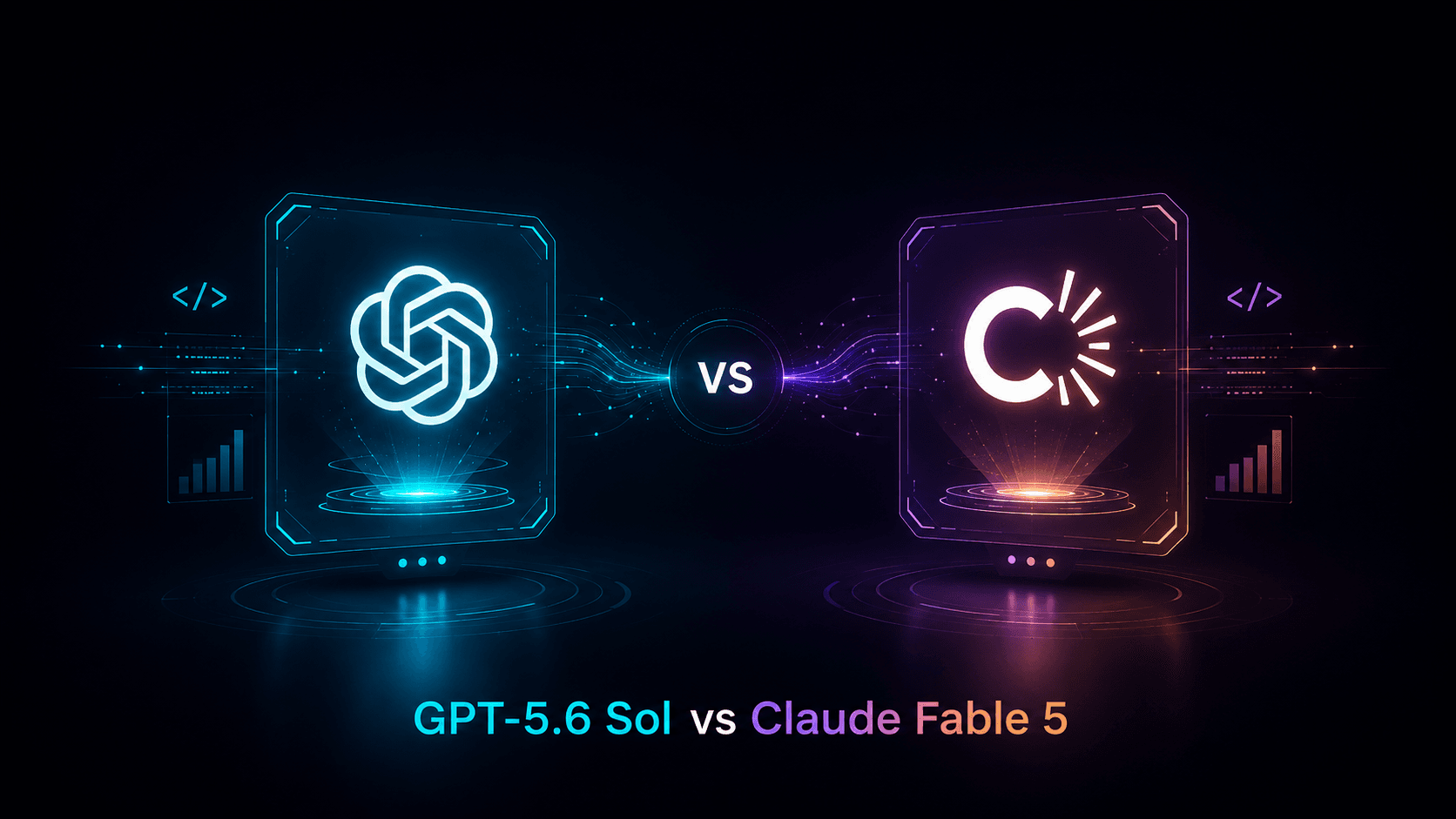
GPT-5.6 Sol vs Claude Fable 5 is an important comparison for programmers looking for the best AI for coding. GPT-5.6 Sol excels in efficiency, terminal usage, and high-speed workflow, while Claude Fable 5 excels in long tasks, in-depth analysis, and code reviews that require a lot of context.
Key Takeaways
- GPT-5.6 Sol is better suited for high-speed agent coding, terminal workflow, structured output, and cost-sensitive API usage.
- Claude Fable 5 is more interesting for long projects, large codebase migrations, in-depth explanations, and reviews that require broad context.
- There is no universal winner; testing the repositories, programming languages, and workflows themselves is more valuable than choosing based on a single benchmark.
Getting to Know GPT-5.6 Sol and Claude Fable 5
GPT-5.6 Sol is the flagship model in OpenAI's GPT-5.6 family. It is designed for coding, knowledge work, cybersecurity, science, computing, and workflows involving multiple tools. OpenAI also provides a level of reasoning max as well as fashion ultra which coordinates multiple agents in parallel for complex tasks.
Claude Fable 5, is the most powerful model Anthropic has released widely. It is intended for long-term agentic work, software engineering, research, and complex projects that can last several days. Fable 5 is available through Claude, Claude Code, the Anthropic API, and several cloud platforms.
Neither is simply a chatbot for generating code snippets. GPT-5.6 Sol and Claude Fable 5 are designed to handle more complex workflows, such as reading a repository, creating an implementation plan, modifying multiple files, running tools, writing tests, and checking results.
Read also: Gamma AI vs Presentations.AI: Which is Best for Making PPT?
GPT-5.6 Sol vs Claude Fable 5 Based on Coding Benchmark
Benchmarks can be a starting point, but the results don't indicate a clear winner. Each benchmark measures different capabilities.
In data published by OpenAI, GPT-5.6 Sol scored 80 on the Artificial Analysis Coding Agent Index, while Claude Fable 5 scored 77.2. Sol also scored 88.8% on Terminal-Bench 2.1, compared to 83.1% for Fable 5. On DeepSWE, GPT-5.6 Sol scored 72.7%, while Fable 5 achieved 69.7%.
Source AI Generated Image
However, Claude Fable 5 performed significantly better on SWE-Bench Pro. Using the same data set, Fable 5 scored 80%, while GPT-5.6 Sol achieved 64.6%. This difference in results demonstrates that AI coding performance is highly dependent on the evaluation type, harness, tool, reasoning configuration, and task characteristics.
Anthropic also stated that Fable 5 achieved very strong results in long-horizon coding and FrontierCode evaluations. In initial testing reported by Anthropic, the model was used to migrate a 50 million-line Ruby codebase in a single day.
These claims come from customer testing published by Anthropic, so they should not be taken as a guarantee that the same results will occur with every repository.
The conclusions from the benchmark are:
- GPT-5.6 Sol looks more powerful for workflow terminals, tool coordination, and coding agents in general.
- Claude Fable 5 can excel at solving certain software issues and jobs that require long contexts.
- Results may change when the model uses different prompts, tool harnesses, effort levels, or execution environments.
To keep up with updates on AI models, coding technologies, and digital industry developments, readers can register at Bittime and read the latest news related to AI and crypto assets.
GPT-5.6 Sol for Coding: What Are the Advantages?
Fast in Iterative Workflow
GPT-5.6 Sol is well suited for development processes that require fast cycles: read the problem, change the code, run tests, fix the error, then repeat the process.
OpenAI the model can write lightweight programs to coordinate tools, process interim results, and determine next steps. This capability is relevant for coding agents that must interact with terminals, test runners, linters, browsers, or APIs.
MindStudio testing also found Sol to be effective for rapid code review. The model was found to be capable of catching common logic errors, off-by-one errors, missing error handling, and inefficient loops with relatively short response times. This assessment is a third-party editorial evaluation, not a formal security benchmark.
Structured Output is More Practical
In automated workflows, output quality isn't just about answer accuracy. Models must also produce JSON, patches, discovery lists, or function calls in a consistent structure.
MindStudio rates GPT-5.6 Sol as superior in planning speed and structured output. These characteristics are useful for CI/CD pipelines, pull request automation, documentation generators, and agents that need to forward output to other systems.
Better Cost Efficiency
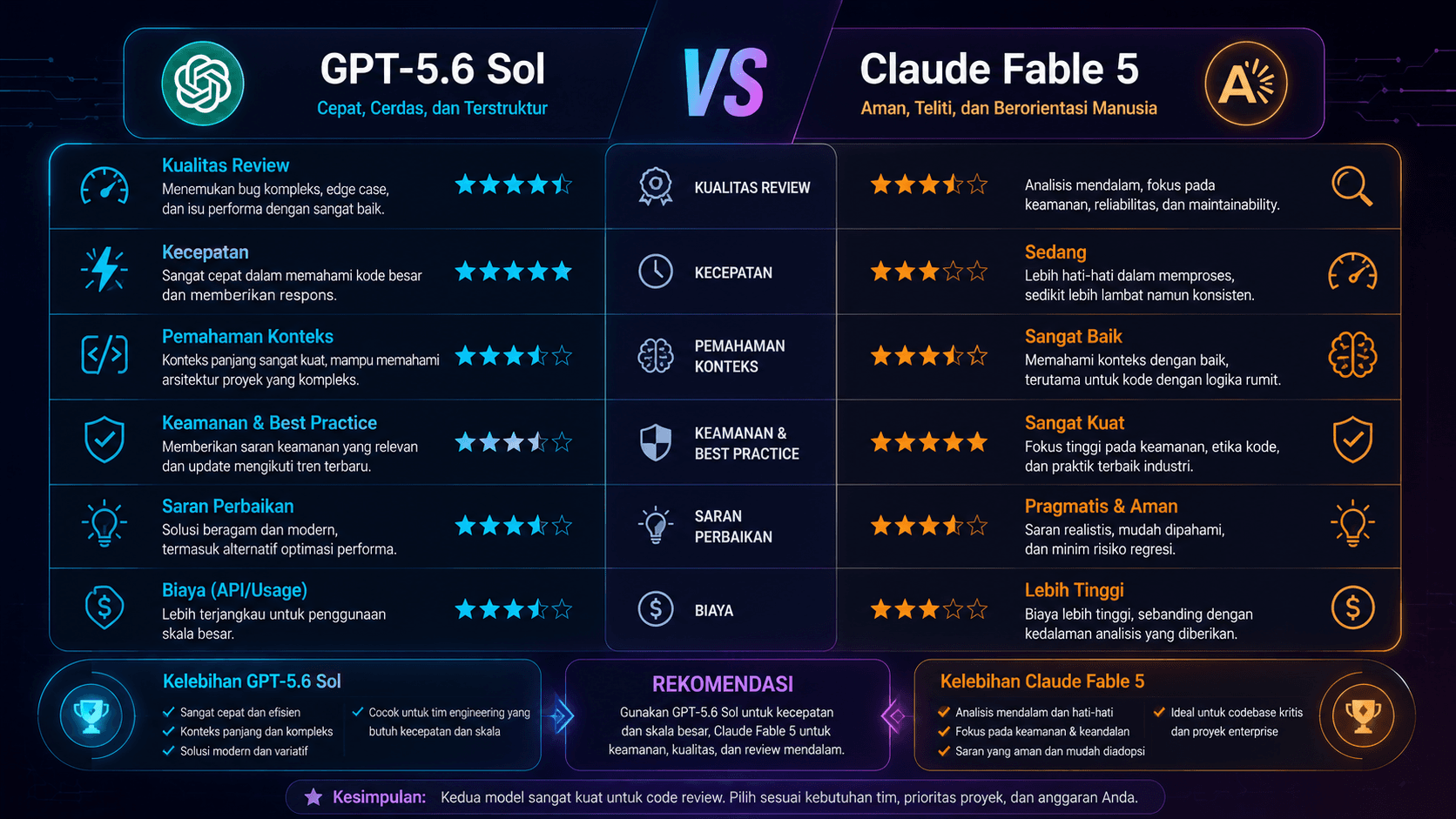
Sol's GPT-5.6 API costs US$5 per million input tokens and US$30 per million output tokens. Claude's Fable 5 costs US$10 per million input tokens and US$50 per million output tokens. Thus, Sol's input costs are 50% lower, while its output costs are 40% lower, based on the standard rates published by both companies.
These differences can be material to:
- Automated code review on hundreds of pull requests.
- Agent that reads large repositories.
- High volume test case generator.
- Migration or refactoring that requires multiple iterations.
- Multi-agent workflow with large token usage.
The cost per token isn't the only factor. A cheap model that requires many retries can result in a higher final cost. Therefore, consider the cost per successful task, not just the price per million tokens.
Powerful for Frontend and Visual Validation
OpenAI states that GPT-5.6 has improvements in layout, visual hierarchy, and design judgment. The official guidelines also recommend that the model be given access to render and inspect the front-end results before completing the work.
In practical testing of the Creator Economy, GPT-5.6 was deemed to have narrowed the gap with Fable 5 in front-end development.
On the task of creating an interactive travel website, both models produced interfaces that were deemed attractive, and the final results were deemed comparable. This testing was a single case and is not sufficient to conclude on the performance of the entire front-end project.
Read also: OpenAI vs Anthropic: AI Model Competition in Enterprise
Claude Fable 5 for Coding: What are the Benefits?
Strong for Long Term Coding Tasks
Claude Fable 5 is positioned by Anthropic for ambitious, long-running projects. The model is designed for large migrations, complex implementations, autonomous coding sessions, test generation, and vision inspection.
This ability is relevant when programmers assign tasks that are broader than one function, for example:
- Migrating frameworks across multiple packages.
- Understanding monorepo architecture.
- Investigating cross-service bugs.
- Redesigning the authentication module.
- Checking the consistency of changes across multiple files.
- Building full features from long specifications.
Very Large Context Window
Claude Fable 5 has a context window of one million tokens and a maximum output of up to 128,000 tokens per request. This capacity can be helpful when the model needs to read multiple files, internal documentation, decision histories, and lengthy specifications in a single workflow.
A large context window doesn't automatically guarantee perfect understanding. The model can still miss details, link files incorrectly, or place too much weight on certain sections. Programmers still need to select relevant context and ask the model to name the files or lines on which it bases its conclusions.
Deeper Code Review
MindStudio assessed Claude Fable 5 as more comprehensive in its security- and architecture-oriented code reviews.
The model was found to more frequently explain the relationships between functions, authentication risks, race conditions, injection, and the design's consequences on the broader system.
This advantage can be useful for junior developers who need an explanation of “why” an implementation is risky, not just a list of errors.
However, this evaluation is not a substitute for a security audit. All AI findings need to be verified with static analysis, dependency scanning, dynamic testing, threat modeling, and human review.
More Conservative in Risky Workflows
According to MindStudio's comparison, Claude Fable 5 tends to be more cautious in agentic workflows, while GPT-5.6 Sol more often fills in incomplete information, assuming it will keep the process running. This conservative approach can be beneficial when errors are difficult to reverse, but it can slow down the process because the model more frequently flags uncertainties.
Fable 5 also uses a safety classifier that can reject certain requests. In the API, a rejection is returned withstop_reason: "refusal", and developers are advised to prepare fallbacks to other models.
Read also: OpenAI ChatGPT Issues New Safety Update Amid Lawsuit: Can It Prevent Overdoses & Violence?
Which is Better for Code Review?
For first-pass review of many pull requests, GPT-5.6 Sol is more practical. This model is relatively fast, less expensive, and well-suited for generating structured comments on common bugs, code quality, error handling, and potential refactorings.
For critical pull requests, Claude Fable 5 is a suitable second reviewer. Its main strengths lie in its extensive explanations, contextual understanding, and architectural assessment. Based on MindStudio's evaluation, Fable 5 is better suited for security-sensitive reviews or those requiring cross-component reasoning.
Source AI Generated Image
A rational workflow can use:
- GPT-5.6 Sol to scan all changes.
- Static analysis and test suite for automated verification.
- Claude Fable 5 to review high-risk functions.
- Human developers for final decisions and approval.
This multi-model approach optimizes speed without relying on a single system for review quality. MindStudio also recommends routing Sol for initial inspection and Fable for in-depth review of risky sections.
Read also: OpenAI and Microsoft Change Partnership Agreement: What Impact Will It Have?
Which is Better for Debugging?
GPT-5.6 Sol is more suitable when debugging requires extensive terminal interaction. The model can run tests, read errors, fix files, and then revalidate the results. OpenAI specifically recommends using targeted tests, type checking, lint, build checking, and smoke testing after changes are made.
Claude Fable 5 is more interesting when bugs involve a broad system context. Examples include state issues that occur across multiple services, data inconsistencies, race conditions, or behavior that only becomes apparent after a long process.
Practical recommendations:
- Use GPT-5.6 Sol for local bugs, test failures, build errors, and iterative debugging.
- Use Claude Fable 5 for root-cause analysis involving multiple modules.
- Use both for complex production incidents, but don't give write access to unattended production systems.
Read also: OpenAI Files IPO, New Round of AI Race Begins
Which is Better for Building Apps?
GPT-5.6 Sol is a strong choice for building applications when speed, cost efficiency, tool use, frontend, and rapid iteration are key priorities. It's also more economical for experiments that require multiple prompts and repetitions.
Claude Fable 5 is better suited for applications with lengthy specifications, complex architectures, numerous dependencies, or long-term autonomous work. Anthropic positions it for large projects that require cross-stage planning, sub-agent delegation, and independent review of results.
Creator Economy found that both were capable of producing competitively high-quality interactive frontends in testing. This suggests that model selection should also consider design preferences, tool harness, and prompt quality.
Read also: OpenAI Releases Prism, a New AI Workspace for Researchers and Scientists
Limitations of GPT-5.6 Sol and Claude Fable 5
Both models can still:
- Produces code that looks correct but fails on edge cases.
- Using a library or API incorrectly.
- Missing security vulnerabilities.
- Making unexplained assumptions.
- Remove or change any unwanted parts of the code.
- Write tests that only justify their own implementation.
- Providing architectural advice without understanding business constraints.
- Produces false positives in code reviews.
Benchmarks from modeling companies should also be read with caution. OpenAI and Anthropic may use different configurations, effort levels, harnesses, and evaluation methods. OpenAI itself states that benchmark cost and latency estimates may differ substantially from actual use.
Read also: Sora by OpenAI: The Viral AI Coin Meme — What It Is & Its Tokenomics
GPT-5.6 Sol vs Claude Fable 5: Which is Best?
GPT-5.6 Sol is more suitable when debugging requires extensive interaction with the terminal. The model can run tests, read error messages, fix files, and then revalidate the results. OpenAI specifically recommends using targeted tests, type checks, lint checks, build checks, and smoke tests after changes are made.
Claude Fable 5 is more useful when bugs involve a broad system context. Examples include state issues that arise across multiple services, data inconsistencies, race conditions, or behavior that only becomes apparent after a long sequence of processes.
Use the following recommendations:
- Choose GPT-5.6 Sun for daily coding, terminal agents, fast debugging, frontend, structured output, and cost-efficient automation.
- Choose Claude Fable 5 to understand large codebases, complex migrations, architecture reviews, in-depth explanations, and long-context work.
- Use both of them for important code review: Sol as first reviewer and Fable as in-depth reviewer.
- Avoid choosing based on just one benchmark. Test both on real-world tasks in your organization.
Read also: OpenAI vs. Anthropic: GPT-5.5 Cyber Infiltrates 9 UK Banks, Regulators Concerned
Conclusion
GPT-5.6 Sol vs. Claude Fable 5 isn't a one-size-fits-all comparison. GPT-5.6 Sol is superior as a practical choice for programmers who need speed, tool use, structured output, and lower API costs.
Claude Fable 5 is better suited for long-term projects requiring large contexts, in-depth reasoning, and cross-architecture evaluation. Its results are also robust on SWE-Bench Pro and long-term agentic projects.
For daily coding, GPT-5.6 Sol is the top recommendation. For critical code reviews, large migrations, or complex repository analysis, Claude Fable 5 is worth considering.
The best strategy for engineering teams is to conduct evaluations using their own repositories and acceptance criteria.

Now that you’ve learnt about the latest AI developments, it’s time to explore AI-based cryptocurrencies on Bittime, such as the digital assets AI, AGI, RENDER, TAO and many more AI coins.
Bittime is a licensed and regulated Digital Financial Asset Trader (PAKD) supervised by Indonesia’s Financial Services Authority (OJK) — where you can buy Bitcoin in Indonesia and hundreds of other crypto assets starting from just Rp10,000. The registration process is fast, secure, and you can get started today.
Track USDT to IDR conversions and monitor your favorite crypto assets in real time. Everything is available in one crypto investment app that you can download for free on the Play Store
Ready to start? Register now on Bittime and execute your investment strategy with a platform trusted by millions of users in Indonesia.
FAQ
Is GPT-5.6 Sol better than Claude Fable 5 for coding?
GPT-5.6 Sol outperforms several agentic coding and terminal benchmarks and has a lower API price. Claude Fable 5 outperforms SWE-Bench Pro and is better suited for long, context-heavy workflows.
Which model is better for code review?
GPT-5.6 Sol is suitable for quick, structured reviews. Claude Fable 5 is more appropriate for architectural reviews, in-depth explanations, and analyses that require a lot of context.
Which is cheaper, GPT-5.6 Sol or Claude Fable 5?
GPT-5.6 Sol costs US$5 per million input tokens and US$30 per million output tokens. Claude Fable 5 costs US$10 for input and US$50 for output.
Can both models be used for autonomous coding agents?
Yes. Both support agentic tasks and tool usage, but still require permission restrictions, test suites, logging, rollbacks, and human review before changes are merged or applied.
Can AI replace programmers?
Not yet. AI can accelerate implementation, debugging, and review, but developers are still needed to define requirements, verify results, manage risks, and make architectural and business decisions.
Disclaimer: The views expressed belong exclusively to the author and do not reflect the views of this platform. This platform and its affiliates disclaim any responsibility for the accuracy or suitability of the information provided. It is for informational purposes only and not intended as financial or investment advice.

.png)