New BNB Chain L1 2027: Why No Separate Token?
2026-10-26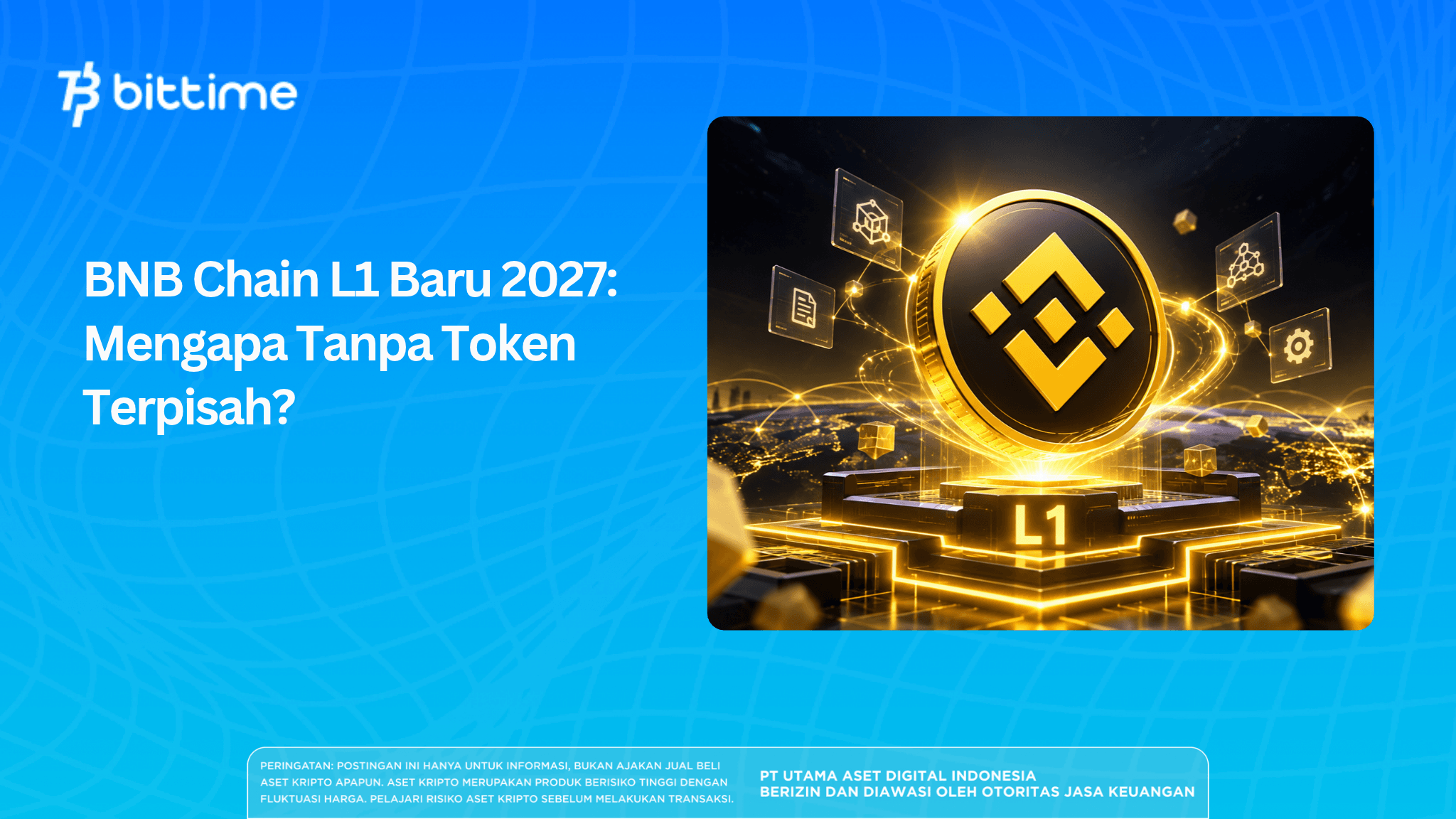
BNB Chain's new L1 is targeted for launch in early 2027, with one important decision: the network will continue to use BNB. Its development will proceed alongside BNB Smart Chain (BSC), so users will not need to learn about an additional native token to understand the network's basic functions.
So why build a new blockchain when BSC already exists? The goal is to serve applications that need faster responses, such as trading and payments, while maintaining the network currently used by the ecosystem.
Key Takeaways
- BNB Chain's new L1 will use BNB for transaction fees and staking without issuing a separate native coin.
- The new network targets applications that need fast responses, while BSC will continue to serve the existing ecosystem.
- The early 2027 mainnet target still depends on testing progress and network readiness.
What Is BNB Chain's New L1?
BNB Chain's new L1 is an additional blockchain project provisionally called New L1. The network is compatible with the Ethereum Virtual Machine (EVM), the environment used to run various smart contract applications.
This compatibility helps developers use tools and programming languages they already know. They still need to check whether their applications work correctly under different network rules.
Three terms should be distinguished from the outset:
- BNB Chain: the ecosystem encompassing several networks and services.
- BNB Smart Chain, or BSC: the network already used by various applications within that ecosystem.
- New L1: an additional blockchain being developed for specific transaction needs.
This news is therefore about expanding the ecosystem. The development of New L1 is more than simply renaming BSC.
Read also: Lisk Chain Shuts Down: How to Withdraw and Migrate LSK
Why Does BNB Chain Need an Additional Network?
Applications on a blockchain do not always have the same needs. Trading services need to respond quickly to changes, while other applications may prioritize access to existing users, assets, and services.
New L1 targets time-sensitive needs. Examples include high-frequency trading, real-time payments, and automated agent activity.
For example, a payment application needs to tell users whether a transaction is still processing or has been completed. Meanwhile, a trading application must handle order changes without making users wait too long.
The new network gives developers room to design processing that suits these needs. Its success will be evident in the experience of using applications, not just in the specifications announced.
When Will BNB Chain's New L1 Launch?
Reports on October 26, 2026, stated that a public testnet is targeted for late 2026, followed by mainnet in early 2027. This schedule remains a development target rather than a confirmed launch date.
The official documentation reviewed shows that the network is still operating as an internal devnet with several validators. Public testnet and mainnet access are not yet available in that documentation.
To understand the stages, note the following distinctions:
- Devnet is used by the development team to build and check network components.
- Testnet is used to test transactions and applications before they are used on the main network.
- Mainnet is the operational network where transactions use assets with real value.
For readers, an announcement of testnet access will be a useful development to watch. At that stage, testing information can help clarify which parts already work and which still need improvement.

Why Is There No Separate Token?
New L1's design continues to use BNB to pay transaction fees and for staking. CZ's response to the project also emphasized the idea of multiple networks using one coin.
In practical terms, BNB gains an additional use within the same ecosystem. Users do not have to learn about a new native asset simply to understand how network fees are paid.
However, using the same coin does not automatically make all network rules identical. Fee calculations, transaction processing, and application connections may still differ.
The documentation also mentions govBNB, a non-transferable record of voting rights obtained through staking. Its function relates to governance, so it should not be understood as a new coin that can be freely traded.
The decision not to introduce an additional native token is not an airdrop announcement either. Readers need to distinguish network development information from token offers that may use similar names.
Read also: XRP USDT Falls 3%: What Are the Gains and Losses in Rupiah?
How Does BNB Chain's New L1 Differ From BSC?
The differences between the two networks are easiest to understand through application needs and how transactions are processed. Comparing speed figures alone does not provide a complete picture.
BSC serves an established ecosystem
BSC remains the network for existing applications and services. Developers do not automatically need to move simply because an additional blockchain design is available.
The decision to use a new network should be guided by product needs. If an application already meets users' needs, switching networks should offer a clear benefit.
New L1 separates transaction ordering from execution
In New L1's design, determining the order of transactions is separated from performing their computations. This allows ordering to proceed without waiting for all execution to finish.
As a result, applications need to interpret transaction status correctly. A transaction that has already been assigned an order may not yet have all its results completed and finalized.
Gas settings require attention
The developer guide states that New L1 charges fees based on the declared gas limit. Gas is a unit used to measure computational work on a blockchain.
This means setting the gas limit too high can make a transaction more expensive than necessary. Wallet and application developers need to adjust their settings so users do not overpay.
This difference directly affects the user experience. Even a fast network still needs fee calculations that are easy to understand.
Read also: Solana Targets V1 Upgrade for September 9: What Should You Know?
Are Transactions Really Completed in 20 Milliseconds?
The figure of around 20 milliseconds refers to the preconfirmation target, not final transaction settlement. Meanwhile, the targeted block interval is around 200 milliseconds.
A preconfirmation is an early signal that a transaction will be processed. This signal can still be revoked before the block reaches finality.
For example, an application can use the early signal to update its interface so users know their request has been received. However, an application that will release assets or perform an irreversible action needs further certainty.
This distinction matters when reading blockchain performance claims. A fast response on screen does not always mean the transaction result is permanent.
What Does This Mean for BNB Holders?
The most direct impact is the planned use of BNB on an additional network. The extent of the benefit will depend on whether applications and users actually use that network.
For BNB holders, three factors are more useful to assess than launch excitement alone:
- Application utility: are there services that provide a clear reason to use New L1?
- Sustained activity: do users continue transacting after promotions or incentives end?
- User experience: do the costs, reliability, and ease of access meet users' needs?
These three factors help distinguish technological capacity from real demand. A blockchain can offer appealing features, but it still needs applications that people use regularly.
Expanding BNB's uses therefore does not guarantee a price increase. Prices are also affected by market conditions, liquidity, and market participants' decisions, not all of which relate to network development.
Read also: Arbitrum Sets a New Record: Arbitrum Price Prediction for the End of 2026
Do BSC Users Have to Move Their Assets?
Nothing in the information reviewed provides a basis for concluding that all BSC users must migrate. The documentation positions the existing and new networks to operate alongside each other.
The available migration guide is preparation material for application developers. Its existence is not an instruction for users to immediately send BNB to the new network.
The native bridge designed to connect BSC and New L1 is also still under development. Users need to wait for the official service and instructions before attempting to move assets.
Once the service is available, check the destination network, supported assets, and instructions from the relevant wallet or application. Assets sharing the same name does not mean funds can be sent using any network.
5 Things to Watch Ahead of the Launch
1. Public testing access
Watch for when the test network becomes accessible and who can participate. This information helps developers begin testing through the proper channels.
2. Test results under clearly defined conditions
Performance figures are more useful when accompanied by measurement methods. The number of participants, transaction types, and network conditions can affect the results.
3. Readiness of security components
Check audit results and unfinished security work. The current documentation specifically states that the privacy feature known as the shielded pool is not ready for use with real funds.
4. Application and wallet support
The network needs services that make it easy to use. Support from wallets, transaction explorers, and applications will determine whether users can interact with it comfortably.
5. Actual usage costs
Evaluate costs based on the activities you need. The experience of making a simple asset transfer may differ from using an application with more complex transactions.
If you want to start learning about digital asset services, you can sign up for Bittime and understand its features and risks before making transactions.
Conclusion
BNB Chain's new L1 offers an approach to serving applications that need fast responses while continuing to use BNB. Its development runs alongside BSC, allowing users to assess the benefits of an additional network without assuming existing services will be abandoned.
Ahead of the 2027 target, the most important factors to examine are test results, security, and available applications. This evidence of use will help establish whether New L1 delivers meaningful benefits for both developers and users.
Bittime is a Digital Financial Asset Trader (PAKD) platform licensed and supervised by Indonesia's Financial Services Authority — where you can buy Bitcoin in Indonesia and hundreds of other crypto assets starting from IDR 10,000. Registration is quick and secure, and you can get started today.
Track the conversion of USDT to IDR and the price movements of your favorite crypto assets in real time. Everything is available in one crypto investment app that you can download for free from the Play Store.
Ready to get started? Sign up for Bittime now and put your investment strategy into action with a platform trusted by millions of users in Indonesia.
FAQ
What is BNB Chain's new L1?
BNB Chain's new L1 is an additional blockchain being developed for applications that need fast transaction responses. The network is EVM-compatible and provisionally called New L1.
When will BNB Chain's new L1 launch?
Recent reports state that mainnet is targeted for early 2027, with a public testnet planned beforehand. This schedule may still change depending on development and testing results.
Does BNB Chain's new network have its own token?
Its design uses BNB as the native asset for transaction fees and staking. The govBNB mentioned in the documentation serves as a non-transferable record of voting rights.
How does BNB Chain's new L1 differ from BSC?
New L1 emphasizes fast responses and introduces changes to transaction processing and fee calculations. BSC continues to serve its established application ecosystem.
Do BNB holders have to migrate?
The information reviewed does not indicate a migration requirement for all BNB holders. Wait for official guidance from service providers if you want to use the new network once it becomes available.
Disclaimer: The views expressed belong exclusively to the author and do not reflect the views of this platform. This platform and its affiliates disclaim any responsibility for the accuracy or suitability of the information provided. It is for informational purposes only and not intended as financial or investment advice.

.png)