Tokenized Stock Volume Surges 288%: Why Does the QQQ Token Dominate?
2026-08-04
The figure of $9.27 billion. That is what actually matters most from the hype around the 288% surge in tokenized stock volume throughout July 2026, far more important than the growth percentage that became the headline everywhere. Nearly the entire surge turned out to come from just one token, QQQB, a tokenized tracker that follows the performance of Invesco’s QQQ ETF.
If you are curious about what is really happening behind this viral statistic, and why Robinhood is also placing a big bet on the same trend, here is the full breakdown based on the latest data.
Key Takeaways
- Tokenized stock volume surged 288% to $11.3 billion in July 2026, but about 82% or $9.27 billion of it came from just one token, Binance’s QQQB.
- QQQB excelled because it offers full 24-hour trading access to the QQQ ETF, which is originally only traded during U.S. market hours, plus a zero maker fee promotion from Binance.
- Robinhood Chain is pursuing a separate strategy by fully subsidizing gas fees for tokenized stock trading, a bet that will be tested once the subsidy ends at the end of September 2026.
The Facts Behind the 288% Surge
Before rushing to conclude that the tokenized stock market is exploding evenly across the board, there is one detail that must first be clarified.
CoinDesk reported through its Stablecoins & Tokenized Assets research that Binance’s bStocks platform contributed $9.41 billion or 83.3% of the total July volume, and QQQB alone contributed $9.27 billion, equivalent to 82% of all tokenized stock volume that month.
This means that if QQQB is excluded from the calculation, July’s tokenized stock volume was only $2.03 billion, actually 30% lower than in June. Other tokenized products lagged far behind: xStocks plunged to $335 million from $1.55 billion, while Ondo recorded $792 million and Backpack $479 million.
Read Also: How to Buy SpaceX Tokenized Stock (SPCXon): A Guide to Ondo’s SpaceX Stock Token
Interestingly, the original QQQ ETF itself fell 6.6% throughout July, deeper than the Nasdaq Composite’s decline of only 3.2%, so this volume surge more reflects active trading activity rather than a long-term accumulation trend.
For those of you interested in monitoring tokenized stock trends and crypto assets at the same time, the most practical step is to have an account on a safe and officially licensed exchange. You can register an account at Bittime, an OJK-licensed crypto platform, so you are better prepared to read opportunities from market developments like this.
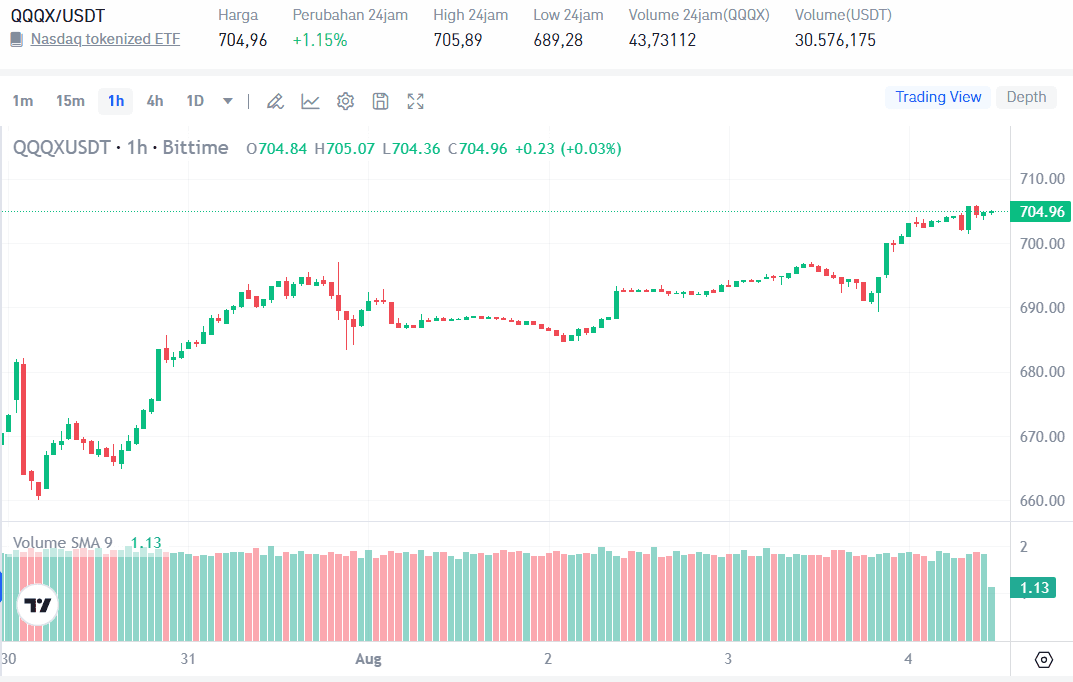
Price movement of Invesco QQQ tokenized stock today. Source: Bittime
Interested in trading Nasdaq tokenized ETF? As well as the QQQX/IDR pair, Bittime also offers QQQX/USDT to support your trading and investment strategies.
Why Is QQQB So Popular?
QQQB is not an ordinary product. This token represents the QQQ ETF on a 1:1 basis, fully backed by shares held at a U.S.-licensed broker-dealer, and holders are entitled to redeem the token for the original shares in accordance with the terms applicable on the Binance platform.
Its main advantage is simple: the original QQQ can only be traded from 9:30 a.m. to 4:00 p.m. New York time, while QQQB can be traded 24 hours a day, seven days a week.
For traders in Asia and Europe who want exposure to the Nasdaq-100 index without having to wait for U.S. market hours to open, this feature is not just a gimmick, but the main reason this product is selling so well.
QQQB’s momentum was also helped by promotional factors. The token began trading on Binance on June 30, 2026, with a zero maker fee promotion until August 31, and Binance temporarily applied a triple volume multiplier for some VIP users starting July 23, although this multiplier does not change the actual transaction value behind it.
Read Also: 7 Reasons You Should Start Investing in Tokenized Stocks
Robinhood Chain and the Big Bet Behind the Same Trend
This is where the nuance often missed in news headlines lies: QQQB is a Binance product, not a product traded on Robinhood Chain. But QQQB’s traction remains strong evidence that there is real demand for 24/7 access to U.S. stocks, and that is what underpins Robinhood’s big bet through its own chain.
Robinhood Chain, an Arbitrum-based blockchain launched by Robinhood in the second quarter of 2026, is specifically designed for the settlement of tokenized stock transactions. Robinhood is fully subsidizing gas fees on this network until at least the end of September 2026, so users can trade tokenized stocks with zero transaction fees.
This subsidy removes the barrier that previously killed similar experiments on the main Ethereum network, where a $5 gas fee for a stock transaction worth only $50 already made the economics make no sense.
Read Also: What Is Ondo Tokenized Stock? List of Assets Available on Bittime
The real test comes once this subsidy is removed. Free trading usually attracts volume, but not all of it necessarily reflects genuine interest, as some of it may just be arbitrage or short-term experiments that disappear as soon as fees start applying.
Another challenge also comes from a different direction: crypto exchanges offer an alternative in the form of stock perpetual futures contracts, which provide 24-hour price exposure without the need to own the underlying shares at all, thus becoming a direct competitor to ownership-based tokenization models such as QQQB or Robinhood Chain.
In addition, DTCC, as the primary U.S. stock clearing institution, is scheduled to launch full tokenized securities infrastructure in October 2026, which has the potential to both validate and threaten retail models like Robinhood’s because large institutions can directly use an already established settlement pathway.
Read Also: bStocks vs xStocks: Which Tokenized Stock Platform Is Superior?
Conclusion
The 288% surge is real, but the story is far narrower than the impression most people take away. One product, Binance’s QQQB, accounts for nearly all of that growth, while diversification into other tokenized stock products is still far from solid.
Robinhood Chain does have an interesting bet on the same trend, but that bet will only truly be tested once its free gas subsidy is removed at the end of September.
Monitor U.S. stock tokens: AMZON, AMDON, TSLAX, NFLXON MSFTON and many more, you can start trading on Bittime.
Bittime is a Digital Financial Asset Trader (PAKD) platform licensed and supervised by the Financial Services Authority — a place where you can buy Bitcoin in Indonesia and hundreds of other crypto assets starting from Rp10,000. Registration is fast, secure, and can be started today.
Monitor the conversion of USDT to IDR and the price movements of your favorite crypto assets in real time. Everything is available in one crypto investment app that can be downloaded for free on the Play Store.
Ready to start? Register now on Bittime and execute your investment strategy with a platform already trusted by millions of users in Indonesia.
FAQ
What is QQQB?
QQQB is Binance’s bStocks token that represents Invesco’s QQQ ETF on a 1:1 basis, backed by original shares held at a U.S.-licensed broker-dealer. This token can be traded 24 hours a day, unlike the original QQQ which is only traded during U.S. market hours.
Is it true that tokenized stock volume rose 288% evenly?
No. The increase was dominated by just one product, QQQB, which contributed about 82% of the total July 2026 volume, while other products such as xStocks actually experienced a decline in volume.
What is the relationship between QQQB and Robinhood Chain?
QQQB is a Binance product, not a product traded on Robinhood Chain. The two only share the same trend, namely high demand for 24/7 trading access to U.S. stocks.
What is Robinhood Chain?
Robinhood Chain is an Arbitrum-based blockchain built by Robinhood specifically for the settlement of tokenized stock transactions. Robinhood is fully subsidizing gas fees on this network at least until the end of September 2026.
When does the Robinhood Chain gas subsidy end?
The subsidy is scheduled to end around the end of September 2026. Trading volume after the subsidy is removed will be an indicator of whether demand for these tokenized stocks is truly genuine or merely dependent on free incentives.
What is the impact of the DTCC launch in October 2026?
DTCC will launch tokenized securities infrastructure for institutional clients, which could both strengthen and threaten retail models such as Robinhood Chain. Large institutions may choose the established DTCC settlement pathway rather than Robinhood’s separate infrastructure.
Disclaimer: The views expressed belong exclusively to the author and do not reflect the views of this platform. This platform and its affiliates disclaim any responsibility for the accuracy or suitability of the information provided. It is for informational purposes only and not intended as financial or investment advice.
.png)