DSNG Stock: Company Profile, Price Performance, and Fundamental Analysis
2026-08-03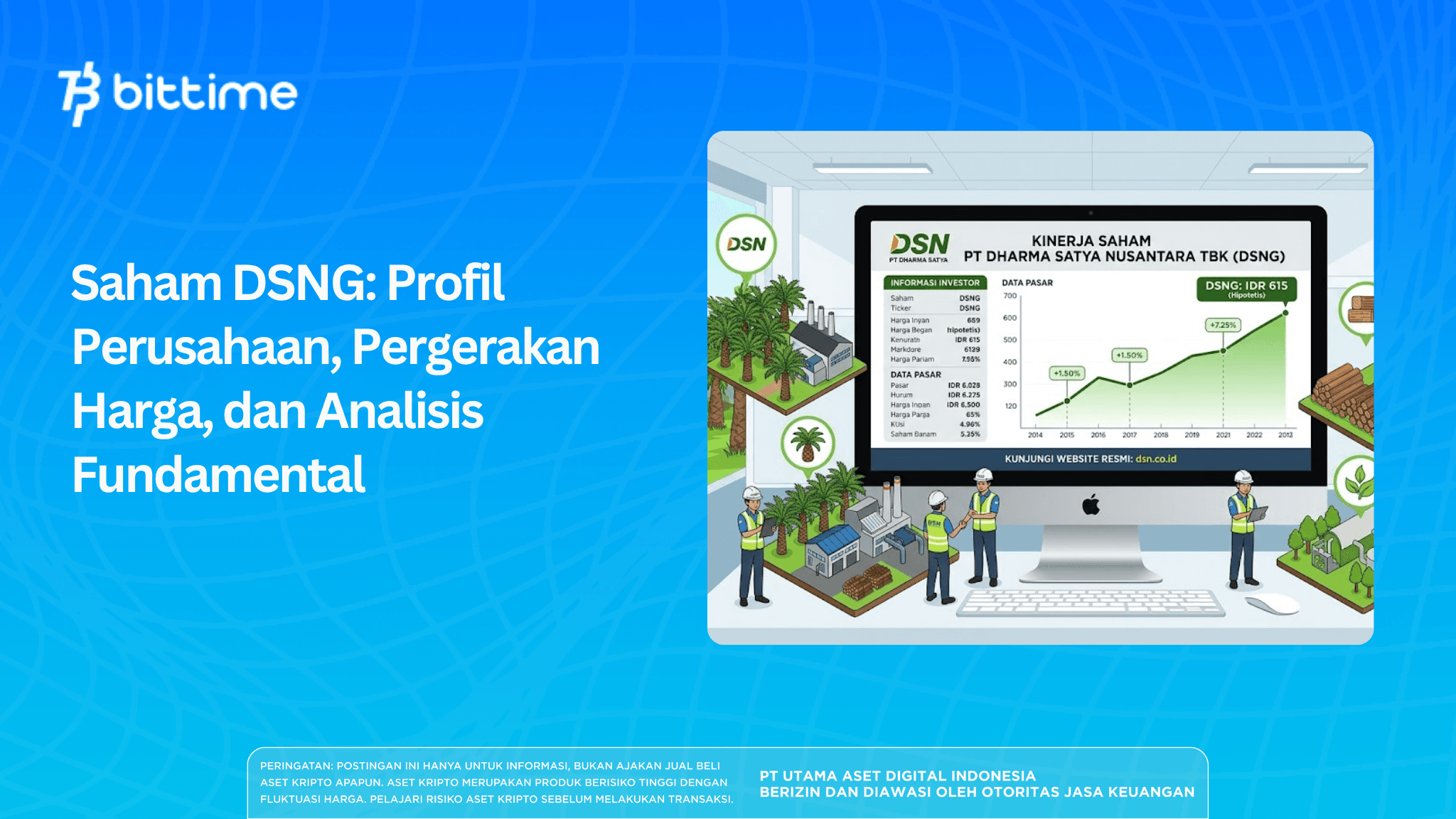
Forty-five years ago, the DSN Group was just a small timber logging company in Kalimantan, hoping its sawn timber would sell in the Japanese market. Today, the issuer with the stock code stock DSNG stands as one of the largest palm oil and wood product players on the Indonesia Stock Exchange, with a market capitalization reaching Rp10.1 trillion.
This long journey is what makes DSNG stock interesting to delve deeper into, from its origins to its current fundamental conditions.
Key Takeaways
- DSNG's revenue grew consistently from Rp1.75 trillion (2010) to Rp10.1 trillion (2024), with net profit also increasing significantly.
- The debt ratio (DER) is relatively healthy at 0.68x equity, but Return on Equity (ROE) of 11.75% is still below the ideal threshold of 15%.
- DSNG stock is currently trading at a PBV valuation of 1.04x, which fundamental analysts consider slightly overvalued.
From the Kalimantan Forest to the Stock Exchange: The Journey of PT Dharma Satya Nusantara
PT Dharma Satya Nusantara Tbk was established on September 29, 1980, starting its business in the wood industry after obtaining a Forest Concession Right (HPH) from the government. Three years later, its first wood processing plant in Samarinda began producing export-quality sawn timber for the Japanese market, according to official DSN Group records.
A significant turning point occurred in 1988 when the company became one of the pioneers in utilizing sengon wood from community plantations, replacing wood sourced from natural forests. The production base then shifted from Kalimantan to Java, starting from Surabaya, Gresik, to Temanggung, Lumajang, and Banyumas.
Also Read: 7 Reasons You Should Start Investing in Tokenized Stock
Major expansion occurred in 1996, when the DSN Group entered the palm oil business in Muara Wahau, East Kalimantan, through subsidiaries such as PT Swakarsa Sinarsentosa and PT Dharma Intisawit Nugraha.
Its first palm oil mill was inaugurated in 2002 with a capacity of 45 tons of fresh fruit bunches per hour, before expanding further into Central and West Kalimantan.
On June 14, 2013, the company officially listed on the Indonesia Stock Exchange with the stock code DSNG. Since then, its expansion has become more aggressive: acquiring two plantation companies at the end of 2018, bringing total planted area to 112,600 hectares with 10 palm oil mills with a capacity of 570 tons per hour.
If you are interested in monitoring DSNG stock movements or want to start investing in stocks and digital assets simultaneously in one platform, you can register a trading account on Bittime, which is already licensed by the OJK.
DSNG Stock Fundamentals: Valuation, Profitability, and Shareholder Structure
From a business perspective, DSNG now operates through three segments: crude palm oil (CPO), wood products (panels, doors, and engineered flooring), and compressed natural gas (CNG) processed from palm oil mill waste and biomass, according to data from CariSaham.com.
From a financial standpoint, the trend over the last five years shows stable growth. Revenue increased from Rp9.63 trillion (2022) to Rp10.1 trillion (2024), while net profit for 2024 was recorded at Rp1.14 trillion, up from Rp839.8 billion in the previous year. The company has even posted positive profits for five consecutive years, one of the stability indicators sought by investors.
Here is a summary of DSNG's key ratios:
Also Read: What is HSC Stock? Definition, Risks, and Latest HSC Stock List
From an ownership perspective, DSNG stock is majority controlled by PT Triputra Investindo Arya (28.26%), followed by PT Krishna Kapital Investama (14.63%) and PT Tri Nur Cakrawala (7.44%). The rest is distributed to individuals and the public.
The company also oversees 43 subsidiaries, most of which are engaged in oil palm plantations and their logistics support, with Andrianto Oetomo serving as President Director and Adi Resanata Somadi Halim as President Commissioner.
Regarding dividends, DSNG has been quite consistent in distributing them since 2014, with the highest payment being Rp50 per share in 2015 and Rp30 per share in 2023 — although it was nil in the 2010-2013 period when the company was still focused on capital expansion.
Also Read: How to Buy SpaceX Tokenized Stock (SPCXon): Guide to SpaceX Ondo Tokenized Stock
Conclusion
DSNG stock reflects the story of a company that grew patiently for over four decades, from a small wood business in Kalimantan to a mid-cap palm oil player on the stock exchange.
Its debt ratio is healthy and its revenue trend is rising, but the ROE which has not yet reached 15% and the slightly overvalued PBV signal that the company's capital efficiency still has room for improvement.
Disclaimer: This article is prepared for informational purposes only, not as a recommendation or solicitation to buy or sell specific stocks. Conduct your own research (DYOR) and consider your risk profile before investing.
Monitor US tokenized stocks: AMZON, AMDON, TSLAX, NFLXON MSFTON and many more, you can start trading on Bittime.

Bittime is a Digital Financial Asset Trader (PAKD) platform licensed and supervised by the Financial Services Authority — where you can buy Bitcoin in Indonesia and hundreds of other crypto assets starting from Rp10,000. The registration process is fast, secure, and can be started today.
Monitor USDT to IDR conversion and the price movements of your favorite crypto assets in real-time. All available in one crypto investment app that can be downloaded for free on the Play Store.
Ready to start? Register now on Bittime and execute your investment strategy with a platform trusted by millions of users in Indonesia.
FAQ
What is DSNG stock?
DSNG is the stock code for PT Dharma Satya Nusantara Tbk, a company operating in the palm oil, wood products, and biomass-based renewable energy industries.
When did DSNG officially list on the stock exchange?
The company conducted its initial public offering (IPO) on the Indonesia Stock Exchange on June 14, 2013.
What is DSNG's current debt ratio?
DSNG's Debt to Equity Ratio (DER) stands at 0.68x equity, which is considered healthy as it is still below 1x.
Does DSNG stock regularly distribute dividends?
Yes, DSNG has consistently paid dividends since 2014, with the highest value being Rp50 per share in 2015.
Is DSNG stock currently undervalued or overvalued?
With a PBV of 1.04x, this stock's valuation is considered slightly overvalued as it is already slightly above the company's book value.
Who are the majority shareholders of DSNG?
The largest shareholder is PT Triputra Investindo Arya with 28.26% ownership, followed by PT Krishna Kapital Investama with 14.63%.
Disclaimer: The views expressed belong exclusively to the author and do not reflect the views of this platform. This platform and its affiliates disclaim any responsibility for the accuracy or suitability of the information provided. It is for informational purposes only and not intended as financial or investment advice.

.png)