Polymarket Blocked in South Korea for Illegal Gambling—What Happened?
2026-08-19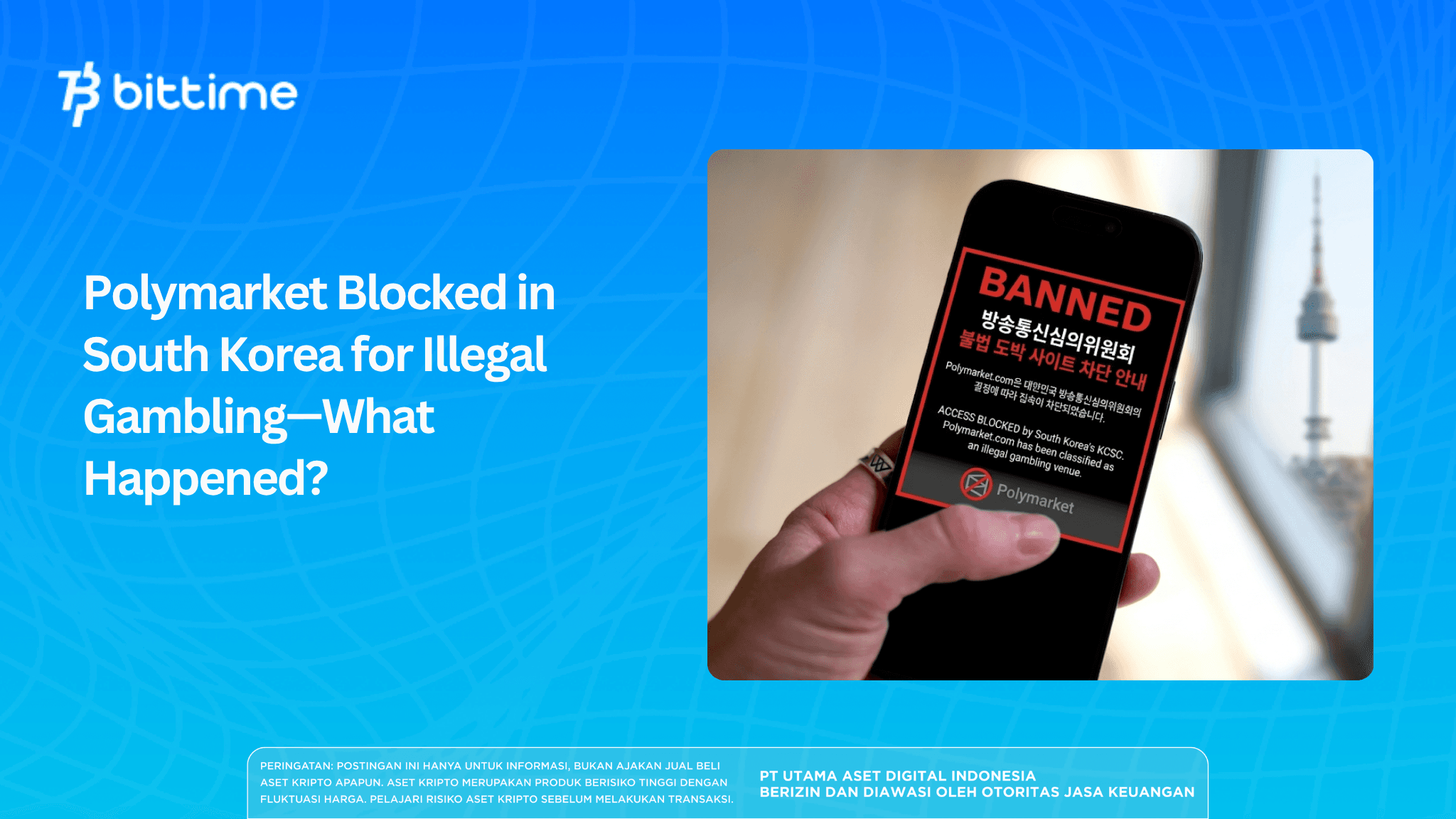
Polymarket has been blocked in South Korea after regulators concluded that the prediction market platform facilitated illegal gambling activities.
The decision adds South Korea to the list of countries restricting access to Polymarket due to legal issues surrounding prediction markets.
On August 18, 2026, the Korea Media and Communications Standards Commission (KCSC) approved the blocking of domestic access to Polymarket.
The regulator determined that the platform's mechanism could fall under the category of gambling under South Korea's Criminal Act and provisions of the National Sports Promotion Act.
The decision has drawn attention because Polymarket does not position itself as a conventional gambling website.
The platform is a prediction market that allows users to trade contracts based on the likelihood of an event occurring, ranging from elections, sports, and economic policies to weather.
For the crypto industry, the case shows that the use of blockchain technology and a peer-to-peer structure does not automatically place a platform outside national laws.
Key Takeaways
- Polymarket was blocked in South Korea after regulators determined that its prediction market facilitated gambling prohibited under local law.
- Polymarket argued that it does not use Korean won, has removed Korean-language services, and uses a non-custodial mechanism.
- The case shows that crypto prediction markets face different regulatory challenges in each country, especially when event-based contracts are considered to have betting characteristics.
Why Was Polymarket Blocked in South Korea?
South Korea's decision to block Polymarket stemmed from the regulator's assessment that activities on the platform could meet the criteria for gambling.
Polymarket allows users to buy “Yes” or “No” contracts whose value depends on the outcome of an event. If the outcome matches the user's position, the contract can provide a payout; otherwise, the user can lose the funds they wagered.
The KCSC determined that this winner-take-all structure makes users' gains or losses dependent on events they cannot control, such as politics, economics, sports, international relations, and weather.
The regulator also highlighted the existence of markets directly related to South Korea, including questions about rainfall in Seoul during August.
Therefore, the issue is not simply whether Polymarket calls its product a prediction market, but how the mechanism is treated under South Korean law.
Read Also: Polymarket vs Kalshi: Crypto Prediction Market Platform Comparison
What Is a Prediction Market and Why Is It Controversial?
A crypto prediction market is a platform where users trade contracts related to the likelihood of an event occurring.
For example, a contract may ask whether a central bank will raise interest rates before a certain date. If the “Yes” contract is priced at US$0.40, the market can simply be interpreted as indicating an approximately 40% probability, although that price is not a guarantee of an objective probability.
This model gives prediction markets two characteristics at once. On one hand, prices can be used as a signal of market expectations. On the other hand, users put up capital and gain or lose money based on the outcome of an event.
This difference in interpretation is why whether Polymarket is illegal or whether prediction markets are legal cannot be determined universally.
South Korea has taken a stricter approach. Meanwhile, some other jurisdictions use financial or derivatives frameworks to assess prediction markets.
Even in South Korea, previous discussions about prediction markets have shown differing views between their role as information markets and their betting characteristics.
Why Does Polymarket Reject Gambling Allegations?
During the review process, Polymarket presented several arguments explaining why, in its view, the platform should not fall under South Korea's gambling category.
Polymarket was said to have removed Korean-language services and does not accept payments in Korean won. The platform also uses peer-to-peer transactions and non-custodial smart contracts, meaning it does not directly hold users' funds like traditional gambling operators.
Another argument is that Polymarket does not issue sports betting tickets or directly act as a party receiving bets.
However, regulators did not accept these arguments.
The KCSC determined that the operator still plays a substantive role because it creates and manages markets, determines trading rules, provides deposit, withdrawal, and settlement infrastructure, and charges users fees.
In other words, the blockchain design was considered insufficient to separate the platform's responsibility from the activities taking place on it.
Read Also: Why Did President Prabowo's Name Appear on Polymarket?
South Korea Had Already Investigated Polymarket
The blocking in August was not a sudden move.
In July 2026, South Korean authorities began reviewing Polymarket to determine whether the service violated gambling regulations. During the same period, police also investigated several local users suspected of participating in gambling through the platform.
The review process gave Polymarket an opportunity to explain its business model before regulators made a decision.
Ultimately, the KCSC coordinated with the National Police Agency, National Gambling Control Commission, and Korea Sports Promotion Foundation before deciding to block domestic access.
Is Polymarket Really Blocked in South Korea?
Yes. The KCSC decision directed internet service providers in South Korea to block access to Polymarket.
However, blocking internet access is not the same as removing the platform's global presence. Polymarket continues to operate in other countries and regions that allow its services, while restrictions may vary by jurisdiction.
CoinDesk reported that more than 30 jurisdictions have restricted access to Polymarket, including France and Spain. Polymarket itself lists several countries that are restricted from the platform.
For blockchain-based companies, this situation demonstrates a major challenge of a global model: a single smart contract or platform may be technically accessible from various locations, but the legality of its use remains determined by local law.
Read Also: Polymarket Buzz, Everyone Is Talking About Prabowo Out as President, Netizens Go Wild!
What Does This Mean for the Crypto Prediction Market Industry?
The Polymarket blocking case could set a precedent for other prediction market platforms.
If regulators in various countries classify event-based contracts as a form of betting, other platforms could face similar scrutiny. This risk is particularly high when markets involve sports, politics, or events that are already subject to specific gambling regulations under local law.
On the other hand, prediction markets have their own economic rationale. Supporters view contract prices as an aggregation of information from many participants. Such markets can provide real-time indicators of expectations regarding political and economic events.
The issue is determining the boundary between an “information market” and “betting.” Through this latest decision, South Korea appears to place greater emphasis on incentive structures and financial outcomes that depend on events.
What Is the Regulatory Outlook for Polymarket?
Polymarket regulation is likely to remain an important topic as prediction market platforms continue to grow and attract larger amounts of capital.
South Korea is not the only country questioning the classification of such services. Differences between regulatory approaches also show that there is still no uniform global standard for prediction markets.
For Polymarket, expansion into new markets will likely require geographic adjustments, user restrictions, local compliance, and an evaluation of the types of contracts offered.
For crypto investors or users, legal status must be checked based on the country where they are located. The fact that a platform is blockchain-based or does not directly hold users' funds does not automatically mean its use is permitted.
Read Also: Tesla and SpaceX Merger Odds Rise on Polymarket, Will It Happen?
Could South Korea's Ban Affect Polymarket?
The direct impact on Polymarket's global operations is likely to be limited because South Korea is only one of many jurisdictions imposing restrictions. However, the reputational and regulatory impact could be more significant.
The more countries treat prediction markets as gambling, the greater the compliance costs for Polymarket and similar platforms. They will need to develop geo-blocking systems, user policies, and more complex control mechanisms.
Conversely, if some jurisdictions develop legal frameworks that recognize prediction markets as financial products or information markets, the industry could develop under different regulatory models.
Conclusion
Polymarket was blocked in South Korea not simply because it uses cryptocurrency, but because regulators determined that its prediction market mechanism has characteristics of gambling activities under South Korean law.
Polymarket has argued that the service is non-custodial and does not directly operate as a betting operator.
However, regulators determined that the platform's role in creating markets, setting rules, providing settlement, and facilitating trading still makes it responsible for those activities.
The case is an important development in the latest Polymarket news and provides a picture of the regulatory challenges facing crypto prediction markets.
Going forward, the biggest question is not only whether prediction markets can provide useful information, but how each country defines the boundary between contract trading and gambling.
Start trading crypto with major assets such as BTC/IDR and ETH/IDR directly on the Bittime app.
Bittime is a licensed Digital Financial Asset Trader (PAKD) platform regulated and supervised by the Financial Services Authority (OJK) — where you can buy Bitcoin in Indonesia and hundreds of other crypto assets starting from Rp10,000. Registration is fast, secure, and you can get started today.
Monitor the USDT to IDR conversion and your favorite crypto asset price movements in real time. Everything is available in one crypto investment app that can be downloaded for free from the Play Store.
Ready to get started? Register on Bittime now and execute your investment strategy with a platform trusted by millions of users in Indonesia.
FAQ
Why was Polymarket blocked in South Korea?
Polymarket was blocked because the KCSC determined that the platform facilitated gambling that conflicts with the Criminal Act and relevant provisions of South Korea's National Sports Promotion Act.
Is Polymarket considered illegal worldwide?
No. Polymarket's legality and accessibility vary by jurisdiction. More than 30 regions have restricted access to it, but the platform remains available in several other markets.
What is a crypto prediction market?
A crypto prediction market is a platform that allows users to trade contracts based on the likelihood of an event occurring, such as an election, sports event, economic policy decision, or weather condition.
Is Polymarket considered gambling?
Its classification depends on the laws of each country. South Korea now considers Polymarket's operations to be an activity that facilitates gambling under its domestic regulations.
Why does Polymarket say its service is not gambling?
Polymarket stated that it had removed Korean-language services, does not accept Korean won, and uses non-custodial smart contract-based transactions. South Korean regulators determined that these technical characteristics do not eliminate the platform's role in managing markets and providing trading infrastructure.
Does South Korea's ban affect Polymarket users in Indonesia?
South Korea's ban does not automatically apply in Indonesia. However, Polymarket's legal status and accessibility in Indonesia must be assessed based on the applicable regulations and policies of Indonesian authorities.
Disclaimer: The views expressed belong exclusively to the author and do not reflect the views of this platform. This platform and its affiliates disclaim any responsibility for the accuracy or suitability of the information provided. It is for informational purposes only and not intended as financial or investment advice.

.png)