Understanding the UNI Burn Mechanism: The Impact of Uniswap v4 and Robinhood Chain
2026-07-20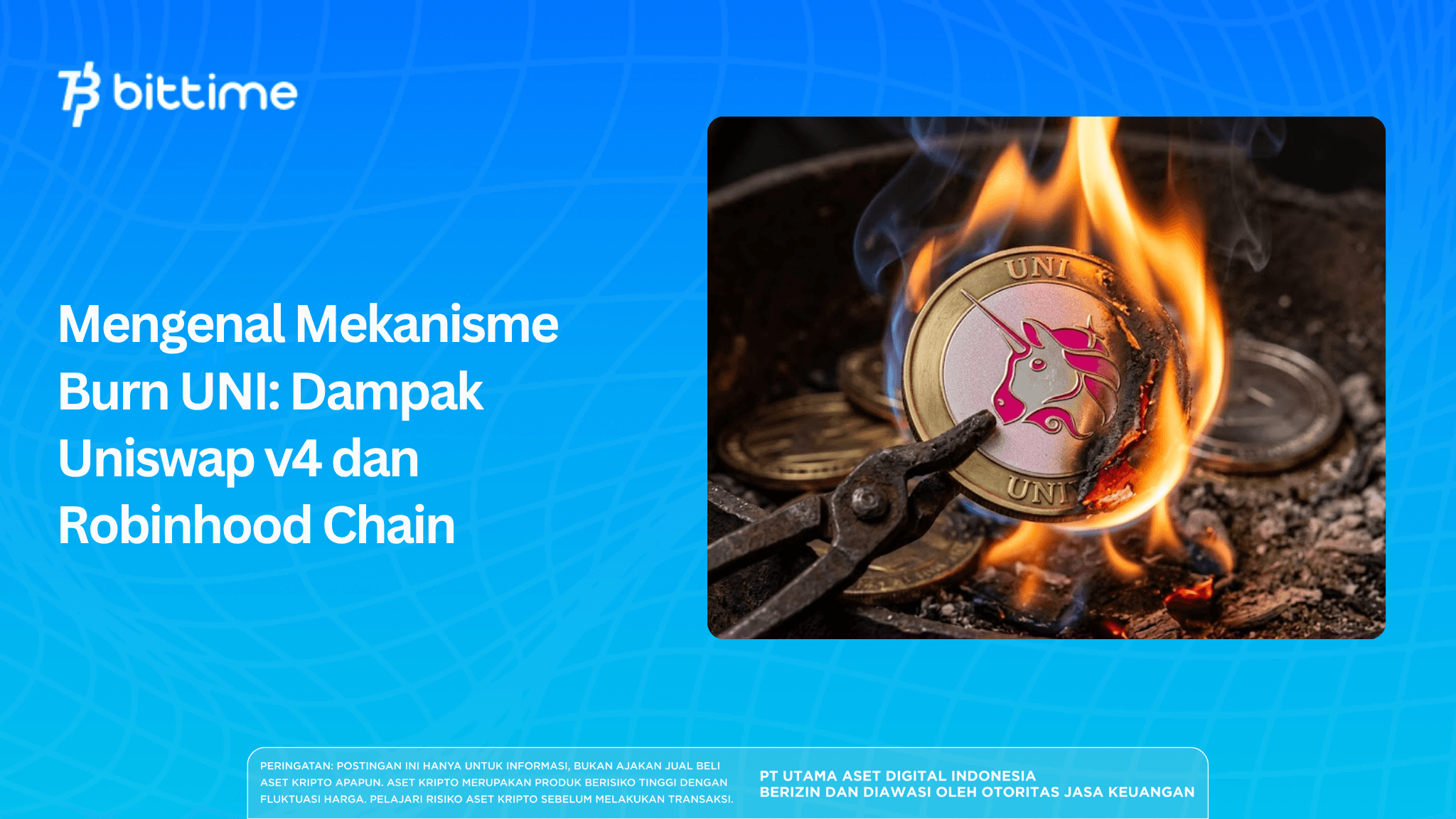
The discussion regarding UNI token burn UNI has become lively again after the Uniswap community submitted a new proposal related to Uniswap protocol fees.
This update is attracting attention because it connects trading activity across various blockchains, including Robinhood Chain, with the UNI token burn mechanism.
If implemented, every increase in protocol usage has the potential to directly contribute to reducing the UNI token supply.
Key Takeaways
- The latest proposal directs Uniswap protocol fees as a source for UNI token burn.
- Uniswap v4 and Robinhood Chain are important parts of the implementation of the latest burn mechanism.
- Token burning can reduce UNI supply, but it does not guarantee that the price will automatically rise.
What is the UNI Burn Mechanism?
UNI burn is the process of permanently removing UNI tokens from the circulating supply. Burned tokens are sent to a burn address, which is a blockchain address that cannot be accessed by anyone, so the tokens cannot be used again.
In the crypto ecosystem, the burn mechanism is generally used to create asset scarcity by reducing supply. However, its effect on price is still determined by the balance between demand and supply in the market.
In the latest Uniswap proposal, token burning does not come from new token minting, but from protocol revenue obtained through protocol fees.
Read Also: Uniswap (UNI) Price Prediction 2030: $100 from Standard Chartered
Why Did the Uniswap Community Propose a New Burn Mechanism?
For years, the growth in Uniswap trading volume has not always provided direct economic benefits to the UNI token. Even though transaction values continue to increase, the relationship between protocol activity and the governance token remains relatively limited.
Through the tokenomics update known as UNIfication, the Uniswap community is trying to create a closer connection between protocol usage and the economic value of the UNI token.
One of its implementations is to use protocol fee revenue to buy and burn UNI tokens on a regular basis.
With this model, the higher the trading activity on Uniswap, the greater the potential for UNI tokens to be removed from circulation.
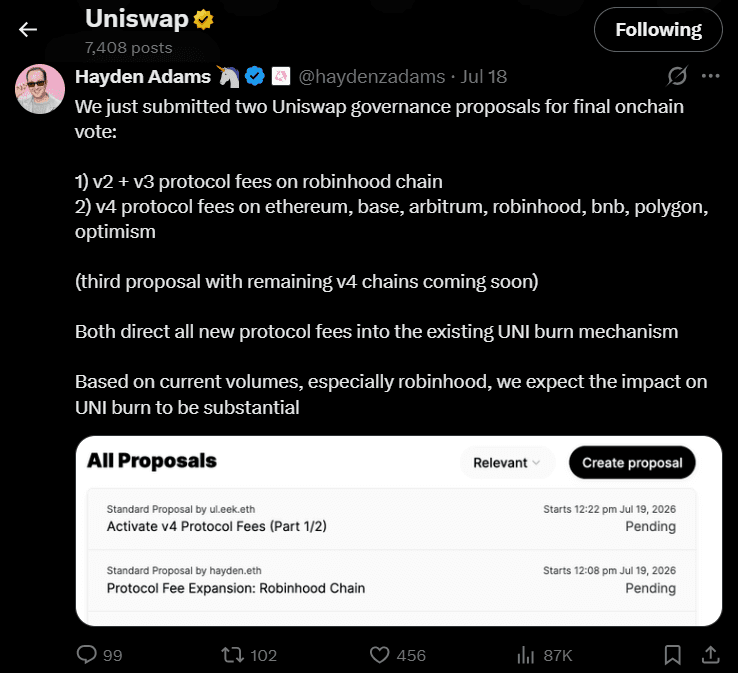
Source: x.com/Uniswap
Read Also: How to Buy Uniswap (UNI)
What are Uniswap Protocol Fees?
Before understanding the latest proposal, it is important to distinguish between swap fees and protocol fees.
Every time a user performs an asset exchange (swap) on Uniswap, they pay a transaction fee or swap fee. So far, most of this fee has become income for liquidity providers (liquidity provider/LP) as a reward for providing assets in the pool.
Meanwhile, protocol fee is a small portion of the swap fee that is allocated as official Uniswap protocol revenue.
Activating protocol fees does not mean traders pay additional fees. Transaction fees remain the same; only the revenue distribution changes as a small portion is directed to the protocol treasury.
This is the point that forms the basis of the latest governance proposal.
Read Also: 10+ Best AI Coins 2026: Here’s the List of Artificial Intelligence Crypto!
The Relationship Between Uniswap v4 and UNI Burn
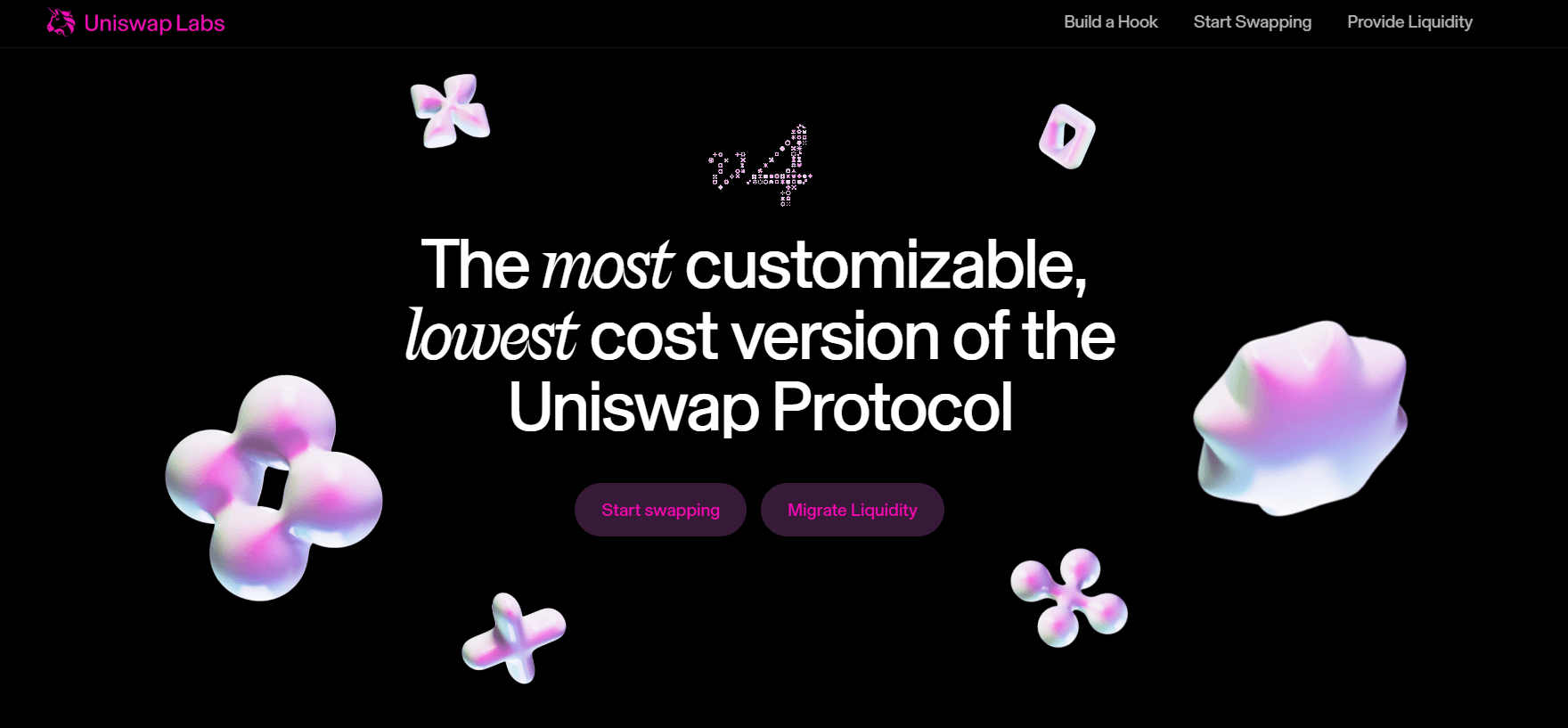
The launch of Uniswap v4 is an important factor that enables the burn mechanism to develop more broadly.
Unlike previous versions, Uniswap v4 introduces major changes to the protocol architecture through features such as Singleton Contract, Flash Accounting, and Hooks.
The Singleton Contract combines all liquidity pools into a single smart contract so deployment costs become more efficient. Flash Accounting helps reduce gas consumption on transactions involving multiple pools, while Hooks allow developers to add custom logic to pools without changing the core protocol.
This flexibility opens opportunities for governance to manage various types of pools and activate protocol fees on specific implementations more efficiently than previous generations.
Read Also: How to Buy SpaceX Tokenized Stock (SPCXon): SpaceX Ondo Token Stock Guide
Why is Robinhood Chain Also in the Spotlight?
Robinhood Chain has become one of the first blockchain networks to simultaneously implement Uniswap v2, v3, and v4.
In a relatively short time, trading activity on the network has grown rapidly, recording transaction volume of more than US$1 billion. This high activity has prompted the Uniswap community to propose activating protocol fees on Robinhood Chain.
If the proposal is approved, a portion of the protocol revenue from trading activity on Robinhood Chain will also contribute to the UNI burn mechanism.
This shows that Uniswap's expansion to various blockchains is not only aimed at expanding adoption but also strengthening the UNI token economic model.
Read Also: 10 Largest RWA Crypto Asset Tokenizations in the World
How Does the UNI Burn Mechanism Work?
In simple terms, the flow of the proposed burn mechanism can be explained as follows.
First, protocol fees are collected from blockchain networks that have activated the feature, including Robinhood Chain and several other networks using Uniswap v4.
Next, this revenue is placed in an asset management system known as TokenJar. Searchers can then obtain these assets by paying with UNI tokens.
The received UNI tokens are then sent back to Ethereum Mainnet before finally being transferred to the burn address. Once this process is complete, these UNI tokens are permanently removed from the circulating supply.
With this mechanism, every increase in trading volume has the potential to increase the amount of UNI tokens burned.
Register at Bittime with a fast, secure, and easy process so you can trade UNI coins!
Blockchains Included in the Uniswap Fee Proposal
The latest governance proposal does not only discuss Robinhood Chain.
The Uniswap community also proposes activating protocol fees for Uniswap v4 implementations on several blockchain networks, including Ethereum, Base, Arbitrum, Optimism, Polygon, and BNB Chain.
This step aims to expand the protocol's revenue sources while increasing the potential for UNI burn if trading activity continues to grow.
The more networks that activate protocol fees, the greater the opportunity for the burn mechanism to obtain a consistent revenue stream.
The Impact of Burning on UNI Price
The most frequently discussed topic among investors is whether token burning automatically makes the UNI price rise.
The answer is not that simple.
In theory, reducing supply can create asset scarcity and potentially exert positive pressure on price if demand remains the same or increases. However, token prices are still influenced by various other factors, such as overall crypto market conditions, investor sentiment, Uniswap adoption levels, and trading activity across various blockchains.
In other words, the burn mechanism can strengthen UNI token fundamentals, but it is not a guarantee that its price will immediately increase after the proposal is implemented.
What Does This Proposal Mean for the Uniswap Ecosystem?
The latest protocol fee proposal shows that Uniswap is starting to build a more sustainable economic model. If previously trading volume growth did not have a direct relationship with the UNI token, now protocol activity has the potential to become the main source of the burn mechanism.
This approach also demonstrates Uniswap's evolution from just a decentralized exchange (DEX) service provider to a DeFi ecosystem with a more mature tokenomics structure. With the support of technology in Uniswap v4 and expansion to various blockchains such as Robinhood Chain, the relationship between protocol usage and the economic value of the UNI token becomes clearer.
Conclusion
The UNI burn mechanism proposal is one of the largest tokenomics updates in Uniswap's development. By utilizing Uniswap protocol fees, revenue from trading activity can be used to buy and permanently burn UNI tokens.
The implementation of Uniswap v4 with a more flexible architecture, combined with expansion to networks like Robinhood Chain, opens opportunities for this mechanism to run on more blockchains.
However, investors need to understand that the impact of burning on UNI price still depends on trading volume growth, protocol adoption levels, and overall crypto market conditions.
Check the price of Bitcoin (BTC), Ethereum (ETH), XRP, Solana (SOL), Polygon (POL), and BNB as well as leading memecoins like DOGE. You can trade directly on Bittime!
Bittime is a licensed and regulated Digital Financial Asset Trader (PAKD) platform by the Financial Services Authority — the place where you can buy Bitcoin in Indonesia and hundreds of other crypto assets starting from Rp10,000. The registration process is fast, secure, and you can start today.
Monitor the conversion USDT to IDR and the price movements of your favorite crypto assets in real-time. All available in one crypto investment app that can be downloaded for free on the Play Store.
Ready to start? Register now on Bittime and execute your investment strategy on a platform trusted by millions of users in Indonesia.
FAQ About UNI Burn and Uniswap v4
What is UNI token burn?
UNI token burn is the process of removing UNI tokens from the circulating supply by sending them to a burn address so that the tokens cannot be used again.
Does the Uniswap fee proposal make user transaction fees increase?
No. The proposal only changes the distribution of existing swap fees. Traders still pay the same transaction fees, but a small portion of the fee is allocated as protocol revenue.
What is the relationship between Uniswap v4 and the UNI burn mechanism?
Uniswap v4 introduces a new architecture that makes protocol fee management more flexible. Revenue from these protocol fees can be used as a source for the UNI token burn mechanism.
Why is Robinhood Chain mentioned in the proposal?
Robinhood Chain is one of the networks with Uniswap v4 implementation and high trading activity. Therefore, this network is proposed to also activate protocol fees that will contribute to the UNI burn mechanism.
Does UNI token burn guarantee that the price will rise?
No. Burning can reduce token supply and potentially support asset value in the long term. However, UNI price is still influenced by market demand, trading volume, investor sentiment, and overall crypto market conditions.
Disclaimer: The views expressed belong exclusively to the author and do not reflect the views of this platform. This platform and its affiliates disclaim any responsibility for the accuracy or suitability of the information provided. It is for informational purposes only and not intended as financial or investment advice.
.png)