Microsoft Reveals Azure Revenue of $29.4 Billion, MSFT Stock Rises
2026-09-04
For the past nine years, investors could only guess how much money was actually flowing from Microsoft's cloud business. The numbers released each quarter were only percentage growth figures, without a definite nominal amount.
On Wednesday, 2 September 2026, that practice finally ended. Microsoft officially disclosed Azure revenue in dollar terms for the first time: $29.4 billion in a single quarter, and the market immediately responded positively as MSFT stock moved higher.
This disclosure is not merely an administrative formality. At the same time, Microsoft completely overhauled how it segments its business lines, from three segments to two, while narrowing the definition of what counts as "Azure." This change is important for investors and tech industry observers to understand, because its impact will be felt in every Microsoft financial report going forward.
Also Read: Nvidia's $500 Billion AI Funding – Will AI Crypto Tokens Also Benefit?
Azure Opens Up: From Mere Percentages to Actual Figures
Until now, the public only got a rough picture of Azure's size through year‑on‑year growth percentages. That practice forced market analysts to build their own estimates of the performance of one of the world's largest cloud computing platforms, rather than relying on official data.
In the quarter ended June 2026, Azure recorded revenue of $29.4 billion, up 42% from the same period the previous year. For the full fiscal year, total Azure sales surpassed $100 billion, jumping from $75 billion in the prior fiscal year.
With this achievement, Azure's contribution to Microsoft's total revenue now approaches one‑third of the company's overall business.
This kind of cloud business momentum is also felt in other sectors, including digital assets based on AI and blockchain technology that are increasingly attracting global investors.
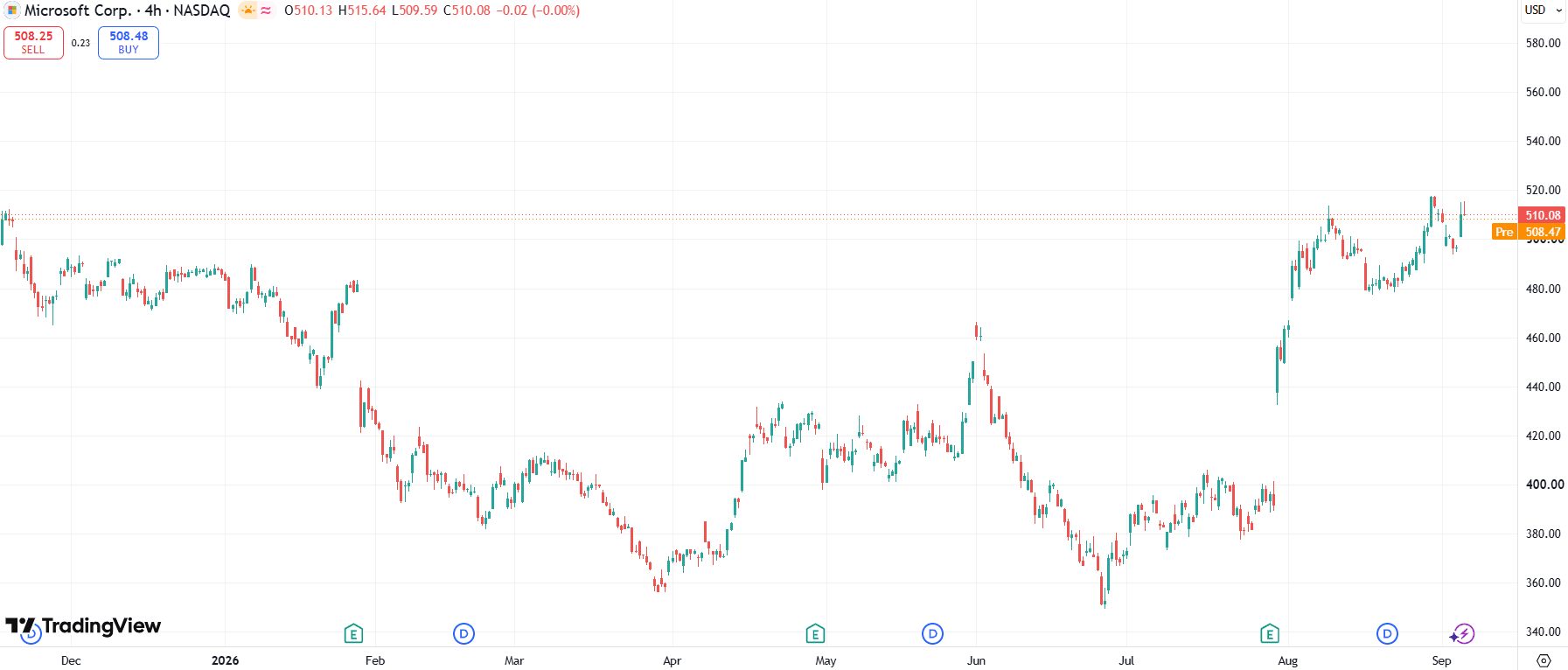
MSFT stock price movement today, 4 September 2026. Source: TradingView
If you want to follow or start investing in crypto assets safely and legally, you can register through Bittime, a crypto asset exchange platform that has obtained official OJK license.
Microsoft Cuts Three Segments into Two, Here Are the Details
The three‑segment reporting structure Microsoft has used since 2015 is now officially retired. Productivity and Business Processes, Intelligent Cloud, and More Personal Computing are merged into two new divisions: Agents and Infra, and Devices and Consumer.
Agents and Infra will encompass Azure, Microsoft 365 cloud services, productivity software, server licenses, and next‑generation AI services. Meanwhile, Devices and Consumer will house the Xbox business, search and digital advertising, Windows licensing, and hardware sales.
There is one detail that is easy to miss but quite crucial: the definition of Azure itself has also narrowed. GitHub cloud, Security Copilot, and cloud health services are now removed from Azure's calculation and moved to Microsoft 365 cloud and Industry solutions cloud metrics.
This means that part of the 42% growth figure was also influenced by the removal of slower‑growing business components, not purely organic acceleration.
This new reporting structure will take effect starting with the first fiscal quarter report in October 2026, and Microsoft has promised to provide restated data for the past two years so investors can compare performance on an apples‑to‑apples basis.
Interestingly, this change comes shortly after TheNextWeb reported that the European Commission had taken an initial position ahead of a final decision later this year on Azure's status as a "gatekeeper" under the Digital Markets Act — a regulatory context that makes the new definition of Azure as a "pure consumption‑based" business feel less coincidental.

Also Read: BIS Unveils New Potential for XRP Ledger in Digital Financial Systems
Azure vs AWS vs Google Cloud, and Why OpenAI Is Key
With revenue of $29.4 billion, Azure still trails Amazon Web Services (AWS), which in the comparable period posted $42.2 billion in revenue, growing 37% YoY. On the other hand, Azure still leads Google Cloud, which booked $24.8 billion, although Google Cloud's growth rate is much faster at 82% YoY, even exceeding market expectations of just $22.5 billion.
One factor most frequently cited by analysts behind Azure's surge is the partnership with OpenAI. According to Stifel estimates, about half of Azure's revenue growth throughout fiscal 2026 came from OpenAI's computing needs.
Anthropic is also said to be increasingly relying on Microsoft's cloud infrastructure for its operations. On the consumer product side, the number of paid Microsoft 365 Copilot licenses also jumped, from more than 20 million in April to more than 30 million in July.
For the first quarter of fiscal 2027, Microsoft management projects Azure growth in the range of 44‑45% on a constant‑currency basis, with Agents and Infra revenue estimated between $75.15 billion and $75.75 billion, while Devices and Consumer is projected at $14.7 billion to $15.2 billion — in line with data compiled by Newsquawk from Microsoft's investor presentation.
This optimism is also reflected in analysts' stance: according to TipRanks data, MSFT stock holds a Strong Buy consensus rating from 32 Buy recommendations and only one Hold in the past three months, with an average price target of $568.31, implying a potential upside of about 14% from the current price.
Also Read: The 10 Largest RWA Crypto Asset Tokenizations in the World
Conclusion
Microsoft's decision to disclose Azure revenue in dollar terms marks a new chapter of transparency in the cloud computing industry, even as the definition of Azure itself is simultaneously narrowed by moving GitHub, Security Copilot, and health services to other metrics.
With revenue of $29.4 billion and 42% growth in the latest quarter, Azure remains in second place behind AWS, but is supported by strong growth projections for the coming quarter and a Strong Buy rating from the majority of analysts.
Monitor US stock tokens: AMZON, AMDON, TSLAX, NFLXON MSFTON and many more – you can start trading at Bittime.

Bittime is a Digital Asset Trading Platform (PAKD) licensed and supervised by the Financial Services Authority — where you can buy Bitcoin in Indonesia and hundreds of other crypto assets starting from Rp10,000. The registration process is fast, secure, and can be started today.
Monitor USDT to IDR conversion and real‑time price movements of your favorite crypto assets. All available in one crypto investment app that you can download for free from the Play Store.
Ready to start? Sign up now at Bittime and execute your investment strategy on a platform trusted by millions of users in Indonesia.
FAQ
What was Azure's revenue in the June 2026 quarter?
Azure recorded revenue of $29.4 billion in the quarter ended June 2026, up 42% from the same period the previous year.
Why did Microsoft only now report Azure in dollar terms?
Previously, Microsoft only released percentage growth figures without a definite nominal amount. This change is part of a broader segment reporting restructuring, while also responding to investor demands for transparency.
What is the Agents and Infra segment?
Agents and Infra is Microsoft's new segment that encompasses Azure, Microsoft 365 cloud services, productivity software, server licenses, and next‑generation AI services. This segment replaces the combination of the three old segments used since 2015.
Is Azure still significantly smaller than AWS?
Yes, in nominal terms Azure ($29.4 billion) still trails AWS ($42.2 billion) in the comparable period. However, Azure leads Google Cloud, which recorded $24.8 billion in the same quarter.
What is the outlook for MSFT stock going forward?
Analysts maintain a Strong Buy consensus rating on MSFT stock with an average price target of $568.31, implying a potential upside of about 14%. Azure growth projections for the next quarter are also in the range of 44‑45% on a constant‑currency basis.
Disclaimer: The views expressed belong exclusively to the author and do not reflect the views of this platform. This platform and its affiliates disclaim any responsibility for the accuracy or suitability of the information provided. It is for informational purposes only and not intended as financial or investment advice.

.png)