JCI Rises After Peaceful Protest—Are Investors Regaining Optimism?
2026-08-28
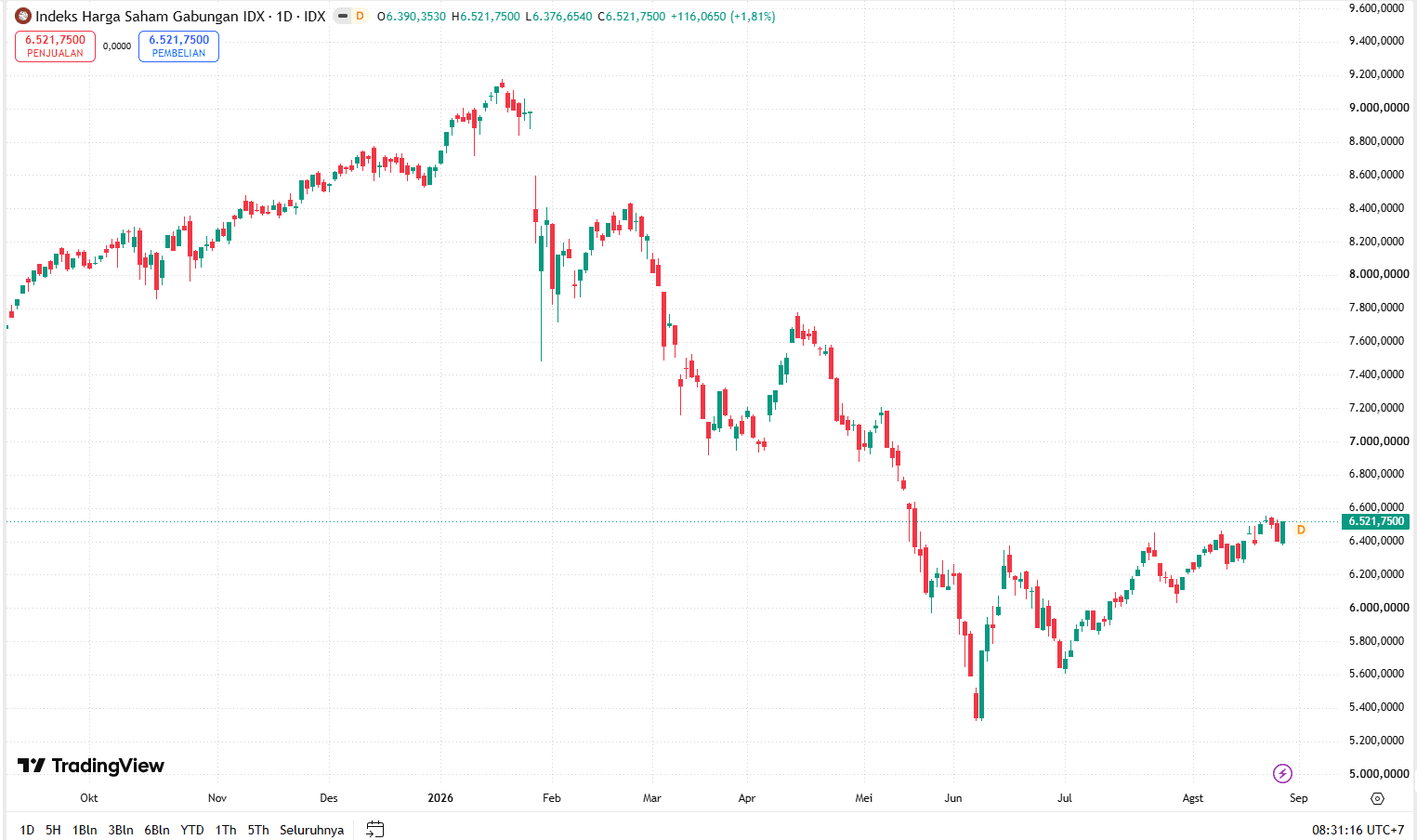
JCI rose strongly after trading on Thursday, August 27, 2026, closed at 6,521.75. The index gained 1.81%, or around 116 points, after the market had previously been overshadowed by concerns over demonstrations in Jakarta.
This move raises a question: have investors truly become optimistic again, or is the JCI rally merely a short-term response?
Key Takeaways
- The JCI rose 1.81% to 6,521.75.
- Gains were fairly broad across various sectors.
- The rupiah and global sentiment still need to be monitored.
JCI Strengthens After Jakarta Protest
The JCI’s movement on August 27 showed a rapid shift in sentiment. The index initially came under pressure due to concerns about domestic security conditions, but later reversed higher as domestic risks were seen as beginning to ease.
One development watched by the market was the target to complete the passage of the Asset Forfeiture Bill by December 15, 2026 at the latest. Investors responded positively after previously remaining cautious amid domestic uncertainty.
Read also: Stock Market Today: JCI May Strengthen, Here Are the Top Stock Picks
Why Did the JCI Rise After the Protest?
The JCI’s rise was not limited to the headline index. Gains were fairly broad, while the industrial sector recorded the strongest increase at around 3.95%. This suggests that buying interest was not concentrated in only a small number of stocks.
The stock market is highly sensitive to changes in perceived risk. When the potential for social and political disruption is seen as declining, investors are generally more willing to take positions in risk assets again.
However, protests are not the only factor determining the JCI’s movement. The rupiah exchange rate, foreign fund flows, global interest-rate policy, listed-company performance, commodity prices, and conditions in international markets also remain influential.
Read also: IDX Stock Notation Update: What Has Changed
JCI Today: Have Investors Become Optimistic Again?
The 1.81% gain signals that investor risk appetite has improved in the short term. Technically, the JCI has moved back above its five-day moving average, while the MACD histogram remains in positive territory. However, the Stochastic RSI still indicates that caution is warranted.
That optimism does not mean the uptrend will continue without a correction. The next trading session could still see the JCI move sideways in the 6,450–6,580 range. The index’s ability to hold the 6,500 area will be an important point to watch.
Meanwhile, the rupiah weakened by around 0.11% to Rp17,744 per US dollar in the same trading session. The divergence between the JCI and the rupiah shows that domestic market conditions are not yet completely free from pressure.
Read also: Why Does the JCI Rise and Fall? Here Are the Key Drivers
Global Sentiment Could Still Change the JCI’s Direction
After concerns surrounding the JCI and the Jakarta protests eased, investors turned their attention back to external factors. US inflation, Federal Reserve interest-rate policy, geopolitics, and oil prices could still shift sentiment in Indonesia’s stock market.
US inflation developments are important because they influence expectations for monetary policy. Higher interest rates for longer could put pressure on risk assets in emerging markets through shifts in capital flows.
Market participants are also watching the rebalancing of the MSCI, which takes effect on September 1, 2026. Changes to global indexes can prompt fund adjustments in certain stocks and increase short-term volatility.
What Should Investors Watch?
Investors should not make decisions solely because the JCI rose after the protest. Watch the rupiah, foreign fund flows, the JCI’s technical levels, and shifts in global sentiment before deciding on the next strategy.
To broaden your market monitoring, you can also sign up on Bittime and follow the latest news updates on digital assets and global market sentiment. By monitoring several asset classes, you can gain a broader view of changes in market participants’ risk appetite.
Conclusion
The JCI gained 1.81% to 6,521.75 as market concerns over domestic risks began to ease. Gains across multiple sectors show a positive investor response, but they are not yet sufficient evidence that all risks have passed.
The rupiah, Federal Reserve policy, US inflation, geopolitics, and capital flows still need to be monitored. Therefore, keep up with the latest developments while using an investment strategy that remains aligned with your risk profile.

Bittime is a licensed Digital Financial Asset Trader (PAKD) platform regulated and supervised by Indonesia’s Financial Services Authority (OJK) — where you can buy Bitcoin in Indonesia and hundreds of other crypto assets starting from Rp10,000. Registration is quick and secure, and you can get started today.
Track the conversion of USDT to IDR and the price movements of your favorite crypto assets in real time. Everything is available in one crypto investment app that can be downloaded for free from the Play Store.
Ready to get started? Sign up on Bittime now and execute your investment strategy on a platform trusted by millions of users in Indonesia.
FAQ
Why did the JCI rise after the protest?
The JCI rose as domestic sentiment improved and some concerns over security risks eased. Developments related to the target for passing the Asset Forfeiture Bill also provided positive sentiment.
How much did the JCI rise on August 27, 2026?
The JCI closed 1.81% higher at 6,521.75. The increase was equivalent to around 116 points from the previous close.
Do protests always cause the JCI to fall?
No. The impact depends on the scale of the disruption, investors’ risk perceptions, the government’s response, and other economic factors affecting the market.
Does the JCI still have room to rise?
Further gains remain possible, but short-term movement could be sideways or undergo a correction. Investors should monitor technical levels as well as domestic and global sentiment.
What are the main risks after the JCI’s rise?
The risks include rupiah weakness, changes in expectations for US interest rates, geopolitics, and volatility in foreign fund flows. A one-day gain should not be the sole basis for an investment decision.
Disclaimer: The views expressed belong exclusively to the author and do not reflect the views of this platform. This platform and its affiliates disclaim any responsibility for the accuracy or suitability of the information provided. It is for informational purposes only and not intended as financial or investment advice.

.png)