Does National Security Condition Affect the IHSG? Here's the Explanation
2026-08-28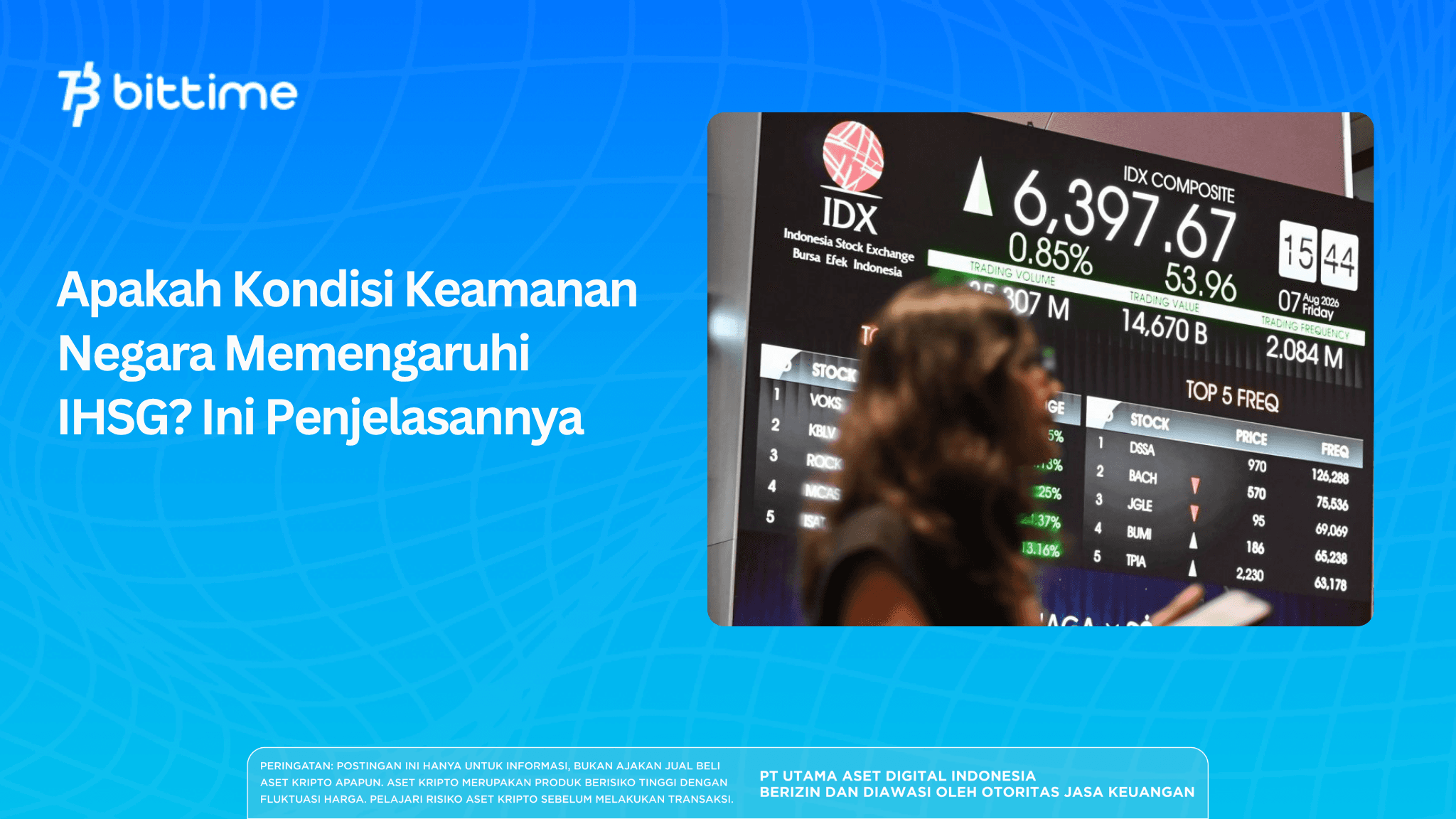
More than eighteen thousand security personnel took to the streets of Jakarta on Thursday, August 27, 2026, escorting demonstrations in dozens of points across the capital. However, on the same day, the Indonesia Composite Stock Price Index (IHSG) actually closed up 1.81% to 6,521.75.
The market reaction, which contradicted many people's expectations, raises a fundamental question: how significant is the actual impact of demonstrations on the IHSG, and does national security truly determine the direction of the stock market?
This question is not new. Throughout the past decade, the relationship between demonstrations and the stock market in Indonesia has been repeatedly tested by waves of major protests—from the 411-212 Movement in 2016, the rejection of the 2019 presidential election results, the Criminal Code Bill (RKUHP), the Omnibus Law, to the online motorcycle taxi (ojol) demonstrations and the Pilkada Bill.
The pattern tends to be similar: the IHSG is temporarily pressured, then rebounds as the situation eases. This article traces this historical data and also looks at how analysts and regulators read the impact of demonstrations on the IHSG in 2026.
Key Takeaways
- Data from 2016–2025 shows that the IHSG almost always rebounds within days to months after major demonstrations subside.
- The main determinant is the escalation of the action—orderly demonstrations tend to have minimal impact, while riots trigger deeper selling pressure.
- The OJK and securities analysts assess that the impact of security turmoil on the market is temporary as long as economic fundamentals remain solid.
Historical Record: How Major Demonstrations Affected the IHSG from 2016 to 2025
Research by Sinarmas Sekuritas, as quoted by Bisnis.com, notes a consistent pattern regarding demonstrations and the stock market over the past decade: annual protests in Indonesia do trigger short-term psychological panic, but the market almost always recovers once legal certainty and government policy evaluations emerge. Here is a summary of six major demonstration episodes and the corresponding IHSG reactions.
411 and 212 Movements (November–December 2016)
These large demonstrations temporarily pressured the IHSG due to concerns over national security stability. As soon as the situation ended peacefully and was followed by government political consolidation, the IHSG rebounded strongly and set new records. Throughout 2016, the index rose 15.32% year-to-date to 5,296.71.
Protest Against Presidential Election Results (May 2019)
Action in front of Bawaslu (Election Supervisory Agency) that turned chaotic caused thin trading and pushed the IHSG down 0.20%. Once authorities contained security and the Constitutional Court provided legal certainty, the IHSG quickly stabilised.
Demonstrations Against RKUHP and the KPK Law (September 2019)
Waves of student protests across various cities caused the IHSG to weaken 0.41% during the protests, then fall another 1.11% the next day. Pressure began to ease once the crowds dispersed, and the market experienced a technical rebound shortly after. Throughout 2019, the IHSG rose only 1.6% year-to-date.
Also Read: Nvidia AI Funding $500 Billion, AI Crypto Tokens Also Benefiting?
Omnibus Law on Job Creation Protests (October 2020)
Massive rejection in various cities triggered daily fluctuations and profit-taking by investors. However, once tensions eased and the regulatory direction became clear, foreign investors actually came in with large net buys. A month later, on November 19, 2020, the IHSG closed at 5,594.06, up 9.08% month-to-date.
Pilkada Law "Emergency Alert" Protests (August 2024)
High political escalation made the IHSG respond negatively, closing down 0.87% to 7,488. Once the DPR (People's Representative Council) cancelled the revision of the Pilkada Law, the emerging legal certainty immediately triggered a market rebound. In September 2024, the IHSG even touched 7,905.39, the highest level since 2014.
Ojol Demonstration and the Death of Affan Kurniawan (August 2025)
Political tensions and clashes triggered selling pressure from foreign investors, causing the IHSG to plunge 2.3% intraday.
After tensions subsided and the government committed to conducting an evaluation, the impact proved temporary—solid macroeconomic fundamentals made the IHSG rise again. Throughout 2025, the IHSG recorded all-time highs 24 times with a year-to-date increase of 22.13%, according to data from Bisnis.com and Databoks Katadata.
Want to start taking advantage of market momentum like the historical patterns above for your digital asset portfolio? Register now at Bittime and monitor market movements in real-time through an OJK-licensed platform.
Why Does the Stock Market Almost Always Rebound After Protests Subside?
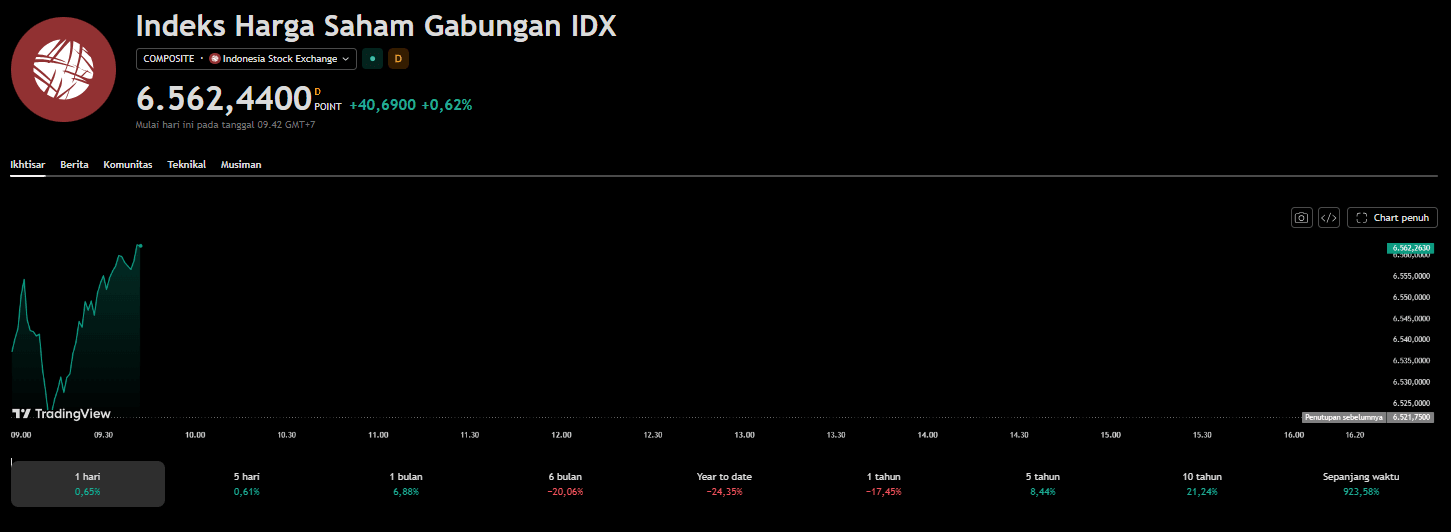
IHSG Price Today. Source: TradingView
This rebound pattern is no coincidence. Political stability and the IHSG are closely linked, but the market tends to respond to the presence or absence of certainty rather than merely the scale of demonstrations. There are three factors that consistently make the IHSG recover quickly after security turmoil subsides.
Rapid legal and political certainty
Each of the major demonstration episodes above was followed by a clear resolution point—Constitutional Court decisions, cancellation of legal revisions, or government policy evaluations. This certainty is what most determines the direction of the IHSG after protests, far more than the protests themselves.
Domestic investors use corrections as buying opportunities
Senior Market Analyst at Mirae Asset Sekuritas, Nafan Aji Gusta, explained that domestic investors are actually aware that the political and economic situation has not fully improved during protests. Even so, some market players choose to take advantage of the buying-the-dip momentum rather than panic selling, as quoted by Katadata.
Macroeconomic fundamentals remain the anchor
As long as inflation is under control, economic growth is maintained, and there are no major global shocks, corrections driven by protest sentiment tend to be technical and short-lived. The Financial Services Authority (OJK) also affirmed this following the wave of protests in August 2025.
Also Read: Tokenized Stocks vs Ordinary Stocks: Definition, Differences, and How to Buy
Market Conditions and Authorities' Response During the August 2026 Protests
Chairman of the OJK Board of Commissioners, Mahendra Siregar, once emphasised that the impact of protest waves on the financial services sector is limited. Referring to data from August 2025, the financial services sector remained stable despite domestic dynamics heating up, and the IHSG even touched its highest level that month, as reported by CNN Indonesia.
Chief Executive of Capital Market Supervision at OJK, Inarno Djajadi, added that foreign fund flows actually recorded an inflow of Rp10.96 trillion in August 2025, improving compared to the previous two months which saw net sales. Domestic risks like these are what the OJK and securities analysts monitor most closely in assessing the short-term direction of the IHSG.
A similar pattern recurred in 2026. Ahead of the demonstration at the DPR RI building on August 27, 2026, Head of Research at Mirae Asset Sekuritas, Rully Arya Wisnubroto, stated that market conditions remained relatively safe as long as the action did not escalate into riots or anarchic acts.
Also Read: 10 Free Bitcoin Mining Sites and Faucets 2026, Which One Is Legit?
He projected the IHSG to move in the range of 6,500–7,000 throughout the third quarter of 2026, with the note that upside room remains limited due to insufficient foreign inflows.
That projection proved accurate. While the demonstration took place in dozens of points across Jakarta with 18,504 security personnel deployed, the IHSG actually closed up 1.81% at 6,521.75. Nafan Aji Gusta assessed that the impact of the protest on the IHSG was likely temporary and sentiment-based as long as it remained orderly, not a reflection of fundamental change, as quoted by Bisnis.com.
Other factors that influenced market movements at that time included the MSCI freeze in early 2025 and institutional investor caution ahead of the Jackson Hole Symposium of the Fed.
Also Read: 10+ Best AI Coins 2026: Here's the List of Artificial Intelligence-themed Crypto!
Conclusion
Data from the past decade shows that the impact of security on the IHSG is real, but generally temporary. Six major protest episodes since 2016 all ended with rebounds, provided the actions were orderly and legal or policy resolutions emerged quickly.
For investors, understanding this pattern is important so as not to panic-sell during corrections, while remaining cautious of escalations that could significantly change market dynamics.
Monitor US stock tokens: AMZON, AMDON, TSLAX, NFLXON MSFTON and many more, you can start trading at Bittime.

Bittime is a Digital Financial Asset Trader (PAKD) platform licensed and supervised by the Financial Services Authority — where you can buy Bitcoin in Indonesia and hundreds of other crypto assets starting from Rp10,000. Registration is fast, secure, and can be started today.
Monitor USDT to IDR conversion and the price movements of your favourite crypto assets in real-time. All available in one crypto investment app that can be downloaded for free on the Play Store.
Ready to start? Register now at Bittime and execute your investment strategy with a platform trusted by millions of users in Indonesia.
FAQ
Does a demonstration always make the IHSG go down?
Not always. Historical data shows that the IHSG has even strengthened on the day of protests, as happened on August 27, 2026, when the index rose 1.81%.
How long does it typically take for the IHSG to rebound after a major protest?
It varies from a few days to a month, depending on how quickly legal or policy certainty emerges. In the case of the Omnibus Law in 2020, for example, the IHSG rose 9.08% within a month after the protests subsided.
What factor most determines the impact of protests on the stock market?
The escalation of the action is the main factor—orderly protests tend to have minimal impact, while riots can trigger more significant selling pressure. The OJK and various securities analysts agree on this point.
Do foreign investors flee during major protests in Indonesia?
Not entirely. OJK data shows that foreign fund flows were temporarily pressured during protests, but returned to inflows once the situation eased, as happened in August 2025.
Does national security conditions also affect crypto asset prices?
Domestic risk sentiment such as protests generally has a greater impact on conventional assets like stocks and the rupiah than on crypto, whose prices are more influenced by global market sentiment. Even so, short-term volatility can still occur in both markets when uncertainty rises.
Disclaimer: The views expressed belong exclusively to the author and do not reflect the views of this platform. This platform and its affiliates disclaim any responsibility for the accuracy or suitability of the information provided. It is for informational purposes only and not intended as financial or investment advice.

.png)