What’s the Difference Between AI, Machine Learning, and Deep Learning? Here’s the Explanation
2026-07-15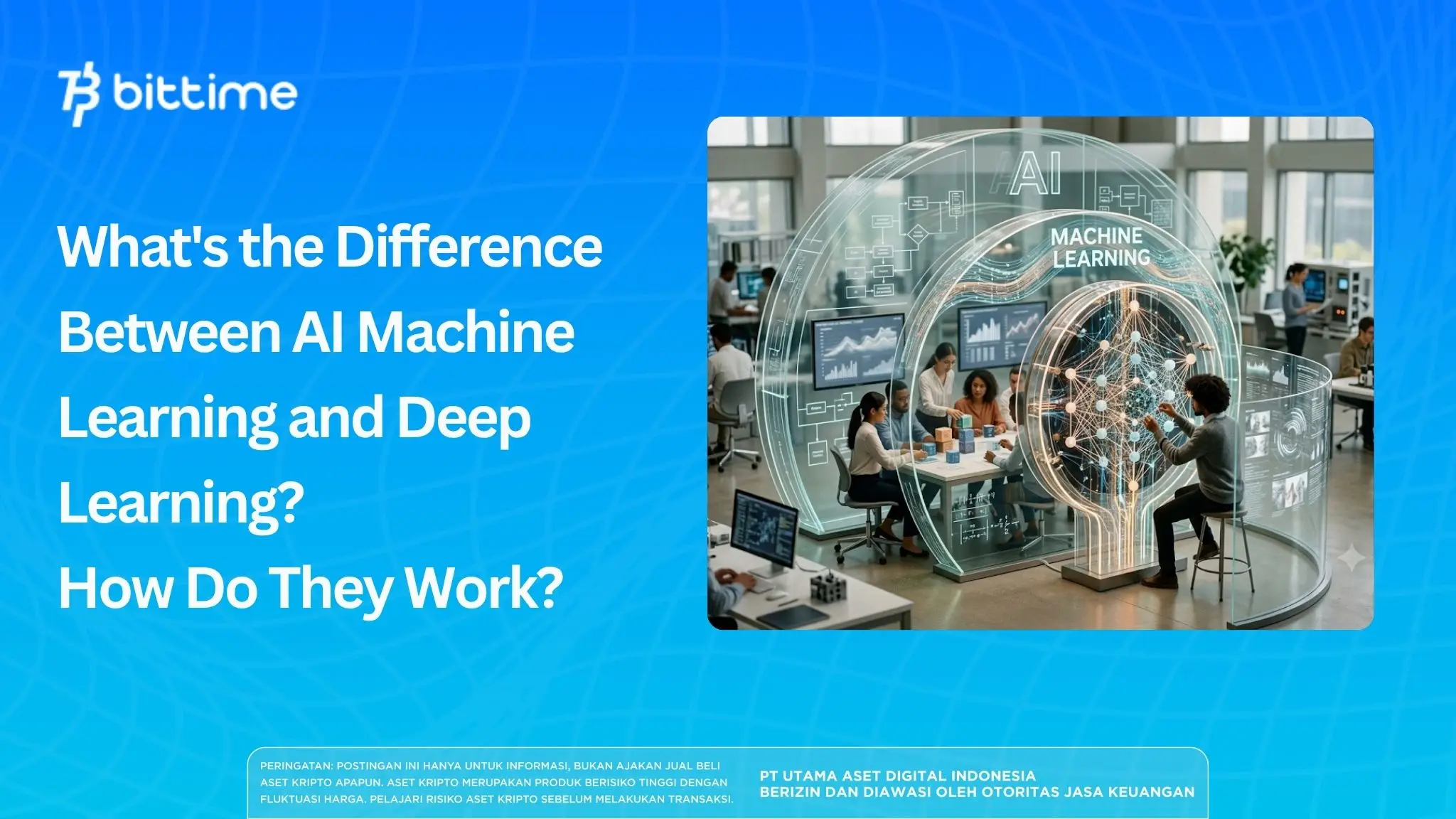 Have you ever been confused about the difference between Artificial Intelligence (AI), Machine Learning (ML), and Deep Learning (DL)? These terms are often used interchangeably, but they actually have different but related meanings.
AI is a broad concept of artificial intelligence, ML is a method that allows AI to learn from data, and DL is an advanced technique in ML that mimics the way the human brain works.
Understanding these differences is important so that you don't misunderstand the terms and can choose the right technology for your needs.
This article will discuss the differences between the three simply and clearly, as well as how each technology works.
Key Takeaways
- Artificial Intelligence (AI) is the big concept of artificial intelligence—making machines think and act like humans.
- Machine Learning (ML) is a branch of AI that allows machines to learn from data without being explicitly programmed. ML uses statistical algorithms to recognize patterns.
- Deep Learning (DL) is a sub-branch of ML that uses multi-layered artificial neural networks (deep neural networks). DL is capable of learning without human intervention.
Understanding and Relationship between AI, ML, and DL
Source: AI
Artificial Intelligence (AI)
Artificial Intelligence (AI) is a field of computer science that aims to create intelligent machines that can perform tasks that normally require human intelligence, such as speech recognition, decision-making, and problem-solving.
AI is a big goal, while ML and DL are some of the many techniques to achieve it.
Machine Learning (ML)
Machine learning (ML) is a branch of AI that allows computers to learn from data without being explicitly programmed. ML systems use statistical algorithms to process historical data, identify patterns, and make predictions. ML is a method that enables AI to "learn" from experience.
Deep Learning (DL)
Deep Learning (DL) is a sub-branch of ML that uses multi-layered artificial neural networks (deep neural networks) to process complex data.
DL is inspired by the workings of the human brain and is capable of automatically learning data features, without the need for human intervention in feature extraction.
Develop your understanding of AI technology and start smart investing in the digital age. Register at Bittime Now, crypto trading is safe and reliable in Indonesia.
The relationship between the three can be described as a hierarchy:
AI → ML → DL
That is, AI is a big umbrella, ML is a subset of AI, and DL is a more specific and sophisticated subset of ML.
Key Differences Between Machine Learning and Deep Learning
Here are the basic differences between ML and DL:
Read Also: What Are AI Cryptocurrencies? 9 Popular AI Coins to Watch in 2026
How Machine Learning and Deep Learning Work
How Machine Learning Works
ML works through a series of stages:
1. Data Gathering:Collect relevant data
2. Data Pre-processing:Cleaning and dividing the data into training set and testing set
3. Choose Model:Selecting the appropriate algorithm (e.g. Decision Tree, SVM)
4. Train Model: Train a model with data to find patterns
5. Test Model: Testing model performance with testing data
6. Tune Model: Adjust parameters to improve accuracy
7. Prediction: Using models to predict new data
ML requires humans to determine which features are important (feature extraction) and select the appropriate algorithm. Examples of ML implementations include email spam detection, stock price prediction, and e-commerce recommendation systems.
Read Also:AI Tokens Worth Looking At This Year: Predicted to Skyrocket 5X!
How Deep Learning Works
DL uses a multi-layered neural network architecture (deep neural networks). How it works:
1. Input Data:Raw data (images, sound, text) is fed into the input layer
2. Forward Propagation:Data flows through hidden layers, each layer extracting more abstract features.
3. Output Calculation:The output layer generates predictions
4. Backpropagation: The difference between the prediction and the actual output is calculated, and then the error is propagated back to adjust the weights of the neurons.
5. Iteration:The process is repeated until optimal accuracy is achieved.
DL is capable of automatically learning data features without human intervention. Examples of DL implementations include facial recognition, autonomous cars, virtual assistants (Siri, Google Assistant), and automatic translation.
Read Also: Getting to Know USD.AI $CHIP Coin and How It Works
Advantages and Disadvantages
Machine Learning (ML)
Advantages:
- Easier to implement
- Faster training time
- Does not require large datasets
- Suitable for structured data
Disadvantages:
- Requires human intervention (manual feature extraction)
- Lower accuracy for raw data (images, sound, video)
Deep Learning (DL)
Advantages:
- Able to process raw data
- Higher accuracy for complex data
- No need for much human intervention
Disadvantages:
- Requires large datasets and advanced computing
- Long and complex training time
- Interpretation of results is difficult (black box)
Conclusion
AI is the big goal of creating intelligent machines, ML is the method that allows AI to learn from data, and DL is an advanced technique in ML that uses neural networks to process complex data.
ML is suitable for structured data with medium datasets and faster execution, while DL excels for unstructured data (images, sound, text) with high accuracy but requires large data and advanced computing.
Choosing between ML and DL depends on the complexity of the problem, data availability, and the resources you have.

Now that you’ve learnt about the latest AI developments, it’s time to explore AI-based cryptocurrencies on Bittime, such as the digital assets AI, AGI, RENDER, TAO and many more AI coins.
Bittime is a licensed and regulated Digital Financial Asset Trader (PAKD) supervised by Indonesia’s Financial Services Authority (OJK) — where you can buy Bitcoin in Indonesia and hundreds of other crypto assets starting from just Rp10,000. The registration process is fast, secure, and you can get started today.
Track USDT to IDR conversions and monitor your favorite crypto assets in real time. Everything is available in one crypto investment app that you can download for free on the Play Store
Ready to start? Register now on Bittime and execute your investment strategy with a platform trusted by millions of users in Indonesia.
FAQ
What is the difference between AI, Machine Learning, and Deep Learning?
AI is a broad concept of artificial intelligence, ML is a branch of AI that learns from data, and DL is a sub-section of ML that uses multi-layer neural networks.
Is Deep Learning part of Machine Learning?
Yes, Deep Learning is a sub-section of Machine Learning. All DL is ML, but not all ML is DL.
When is it better to use Machine Learning vs Deep Learning?
Use ML for structured data with medium datasets and fast execution. Use DL for unstructured data (images, audio, text) with large datasets and high accuracy.
What are some examples of Machine Learning implementations?
Email spam detection, stock price prediction, product recommendation systems, and digital advertising optimization.
What are some examples of Deep Learning implementations?
Facial recognition, virtual assistants (Siri, Google Assistant), autonomous cars, and automatic translators.
What are the advantages of Deep Learning over Machine Learning?
DL is able to process raw data automatically, with higher accuracy, and minimal human intervention.
What are the disadvantages of Deep Learning?
Requires large datasets, advanced computing (GPU/TPU), long training times, and difficult to interpret results (black box).
Disclaimer: The views expressed belong exclusively to the author and do not reflect the views of this platform. This platform and its affiliates disclaim any responsibility for the accuracy or suitability of the information provided. It is for informational purposes only and not intended as financial or investment advice.

.png)