What Is the MSCI Emerging Markets Index, and Why Is Indonesia’s Status Drawing Investors’ Attention?
2026-06-24
The movement of foreign funds in the stock market is often influenced by factors not directly visible to retail investors. One of them is a country’s position in the MSCI Emerging Market index.
When Indonesia MSCI once again became a topic of discussion in June 2026, global investors focused on one important question: does the Indonesian stock market still meet the standards to remain in the MSCI emerging markets group?
For many market participants, MSCI’s decision affects international capital flows, trading liquidity, and the risk perception attached to Indonesia’s financial markets.
Key Takeaways
- Indonesia remains in the MSCI Emerging Market category in the June 2026 review.
- MSCI continues to highlight market transparency and the quality of information flow in Indonesia.
- MSCI’s decision can influence foreign fund flows and the liquidity of the Indonesian stock market.
Register at Bittime now and start trading crypto with a fast, secure, and easy process in the app.
What Is MSCI Emerging Market?
MSCI Emerging Market is a group of indices published by Morgan Stanley Capital International (MSCI) to measure the performance of stock markets in developing countries around the world.
This index serves as a benchmark for thousands of investment managers, pension funds, sovereign wealth funds, and global exchange traded funds (ETFs) in determining their investment allocations.
A country included in the Emerging Market category generally has:
- Adequate market size.
- Sufficiently high trading liquidity.
- Good accessibility for foreign investors.
- Relatively mature market regulations.
Because many investment funds follow the MSCI index composition, a country’s status in this classification can influence large-scale capital flows.
In practice, MSCI divides markets into several main categories:
- Developed Market
- Emerging Market
- Frontier Market
- Standalone Market
Indonesia is currently still in the Emerging Market group along with countries such as India, Brazil, Saudi Arabia, and China.
Source: Kael
Read Also: Getting to Know LLYon, Eli Lilly & Co Tokenized Stock and How to Buy It on Bittime
Why Is Indonesia’s Status in MSCI in the Spotlight?
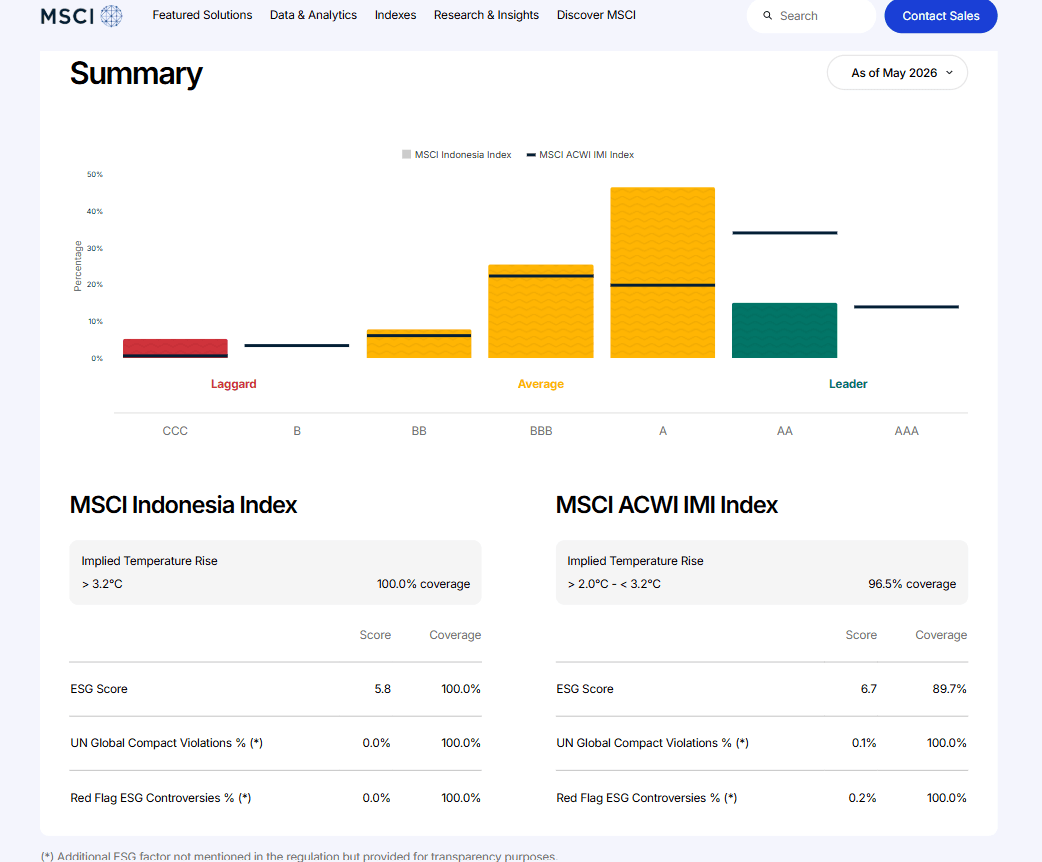
MSCI’s main focus in recent months has not been on Indonesia’s economic condition, but on the quality of capital market infrastructure and information transparency.
Based on the latest review, MSCI has maintained Indonesia’s status as an Emerging Market. However, the institution has extended the evaluation process until November 2026 because several issues still need to be addressed.
Some of the aspects under attention include:
Share Ownership Transparency
Global investors want clearer information regarding share ownership structures and the actual number of shares available for trading (free float).
Quality of Information Flow
MSCI downgraded the assessment on the Information Flow indicator. Foreign investors assess that access to company information and market data still needs improvement to be more easily accessible globally.
Pricing Integrity
MSCI also received input regarding alleged coordinated trading activities in certain stocks. This aspect relates to investor confidence in healthy price formation mechanisms.
According to a report quoted by CNBC Indonesia, Indonesia has successfully maintained its status, but these notes remain a focus of MSCI’s future evaluation.
Source: MSCI
Read Also: How to Buy SpaceX Tokenized Stock (SPCXon): SpaceX Ondo Tokenized Stock Guide
Impact of MSCI’s Decision on Foreign Funds and the Indonesian Stock Market
For retail investors, MSCI’s decision may seem far removed from daily trading activities. However, for global institutional investors, the decision has major consequences.
According to Ashmore’s view quoted by Indopremier, foreign investor confidence, capital inflows, and the Indonesia Stock Exchange’s liquidity premium greatly depend on the results of MSCI’s evaluation.
If Indonesia remains in the Emerging Market category:
- Potential foreign fund inflows remain preserved.
- Market liquidity tends to be better.
- Interest from global institutional investors can be maintained.
Conversely, if Indonesia were downgraded to Frontier Market status, some investment funds that follow the MSCI Emerging Market index could potentially adjust their portfolios.
The impacts could include:
- Selling pressure from foreign investors.
- Decreased trading liquidity.
- Increased market risk perception.
Therefore, MSCI’s decisions often receive significant attention from market participants before and after the official announcement.
Read Also: 10 Largest Crypto Asset RWA Tokenizations in the World
What Are the Risks If Indonesia Is Downgraded to Frontier Market?
Frontier Market status is generally given to smaller markets or those with lower accessibility compared to Emerging Markets.
A downgrade does not automatically mean a country’s economic condition is deteriorating. However, in the context of capital markets, a classification change can alter how global investors perceive investment risks and opportunities.
Some consequences often associated with frontier market risks include:
- Reduced exposure from large institutional funds.
- Decreased attractiveness for passive index-based investors.
- Potential increase in market volatility.
- Reduced liquidity premium that the market has enjoyed.
For this reason, Indonesian capital market regulators continue to strive to improve issuer transparency, reporting quality, and information access for foreign investors.
Read Also: 9 Advantages of Profitable Digital Gold Investment in 2026 (XAUT & PAXG)
Conclusion
MSCI Emerging Market plays an important role in shaping global investors’ perception of a country. For Indonesia, the MSCI decision in June 2026 provided breathing room because Emerging Market status was maintained.
However, the evaluation is not over. Issuer transparency, information flow quality, and investor confidence remain homework that needs to be completed before the next review in November 2026.
The outcome of this process will be a key factor influencing foreign funds, exchange liquidity, and the competitiveness of the Indonesian stock market in the eyes of international investors.

Monitor tokenized stocks AMZON, AMDON, TSLAX, NFLXON MSFTON and many more — you can start trading on Bittime.
Bittime is a licensed and supervised Digital Financial Asset Trader (PAKD) platform by the Financial Services Authority — the place where you can buy Bitcoin in Indonesia and hundreds of other crypto assets starting from Rp10,000. The registration process is fast, secure, and can be started today.
Monitor the conversion of USDT to IDR and the price movements of your favorite crypto assets in real-time. All are available in one crypto investment app that can be downloaded for free on the Play Store.
Ready to start? Register now at Bittime and execute your investment strategy with a platform trusted by millions of users in Indonesia.
FAQ
What is MSCI Emerging Market?
MSCI Emerging Market is an index that groups developing countries based on the size, liquidity, and accessibility of their capital markets.
Why is Indonesia’s status in MSCI important?
Because many global institutional investors use MSCI indices as a reference for their investments.
Is Indonesia still in MSCI Emerging Market?
Yes. As of the June 2026 review, Indonesia is still maintained in the Emerging Market category.
What is MSCI’s main concern regarding Indonesia?
MSCI highlights share ownership transparency, information flow quality, and market integrity.
What is Frontier Market?
Frontier Market is a category for markets that have a lower level of development and accessibility than Emerging Markets.
When will MSCI re-evaluate Indonesia?
MSCI is scheduled to continue the evaluation process for Indonesia in November 2026.
Disclaimer: The views expressed belong exclusively to the author and do not reflect the views of this platform. This platform and its affiliates disclaim any responsibility for the accuracy or suitability of the information provided. It is for informational purposes only and not intended as financial or investment advice.

.png)