What Is Chinese Oil Asset Reserve (COAR)? An Oil-Themed Solana Meme Coin
2026-05-20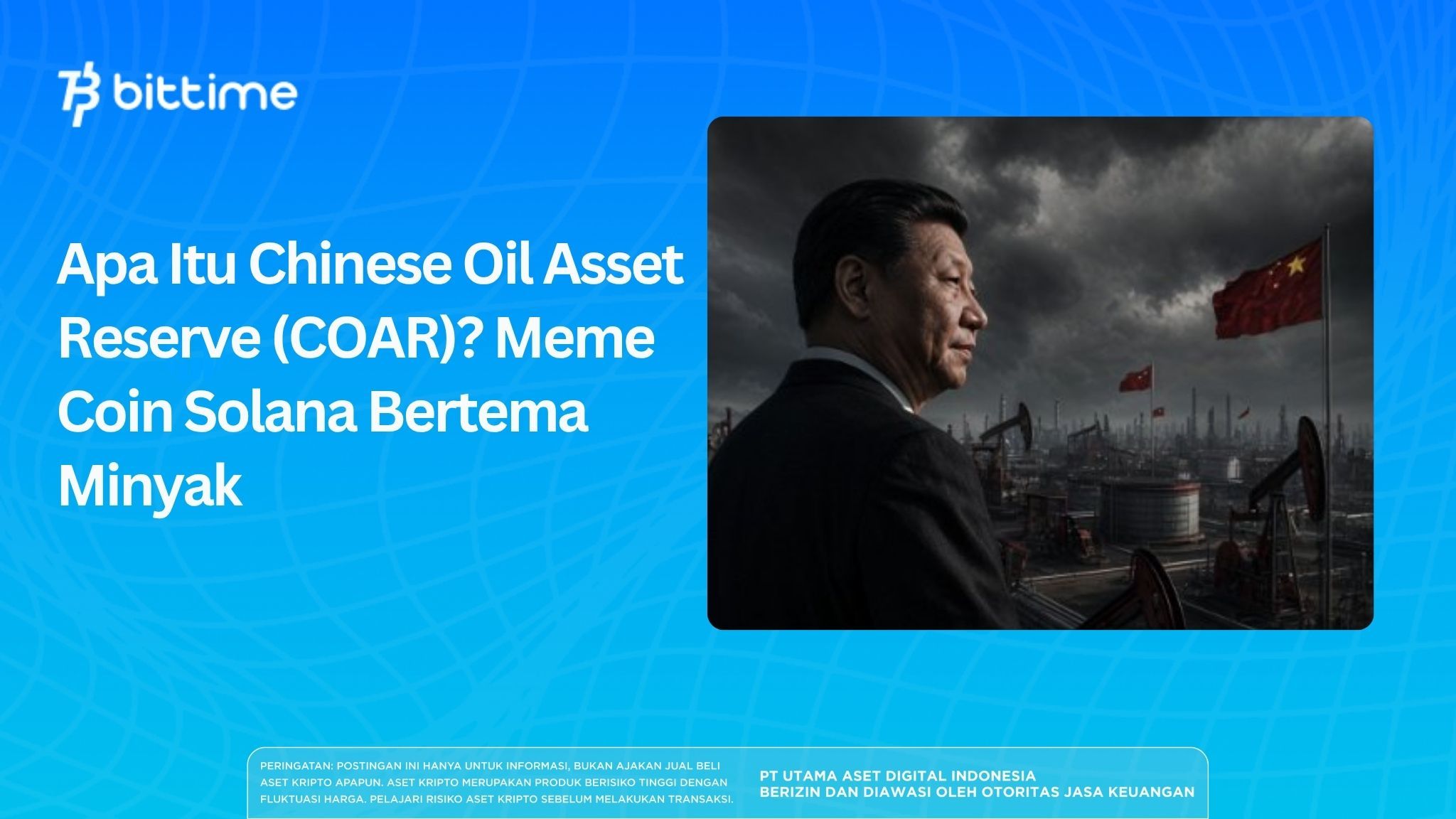
Chinese Oil Asset Reserve (COAR) is an oil-themed token on the Solana network that has gained attention because it combines commodity narratives, meme coins, and DEX trading. Many traders ask whether COAR is truly linked to oil reserves, a government, or physical assets.
The safest answer: COAR should be viewed as a speculative crypto asset based on narrative, not a regulated oil product. Public data provides on-chain details, but information about the team, independent audits, and business model remains limited.
Key Takeaways
- Chinese Oil Asset Reserve (COAR) runs on Solana and uses the oil narrative as a market attraction.
- There is not enough public evidence that COAR is backed by physical oil, a government, or redeemable reserve claims.
- Before buying, check the COAR contract, liquidity, volume, holders, market cap, and official project sources.
Register on Bittime now and start trading crypto with a fast, safe, and easy process in the app.
What Is Chinese Oil Asset Reserve (COAR)?
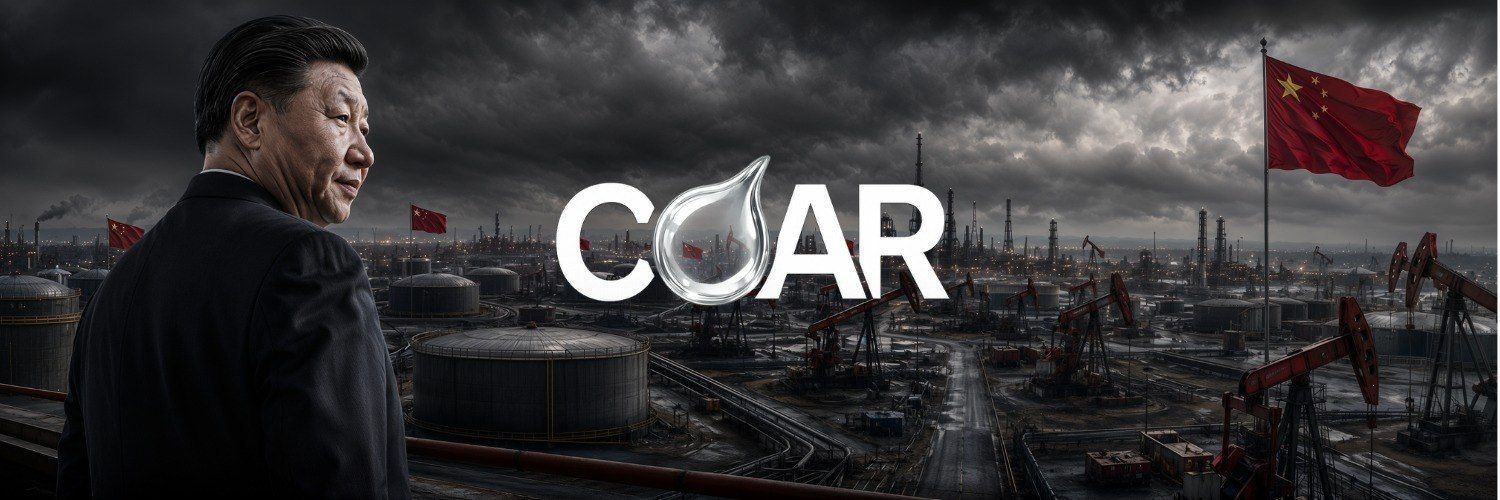
Chinese Oil Asset Reserve (COAR) is the COAR token on Solana, marketed as a “Crude Oil Asset Reserve”. The project brings the oil reserve theme to the on-chain market through community activity, branding, and DEX trading.
COAR is not a stock, oil ETF, or ownership contract for barrels of oil. Its value is closer to a narrative meme coin, which is an asset that moves based on market attention, liquidity, community sentiment, and trading momentum.
Is COAR backed by oil?
There is not enough public information to confirm that COAR is backed by physical oil, real oil reserves, or any government. The project website also states that COAR is a speculative digital asset and is not backed by physical oil reserves or a government entity.
This means buyers should not treat COAR as a claim to oil. The oil narrative should only be read as a marketing theme until there is clear proof of reserve audits, legal structure, and a redemption mechanism.
Product, Team, and Security
COAR appears to operate as a community token on Solana, not as an oil platform with verified physical products. Public information about the team’s identity, full technical audit, and legal entity behind the project is not strong enough to support safety claims.
Automated audit labels on DEX trackers are not the same as independent audits. Traders still need to check the contract, holder distribution, pool history, and mint authority through a Solana explorer.
Also read: How to Trade Meme Coins on Solana: Avoid Major Losses
COAR Price, Volume, and COAR Market Cap
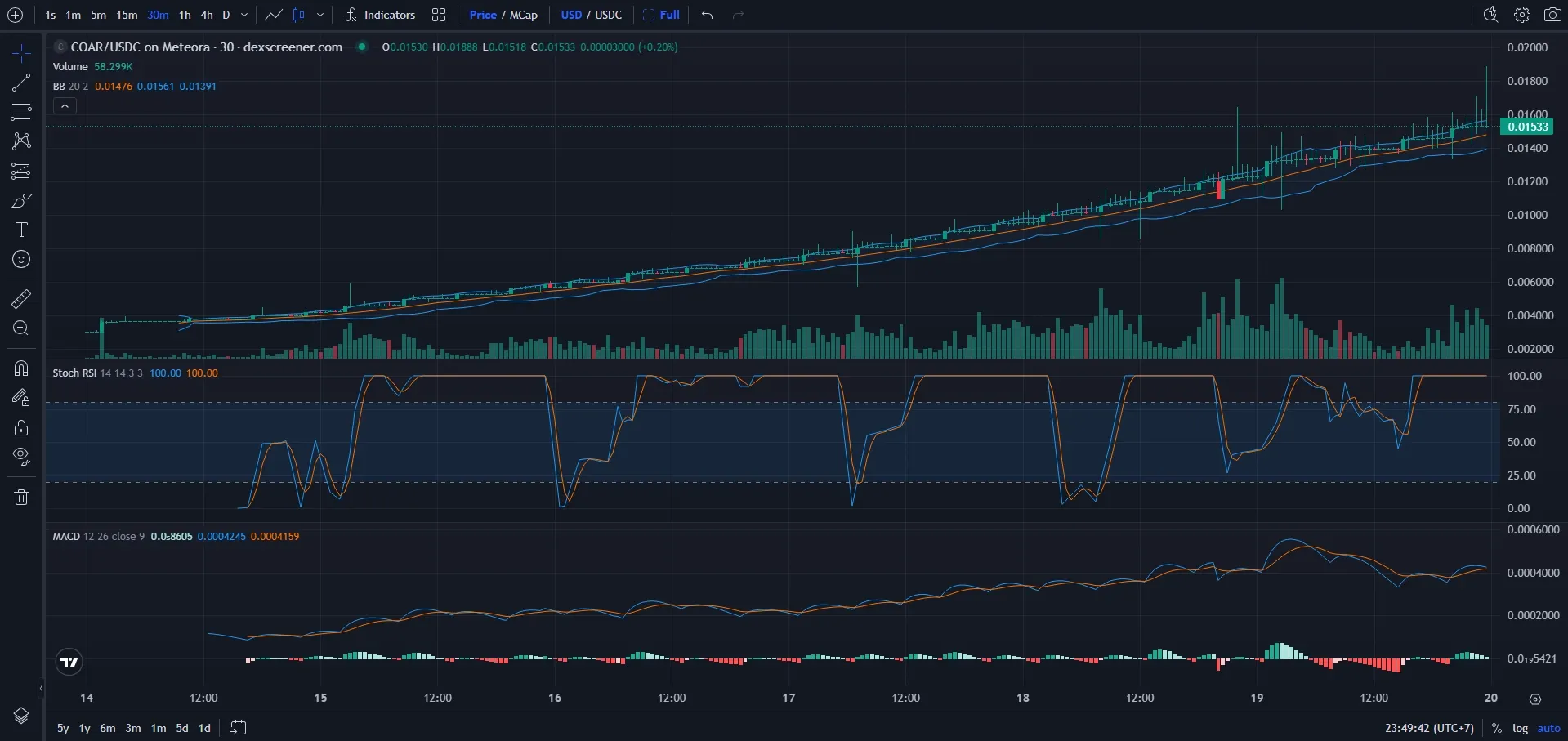
The COAR price moves quickly because it is traded on DEXs and depends heavily on liquidity. At the time of checking, public data showed COAR trading at around US$0.015, with a market cap of around US$15 million and 24-hour volume in the millions of dollars.
These figures can change within minutes. To check the COAR price, volume, and COAR market cap, check CoinGecko, DexScreener, GeckoTerminal, and a Solana explorer. Focus on price, volume, liquidity, market cap, transactions, and holders.
Chinese Oil Asset Reserve (COAR) Tokenomics
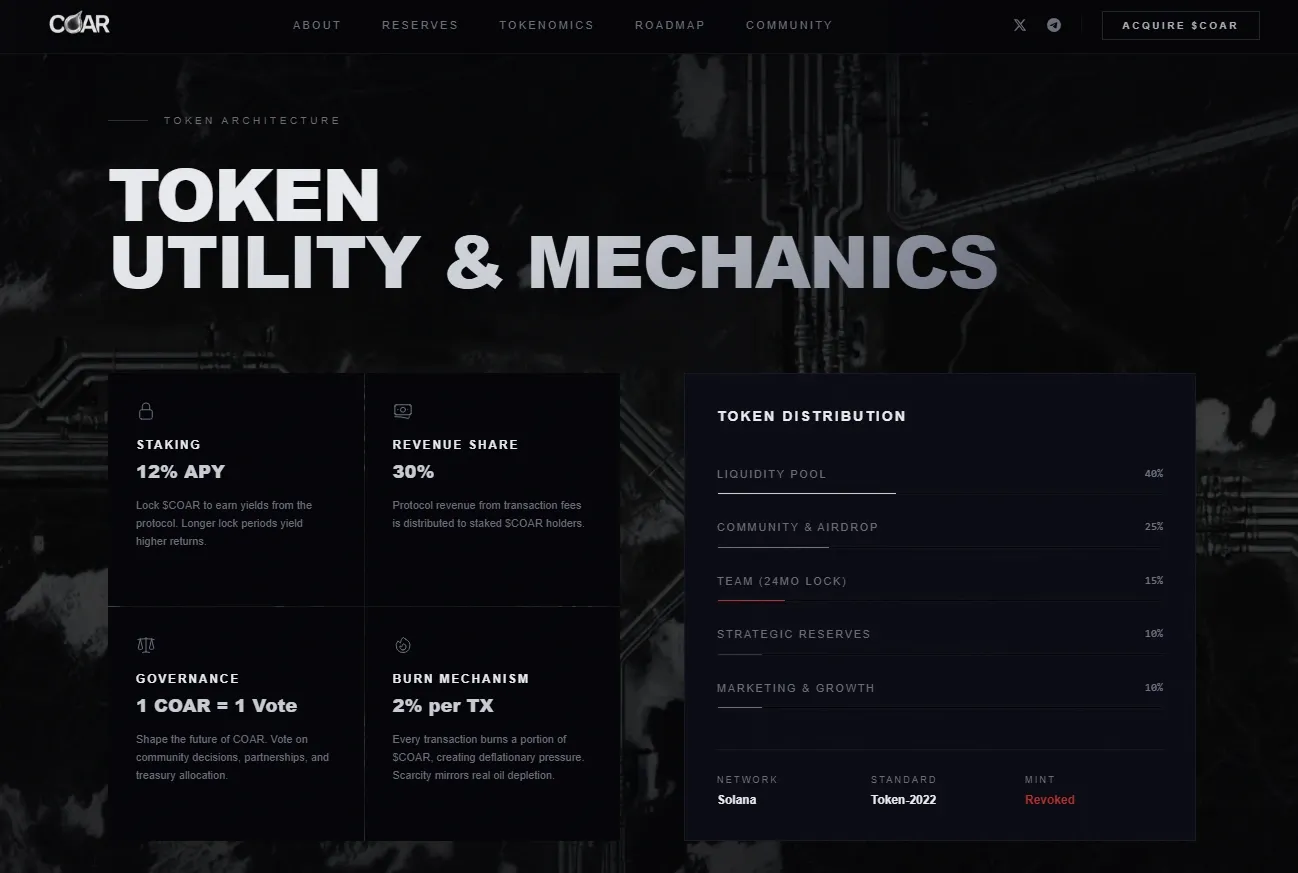
The COAR tokenomics shown on the project website state a total supply of 1 billion tokens, the Solana network, the Token-2022 standard, and revoked mint authority. Its distribution includes 40% liquidity pool, 25% community and airdrop, 15% team with a 24-month lock, 10% strategic reserves, and 10% marketing and growth.
The project website also displays utilities such as 12% APY staking, 30% revenue share, governance with 1 COAR equal to 1 vote, and a 2% burn per transaction. All utility claims should be rechecked through the contract, documentation, and proof of implementation.
How to Check the COAR Contract?
The COAR contract can be obtained from the official website, then matched on Solscan, CoinGecko, DexScreener, GeckoTerminal, or a Solana wallet. Do not search for the token by the name COAR alone.
Fake tokens can use similar names, logos, or tickers. Make sure the chain, contract, trading pair, and liquidity pool match.
Also read: How to Buy the MELANIA Token on a DEX on the Solana Network
Chinese Oil Asset Reserve (COAR) Roadmap
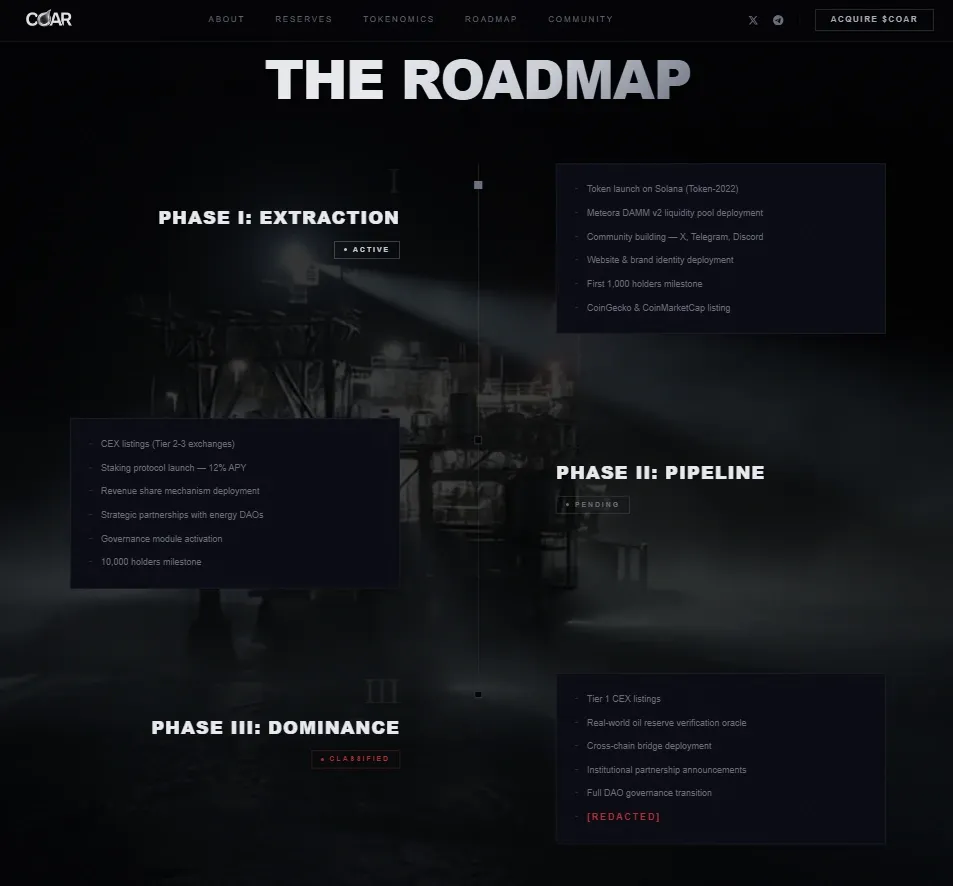
The Chinese Oil Asset Reserve (COAR) roadmap includes the token launch on Solana, the deployment of the Meteora DAMM v2 liquidity pool, community development, initial holder targets, and market data listings.
Later phases list plans for CEX listings, staking, revenue share, partnerships with energy DAOs, governance, oracle verification of real-world oil reserves, cross-chain bridges, and full DAO transition. These sections still need to be monitored as project plans, not proof of active features.
Why Are Oil Meme Coins Trending?
Oil meme coins are trending because oil has a global narrative that is easy to understand. Traders see oil as an important commodity, then meme coin projects use the theme to build a strong market identity.
On Solana, low transaction fees and an active DEX ecosystem allow token narratives to emerge quickly. Risk also rises because many new tokens move without products, public teams, or strong audits.
COAR vs COSF vs WCOR
COAR, COSF, and WCOR are part of a group of oil narrative tokens that traders often compare. COAR carries the Chinese Oil Asset Reserve or Crude Oil Asset Reserve theme. COSF is associated with Chinese Oil Strategic Fund. WCOR carries the World Collective Oil Reserve theme.
A healthy comparison is not enough if it only uses names. Check the contract, chain, market cap, liquidity, holders, pool history, backing claims, and team transparency. If there is no proof of oil reserves, all similar tokens should be treated as speculative assets.
Also read: What Is LetsBONK.fun? How to Launch a Memecoin on Solana
Risks of Oil Narrative Tokens
The risks of oil narrative tokens are quite high. Prices can rise sharply, but they can also fall quickly when volume disappears or the narrative shifts.
The main risks include volatility, thin liquidity, imitation contracts, unproven reserve claims, holder concentration, and an unrealized roadmap. Beginners should monitor first before using large funds.
How to Buy Chinese Oil Asset Reserve (COAR)?
The process to buy Chinese Oil Asset Reserve (COAR) usually starts with a Solana wallet such as Phantom or Solflare. Users need to prepare SOL for network fees and swap assets such as USDC or SOL.
Once the wallet is ready, open a DEX aggregator or a DEX that supports the COAR pair. Paste the official contract, check the pair, check liquidity, set reasonable slippage, then make a small test swap first. After the transaction is complete, check the balance through a Solana explorer.
Conclusion
Chinese Oil Asset Reserve (COAR) is an oil-themed Solana crypto asset that has attracted attention because of its commodity narrative and DEX trading activity. However, COAR cannot yet be treated as a physical oil-backed asset, regulated product, or official reserve instrument.
Use COAR as a research object, not a buying recommendation. Verify the contract, price, volume, market cap, tokenomics, roadmap, and project claims before making any decision.
FAQ
What is Chinese Oil Asset Reserve (COAR)?
Chinese Oil Asset Reserve (COAR) is a Solana-based token that uses the oil narrative as its main theme. COAR is more accurately viewed as a speculative meme coin, not a regulated oil asset.
Is COAR backed by physical oil?
There is not enough public evidence that COAR is backed by physical oil. Project information states that COAR is not backed by physical oil reserves or a government entity.
Where can I check the COAR contract?
The COAR contract can be checked through the official project website, Solscan, CoinGecko, DexScreener, and GeckoTerminal. Make sure the contract address matches before making a swap.
What are the risks of buying the COAR token on Solana?
The risks of buying COAR include high volatility, rapidly changing liquidity, imitation contracts, unproven project claims, and selling pressure from large holders.
How do I buy Chinese Oil Asset Reserve (COAR)?
Prepare a Solana wallet, add SOL for gas, open a DEX or aggregator, paste the official COAR contract, check the pair and liquidity, then swap with an amount that matches your risk limit.
Disclaimer: The views expressed belong exclusively to the author and do not reflect the views of this platform. This platform and its affiliates disclaim any responsibility for the accuracy or suitability of the information provided. It is for informational purposes only and not intended as financial or investment advice.

.png)