XRP Mentioned 101 Times in BIS Research: What Was Actually Tested?
2026-09-04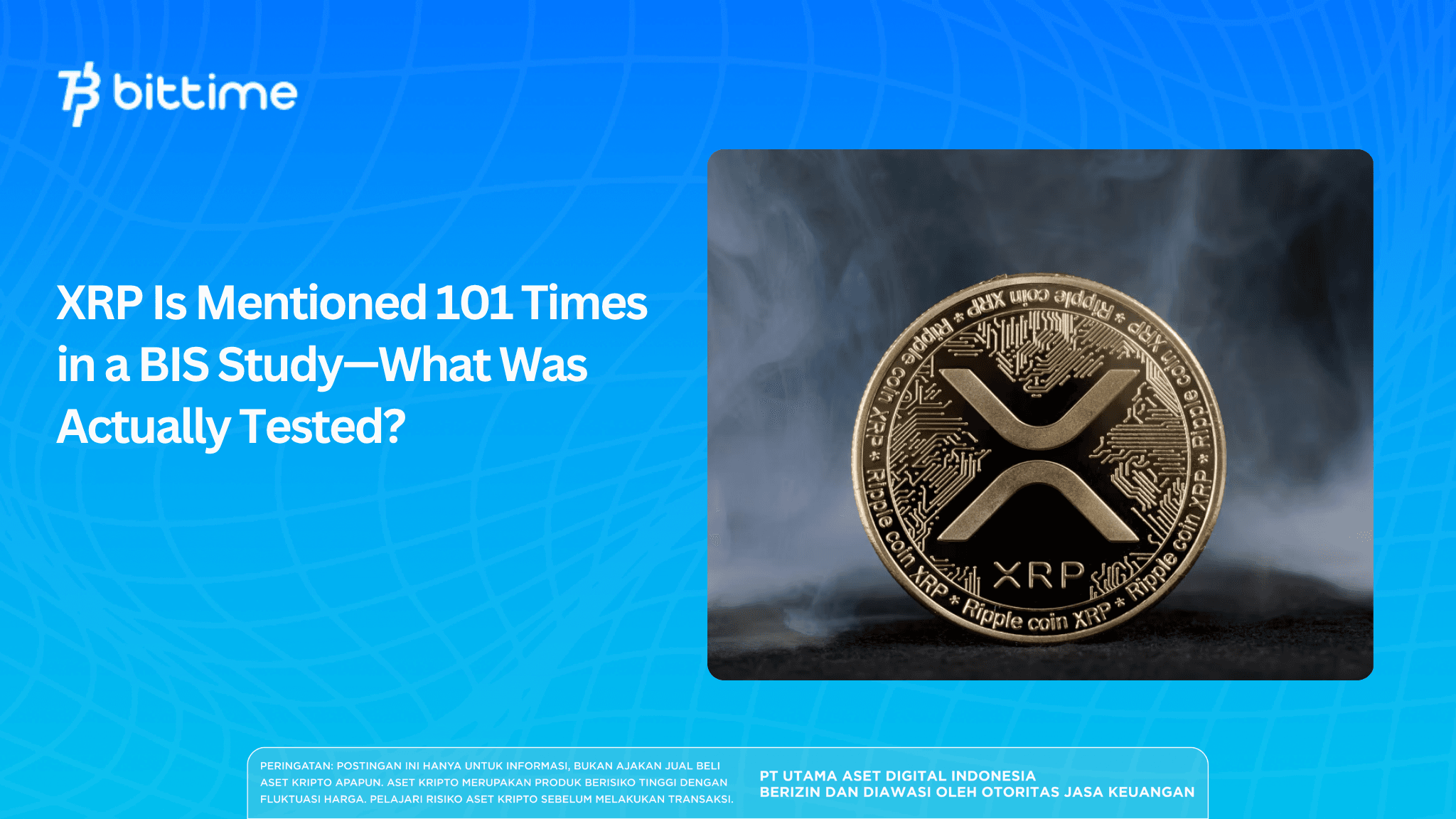
XRP is back in the spotlight after the Bank for International Settlements (BIS) published Working Paper No. 1374 titled “Verifiable Official Statistics: A Blockchain-Based Approach” on September 2, 2026.
The paper uses XRP Ledger (XRPL) as the infrastructure for a proof of concept designed to verify the authenticity and integrity of official statistical data.
However, the narrative that “XRP was mentioned 101 times by the BIS” needs to be placed in the proper context. What was tested was not XRP as an investment asset, but the XRP Ledger blockchain technology for recording cryptographic proofs of official data.
Key Takeaways
- The BIS developed an XRP Ledger-based proof of concept to help verify the origin and integrity of official statistical data.
- The system records the cryptographic fingerprint of data on XRPL rather than storing raw data on the blockchain.
- The research is significant for the development of institutional blockchain applications, but it is not an announcement of a BIS-Ripple partnership or an XRP investment recommendation.
What Was the BIS Actually Testing with XRP Ledger?
The problem the BIS aims to solve is quite specific: how can users ensure that an official dataset genuinely comes from the issuing institution and has not been altered after publication?
This becomes increasingly relevant as economic data is consumed by digital platforms, automated applications, and AI-based systems.
The SDMx (Statistical Data and Metadata eXchange) standard is used to exchange official statistics, but the standard does not automatically provide a blockchain-based mechanism to prove that a received file remains identical to its original version.
The BIS then developed a system that links datasets to the identity of the issuer using cryptography and blockchain technology. In the implementation, XRP Ledger was used to anchor this proof.
In other words, XRPL functions more like a recording and verification layer than a place to store the entire dataset.
Read Also: BIS Reveals New Potential for XRP Ledger in Digital Financial Systems
How Does This XRPL Test Work?
The mechanism starts with an SDMx dataset. The system performs canonicalisation and hashing so that each piece of data has a verifiable digital fingerprint.
Several fingerprints can then be combined using a Merkle tree structure. The final result is a single compact value, or Merkle root, which is recorded on the XRP Ledger.
The original data does not need to be placed on the blockchain. Because only the fingerprint is recorded, the confidentiality of the dataset can be maintained.
Users who obtain the file can recalculate the fingerprint and compare it with the proof recorded on the ledger.
The BIS also incorporated W3C Verifiable Credential and identity mechanisms connected to XRPL addresses.
With this approach, users can verify who issued the data while also determining whether the contents of the file have changed after publication.
Prototype testing showed a median publication time of around 3–5 seconds, while verification required 1–2 seconds under controlled testing conditions. The BIS also found that on-chain costs can become very small when many datasets are combined into a single batch.
Track XRP and other crypto assets with signing up on Bittime and stay up to date with the latest market developments.
Why Was XRP Ledger Chosen?
This is the most relevant part of the discussion surrounding XRP.
The BIS did not simply mention blockchain technology in the abstract. The working paper includes a proof of concept using XRPL that was actually developed and tested.
Therefore, the mention of XRP Ledger 101 times is technically noteworthy, but the number itself is not an indicator that the BIS endorsed XRP.
The researchers’ primary focus was on ledger characteristics suitable for verification needs: fast transactions, low costs, ledger finality, and the availability of development resources.
The system was also designed so that the concept could be extended to other data formats and does not fundamentally depend on a single blockchain.
Therefore, the term “institutional XRP adoption” should be used carefully. What was tested was the XRP Ledger infrastructure, not the use of XRP as a payment instrument or investment asset by the BIS.
Read Also:Gold Tokenization on XRP Ledger, Could It Become a New Catalyst for XRP?
Could This Research Be Related to Asset Tokenization?
The potential becomes even more interesting when verified data can be used as input for digital financial systems.
In the paper, the BIS discusses the possibility of further developing a system that can use verified data for applications such as programmable digital assets.
Conceptually, economic data with proven integrity could serve as an input for digital instruments whose terms depend on certain indicators.
For example, inflation data or certain economic indicators could serve as references for digital contracts, derivative products, or digital asset tokenization instruments.
However, this stage remains a potential direction for development, not a financial product already launched by the BIS.
Find out how to buy XRP (XRP) on Bittime!
What Does This Mean for XRP?
This research provides an important signal about how blockchain technology can be used by the BIS for institutional needs that differ from ordinary crypto transactions.
If experiments like this develop into production implementations, XRP Ledger could potentially receive greater attention as infrastructure for data integrity, interoperability, and digital financial applications.
However, its impact on the price of XRP cannot be concluded directly. The use of XRPL does not automatically mean that the BIS is buying or using large amounts of XRP.
In fact, the paper explicitly remains at the proof-of-concept stage, meaning further testing is still required before the system can be used in a production environment.
Therefore, the news that “XRP was mentioned 101 times” should be viewed as an indicator of growing attention toward XRPL technology, rather than evidence that the BIS has adopted XRP as an official asset.
Read Also: XRP Ledger v3.3.0 Update: Five New Features for Banking and Tokenized Assets
Conclusion
The BIS research is indeed an interesting development for the XRP Ledger ecosystem.
For the first time, the discussion of XRP in this context is not centered on price or cross-border payments, but on verifying economic data using blockchain technology.
What was tested was a mechanism for ensuring that official statistics remain authentic and unchanged after publication. XRPL was used to record this cryptographic proof with latency of a few seconds and low on-chain costs.
Therefore, the more relevant question is not “Has the BIS adopted XRP?” but rather “Can XRPL become one of the viable infrastructures for institutional digital data and financial needs?” This latest research shows that this question is already being tested in practice.

Interested in trading XRP? In addition to the XRP/IDR pair, Bittime also provides XRP/USDT to make your trading and investment strategies easier.
Bittime is a licensed and Financial Services Authority-supervised Digital Financial Asset Trader (PAKD) platform — where you can buy Bitcoin in Indonesia and hundreds of other crypto assets starting from Rp10,000. Registration is fast, secure, and you can get started today.
Track the USDT to IDR conversion and the real-time price movements of your favorite crypto assets. Everything is available in a single crypto investment app that can be downloaded for free from the Play Store.
Ready to get started? Sign up on Bittime now and execute your investment strategy with a platform trusted by millions of users in Indonesia.
FAQ
What does it mean that XRP was mentioned 101 times in BIS research?
It means that XRP Ledger became an important part of the technical discussion in the BIS paper. The figure of 101 mentions does not mean that the BIS issued an investment recommendation for XRP.
What did the BIS test on XRP Ledger?
The BIS tested a system for anchoring cryptographic fingerprints of official statistical datasets to the XRP Ledger so that the authenticity and integrity of the files can be verified.
Does this mean the BIS is partnering with Ripple?
No. The paper is a proof of concept and the use of XRPL in the research is not the same as a commercial partnership between the BIS and Ripple.
Is the BIS research automatically bullish for XRP price?
Not necessarily. This research may strengthen the narrative around XRPL utility, but it does not guarantee any particular movement in the price of XRP.
Disclaimer: The views expressed belong exclusively to the author and do not reflect the views of this platform. This platform and its affiliates disclaim any responsibility for the accuracy or suitability of the information provided. It is for informational purposes only and not intended as financial or investment advice.

.png)