XRP Weakens After Failed CLARITY Act Vote, What Next?
2026-09-17
The vote was 49 to 50. That thin margin was what caused the price of XRP to weaken by more than 8 percent in just a matter of hours on September 16, 2026. The United States Senate failed to pass a cloture motion to continue discussion of the CLARITY Act, a crypto market structure bill long considered key to regulatory certainty for digital assets in the US.
XRP price was immediately pressured to around $1.27 before recovering slightly, continuing the downward trend from the $1.42 level two days earlier.
Why did XRP fall so sharply, even though Ripple says its legal position remains safe? The answer lies in details that are often missed in headlines, and those details will be thoroughly discussed in this article.
Key Takeaways
- XRP plunged more than 8% after the US Senate failed to pass the CLARITY Act cloture motion with a 49-50 score, far from the 60-vote threshold needed.
- Ripple says XRP's legal status as a digital commodity remains in effect thanks to the 2023 court ruling and the March 2026 SEC-CFTC interpretation, although this protection is considered more fragile than legislation.
- US spot XRP ETFs still recorded cumulative net inflows of $1.71 billion, indicating institutional interest has not completely faded despite price pressure.
Why Did XRP Price Weaken After the Failed CLARITY Act Vote?

XRP's decline this time was directly triggered by the result of a procedural vote in the US Senate. On September 15, 2026, the cloture motion to bring the CLARITY Act to the official debate stage was rejected by a vote of 49-50.
Not a single Democratic senator supported it, and three Republican senators, namely Susan Collins, Josh Hawley, and Jerry Moran, also voted against it.
According to a CryptoSlate report, XRP price briefly touched its lowest level of $1.27 before recovering slightly to $1.28–$1.29. This decline is not XRP's story alone.
The broader crypto market also weakened, with Bitcoin also pressured below $76,000 on the same day, accompanied by a wave of massive liquidations of long leverage positions.
Read Also: Purbaya Removed from Finance Ministry, to Become BI Governor? Check the Facts
What made this decline feel psychologically heavy was the market's previously high expectations. The CLARITY Act was seen as the first federal legal framework to clearly divide oversight authority over crypto assets between the SEC and CFTC.
Its failure means comprehensive regulatory certainty for the US crypto industry must be delayed again, for who knows how long.
If you want to start trading or monitor XRP price movements in real time on a legal platform supervised by OJK, you can register a Bittime account to start exploring the crypto market more safely.
CLARITY Act Bill Deadlocked Again, This Is the Root of the Problem
The failed September 15 vote was not a sudden surprise. The bill had gone through a long and winding journey since the US House passed its initial version in July 2025 with a 294-134 vote.
The Senate Banking Committee then passed it 15-9 in May 2026, but only two Democratic senators, Ruben Gallego and Angela Alsobrooks, supported it.
Since then, the bill has been held hostage by two major issues. First, the long-running feud between the crypto industry and banking over stablecoin yield provisions, which caused Hawley and Moran to withdraw their support.
Second, and this is the most crucial, the ethics clause that restricts public officials from profiting from crypto businesses while in office.
Read Also: BIS Reveals New Potential of XRP Ledger for Digital Financial Systems
This second clause directly targets the Trump family's crypto business, including World Liberty Financial. According to Decrypt, several Democratic senators such as Elizabeth Warren and Chris Van Hollen urged that this provision be tightened before they would agree to vote.
Trump had met directly with several senators at the White House to negotiate, and only two days before the vote, he agreed to about 80% of the ethics proposal put forward by Senators Thom Tillis and Ruben Gallego, including giving additional enforcement authority to state attorneys general.
Unfortunately, those last-minute concessions were still not enough to secure the needed Democratic votes. With Congress moving toward recess ahead of the November midterm elections, the chance of this bill being enacted in 2026 is shrinking, and the process will most likely have to be repeated from scratch next year.
Read Also: Register for the Bittime Futures Public Beta Waitlist and Get Trial Funds Rewards up to 1500 USDT
Ripple Believes XRP's Legal Position Remains Safe, Here's Why
Interestingly, Ripple instead used this moment to emphasize XRP's regulatory advantage over other crypto assets. Ripple CEO Brad Garlinghouse called the vote result disappointing, but stressed it does not change the company's business momentum, global footprint, or customer base, as reported by CryptoSlate.
Meanwhile, Ripple Chief Legal Officer Stuart Alderoty said via X that XRP's legal position remains on established footing, regardless of the Senate vote result. According to a Coinspeaker report cited by Yahoo Finance, Alderoty's argument rests on two things:
- The 2023 court ruling in SEC v. Ripple. Judge Analisa Torres ruled that Ripple's institutional sales were unregistered securities offerings, but programmatic sales on exchanges and certain other distributions did not meet the investment contract test (Howey test).
- The joint SEC and CFTC interpretation in March 2026, which classified XRP as one of 18 crypto assets with digital commodity status. The CFTC agreed to administer the Commodity Exchange Act in line with that framework.
Read Also: Popular Tokenized Stocks 2026: Technology Shares Become Investor Favorites
However, it should be noted that this protection is an interpretation of existing law, not new legislation. This means the SEC still has room to revise its approach in the future.
The transaction-based Howey test also remains applicable, so digital commodities that are not securities can still be sold as part of an investment contract subject to securities law. In other words, XRP's current safe status is conditional, not permanent.
Ripple itself stated it will continue to push for a permanent legal framework, while hoping SEC Chair Paul Atkins and CFTC Chair Mike Selig take a greater role in rulemaking, given that the legislative path is now nearly deadlocked.
ETF Data and Latest XRP Price Technical Analysis
Although the price is under pressure, institutional interest in XRP has not completely faded. Based on data cited by CryptoSlate, US spot XRP ETFs recorded cumulative net inflows of about $1.71 billion through September 14, 2026, with net assets of about $1.58 billion.
This figure places XRP in third position after Bitcoin and Ethereum among single-asset crypto ETF categories in the US, ahead of Solana, which recorded cumulative inflows of $1.37 billion.
Technically, analysis from FXStreet shows XRP trading around $1.28, held below the 50-day EMA at the same level, as well as the 200-day EMA at $1.36.
Read Also: 10+ Best AI Coins 2026: This Is the List of Artificial Intelligence-Themed Cryptos!
Nearest support is at the 100-day EMA, namely $1.25. The RSI indicator is around 45, while MACD is in negative territory, indicating weak momentum.
This pattern indicates consolidation that tends to be bearish, not potential for a continued crash. If the $1.25 support is broken, the decline could continue to the $1.20 demand area.
Conversely, if that level holds, XRP price will most likely remain trapped in a narrow range below the strong 200-day EMA resistance.
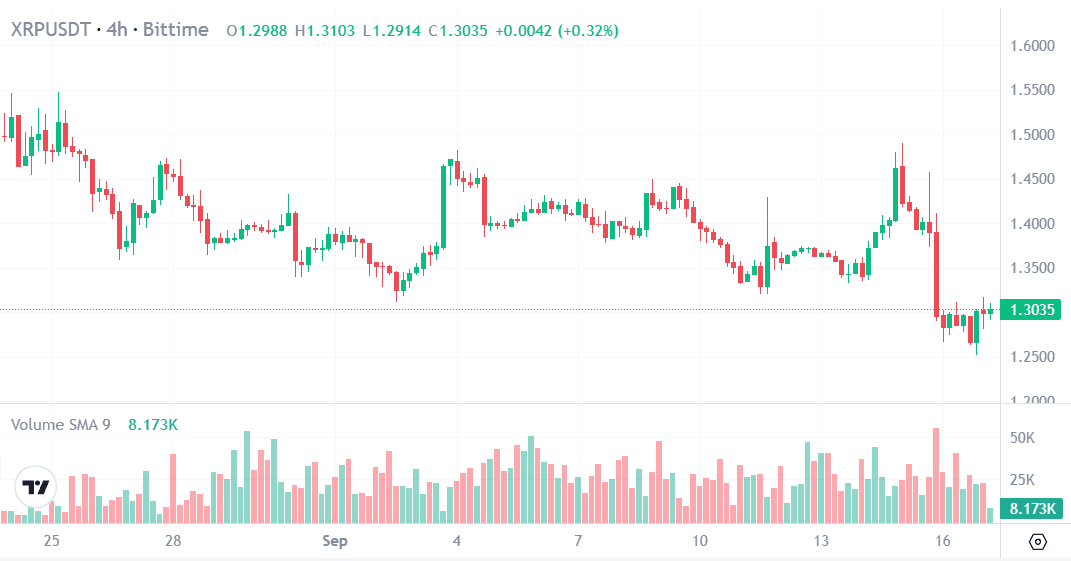
XRP price update today (September 17, 2026): Based on XRP/USDT chart data on Bittime, XRP price is starting to show signs of stabilization.
In the last 4-hour trading session, XRP opened at $1.2988, briefly rose to a high of $1.3103, fell to a low of $1.2914, then closed at $1.3035, or up slightly 0.32% compared with the previous session.
This small increase indicates XRP is starting to bounce from the oversold zone after the CLARITY Act selloff, although the price is still far below the $1.42 level before the vote took place.
This movement is in line with the consolidation projection mentioned earlier, in which XRP has not shown a breakout signal, but short-term selling pressure is starting to ease.
Read Also: 10 Largest RWA Crypto Asset Tokenizations in the World
Conclusion
The failure of the CLARITY Act vote in the US Senate did hit XRP price in the short term, but it does not change XRP's legal status, which had already been secured earlier through the 2023 court ruling and the March 2026 SEC-CFTC interpretation.
While Congress remains stuck in ethical debates and political interests ahead of the election, strong ETF inflows show institutional investors have not lost long-term confidence in XRP.
Going forward, XRP price direction will depend heavily on the SEC and CFTC's steps through rulemaking, as well as macro sentiment such as the Fed's interest rate decisions. As always, monitor data and do your own research before making investment decisions.
Check the price of Bitcoin (BTC), Ethereum (ETH), XRP, Solana (SOL), GRAM, and BNB as well as leading memecoin DOGE. You can trade directly on Bittime!

Bittime is a licensed Digital Financial Asset Trader (PAKD) platform supervised by the Financial Services Authority — where you can buy Bitcoin in Indonesia and hundreds of other crypto assets starting from Rp10,000. Registration is fast, secure, and can be started today.
Monitor USDT to IDR conversion and your favorite crypto asset price movements in real time. All available in one crypto investment app that you can download for free on the Play Store.
Ready to start? Register now at Bittime and execute your investment strategy with a platform trusted by millions of users in Indonesia.
FAQ
Why did XRP price fall after the CLARITY Act vote?
XRP price fell because the US Senate failed to pass the cloture motion for the CLARITY Act by a vote of 49-50, triggering concerns about delayed crypto regulatory certainty in the US. The decline also aligned with broad crypto market weakness.
What is the CLARITY Act and why is it important for XRP?
The CLARITY Act is a US crypto market structure bill that divides oversight authority over digital assets between the SEC and CFTC. The bill is important because it would provide long-term legal certainty for XRP and other crypto assets in the US.
Is XRP's legal status still safe even if the CLARITY Act fails?
Ripple states that XRP's status as a digital commodity remains in effect thanks to the 2023 court ruling and the March 2026 SEC-CFTC interpretation. However, this protection is a legal interpretation, not legislation, so it could change in the future.
When might the CLARITY Act be passed again?
The chance of passing the CLARITY Act in 2026 is getting smaller because Congress is approaching recess ahead of the November midterm elections. The process of discussing a similar bill will most likely have to be repeated next year.
What is the XRP price prediction after this event?
As of September 17, 2026, XRP is trading around $1.30, up slightly 0.32% and starting to bounce from its post-selloff low. Technically, XRP could consolidate in the $1.25 to $1.36 range in the near term, with the next direction heavily influenced by Fed policy and SEC-CFTC rulemaking steps.
Disclaimer: The views expressed belong exclusively to the author and do not reflect the views of this platform. This platform and its affiliates disclaim any responsibility for the accuracy or suitability of the information provided. It is for informational purposes only and not intended as financial or investment advice.

.png)