What Is Market Liquidity? Meaning, How It Works, and Why It Matters in Crypto
2026-05-21
In financial markets, especially cryptocurrency trading, market liquidity is one of the most important concepts investors need to understand. While many traders focus only on price movement, liquidity often determines how stable and efficient a market truly is.
Market liquidity refers to how easily an asset can be bought or sold without significantly affecting its price. In highly liquid markets, transactions happen smoothly because buyers and sellers are constantly active. In contrast, low-liquidity markets tend to experience sharp volatility and unstable price action.
Key Takeaways
- Market liquidity measures how easily assets can be traded without major price changes.
- High liquidity generally leads to tighter spreads and lower volatility.
- Low-liquidity crypto markets are more vulnerable to slippage and price manipulation.
What Is Market Liquidity?
Market liquidity is the ability of a financial market to facilitate the buying and selling of assets quickly and efficiently. A liquid market usually has strong trading activity, high transaction volume, and narrow bid-ask spreads.
According to Investopedia, liquid assets can be converted into cash rapidly without losing significant value. In crypto markets, Bitcoin and Ethereum are considered highly liquid because they trade across major exchanges worldwide with billions of dollars in daily volume.
On the other hand, smaller altcoins with limited trading activity often suffer from low liquidity, making prices easier to manipulate.
How Market Liquidity Works
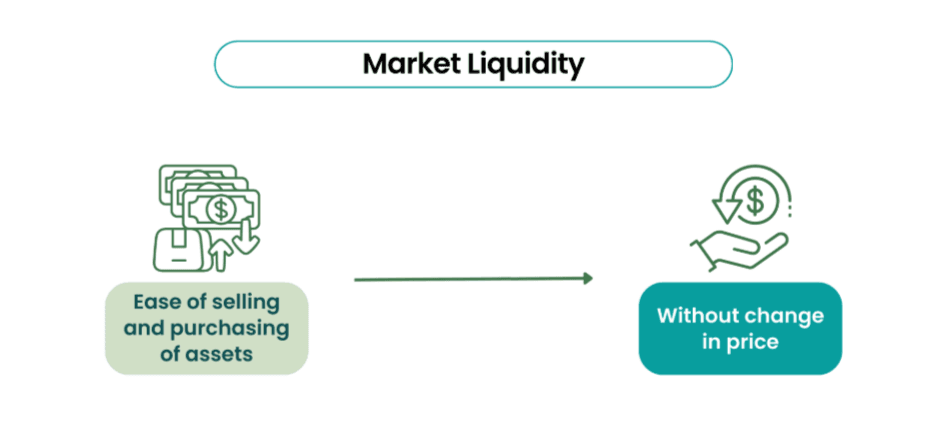
Market liquidity works through the interaction between buyers and sellers. When there are many active participants placing buy and sell orders, trades can be executed efficiently with minimal price impact.
Liquidity in crypto markets is also supported by market makers and liquidity providers. These participants continuously place orders to maintain healthy trading activity and reduce price gaps.
Several indicators are commonly used to measure liquidity:
- Daily trading volume
- Bid-ask spread
- Order book depth
- Trade execution speed
A narrow spread typically indicates strong liquidity, while a wide spread suggests lower market efficiency.
Slippage is another important concept tied to liquidity. It occurs when a trade executes at a different price than expected due to insufficient market depth. In decentralized finance (DeFi), slippage becomes more noticeable during large token swaps.
Types of Market Liquidity
1. Market Liquidity
This refers to the liquidity of the overall market and how efficiently assets can be traded.
2. Accounting Liquidity
Accounting liquidity measures the ability of individuals or companies to meet short-term financial obligations using liquid assets.
In crypto trading, market liquidity is generally the more relevant metric because it directly affects trading conditions and price stability.
Why Market Liquidity Matters in Crypto
Liquidity plays a critical role in maintaining healthy cryptocurrency markets. Highly liquid markets tend to attract institutional investors because they offer smoother execution and lower trading costs.
Low-liquidity markets can create several risks, including:
- Extreme volatility
- High slippage
- Price manipulation
- Difficulty exiting positions
This issue often appears in newly launched meme coins or low-cap tokens where even a single large trade can trigger massive price swings.
According to reports cited by CoinDesk and Cointelegraph, institutional demand through Bitcoin ETFs during 2025 helped strengthen overall crypto market liquidity by increasing capital inflows and trading activity.
Factors That Affect Market Liquidity
Several factors influence liquidity levels in financial markets:
Trading Volume
Higher trading activity generally increases liquidity.
Number of Market Participants
More buyers and sellers create a healthier and more stable market.
Exchange Listings
Assets listed on major exchanges typically enjoy stronger liquidity.
Market Sentiment
Positive or negative news can rapidly affect trading activity.
Regulation
Government policies and regulatory clarity also influence liquidity conditions.
Risks of Low Market Liquidity
Low liquidity can become a serious problem for traders, especially in volatile crypto markets.
Common risks include:
- Large price swings
- High slippage
- Pump-and-dump schemes
- Difficulty selling assets
- Increased market manipulation
For this reason, experienced traders often analyze trading volume and order book depth before entering a position.
Conclusion
Market liquidity is one of the core foundations of modern financial markets, including cryptocurrency. It determines how efficiently assets can be traded without causing drastic price changes.
In crypto markets, strong liquidity usually signals stability, investor confidence, and healthy market participation. Understanding how market liquidity works can help investors reduce trading risks and make better financial decisions.
FAQ
What is market liquidity?
Market liquidity refers to how easily an asset can be bought or sold without significantly affecting its price.
Why is liquidity important in crypto?
High liquidity improves trading efficiency, reduces slippage, and creates more stable price action.
Which crypto assets have high liquidity?
Bitcoin and Ethereum are among the most liquid cryptocurrencies due to their massive trading volume.
What happens in low-liquidity markets?
Low-liquidity markets often experience sharp volatility, price manipulation, and wider spreads.
How do traders measure liquidity?
Traders usually analyze trading volume, bid-ask spreads, and order book depth to evaluate liquidity.
How to Buy Crypto on Bittime?

Want to trade sell buy Bitcoins and crypto investment easily? Bittime is here to help! As an Indonesian crypto exchange officially registered with Bappebti, Bittime ensures every transaction is safe and fast.
Start with registration and identity verification, then make a minimum deposit of IDR 10,000. After that, you can immediately buy your favorite digital assets!
Check the exchange rate BTC to IDR, ETH to IDR, SOL to IDR and other crypto assets to find out today's crypto market trends in real-time on Bittime.
Also, visit the Bittime Blog for interesting updates and educational information about the crypto world. Find reliable articles about Web3, blockchain technology, and digital asset investment tips designed to enrich your crypto knowledge.
Disclaimer: The views expressed belong exclusively to the author and do not reflect the views of this platform. This platform and its affiliates disclaim any responsibility for the accuracy or suitability of the information provided. It is for informational purposes only and not intended as financial or investment advice.

.png)