Tips for Finding the Best Altcoins Before the Next Bull Run
2026-06-22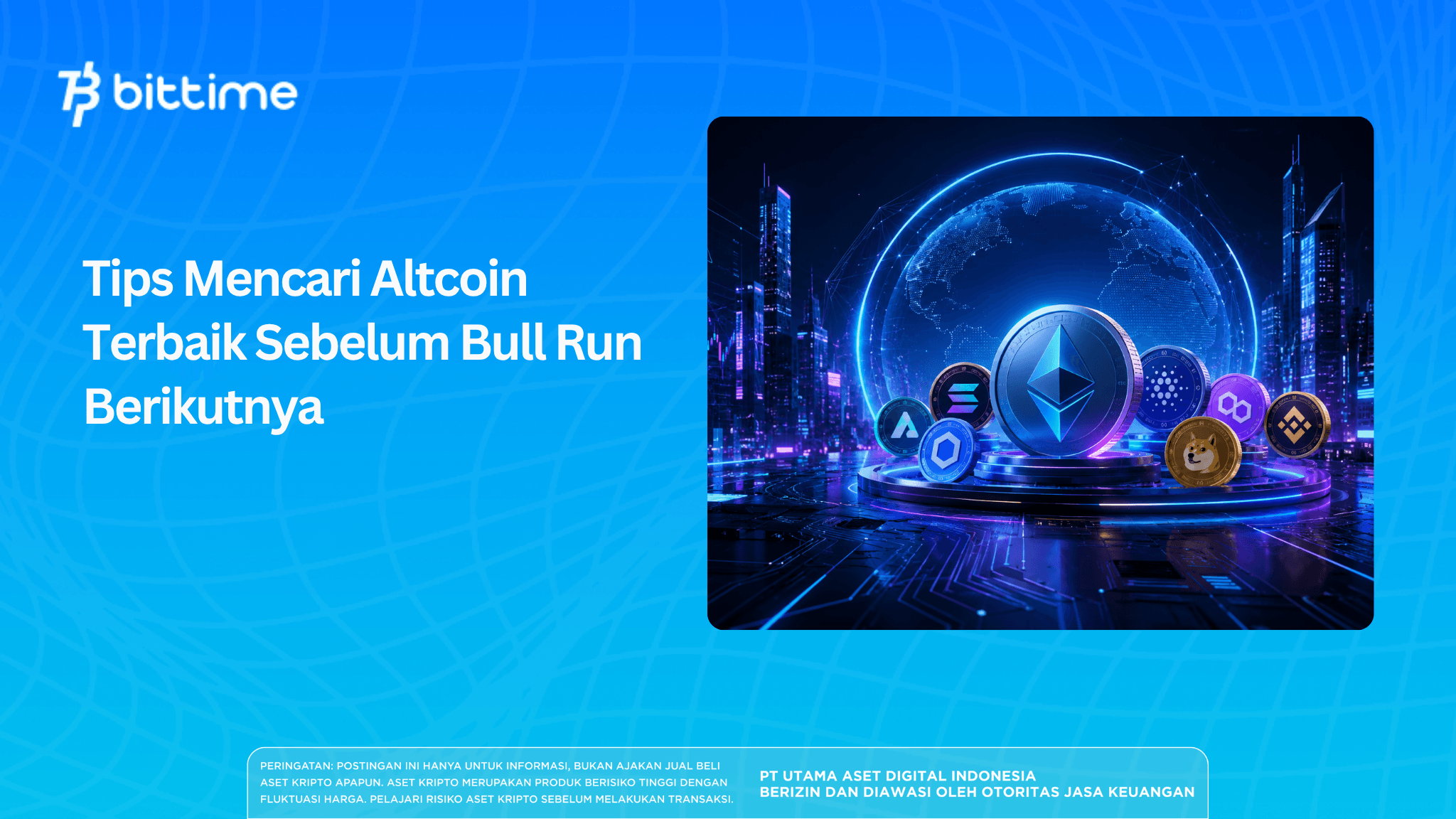
Amid the uncertainty in the 2026 crypto market, many investors are wondering: how can they find the best altcoins to invest in before the next bull run arrives?
Altseason typically occurs after Bitcoin dominates the market and capital then shifts to altcoins with strong fundamentals. However, with more than 20,000 altcoins in circulation, finding the ones with real potential is no easy task.
Choosing the right altcoin requires in-depth research, not just jumping on the hype bandwagon or giving in to FOMO.
Key Takeaways
- Focus on the project with real utility and healthy tokenomics, not just a hype narrative or meme coin.
- Always check liquidity, market cap, listing on a trusted exchange, and avoid red flags such as anonymous teams or large token unlocks.
- Build a watchlist build a strong narrative (AI, RWA, DeFi infrastructure) and monitor on-chain metrics regularly before deciding on a long-term investment.
Register at Bittime now and start trading crypto with a fast, safe, and easy process in the app.
Understanding Market Cycles and When Altseason Typically Occurs
Before discussing how to find the best altcoins, it’s important to understand the market context. Crypto bull runs are typically led by Bitcoin. When BTC reaches its peak and its dominance begins to decline, capital tends to flow into altcoins—this is what’s known as “altseason.”
In bearish or "scared market" phases, such as those seen in mid-2026, altcoins typically fall more sharply than Bitcoin. This is precisely where research opportunities arise, as many good projects are trading at lower valuations. However, remember: a low price doesn't guarantee a rise. Many altcoins die after the hype passes.
Read also: Bitcoin Price Today Down: Market Analysis and Opportunities for Crypto Altcoins
Step 1: Fundamental Research-Utility and Solved Problems
The first step in altcoin research is understanding what the project actually does. Does it solve a real problem?
Look for altcoins that have a clear use case, for example:
- Layer-1 blockchain with high speed and low fees
- Real World Assets (RWA) project that tokenizes traditional assets
- DeFi infrastructure or AI agents are developing
- Oracles or data providers like Chainlink that support a broader ecosystem
Read the whitepaper or official documentation. Compare it to competitors in the same niche. Projects that only offer "potential" without real execution usually don't last long.
Read also: Why Hasn't Altseason Arrived? Altcoin vs Bitcoin Divergence That Can't Be Ignored
Step 2: Tokenomics and Supply Structure Analysis
Poor tokenomics is one of the main causes of altcoin failure. Consider the following:
- Total supply dan circulating supply
- Token allocation for the team, investors, and community (avoid if the team controls too large a portion)
- Burn, staking, or utility mechanisms that create buying pressure
- Massive token unlock-unlock schedules often lead to selling pressure
Projects with transparent tokenomics and long-term incentives are usually more attractive for long-term altcoin investments.
Step 3: Check Market Cap, Liquidity, and Trading Volume
Market cap provides an indication of a project's size. Altcoins with low market caps (under $50–100 million) have the potential for high returns, but they also carry much greater risk—they could lose everything.
Liquidity and daily volume are crucial. Coins with low volume are difficult to sell when the price drops without causing significant slippage. It's best to prioritize projects listed on leading centralized exchanges (Binance, Coinbase, Kraken, etc.) over smaller DEXs.
Read also: Altcoin Season 2026: Has It Already Started or Is It Too Early?
Step 4: Evaluate Team, Community, and Reputation
A credible team with a proven track record is one of the most important factors. Check:
- Founder's previous experience in the crypto or technology industry
- Is the team doxxed (open identity) or anonymous?
- Community activity on Twitter/X, Discord, Telegram-is it organic or just bots?
- Reputation on forums like Reddit or Crypto Twitter
A strong and active community is often an early indicator of adoption. However, be wary of communities that are too sloppy and lack substantive discussion.
Step 5: Monitor On-Chain Metrics and Real-Time Activity
In 2026, on-chain data will become increasingly important. Use tools like:
- DefiLlama (for TVL and DeFi activity)
- Dune Analytics
- Nansen or Arkham (for whale cash flow)
- Terminal Token (for protocol revenue)
Look for a consistent increase in active users, daily transactions, or revenue. Projects with real activity are typically more resilient to market corrections.
Read also: Altcoin Season 2026: Is the Altcoin Season About to Begin?
Avoid Often Ignored Red Flags
Based on the experience of many investors, here are some danger signs to watch out for:
- Anonymous team without a clear roadmap
- Unfair token allocation (team/investors control >30-40%)
- Excessive marketing without a product that works
- Promise of high returns or “guaranteed profit”
- There are no smart contract audits from reputable firms.
- Excessive hype on social media without any supporting fundamentals
Many cases of rug pulls and scams occur because investors ignore the steps above.
Read also: Bitcoin Dominance vs Altseason: How to Read It
Practical Strategies for Building an Altcoin Watchlist
- Choose 3–5 key narratives that you believe in for the next cycle (e.g., AI infrastructure, RWA, decentralized physical infrastructure/DePIN, or scaling solutions).
- List 10–15 projects in the narrative.
- Conduct in-depth research using the framework above.
- Monitor metrics regularly and update the watchlist every month.
- Use Dollar Cost Averaging (DCA) when entering, don't go all-in at once.
- Allocate most of your portfolio to BTC and ETH as a foundation, then allocate the rest to potential altcoins.
Risks That Beginner Investors Often Ignore
Altcoin investments are highly volatile. In addition to market risk, there are regulatory risks, technical risks (smart contract bugs), and liquidity risks. Never invest money you can't afford to lose. Many people have lost significant capital due to overexposure to high-risk altcoins during bull runs.
Always diversify and set risk management rules before buying.
Check the prices of Bitcoin (BTC), Ethereum (ETH), XRP, Solana (SOL), and BNB, as well as the popular meme coin DOGE. You can trade directly on Bittime!
Conclusion
Finding the best altcoins to invest in before the next bull run requires patience, disciplined research, and the ability to control your emotions. No method is 100% accurate, and even projects with the strongest fundamentals can fail due to macro market conditions or poor execution.
Start by understanding market cycles, conduct systematic fundamental research, pay attention to tokenomics and liquidity, and always be on the lookout for red flags. Build a well-thought-out watchlist and use a DCA strategy. Most importantly: do your own research (DYOR) and only invest according to your risk profile.
The crypto market offers huge opportunities, but also equally huge risks. Prepare yourself with solid knowledge—that’s the best way to face the next bull run.
Bittime is a licensed and regulated Digital Financial Asset Trader (PAKD) supervised by Indonesia’s Financial Services Authority (OJK) — where you can buy Bitcoin in Indonesia and hundreds of other crypto assets starting from just Rp10,000. The registration process is fast, secure, and you can get started today.
Track USDT to IDR conversions and monitor your favorite crypto assets in real time. Everything is available in one crypto investment app that you can download for free on the Play Store
Ready to start? Register now on Bittime and execute your investment strategy with a platform trusted by millions of users in Indonesia.
FAQ
What is meant by altseason in crypto?
Altseason is a period when altcoins experience significant price increases, typically after Bitcoin dominates the market and capital flows into altcoins. This period is often characterized by declining Bitcoin dominance and large pumps in many fundamentally sound altcoins.
Why is fundamental research important when choosing altcoins?
Fundamental research helps ensure that the selected altcoin has real utility and solves relevant problems, rather than simply following hype. Without sound research, investors risk buying projects that are only driven by fleeting sentiment and easily collapse once the hype subsides.
What should you pay attention to in altcoin tokenomics?
Pay attention to the total supply, circulating supply, token allocation to the team and investors, and burn or staking mechanisms. Poor tokenomics, such as excessive team allocations or opaque unlock schedules, are often the cause of selling pressure and long-term project failure.
How to avoid the risk of rug pull on altcoins?
Avoid projects with anonymous teams, excessive marketing without a real product, and unfair token allocation. Always check that the smart contract has been audited by a reputable firm, that liquidity has been burned or locked, and that the community is organic, not just bots or shills.
What strategies are recommended for building an altcoin portfolio?
Select 3–5 strong narratives (such as AI, RWA, or DeFi infrastructure), create a watchlist, and conduct in-depth research using a fundamental framework. Use a Dollar Cost Averaging (DCA) strategy, allocate the majority of your portfolio to BTC and ETH, and always implement strict risk management.
Disclaimer: The views expressed belong exclusively to the author and do not reflect the views of this platform. This platform and its affiliates disclaim any responsibility for the accuracy or suitability of the information provided. It is for informational purposes only and not intended as financial or investment advice.

.png)