What Is a Stock Market Simulator? How to Simulate Stock Trading
2026-08-18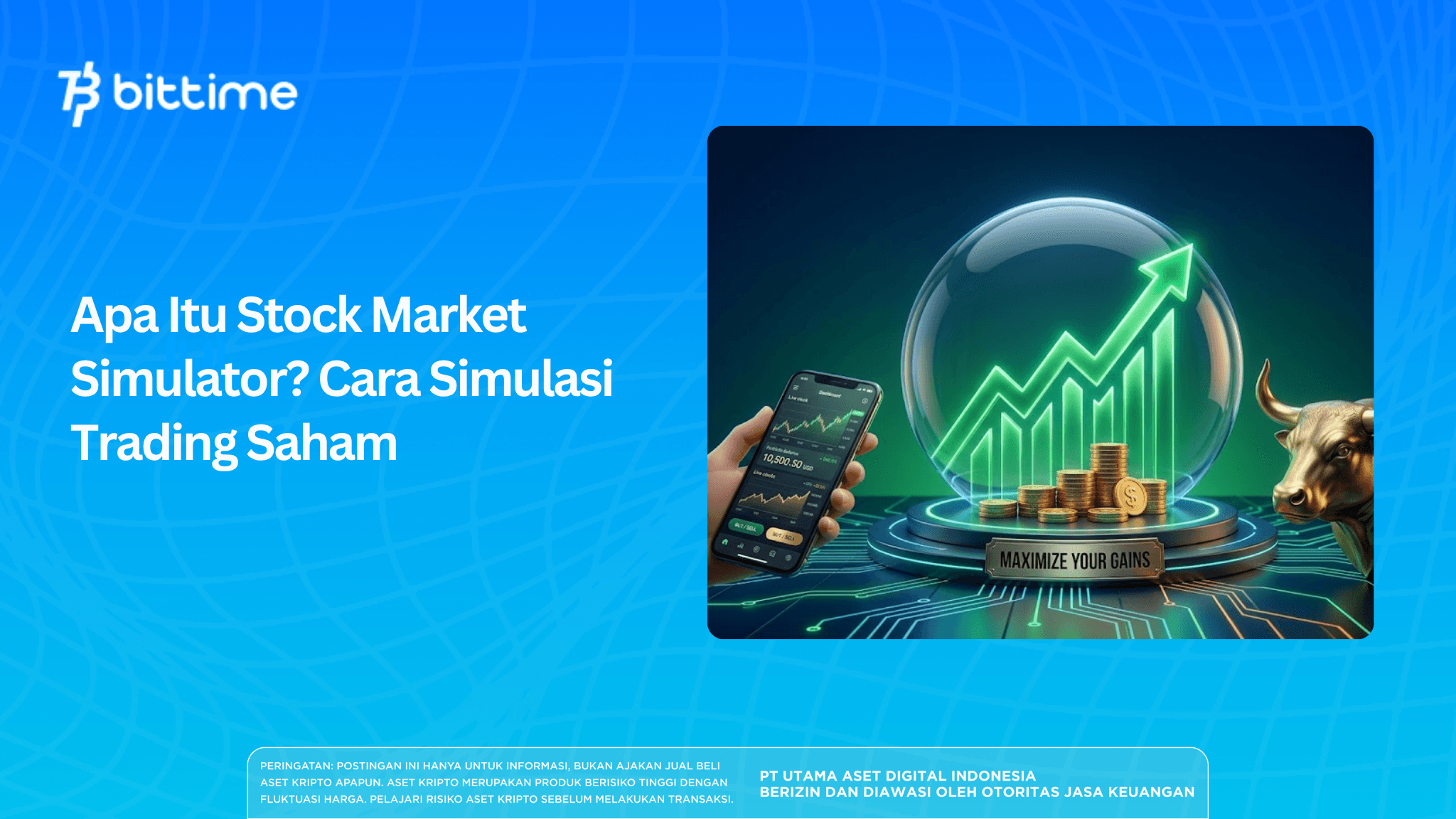
Every year, thousands of new people jump into the stock market with real capital—without ever having felt what it's like to see a portfolio turn red in minutes. GoatFundedTrader notes that around 90% of retail traders actually lose money, and most stop trading in less than two years due to lack of preparation.
Stock market simulators emerge as a middle ground: practice platforms that allow anyone to try buying and selling stocks with virtual money, complete with real-time market data, before risking real money.
The question is, what exactly is a stock market simulator in more detail, and why are more and more beginners as well as experienced traders relying on it before entering the real market?
Key Takeaways
- A stock market simulator is a stock trading practice platform with virtual money and real-time market data, without the risk of losing real money.
- Popular simulators like Wall Street Survivor, Webull, and Interactive Brokers provide virtual capital ranging from $100,000 to $1 million.
- Sharekhan Financial Blog notes that simulators can cut loss risk for beginner traders by up to 50%.
What Is a Stock Market Simulator and How Does It Work?
A stock market simulator is an application or platform that mimics real stock market conditions using virtual money. Another term often used for this is paper trading—you place buy and sell orders, monitor price movements, and build a portfolio, but it's all just on paper.
How it works is quite simple. Platforms like Wall Street Survivor give a virtual starting capital of $100,000 with access to real-time market data for stocks, ETFs, crypto, and options. Every price movement and order execution is made as close as possible to the real market, including NYSE and NASDAQ.
Behind the scenes, a good simulator runs a matching engine that processes transactions based on real market data, complete with simulated slippage and transaction fees.
According to GoatFundedTrader, simulators that only rely on daily closing prices or perfect execution actually train traders for an unrealistic market—not a reflection of true conditions.
Interestingly, this risk-free practice principle doesn't just apply to stocks. If you're more interested in exploring crypto assets, you can directly practice on an OJK-supervised platform with Bittime and start understanding the dynamics of the digital market from the outset.

Illustration: AI-generated image
Why Is a Stock Trading Simulator Important for Beginners as well as Experienced Traders?
For beginners, a simulator becomes a safe space to make their first mistakes—typing the wrong stock code, choosing the wrong order type, or forgetting to set a stop-loss. NerdWallet likens this to a student learning to drive who first tries it in an empty lot, not directly on the highway.
Data supports this benefit. Sharekhan Financial Blog notes that more than 70% of new traders use a simulator before actually investing with real money. This habit has proven effective: users who regularly practice on a simulator report a reduction in loss risk of up to 50% compared to those who jump in without practice.
Simulators are not just for beginners. Experienced traders use them to test new strategies—from short selling and options trading to extreme volatility scenarios—without risking their real portfolio.
Also Read: Nvidia's $500 Billion AI Funding, AI Crypto Tokens Also Benefiting?
Bankrate notes that 80% of simulator users report increased confidence after practicing regularly, while more than half of users specifically use it to test trading strategies.
There is one often underestimated benefit: emotional control. Warren Buffett often emphasizes that emotional discipline is the key to long-term investor success.
Simulators provide an initial picture of the psychological pressure when prices move wildly—although, as noted by GoatFundedTrader, the pain of losing virtual money is still not exactly the same as losing real money.
Also Read: Popular Tokenized Stocks in 2026: Technology Stocks Become Investor Favorites
Best Stock Trading Simulator Recommendations for Practice
If you're looking for trading simulator recommendations to start practicing, here are some of the most highly recommended platforms based on reviews from NerdWallet and Wall Street Survivor:
- Wall Street Survivor — $100,000 virtual capital, real-time data for stocks, ETFs, crypto, and options. Claimed as the #1 stock simulator by Corporate Finance Institute, equipped with monthly prize contests.
- Interactive Brokers (IBKR) — virtual capital up to $1 million with access to almost all types of instruments offered by the broker. Suitable for advanced traders, though less beginner-friendly because you must open an account first.
- Webull — unlimited virtual capital and can be tried without opening an account (limited features). Its simple interface makes it suitable for beginners just learning to read charts.
- Moomoo — $1 million virtual capital with complete charts and various order types. Can be tried via preview with just an email before full registration.
- thinkorswim by Charles Schwab — paperMoney mode with $100,000 capital, realistically simulating spreads and execution delays.
- Investopedia Stock Simulator — free with $100,000 capital, covering stocks, ETFs, options, and a selection of crypto, plus a user competition feature.
Each has different strengths—IBKR excels in instrument variety, Webull in ease of access, while Wall Street Survivor excels in integrated education.
Also Read: Tokenized Stocks vs Traditional Stocks: Definition, Differences, and How to Buy
Conclusion
A stock market simulator is not just a digital toy for trying out buying and selling stocks. This tool is a structured practice space that separates the process of learning market mechanics from real financial risk—and data from various studies shows its impact is real, not just marketing claims.
However, simulators have limits. They cannot simulate the psychological burden of losing real money, nor do they always perfectly replicate the liquidity and execution quirks of real brokers. Therefore, the most realistic way to use them is as a gradual bridge: practice with discipline for several months, record every decision, and only then move to real capital in small amounts.
Monitor US stock tokens: AMZON, AMDON, TSLAX, NFLXON MSFTON and many more, you can start trading on Bittime.

Bittime is a licensed Digital Financial Asset Trader (PAKD) platform supervised by the Financial Services Authority — where you can buy Bitcoin in Indonesia and hundreds of other crypto assets starting from Rp10,000. The registration process is fast, secure, and can be started today.
Monitor USDT to IDR conversion and the price movements of your favorite crypto assets in real-time. All available in one crypto investment app that can be downloaded for free on the Play Store.
Ready to start? Register now at Bittime and execute your investment strategy with a platform trusted by millions of users in Indonesia.
FAQ
Is a stock market simulator paid?
The majority are free, such as Wall Street Survivor, Webull, and Investopedia Simulator. Some platforms like Interactive Brokers require opening an account first, although the simulation itself is free of charge.
How much virtual capital do simulator platforms usually provide?
It varies, ranging from $100,000 on Wall Street Survivor and Investopedia to $1 million on Interactive Brokers and Moomoo. Webull even provides unlimited virtual capital.
Does the profit result in the simulator reflect performance in the real market?
Not entirely. Simulators struggle to replicate the emotional pressure of losing real money and the liquidity quirks of real brokers, so the results are better used as an indicator of technical understanding, not a guarantee of real profit.
Can a stock market simulator be used for crypto trading practice?
Some platforms like Wall Street Survivor and Investopedia Simulator already provide limited crypto simulations. For more focused crypto practice, licensed platforms like Bittime can be an option once you understand the basics.
How long is ideal to practice on a simulator before trading with real money?
GoatFundedTrader recommends consistent practice for at least three months before switching to real capital. This duration provides enough time to test strategies in various market conditions, both bullish and bearish.
Disclaimer: The views expressed belong exclusively to the author and do not reflect the views of this platform. This platform and its affiliates disclaim any responsibility for the accuracy or suitability of the information provided. It is for informational purposes only and not intended as financial or investment advice.

.png)