What Is Short Selling? How Traders Profit When Prices Drop
2026-09-16
When the market declines, some traders still have opportunities to profit through a strategy called short selling. Unlike regular trading, which seeks profit from rising prices, short selling allows traders to profit when an asset’s price falls.
So, what kind of strategy is short selling, and how does it work? Simply put, short selling involves selling a borrowed asset first and then buying it back when the price falls.
However, this strategy does not only offer profit opportunities. Short selling also carries high risks because losses can increase if the price moves against the prediction.
Key Takeaways
- Short selling allows traders to profit when prices fall.
- This strategy requires sound market analysis and risk management.
- The risks of short selling are higher because losses can increase when prices rise.
What Is Short Selling?
The definition of short selling is trading strategy that involves selling an asset before owning it, with the aim of buying it back at a lower price.
In practice, traders borrow an asset from a broker or trading platform and then sell it in the market. If the price falls as predicted, the trader can buy the asset back at a lower price and profit from the price difference.
This strategy is typically used when traders see signs that an asset may experience a price decline.
Read also: Trading Crypto Futures in Indonesia? Here Are the 2026 OJK Rules You Need to Understand
How Short Selling Works in Trading
Understanding how short selling works is important before using this strategy because its mechanism differs from regular trading.
In general, the short selling process consists of several stages:
1. Borrow the Asset
The trader borrows an asset from a broker or platform that provides short selling features.
The asset is then sold in the market at its current price.
2. Wait for the Price to Fall
The trader expects the asset price to fall in line with the analysis.
The larger the price decline, the greater the potential profit.
3. Buy Back the Asset
The trader buys back the asset that was previously sold.
The asset is then returned to the lender.
4. Take the Price Difference
The profit comes from the difference between the initial selling price and the repurchase price.
However, if the price rises, the trader incurs a loss because they must buy the asset back at a higher price.
Read also: Legal Crypto Apps in Indonesia 2026: How to Check OJK-Licensed Platforms
Example of Short Selling in Trading
Here is a simple example of short selling:
A trader predicts that the price of asset XYZ will fall.
The steps:
- The trader borrows 100 shares of XYZ.
- The price at that time is Rp10,000 per share.
- The asset is sold for Rp1 million.
- The price falls to Rp8,000.
- The trader buys back 100 shares at a cost of Rp800,000.
- The Rp200,000 difference becomes the profit before transaction fees.
Conversely, if the price rises to Rp12,000, the trader must buy the shares back for Rp1.2 million, resulting in a loss.
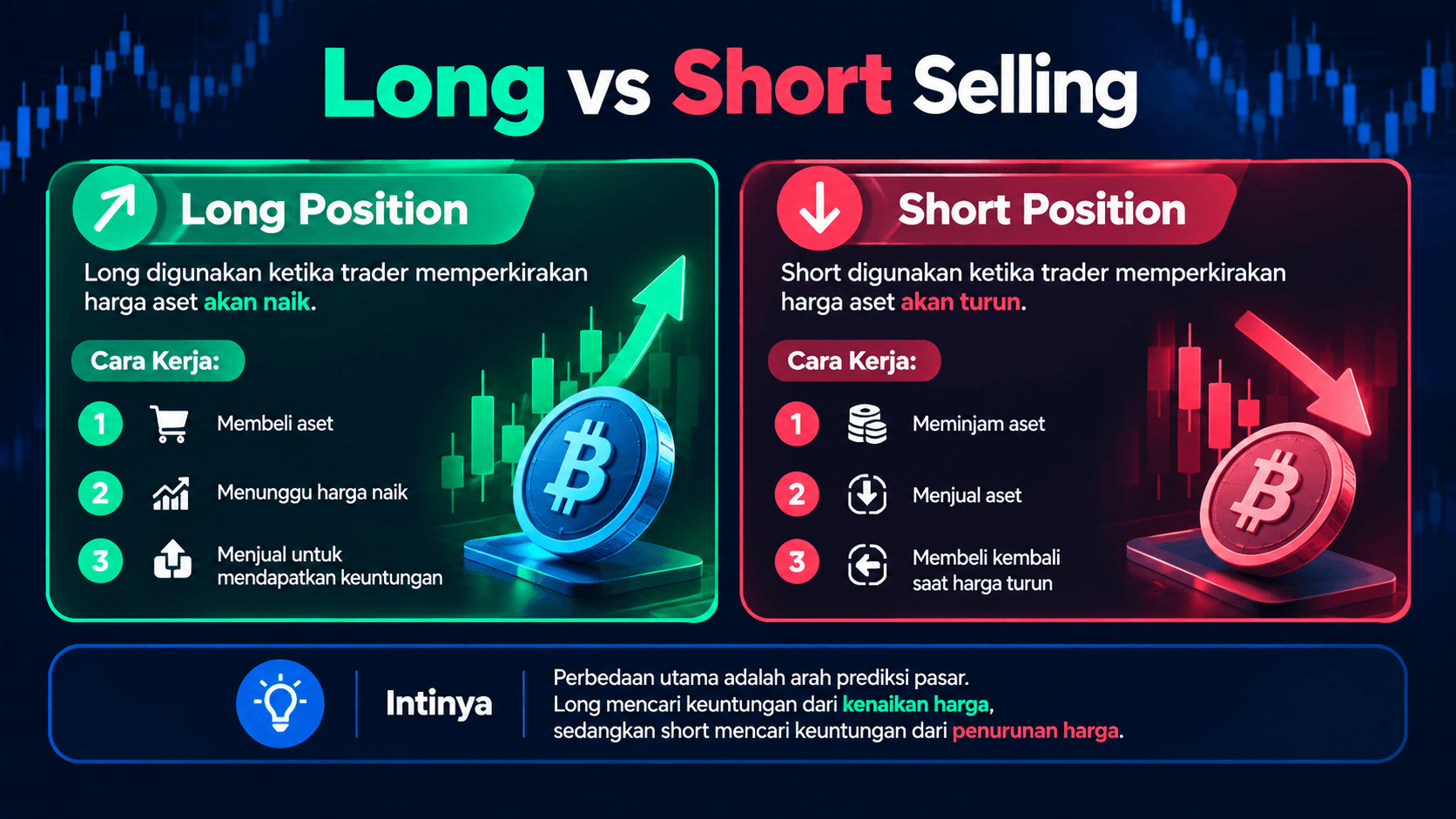
Differences Between Long and Short Selling
There are two main position directions in trading: long and short.
Long Position
Long is used when a trader expects the asset price to rise.
How it works:
- Buy the asset.
- Wait for the price to rise.
- Sell to make a profit.
Short Position
Short is used when a trader expects the asset price to fall.
How it works:
- Borrow the asset.
- Sell the asset.
- Buy it back when the price falls.
The main difference is the direction of the market prediction. Long seeks to profit from rising prices, while short seeks to profit from falling prices.
Read also: Futures Liquidation Conditions: When Can a Trader’s Position Be Liquidated?
Types of Short Selling You Should Know
There are several common types of short selling.
1. Covered Short Selling
Covered short selling involves borrowing the asset first before selling it.
This method is more commonly used because its mechanism is more clearly defined.
2. Naked Short Selling
Naked short selling is carried out without borrowing the asset first.
This type carries higher risks and is subject to strict rules in some markets.
3. Short Selling Through Derivatives
Traders can also conduct short selling through futures, margin trading, or perpetual contracts.
This method is widely used in the crypto market because it allows traders to take positions when prices fall.
Read also: How to Protect a Crypto Spot Portfolio with Futures
How to Short Sell for Beginners
For beginners, understanding the basic steps is essential before trying this strategy.
Here are the general steps for short selling:
- Choose a trading platform that provides a short-selling feature.
- Analyze market conditions using technical indicators.
- Determine the entry area and price target.
- Use a stop-loss to limit risk.
- Avoid using excessive leverage.
Short selling requires discipline because adverse price movements can cause significant losses.
Read also: Margin Call in Crypto Futures? Do This to Avoid Liquidation
Indicators Commonly Used by Short Traders
Traders typically use several indicators to identify short opportunities.
RSI (Relative Strength Index)
RSI can help identify overbought conditions when the price is considered to have risen too high.
Support and Resistance
A price that fails to break through resistance can be an area watched by short traders.
Moving Average
Moving average crossovers can help identify changes in trend direction.
Trading Volume
A price decline accompanied by high volume is usually watched more closely because it indicates strong selling pressure.
Read also: Differences Between Crypto Spot and Futures for Beginner Traders
Example of Short Selling in the Crypto Market
In the crypto market, short selling is often used when traders expect an asset to undergo a correction.
For example, when Bitcoin rises too quickly and signs of weakening momentum appear. Some traders may take short positions in the hope of profiting when the price falls.
However, the crypto market is highly volatile, so price movements can change rapidly.
Short Selling Risks You Should Understand
Although it offers profit opportunities, short selling carries significant risks.
Unlimited Losses
In a long position, the maximum loss is usually the amount of capital used.
However, in short selling, the asset price can continue to rise, causing potential losses to become larger.
Short Squeeze
A short squeeze occurs when many traders take short positions, but the price instead rises sharply.
Traders who incur losses typically buy back the asset to close their positions, increasing buying pressure.
Leverage Risk
The use of leverage can increase profits but can also magnify losses.
Is Short Selling Suitable for Beginners?
Short selling is not an ideal strategy for every trader.
Before trying this strategy, beginners need to understand:
- Technical analysis.
- Risk management.
- Trading psychology.
- The use of leverage.
- How to read market trends.
Beginner traders should start by understanding the mechanism before using significant amounts of capital.
Trading and Market Strategy Updates
Understanding strategies such as short selling requires continuously updated market information.
If you want to follow crypto news, market analysis, and the latest developments in digital assets, you can monitor updates through Bittime to help understand market conditions before making trading decisions.
Conclusion
Short selling is a trading strategy that allows traders to profit when an asset’s price declines.
By understanding how short selling works, examples of its use, the types of strategies, and their risks, traders can use this method more wisely.
Although it can provide profit opportunities in a bearish market, short selling carries high risks and therefore requires sound analysis, discipline, and risk management.

Bittime is a licensed Digital Financial Asset Trader (PAKD) platform licensed and supervised by the Financial Services Authority (OJK) — where you can buy Bitcoin in Indonesia and hundreds of other crypto assets starting from Rp10,000. The registration process is fast and secure, and you can get started today.
Monitor USDT to IDR and your favorite crypto asset price movements in real time. Everything is available in one crypto investment app that can be downloaded for free from the Play Store.
Ready to get started? Sign up on Bittime now and execute your investment strategy with a platform trusted by millions of users in Indonesia.
FAQ
What is short selling?
Short selling is a trading strategy that involves selling an asset first and then buying it back when the price falls to make a profit.
How does short selling work?
The trader borrows an asset, sells it, and then buys it back when the price falls. The price difference becomes a profit or loss.
Is short selling safe?
Short selling carries high risks because an asset’s price can rise without limit, causing losses to increase.
What is an example of short selling?
A trader sells an asset at a high price and then buys it back when the price falls to earn a profit from the price difference.
What are the types of short selling?
Types of short selling include covered short selling, naked short selling, and short selling through derivatives.
Disclaimer: The views expressed belong exclusively to the author and do not reflect the views of this platform. This platform and its affiliates disclaim any responsibility for the accuracy or suitability of the information provided. It is for informational purposes only and not intended as financial or investment advice.

.png)