RWA Crypto 2025: Prospects, Risks, and Comparison of Major Protocols (WAT, Ondo, Centrifuge)
2025-10-19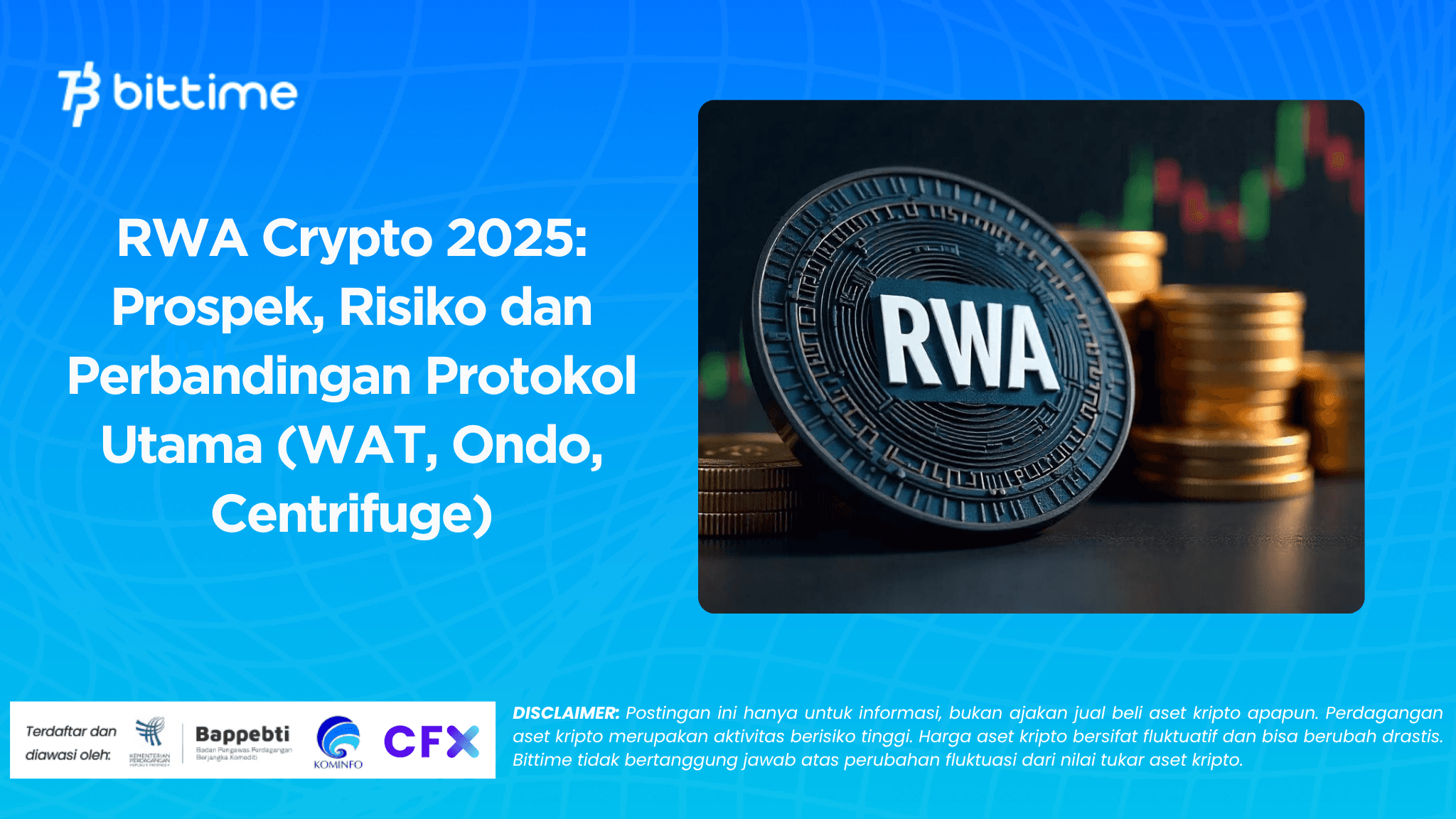
The tokenization of real-world assets or Real World Assets (RWA) is a major trend in the world of DeFi and crypto in 2025. This concept transforms physical assets such as real estate, gold, and government bonds into digital tokens on the blockchain.
This allows assets that were previously difficult to access to be traded globally with high transparency.
RWA is not just about technology. It is a bridge between traditional finance and the DeFi ecosystem. Many investors see it as a way to earn stable on-chain yields through assets that have real value.
Read also: Benefits of Real-World Asset (RWA) Tokenization Development on the XRP Ledger
What is RWA and why is it in the spotlight in 2025
Real-world asset tokenization is the process of converting physical or traditional assets such as property, bonds, gold, or debt into digital tokens on the blockchain.
This allows assets that were previously difficult to access or trade to become more “liquid,” more accessible, and fractionally owned.
Several reasons why RWA is trending in 2025:
- The traditional asset market is huge, but many parts are “stuck” due to low liquidity or limited access. Tokenization can open up new access.
- Integration with DeFi: fixed assets can be used as collateral, on-chain yield, combined with decentralized finance applications.
- Regulations and infrastructure are maturing, so RWA projects are no longer just “pilots” but are entering real scale.
Opportunities on the horizon
Let's look at some of the key benefits:
- Fractional access: You don't have to buy an entire building or a large bond; through tokenization, you can buy “small pieces.”
- Better liquidity: Assets that were previously difficult to sell can become easier to trade on the blockchain.
- Stable yield: Since the underlying assets can be bonds or properties that generate cash flow, there is the potential for yields that differ from speculative crypto.
- Investor inclusion: More people can participate, as large amounts of capital are not required as in traditional investments.
Risks to consider
Of course, not everything is smooth sailing. Some challenges include:
- Regulation and ownership rights: Tokenization involves real-world assets, which means there must be legal structures and regulatory certainty.
- Limited liquidity: Despite the promise of high liquidity, in reality, many RWA tokenizations have low trading volumes or limited secondary markets.
- Underlying asset risk: If the physical asset is problematic (damaged property, delayed projects, bond defaults), the token could lose value.
- Technical and operational integration: Many protocols must build verification procedures, audits, custodians, smart contracts, and everything must work in tandem.
In short, RWA is an exciting opportunity, but it is not without obstacles.
Read also: What is MBG (Multibank Group) Token? A Crypto RWA Project Listed on Bittime
Main protocol 1: WAT Protocol (WorldAssets)
Let's start with a protocol that may be less familiar than the next two, but has an interesting concept, namely the WAT Protocol from WorldAssets.
WorldAssets has built a protocol called the WAT Protocol, which aims to tokenize global physical assets (real estate, gold, energy) onto the blockchain using the ERC-20 standard.
What makes WAT interesting
- WAT uses two types of tokens: one token called “ATC” as an asset ownership token, and “INC” as a yield token synchronized with asset income.
- This protocol has launched the tokenization of gold (custody in Hong Kong) and real estate in Canada & Dubai, as well as natural energy in Turkmenistan, if quoted.
- There are plans to open a global asset provider in Q3 2025, which means that the scale could be large if it goes ahead.
Risks & considerations
- As the protocol is still in the “global rollout” phase, operational, legal, and adoption risks remain very real.
- For investors: do INC tokens truly reflect the income stream from the assets? There are verification challenges.
- Secondary liquidity may not yet be as high as established protocols.
If you are considering the WAT Protocol as an option in your “RWA crypto” portfolio, it is important to conduct due diligence: check the ATC/INC mechanism, the legal wrapper of physical assets, and how the market trades them.
Read also: 3 RWA Tokens Predicted to Moonbag in October 2025
Main protocol 2: Ondo Finance (ONDO)
Next, we look at Ondo Finance, which is well known as one of the big players in the world of RWA, particularly bond and treasury tokenization.
What Ondo does
- Ondo issues tokenized products in the form of OUSG and USDY, which provide exposure to short-term U.S. Treasuries and cash equivalent assets.
- This protocol reportedly has significant “TVL” (total value locked) in the field of treasury tokenization.
- Focus on reliability: because U.S. Treasuries have a high reputation, this provides a kind of “bridge” to investors seeking more stable yields than pure crypto assets.
Pros
- Exposure to assets that are relatively safer than many speculative cryptocurrencies.
- A path to more institutional “DeFi RWA,” not just small crypto communities.
- Could be an alternative for investors seeking on-chain yields with real-world underlying assets.
Risks
- Despite the “safe” underlying assets, there is still complexity: bond tokenization still involves custodians, legal wrappers, and integration into DeFi.
- Yields may be lower than high-risk speculative assets.
- Regulations regarding who can purchase (depending on jurisdiction) may limit liquidity.
Overall, Ondo Finance is a more “mainstream” option in crypto RWA and may suit investors seeking exposure to real assets with a more conservative approach than pure crypto.
Read also: FIGR: The First RWA Tokenization Stock Ready for Listing on Nasdaq
Main protocol 3: Centrifuge (CFG)
Finally, we discuss Centrifuge and its CFG token, an RWA protocol that focuses more on tokenization and financing of real assets (invoices, real estate, SMEs) and integration into DeFi.
What Centrifuge Does
- Centrifuge helps companies convert real-world assets (e.g., invoices/receivables) into tradable tokens or collateral.
- The protocol has surpassed TVL > US$1 billion in the RWA segment by 2025.
- The CFG token serves as a governance and incentive token within the Centrifuge ecosystem.
Advantages
- Provides access to assets that are typically difficult to access (e.g., business receivables, small real estate) and integrates them into DeFi.
- More mature infrastructure compared to many other RWA projects; demonstrates that RWA is not just a concept but is already in operation.
- Can offer yields that differ from regular bonds due to higher risk, making the potential rewards more attractive.
Risks
- Due to higher risks (e.g., small business credit, receivables), default/non-payment rates may be higher.
- Liquidity may be more limited: although tokenization occurs, the secondary market is not as large as the general crypto market.
- Legal and operational complexity is higher than for “simpler” asset tokenization like treasuries.
For investors who are willing to take on more risk and want exposure to more “alternative” real asset classes, Centrifuge could be an attractive option.
Read also: Top 10 Crypto RWA You Should Keep an Eye On!
How to choose & combine RWA protocols — practical tips
To avoid rushing into choosing a project, here are some checklist points that can help you:
- Understand the underlying assets: Do the tokens represent property, bonds, or receivables? What are the underlying risks?
- Verify legal/structural aspects: Are there custodians, audits, and clear legal structures?
- Market liquidity: Can the tokens be traded fairly? Is the volume sufficient?
- Tokenomics & incentives: How do the tokens (INC, ONDO, CFG) gain value? Is their use clear?
- Regulations & jurisdiction: Can you access the token from your country? Are there any restrictions?
- Diversified portfolio: Since the risks differ between WAT (more physical assets), Ondo (treasuries), and Centrifuge (small business assets), it may be wise to diversify.
- Investment timeframe & goals: Are you looking for stable yields or higher long-term returns?
Secure Platform to Start: Bittime
Before you jump in as an early mover, choose a secure and trusted trading platform. Bittime offers beginner-friendly transactions, competitive fees, and mature security features.
Sign up on Bittime, start with a small capital, and navigate the 2025 crypto bull market with a secure foundation.
Conclusion
The tokenization of real-world assets through RWA is one of the significant waves in the crypto/DeFi world that is increasingly aligning with traditional finance.
By 2025, we see that this is no longer just a “buzzword”—there are real projects, protocols starting to run, and new ways for investors and traditional assets to meet.
However, like all investments, this comes with risks: limited liquidity, unresolved regulations in many places, underlying assets with their own risks, and many “new variables” to understand.
If you're interested in capitalizing on RWA opportunities, a wise approach is: educate yourself first, diversify, and choose protocols you understand.
Of the three protocols we discussed: WAT Protocol offers a physical/commodity approach, Ondo Finance offers a more conservative route to treasuries, and Centrifuge offers a more “venture” alternative in less accessible real assets.
Hopefully, this article helps you better understand the 2025 crypto RWA landscape. Happy exploring, and may you find wise investments!
How to Buy Crypto on Bittime
Want to trade sell buy Bitcoins and crypto investment easily? Bittime is here to help! As an Indonesian crypto exchange officially registered with Bappebti, Bittime ensures every transaction is safe and fast.
Start with registration and identity verification, then make a minimum deposit of IDR 10,000. After that, you can immediately buy your favorite digital assets!
Check the exchange rate BTC to IDR, ETH to IDR, SOL to IDR and other crypto assets to find out today's crypto market trends in real-time on Bittime.
Also, visit the Bittime Blog for interesting updates and educational information about the crypto world. Find reliable articles about Web3, blockchain technology, and digital asset investment tips designed to enrich your crypto knowledge.
FAQ
What is Crypto RWA?
RWA (Real World Assets) is the concept of tokenizing real-world assets like real estate, gold, or bonds on the blockchain.
Why is RWA attractive in 2025?
Because it provides stability, transparency, and returns from real-world assets through the crypto ecosystem.
What are some popular RWA projects?
WAT Protocol, Ondo Finance, Centrifuge, and Goldfinch are among the most active in 2025.
What are the main risks of investing in RWA?
Regulatory risks, lack of liquidity, and transparency of underlying assets.
Can I sell RWA tokens quickly if I need funds?
Possibly, but not always. Some RWA projects have good liquidity, but many have limited secondary markets. It’s important to check trading volume, exchange listings, and whether the token is “whitelisted” or has restrictions.
Disclaimer: The views expressed belong exclusively to the author and do not reflect the views of this platform. This platform and its affiliates disclaim any responsibility for the accuracy or suitability of the information provided. It is for informational purposes only and not intended as financial or investment advice.
.png)