Horizen Prepares New ZEN Staking Launch — ZenIP-42408 Proposal Now Open for Community Discussion
2026-03-11
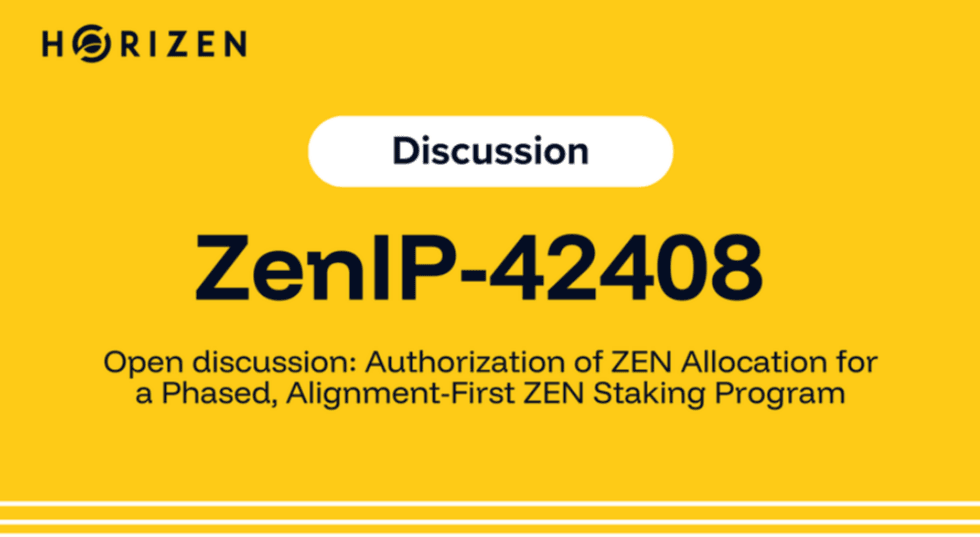
The Horizen community has a fresh reason to pay close attention to what is happening on the network. Through its official account, Horizen Global announced that ZenIP-42408 — a proposal put forward by Horizen co-founder Rob Viglione — has officially entered the community discussion phase.
The core idea is straightforward but carries real weight: bringing back zen coin staking, but with a meaningfully different approach from what existed before. This is not a simple replay of the old mechanism. It is a deliberate redesign of the reward system, one built to align with the long-term vision of Horizen 2.0.
Key Takeaways
- ZenIP-42408 is a new horizen staking proposal authored by Rob Viglione, designed as a phased relaunch that directly supports the development of Horizen's privacy ecosystem.
- Horizen coin (ZEN) has operated as an ERC-20 token on the Base network since July 2025, giving it access to broader Ethereum DeFi liquidity and infrastructure.
- The zen coin staking framework was initially approved under ZenIP-42407 as part of Horizen 2.0 tokenomics — ZenIP-42408 now arrives as its strategic continuation.
What Is ZenIP-42408 and Why Does It Matter?
ZenIP-42408 was born from a question that has been circulating through the Horizen community for some time: when and how will zen coin staking return following the network's major migration to Base?
What sets this proposal apart from conventional staking programs is its underlying philosophy. Rather than framing staking purely as a yield mechanism, ZenIP-42408 takes a more intentional approach.
It proposes a phased relaunch where staking rewards are tied directly to long-term support for the privacy ecosystem Horizen is actively building. In other words, ZEN holders who stake are not simply parking assets for passive income — they are becoming active contributors to the security and growth of the network.
Rob Viglione opened the proposal for public discussion on Horizen's community Discourse forum. The move reflects the decentralized governance principles Horizen has long championed, where any significant change to the network must pass through community review and voting before it can be implemented.
Horizen's Journey Toward Horizen 2.0
To understand why this zen proposal staking matters so much right now, it helps to step back and look at how dramatically Horizen has transformed over the past year.
On July 23, 2025, Horizen completed its full migration of the ZEN token to the Base network as an ERC-20 asset. This move effectively closed the chapter on Horizen as a standalone Proof-of-Work Layer 1 blockchain. In its place, Horizen now operates as a Layer 3 appchain built on Base — Coinbase's Layer 2 network running on top of Ethereum.
The implications were significant. On the positive side, ZEN gained access to the deep liquidity and mature DeFi infrastructure of the Ethereum ecosystem. On the other side, the legacy node-based staking model — built around Super Nodes and Secure Nodes — became obsolete overnight. This is precisely where ZenIP-42407 stepped in.
Approved with near-unanimous community support in September 2024, it laid the new tokenomics foundation for Horizen 2.0, including an allocation of 40% of ZEN emissions toward Collator and Delegator rewards within a Proof-of-Stake framework.
ZenIP-42408 now arrives as the strategic next step: ensuring the new horizen staking program is not just technically functional, but genuinely meaningful for the ecosystem it is meant to support.
What Changes Under the Proposed Horizen Staking Model?
One of the most compelling aspects of ZenIP-42408 is its emphasis on a phased approach to rollout. This is more than a technical preference — it reflects lessons learned from across the broader crypto landscape, where aggressively launched staking programs have repeatedly led to uncontrolled token inflation or rapid disengagement once early incentive waves subside.
Under the proposed new zen coin staking framework, several key elements stand out.
First, staking rewards would be tied to genuine ecosystem contribution, not simply to how long tokens are locked. This aligns with the milestone-based incentives already deployed in Horizen's Thrive Builder Program, where grants are unlocked based on measurable progress rather than time alone.
Second, the program is explicitly designed to support Horizen's privacy ecosystem. That means there is direct alignment between ZEN holders who stake and the growth of applications being built on Horizen — from Zendex, the privacy-focused DEX, to Tachyon for cross-chain transfers, and other DeFi protocols in development.
Third, all final decisions remain with the community. Voting takes place on Snapshot using wallets connected to the Horizen EON network, maintaining the transparent and decentralized governance model that has defined Horizen's major decisions in recent years.
Conclusion
ZenIP-42408 is a meaningful signal that horizen coin is evolving not just technically, but strategically. A redesigned zen coin staking program — if approved by the community — could become a genuine catalyst for deeper, more sustained engagement from ZEN holders who believe in the network's long-term direction.
For anyone following the development of horizen staking and the broader privacy-focused crypto space, this is a moment worth watching.
The ongoing community discussion is a rare opportunity to observe a blockchain network rebuilding its incentive structure from the ground up — openly, transparently, and on its own terms. As always with any crypto asset, any investment decision should be grounded in independent research and a clear understanding of the risks involved.
FAQ
1. What is ZenIP-42408 and how is it different from ZenIP-42407?
ZenIP-42407 is the foundational Horizen 2.0 tokenomics proposal that was already approved, establishing the Proof-of-Stake staking framework. ZenIP-42408 is a follow-up proposal specifically addressing how the zen coin staking program should be launched in phases to align with Horizen's privacy ecosystem development goals.
2. When will the new horizen staking program go live?
No official launch date has been announced. ZenIP-42408 is currently in the community discussion phase. A formal community vote will follow before any technical implementation begins.
3. How can I participate in the ZenIP-42408 vote?
Voting is conducted on Snapshot using a wallet connected to the Horizen EON network. ZEN holders who have delegated their tokens to a forger node automatically carry voting power proportional to their staked amount.
4. Can I stake ZEN coin right now?
The official horizen staking program is not yet live following the migration to Base. In the meantime, the Zenrise platform offers XP points that can be redeemed for various rewards, including potential staking boosts once the program launches.
5. Where can I buy and store Horizen coin (ZEN)?
ZEN is listed on major exchanges including Binance and Coinbase. Since the July 2025 migration, ZEN is now an ERC-20 token on the Base network and can be stored in any Ethereum-compatible wallet such as MetaMask.
Cara Beli Crypto di Bittime?

Want to trade sell buy Bitcoins and crypto investment easily? Bittime is here to help! As an Indonesian crypto exchange officially registered with Bappebti, Bittime ensures every transaction is safe and fast.
Start with registration and identity verification, then make a minimum deposit of IDR 10,000. After that, you can immediately buy your favorite digital assets!
Check the exchange rate BTC to IDR, ETH to IDR, SOL to IDR and other crypto assets to find out today's crypto market trends in real-time on Bittime.
Also, visit the Bittime Blog for interesting updates and educational information about the crypto world. Find reliable articles about Web3, blockchain technology, and digital asset investment tips designed to enrich your crypto knowledge.
Disclaimer: The views expressed belong exclusively to the author and do not reflect the views of this platform. This platform and its affiliates disclaim any responsibility for the accuracy or suitability of the information provided. It is for informational purposes only and not intended as financial or investment advice.

.png)