Ripple Partners with Jeonbuk Bank for Cross-Border Payments
2026-08-26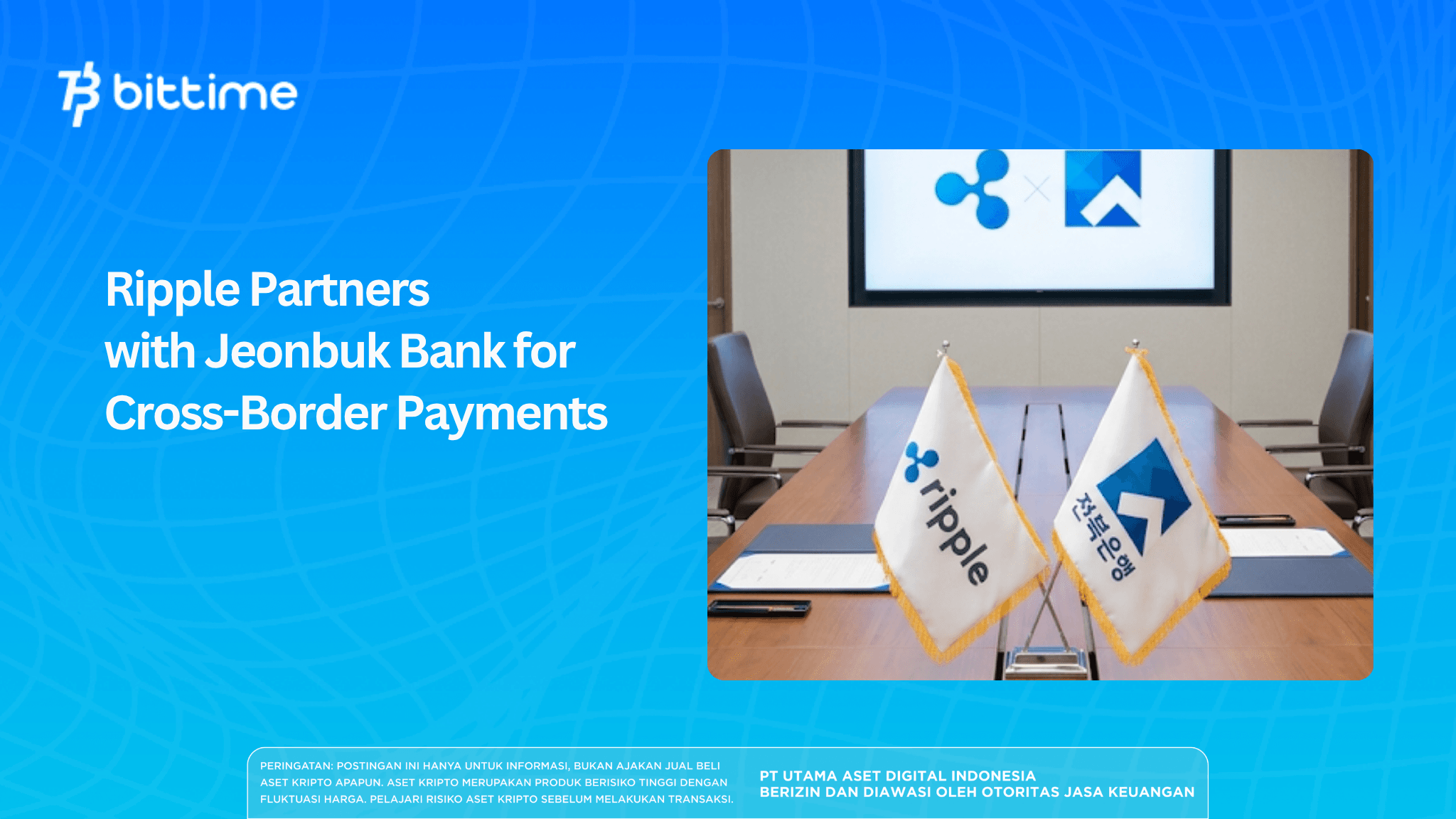
Ripple and Jeonbuk Bank have partnered to provide cross-border payment services for business customers in South Korea.
The partnership brings blockchain technology closer to conventional banking activities, particularly for companies that regularly conduct international transactions.
Through Ripple Payments, Jeonbuk Bank will provide business remittance services that can be completed within seconds to minutes and operate 24/7. The target users include import-export companies, IT startups, and online content creators.
The move also strengthens Ripple's position in South Korea's institutional market. However, one important detail has yet to be announced: the specific settlement asset or route that will be used for Jeonbuk Bank's transactions.
Key Takeaways
- The Jeonbuk Bank Ripple partnership is significant because Jeonbuk is the first regional bank in South Korea to adopt Ripple Payments.
- Ripple cross-border payments are designed to accelerate international business transactions from taking days to just seconds or minutes.
- The partnership is positive for the adoption of Ripple's technology, but it should not yet be interpreted as confirmation that every transaction will use XRP.
Jeonbuk Bank Uses Ripple for Cross-Border Payments
On August 18, 2026, Ripple announced its partnership with Jeonbuk Bank to implement Ripple Payments for cross-border remittances. Ripple described Jeonbuk as the first regional bank in Korea to use the platform.
The service is primarily intended for business customers with international transaction needs. Import and export companies, IT startups, and online content creators are among the user groups mentioned in the announcement.
The key difference lies in the settlement process. Traditional international bank transfers can pass through multiple intermediary banks via the SWIFT network and may take several days.
Ripple states that Ripple Payments can provide near-real-time settlement, with transactions completed within seconds to minutes and operating around the clock.
For companies, this change is not simply about speed. Faster international transactions can help companies manage cash flow, supplier payments, receipts from overseas customers, and liquidity needs more efficiently.
Read Also: Ripple Adds Korean Bank Partner, What Does It Mean for XRP Price?
How Is Ripple Payments Different from Traditional Transfers?
In conventional banking systems, cross-border payments often involve correspondent networks. The more complex the payment route, the more points there are that can affect settlement times and transaction costs.
Ripple cross-border payments offer an approach based on digital infrastructure designed to accelerate this process. Ripple Payments operates 24/7 and is designed to provide settlement in a much shorter time than traditional transfers.
However, it is important not to oversimplify this partnership as “Ripple replacing SWIFT.”
SWIFT is primarily a financial messaging network, while Ripple provides payment and settlement infrastructure. The actual implementation still depends on the payment route, currencies, financial institutions, and configuration being used.
Therefore, the actual impact on Jeonbuk Bank customers can only be assessed further once details about payment corridors, fees, currencies, and transaction volumes are made public.
Monitor XRP and other crypto assets with registering with Bittime and follow the latest market updates.
Will Jeonbuk Bank Use XRP?
This is one of the biggest questions surrounding the partnership between Ripple and the South Korean bank.
A partnership with Ripple does not automatically mean that transactions will use XRP. Based on the latest available information, Ripple and Jeonbuk Bank have not publicly disclosed whether settlement will use XRP, RLUSD, another digital asset, or a fiat-based mechanism.
This is important because Ripple Payments is a platform, while XRP is a crypto asset that is distinct from Ripple the company. Therefore, news about the adoption of Ripple Payments should not immediately be interpreted as a catalyst for XRP usage in every transaction.
For XRP investors, information about the settlement asset actually being used will be a much more material development.
If XRP is indeed used on a large scale, its potential impact on XRP liquidity demand would certainly differ from a scenario in which transactions use stablecoins or fiat-based routes.
Read Also: Ripple Integrates RLUSD for Global Payments, Here's the Latest Update!
Ripple Is Becoming More Aggressive in South Korea's Institutional Market
The partnership with Jeonbuk Bank is not Ripple's first move in South Korea's financial sector in 2026.
Ripple previously partnered with Kyobo Life Insurance to explore on-chain settlement of government bonds. Ripple also partnered with Kbank, a South Korean internet-only bank, on institutional wallet infrastructure through Ripple Custody.
This series of partnerships shows that Ripple's strategy in Korea is not focused on just one type of use case. Ripple is seeking to provide infrastructure for payments, custody, wallets, treasury, and digital assets to financial institutions.
From an industry perspective, this development is interesting because blockchain adoption is beginning to move from technology experiments toward specific operational needs. Banks do not have to transform their entire financial systems into blockchain-based systems to benefit from the technology.
What Does This Mean for Ripple Cross-Border Payments?
The Jeonbuk Bank partnership strengthens the narrative that Ripple cross-border payments are beginning to gain a foothold in South Korea's regional banking sector.
For Jeonbuk Bank, the technology could be a way to improve services for business customers operating globally. For Ripple, the integration provides additional evidence that its infrastructure can be used by traditional financial institutions.
However, long-term success will depend on actual usage. Settlement speed alone is not enough.
Costs, liquidity, compliance, the number of available corridors, transaction volume, and customer experience will determine whether the technology actually provides an advantage over existing systems.
Therefore, the next developments worth watching are when the service becomes widely available, which countries and currencies will be supported, and how its fee and settlement structure will work.
Read Also: XRP Ledger Becomes the Backbone of South Korea's Digital Won Pilot
What Does This Partnership Mean for Ripple and XRP?
From Ripple's perspective, this partnership is a positive development because it expands the company's institutional network in one of Asia's important financial markets.
For XRP, the impact needs to be assessed separately. Adoption of Ripple products may increase the company's legitimacy and strengthen its ecosystem, but it does not automatically create direct demand for XRP.
Investors should wait for official information about the settlement mechanism before drawing conclusions about its impact on XRP's price.
This approach makes more sense than assuming every Ripple partnership with a bank is a signal for XRP to rise.
Start trading XRP/IDR with Bittime here!
Conclusion
The partnership between Jeonbuk Bank and Ripple shows that blockchain technology is increasingly becoming part of South Korea's banking payment infrastructure.
The clearest impact at this point is the expansion of Ripple Payments for cross-border business transactions.
Meanwhile, the direct connection to XRP remains uncertain until Ripple or Jeonbuk Bank discloses the settlement asset being used.

Interested in trading XRP? In addition to the XRP/IDR pair, Bittime also provides XRP/USDT to make your trading and investment strategies easier.
Bittime is a licensed Digital Financial Asset Trader (PAKD) platform regulated and supervised by the Financial Services Authority (OJK) — where you can buy Bitcoin in Indonesia and hundreds of other crypto assets starting from IDR 10,000. The registration process is fast, secure, and can be started today.
Monitor USDT to IDR conversions and your favorite crypto asset price movements in real time. Everything is available in one crypto investment app that can be downloaded for free from the Play Store.
Ready to get started? Register with Bittime now and execute your investment strategy with a platform trusted by millions of users in Indonesia.
FAQ
What Is Jeonbuk Bank Ripple?
Jeonbuk Bank Ripple is a partnership between Jeonbuk Bank and Ripple to implement Ripple Payments for cross-border remittance transactions for business customers.
What Is the Purpose of Ripple's Partnership with Jeonbuk Bank?
The goal is to provide faster and more efficient international payments for businesses, including import-export companies, IT startups, and online content creators.
Does Jeonbuk Bank Use XRP?
There has been no public confirmation that Jeonbuk Bank's transactions will use XRP. The settlement asset used in the implementation has not been specifically disclosed.
Is Ripple Payments Faster Than SWIFT Transfers?
Ripple states that Ripple Payments can complete transactions within seconds to minutes and operate 24/7, while traditional transfers through intermediary banking networks can take several days.
What Does This Mean for Ripple in South Korea?
The partnership strengthens Ripple's expansion in South Korea's institutional sector and marks Ripple's third partnership with a Korean financial institution in 2026, following partnerships with Kyobo Life Insurance and Kbank.
Disclaimer: The views expressed belong exclusively to the author and do not reflect the views of this platform. This platform and its affiliates disclaim any responsibility for the accuracy or suitability of the information provided. It is for informational purposes only and not intended as financial or investment advice.

.png)