Futures Trading Psychology: How to Manage Emotions in Crypto
2026-09-17
The price of Bitcoin can surge 8% overnight, then plunge 12% the next morning. Such sharp swings are the real test for the trading psychology of every futures trader.
Risk disclosure data from various global financial market regulators consistently shows that the majority of retail traders lose money not because of poor technical analysis, but because they fail to manage trading emotions when market pressure peaks.
This article discusses how to control emotions when trading and the trader psychological mistakes that most often destroy futures accounts.
Key Takeaways
- Trading psychology, not just technical indicators, is the main determinant of consistent profits in futures trading.
- Fear, greed, and revenge trading are the three most destructive emotional patterns, especially in the extremely volatile crypto market.
- A written trading plan, strict risk management, and a trading journal are the three most effective tools for controlling psychological bias.
Why Trading Psychology Determines Results in Futures Trading
Futures trading offers high leverage — a small amount of capital can control a large position. As a result, the emotional pressure felt by traders is far more intense than in regular spot trading.
When price moves against a position, the human brain automatically responds reactively and quickly, long before the rational part of the brain can take over decision-making.
This is why the crypto trader's mindset often loses to momentary instinct. Without discipline, traders easily add to losing positions, close winning positions too early, or recklessly enter the market without a clear plan.
If you want to start training trading discipline in a safe and regulated environment, you can register an account at Bittime and start practicing with a strategy you have designed yourself.
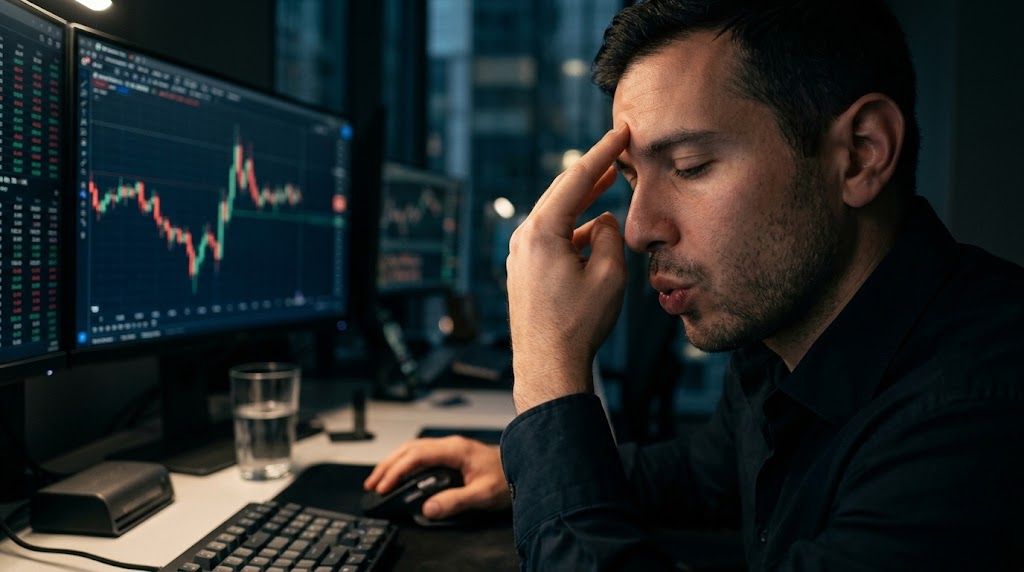
The Most Common Trader Psychological Mistakes
These psychological biases repeatedly trap traders from beginners to experienced ones:
- Fear — fear of loss makes traders hesitate to enter even when the signal is valid, or panic and exit a position too quickly.
- Greed — holding a position too long in the hope of bigger profits, until price finally reverses.
- Revenge trading — recklessly opening a large position after consecutive losses to "get revenge" on the market, the result is almost always worse.
- Overconfidence — several consecutive profits make traders increase position size without comparable analysis.
- FOMO — entering a position at the peak price for fear of missing out on a widely discussed trend.
The loss aversion theory introduced by Daniel Kahneman and Amos Tversky in 1979 explains the root of this problem: psychologically, the pain of a loss feels far stronger than the pleasure of an equivalent gain.
As a result, traders focus more on avoiding losses than on pursuing rational opportunities. A study in International Journal of Emerging Markets even proved that FOMO strengthens the influence of loss aversion and herd mentality on retail investment decisions.
Specifically in crypto, you can also use the Crypto Fear & Greed Index from Alternative.me as a mirror of market sentiment — this scale from 0 (Extreme Fear) to 100 (Extreme Greed) helps traders recognize when collective market emotion is extreme, according to KuCoin Learn.
Read Also: Purbaya Removed from Finance Ministry, Becomes BI Governor? Check the Facts
Strategies for Managing Emotions When Futures Trading
- Create a written trading plan — determine entry trigger, profit target, and loss limit before opening a position.
- Apply strict risk management — limit risk to 1-2% of capital per position so your psychology remains stable even after several losses.
- Set stop-loss and take-profit — lock in profits and limit losses automatically, reducing psychological pressure while monitoring positions.
- Regularly keep a trading journal — record the reason for entry, emotional state, and result of each transaction to recognize recurring mistake patterns.
- Take a break after a large loss — decisions made in an emotional state almost always end badly.
Read Also: Legal Crypto Apps in Indonesia 2026: How to Check OJK-Licensed Platforms
Conclusion
Trading psychology is the foundation that determines whether a technical strategy can truly be executed consistently in a pressure-filled futures market. Recognizing biases such as fear, greed, and revenge trading.
Then balancing it with a written trading plan, strict risk management, and a trading journal is the most realistic combination for keeping an account alive over the long term — especially in the crypto market, whose volatility is far wilder than that of other assets.
Check the prices of Bitcoin (BTC), Ethereum (ETH), XRP, Solana (SOL), GRAM, and BNB as well as the leading memecoin DOGE. You can trade directly on Bittime!

Bittime is a licensed Digital Financial Asset Trader (PAKD) platform supervised by the Financial Services Authority — where you can buy Bitcoin in Indonesia and hundreds of other crypto assets starting from IDR 10,000. The registration process is fast, secure, and can be started today.
Monitor USDT to IDR conversion and the price movements of your favorite crypto assets in real time. Everything is available in one crypto investment app that can be downloaded for free on the Play Store.
Ready to start? Register now at Bittime and execute your investment strategy with a platform trusted by millions of users in Indonesia.
FAQ
What is trading psychology?
Trading psychology is the mental and emotional state of a trader when facing market risk and uncertainty. This state determines whether trading decisions are made rationally or driven by momentary emotion.
Why is trading psychology important in futures trading?
High leverage in futures trading makes emotional pressure far more intense than in regular trading. Without good emotional control, traders easily make impulsive decisions that are harmful.
What are the most common trader psychological mistakes?
Revenge trading and FOMO are the two most destructive mistakes because they push traders to take large positions without thorough analysis. Both often appear after consecutive losses or when price moves quickly.
How do you control emotions when trading?
The most effective way is to create a written trading plan and follow it with discipline, combined with risk management of at most 1-2% of capital per position. A trading journal also helps recognize recurring emotional patterns.
Does the Crypto Fear & Greed Index help trading psychology?
Yes, this index helps traders recognize market sentiment objectively so they do not get swept up in collective euphoria or panic. However, it still needs to be combined with other analysis, not used as the sole basis for decisions.
Disclaimer: The views expressed belong exclusively to the author and do not reflect the views of this platform. This platform and its affiliates disclaim any responsibility for the accuracy or suitability of the information provided. It is for informational purposes only and not intended as financial or investment advice.

.png)