BUMI's Stock Prospects After Transactions Reach Rp2.2 Trillion: Still Attractive?
2026-07-24
BUMI Stock was the most heavily traded stock on Thursday, July 23, 2026, with a transaction value of Rp2.2 trillion.
Its price surged 8.93% to Rp183 after 12.1 billion shares changed hands, accompanied by net foreign buying of around Rp55.5 billion.
Key Takeaways
- The Rp2.2 trillion transaction indicates very high market interest, but also carries the risk of volatility and profit-taking.
- The main catalysts for BUMI shares come from the company's first-quarter 2026 performance growth, cost efficiency, and the development of its gold, silver, and copper mines.
- The outlook remains speculatively attractive, but investors should await confirmation of the second-quarter report and monitor the price's ability to hold above the breakout area.
What Happened to BUMI Stock?
Shares of PT Bumi Resources Tbk or BUMI closed at Rp183 per share on July 23, 2026. This position reflects a rise of almost 9% in one day and makes BUMI the largest transaction contributor on the Indonesia Stock Exchange.
A total of 12.1 billion shares were traded with a transaction value of approximately Rp2.2 trillion. This figure is significantly higher than the normal trading activity of many stocks on the stock exchange.
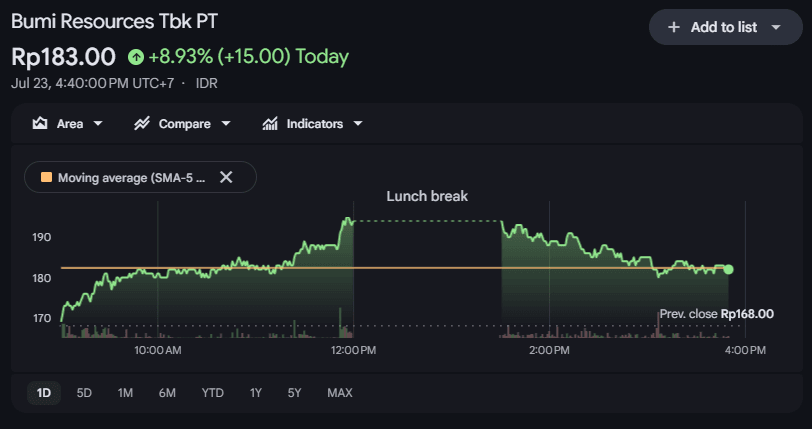
BUMI's movement also occurred when the JCI closed down 0.30%. This means the stock moved against the index and attracted special attention from market participants.
However, large transactions can have two meanings.
First, accumulation occurs because investors expect a company's performance or prospects to improve. Second, short-term buying and selling activity occurs after a rapid price increase.
Therefore, the transaction value cannot be used as the sole basis for purchasing BUMI shares.
Read also:BUMI Stock: 2026 Predictions, Owners & Business Sectors
Why did BUMI shares rise?
BUMI's share price increase was driven by a combination of fundamental catalysts, financial report expectations, and market momentum.
Performance Expectations for Q2-2026
Investors are waiting to see whether BUMI can maintain the increases in production, sales volume, and cost efficiencies seen in the first three months of 2026.
The market will also be closely monitoring the company's ability to maintain profits while average coal selling prices remain under pressure.
Net Purchases by Foreign Investors
On the day of the increase, BUMI shares recorded net foreign buying of approximately IDR 55.5 billion. Foreign buying could strengthen momentum, although the amount is still relatively small compared to the total transactions of IDR 2.2 trillion.
Diversification into Strategic Minerals
BUMI is expanding its business from a predominantly coal-dependent company to a multi-commodity mining group.
This narrative has gained increased attention since Australia's gold, silver and copper assets entered production.
Technical Momentum
Increased volume and a breakout of the previous price level can trigger buying from momentum traders.
This situation also has the potential to cause short covering or repurchases by traders who previously expected prices to fall.
To keep up with the latest stock prices, commodity news and financial market developments, you can register at Bittime and read investment updates regularly.
How is Bumi Resources performing?
BUMI's fundamentals showed improvement in the first quarter of 2026.
Revenue reached US$417.7 million, up 19.7% from US$348.8 million in the same period last year. Gross profit increased 61.6% to US$82.8 million, while operating profit rose 75.8% to US$49.1 million.
Operating margin also improved from 8% to 11.7%. Net profit reached US$41.1 million, up 36.6%, while profit attributable to owners of the parent entity grew 35.2% to US$24.1 million.
From an operational perspective, coal production increased 12% to 19.2 million tons. Sales rose 14% to 19.1 million tons, while inventories decreased from 2.4 million tons to 2 million tons.
Improvements were also seen in the strip ratio, which dropped from 8.4 times to 7.7 times. A lower ratio can help reduce costs because the company removes less overburden to recover coal.
This performance is even more impressive because the average FOB selling price actually fell 10% from US$64.9 to US$58.6 per ton. Volume growth and operational efficiency offset the decline in selling prices.
Read also:BUMI Stock Price Prediction 2026
What Does Decreasing Production Costs Mean?
BUMI's average production cost will decrease from approximately US$45.1 to US$40 per ton in the first quarter of 2026. This decrease is supported by improvements in strip ratios and lower fuel costs.
Cost efficiency is important because the coal business is very sensitive to changes in commodity prices.
If the selling price drops by US$5 per ton, companies with high production costs could experience a significant decline in margins. Conversely, companies that are able to reduce costs have more room to maintain profits.
Investors need to monitor whether the cost of US$40 per ton can be maintained. Increases in fuel, contractor costs, royalties, or strip ratios could further depress profitability.
Read also:BUMI Stocks Soar in 2026: New Momentum or Repetition of Old Euphoria?
What are the prospects for non-coal diversification?
One of the most important catalysts for BUMI's stock prospects is the development of the Mt. Carlton mine in Queensland, Australia.
The mine produces gold, silver, and copper. Open-pit operations in the V2 area have been producing since April 2026, while underground mining operations in the A39 area have begun to access higher-grade ore.
The restart of Mt. Carlton also created approximately 300 jobs and was supported by the completed commissioning of the processing facility. Open-pit and underground mining activities are handled jointly by the mining contractor and the processing facility operator.

Source: AI Generated Image
All concentrate from the project is planned to be marketed through a seven-year offtake contract. This agreement provides certainty to potential buyers, although revenue remains dependent on production volume, ore grade, recovery rate, and metal prices.
BUMI is targeting a more balanced EBITDA composition between coal and non-coal businesses by 2031. This target could reduce dependence on a single commodity if successfully achieved.
However, Mt. Carlton's contribution cannot yet be directly compared to the scale of BUMI's coal business. Investors will need to await actual production, cost, revenue, and cash flow data from the project.
Read also:BUMI Shareholders: Complete List & 2026 Predictions
Is the Rp2.2 Trillion Transaction a Positive Signal?
Large transaction values have several positive sides.
- Stock liquidity increases.
- The process of buying or selling becomes easier.
- The stock has attracted the attention of institutional and retail investors.
- Price movement could gain further momentum.
- Foreign purchases signal additional demand.
However, large transactions also carry risks.
High volume after a sharp rise could indicate a shift in shares from early buyers to late-bird investors. If demand begins to weaken, prices could experience a correction, even if the previous trading volume was high.
Investors should pay attention to whether high volume is accompanied by:
- Prices remain stable.
- Sustainable foreign accumulation.
- Closing near the high.
- Fundamental performance in line with expectations.
- There was no major distribution the following day.
Read also: What is RDPU? Definition, Benefits, Risks, and How It Works
BUMI Stock Technical Analysis
The closing price of Rp183 has surpassed several short-term technical targets issued before the latest rally. Previously, technical projections placed the target at around Rp174–Rp181, while other recommendations placed the target at a higher range of Rp214–Rp238.
Since the price has reached Rp183, investors need to see whether the breakout can be maintained.
Support BUMI Shares
Indicative support areas to watch are:
Support Rp176–Rp180
This area is near the most recent breakout zone. A price correction but holding within this area could indicate that old resistance has turned into support.
Support Rp168–Rp170
This level is close to the price before the July 23rd spike. A drop below this area could indicate that most of the daily gains are starting to be erased.
Support Rp158–Rp160
The Rp158–Rp160 area previously served as a technical target and resistance. If selling pressure intensifies, this zone could become intermediate support.
BUMI Stock Resistance
Indicative resistance areas include:
Resistance Rp190
Rp190 is the closest psychological area after the price broke through Rp180.
Resistance Rp200
The Rp200 level can trigger profit-taking because it is a round number and easy to target for short-term traders.
Resistance Rp214–Rp238
This range has been used as a technical target in previous recommendations. However, this target doesn't guarantee the price will reach it, especially if volume decreases or financial reports fall short of expectations.
Technical levels are dynamic. The opening price, volume, and index conditions in the following session can alter these support and resistance levels.
Read also:How Many Shares Are in 1 Lot? Here Are the IDX Rules and How to Calculate Them
What is the Target Price for BUMI Shares?
Several projections place BUMI's fundamental stock target at around Rp300–Rp304. However, the available consensus coverage is very thin, as it comes from only one analyst, so this figure cannot be considered broadly consensus.
From a price of Rp183, the Rp300 target implies a potential upside of around 64%. However, this potential will only be relevant if analyst assumptions are met, such as:
- Production and sales continue to grow.
- Production costs remain under control.
- Coal prices did not fall sharply.
- Mineral projects are starting to make contributions.
- Cash flow and funding structure remain healthy.
- There is no dilution that reduces the value per share.
Price targets are not guaranteed. Changes in commodity assumptions, costs, production, and market conditions may cause targets to be revised upwards or downwards.
Read also:Why Are FORU Shares Rising? A Look Back at Fortune Indonesia's Potential Mining Giant
BUMI Stock Prospect Scenario
Bullish Scenario
The prospects for BUMI shares can become more positive if:
- The second quarter report showed continued profit growth.
- Coal production and sales continue to increase.
- Production costs remain near US$40 per tonne.
- Mt. Carlton meets production targets.
- Prices remain above Rp180.
- Foreign purchases continue.
- Coal prices are improving.
In this scenario, the price could test Rp190, Rp200, and then the Rp214–Rp238 area.
Neutral Scenario
Stocks may consolidate if performance remains good, but there are no additional catalysts that are strong enough.
Movement in the Rp168–Rp200 range allows the market to digest the rapid increase and wait for the next financial report.
Bearish Scenario
The risk of correction increases when:
- The price fell again below Rp. 168.
- Purchase volume weakened.
- Foreign investors turned around and recorded net sell.
- Production costs increase.
- Coal prices fell further.
- Second quarter performance was below expectations.
- Mineral projects are experiencing delays.
In this scenario, the price has the potential to retest Rp158–Rp160 or a lower area.
What are the risks of BUMI shares?
Dependence on Coal Prices
Despite beginning to diversify, BUMI's revenue and profits are still heavily influenced by its coal business. Average selling prices fell 10% in the first quarter of 2026, although the impact was offset by increased volume and efficiency.
Operational Cost Risk
Increases in fuel prices, strip ratios, contractor fees, and royalties can narrow margins.
Diversification Execution Risk
Gold, silver, and copper mining requires capital, operational expertise, and time to achieve stable production. Diversification targets may not be achieved on schedule.
Volatility Risk
BUMI has a large retail investor base and trading volume. Prices can move rapidly due to sentiment, broker flows, and profit-taking.
Valuation Risk
Price increases that outpace earnings growth can make valuations expensive. Investors need to assess earnings per share, cash flow, and the number of shares outstanding, not just the transaction value.
Regulatory and ESG Risks
The coal business faces changes in production policies, domestic market obligations, royalties, taxation, and energy transition pressures.
Read also:MSFT Stock Predicts to Reach $646, Bernstein Optimistic Ahead of Microsoft Earnings
Are BUMI shares still attractive?
BUMI shares remain attractive to watch as the company demonstrates volume growth, cost efficiency, profit growth, and diversification progress.
However, positions after a nearly 9% surge require a different approach than when prices are still below the breakout area.
Short-term investors can wait:
- Retest area Rp176–Rp180.
- Continued volume confirmation.
- Breakout valid above Rp190.
- Discipline stop-loss if price loses support again.
Long-term investors need to monitor:
- Financial report for the second quarter of 2026.
- Operational cash flow.
- Selling price and cost of coal.
- Mt. Carlton production realization.
- Capital expenditure.
- Debt structure.
- Earnings per share growth.
Keep tracking other stock tokens such as AMZON, AMDON, and NFLXON as well as MSFTON, then you can start trading on the trusted exchange, only on Bittime.
Conclusion
BUMI's stock prospects are supported by growth in its first quarter 2026 performance, production cost efficiencies, increased sales volume, and the development of mineral assets in Australia.
Transactions of Rp2.2 trillion and net foreign buying indicate strong market interest. However, large trading activity does not automatically guarantee continued price increases.
After closing at Rp183, BUMI faces psychological resistance at Rp190 and Rp200. The Rp176–Rp180 area serves as initial support that must be maintained, while a correction below Rp168 could weaken momentum.
BUMI remains worth watching, but buying decisions should await a reasonable price and fundamental confirmation. Investors should also avoid FOMO after sharp gains and adjust position size according to risk tolerance.

Gain exposure to shares in leading technology companies through tokenised stocks like TSLAX, MSFTON or GOOGLX only on Bittime!
Bittime is a licensed and regulated Digital Financial Asset Trader (PAKD) supervised by Indonesia’s Financial Services Authority (OJK) — where you can buy Bitcoin in Indonesia and hundreds of other crypto assets starting from just Rp10,000. The registration process is fast, secure, and you can get started today.
Track USDT to IDR conversions and monitor your favorite crypto assets in real time. Everything is available in one crypto investment app that you can download for free on the Play Store
Ready to start? Register now on Bittime and execute your investment strategy with a platform trusted by millions of users in Indonesia.
FAQ
Why did BUMI shares rise?
The increase was driven by expectations for the second-quarter report, improved performance, cost efficiencies, mineral diversification, and foreign purchases. Technical momentum also strengthened demand.
What will be the price of BUMI shares on July 23, 2026?
BUMI closed at Rp183 per share, up 8.93%. Transaction value reached approximately Rp2.2 trillion with a volume of 12.1 billion shares.
What is the target price for BUMI shares?
Some projections place the target at around Rp300–Rp304, but the consensus data includes only one analyst. This target is not guaranteed and is subject to change based on the company's performance.
What is the support for BUMI shares?
The nearest indicative support is at Rp176–Rp180, followed by Rp168–Rp170, and Rp158–Rp160. These levels need to be updated based on the latest price movements.
Are BUMI shares suitable for long-term investment?
BUMI should be considered by investors who understand commodity risks and volatility. Its suitability depends on profitability sustainability, cost efficiency, cash flow, and successful diversification.
Disclaimer: The views expressed belong exclusively to the author and do not reflect the views of this platform. This platform and its affiliates disclaim any responsibility for the accuracy or suitability of the information provided. It is for informational purposes only and not intended as financial or investment advice.

.png)