Is Pons Launchpad Legit or a Scam? Learn How It Works and the Risks
2026-07-20
Pons Launchpad legit or scam? Pons is a non-custodial platform for creating and discovering fixed-supply tokens on the Robinhood Chain. While the platform is live, each token launched must be vetted individually, as its presence on Pons does not guarantee security.
Key Takeaways
- Pons has an active platform, token creation mechanism, terms of use, and operator identity in the form of Pons Labs, LLC.
- Pons does not guarantee, vet, or endorse any tokens and creators using its platform.
- The biggest risks come from user-generated tokens, holder concentration, volatility, smart contracts, and difficulty selling assets.
What is Pons Launchpad?
Pons Launchpad is a token launch platform that operates on Robinhood Chain users can create, discover, and trade fixed-supply tokens through an interface that connects directly to the wallet.
This platform is non-custodial. This means that Pons does not store users' assets, private keys, or recovery phrases. Every transaction is submitted and approved through the user's wallet, while smart contracts and the blockchain network determine how transactions are processed.
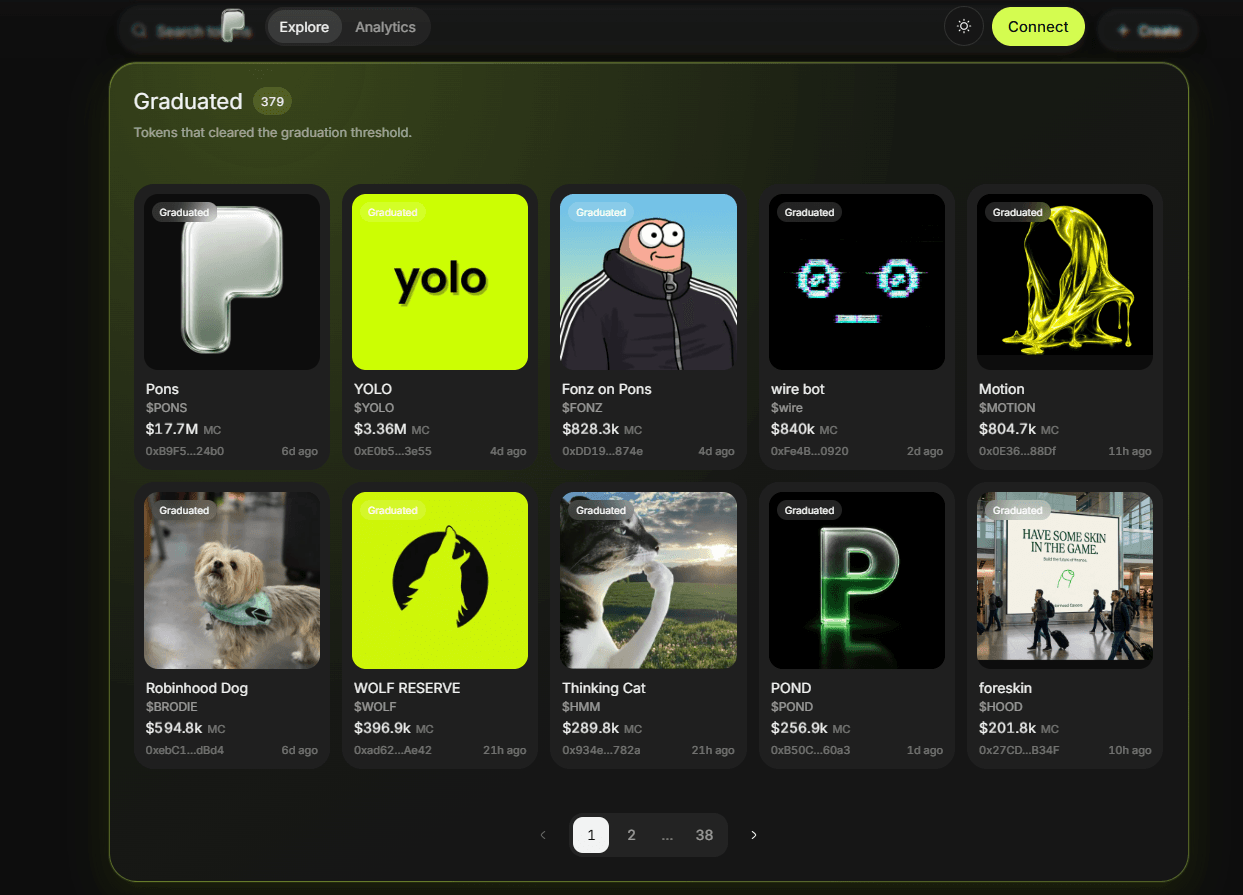
Source: ponsfamily.com/launchpad
This model gives users direct control over their assets. However, it also carries greater security responsibilities. Pons cannot reverse transactions, return misdirected funds, restore wallets, or revoke contract permissions previously approved by users.
Pons is also not a bank, broker, centralized exchange, custodian, or investment advisor. The platform serves as an interface connecting users' wallets to the network, contracts, liquidity pools, and third-party services.
Read also:What Is HyperBull (HBULL)? How It Works and Its Potential Yield
How Does Pons Launchpad Work?
Pons provides a feature for launching new tokens without having to build a token issuance interface from scratch. Creators can enter a project name, ticker, description, image, and social media links.
In general, the token launch process can take place through the following stages:
- Creators connect wallets to Pons Launchpad.
- The creator fills in the basic identity of the token.
- The creator determines the wallet that receives the fee share.
- Creators can make initial purchases through the developer buy feature.
- Wallet displays transaction details and fees.
- The creator approves the transaction via wallet.
- Smart contracts create tokens on Robinhood Chain.
- Tokens start trading and are moving towards the graduation stage.
The token creation page shows a launch fee of 0.0005 ETH and a graduation threshold of 4.2 ETH. The page also displays the liquidity status as “Locked.” However, users should still check on-chain transactions and contracts to verify how liquidity locking is implemented for each token.
What Does Graduation Mean in Pons?
Graduation is the stage when a token reaches a certain threshold in its growth process. Once it meets the platform's criteria, the token can move into a broader liquidity or trading structure.
Graduation is not a security certificate. A token successfully reaching this threshold only indicates that it has met certain mechanical requirements, not that:
- The team has been verified.
- Smart contracts have been audited.
- Holder distribution is healthy.
- The project has fundamentals.
- The price will not go down.
- Liquidity will always be available.
- Creators will not sell their ownership.
Investors should treat graduation as a technical milestone, not a recommendation to buy.
Read also:What is HOOD4663? A Community Token Inspired by Robinhood Chain
Pons Launchpad Legit or Scam?
Based on verifiable elements, Pons has a functioning platform, token generation page, analytics, legal documents, risk warnings, and an operator identified as Pons Labs, LLC. The platform's terms of use are effective as of July 16, 2026, and list the company's contact channels.
These factors support the conclusion that Pons isn't just an anonymous site with no product. However, the existence of a functioning company, website, and product isn't enough to prove the entire system is risk-free.
Pons explicitly states that the creation of a token does not imply that the platform has reviewed, approved, sponsored, or endorsed the token or its creator. Tokens displayed based on volume, activity, or novelty should also not be considered recommendations from the platform.
Thus, the more correct answer is:
Pons Launchpad has a usable product, but it cannot be considered completely secure. Any token launched on the platform remains subject to the potential for failure, loss of liquidity, manipulation, or creation by malicious parties.
Investors need to distinguish between two objects of assessment:
- Pons platform security, including interfaces, smart contracts, domains, and wallet connections.
- Security of user-generated tokens, including creators, holder distribution, liquidity, contracts, and project objectives.
A functioning launchpad does not automatically make the tokens within it legit.
Read also:What is Catwifhood (HOOD) that is in the spotlight after a hundred percent rally on PumpSwap?
Is Pons Family Safe or Not?
Pons Family doesn't hold user assets, thus reducing the risk of custodian bankruptcy. However, the non-custodial nature doesn't eliminate the risk of fund loss.
Users may still experience losses due to:
- Signing a wrong transaction.
- Providing approval tokens to malicious contracts.
- Buying fake tokens.
- Using a wallet that has been hacked.
- Experiencing high slippage.
- Interact with clone sites.
- Buying tokens that have no buyers when you want to sell them.
- Loss of entire investment value.
Pons itself warns that tokens and liquidity positions may be experimental, illiquid, dangerous, or worthless. The platform also does not guarantee liquidity, market depth, settlement, order execution, or the ability of users to exit positions.
Therefore, the term "safe" should be used with caution. Platforms may have official interfaces and legal documentation, but blockchain transactions and third-party tokens still carry high risks.
Read also:What Is VEIL? The Private DePIN Network on Robinhood Chain
Pons' Relationship with Robinhood Chain
Pons is built on the Robinhood Chain and uses that network for token creation and trading.
This connection explains where the app operates, but it doesn't automatically prove that every Pons token is issued, audited, or guaranteed by Robinhood.
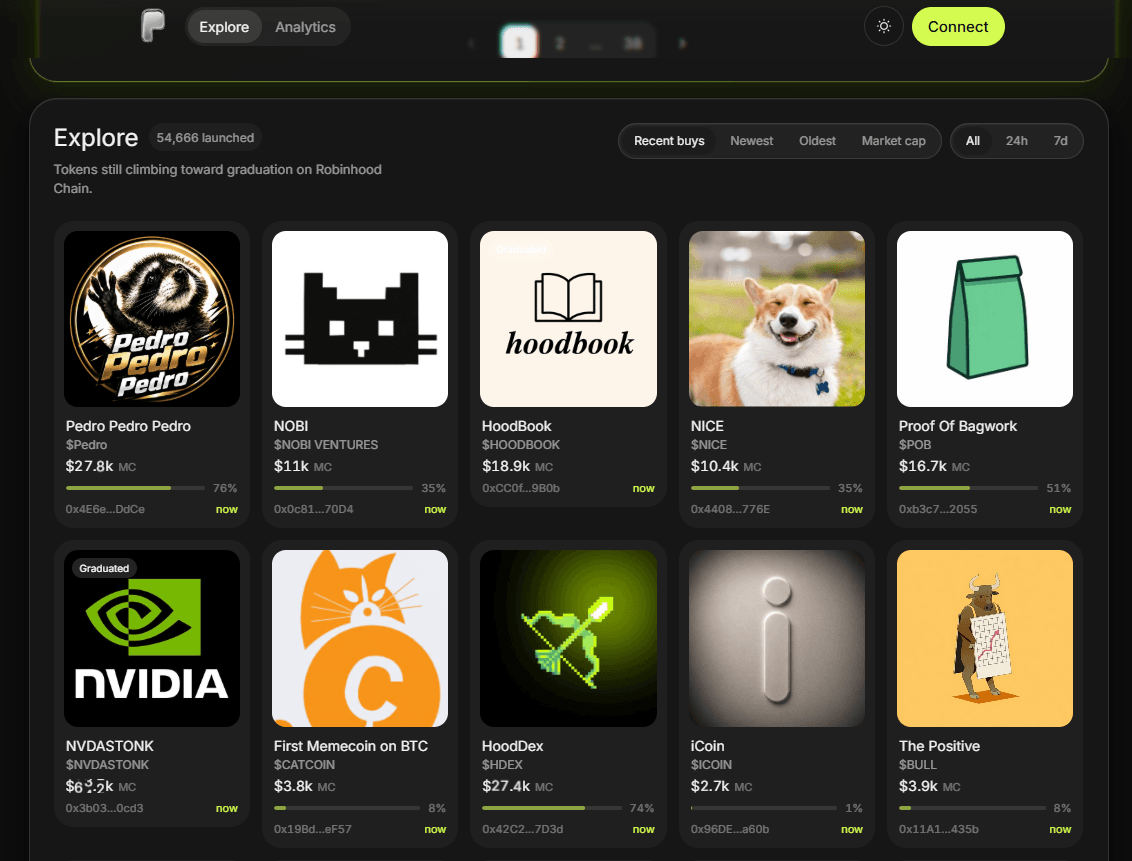
Source ponsfamily.com/launchpad
Users should not immediately conclude that:
- Pons is a Robinhood stock.
- The Pons token is the official Robinhood token.
- Robinhood guarantees user losses.
- The token has passed an institutional selection process.
- Token purchases get protection like stocks.
Independent projects can build applications on open blockchain networks. Use of a network does not necessarily indicate commercial support or guarantees from the network's administrators.
Read also:Is Noxa.fi Safe? Features, Costs, and Risks
Is PONS Token Safe?
PONS is a token associated with the Pons ecosystem. The contract address listed for the token is:
0x39dBED3a2bd333467115dE45665cC57F813C4571
The PONS/WETH trading pair can be monitored via the DEX. When checked, the pair showed active trading activity and liquidity. The automated scanner didn't reveal any immediate issues, but it also warned that automated scan results aren't always accurate.
The presence of liquidity and transaction activity is not a guarantee of security. Investors still need to check:
- Concentration of ownership.
- Contract administrator rights.
- Possibility of minting additional tokens.
- Liquidity lock status.
- Developer wallet history.
- Blacklist or pause function.
- The relationship between launchpad revenue and PONS tokens.
- Transparency of protocol fee usage.
Read also:What Is WISHBONE? Getting to Know the Memecoin from the Robinhood Chain Ecosystem
How to Check Scam Tokens on Pons Launchpad
New tokens require more rigorous vetting than assets that have been traded for years. Here are some steps to consider before purchasing tokens on the Pons Family.
1. Match Contract Address
Token names and symbols are not unique. Fraudsters can create tokens with the same name, ticker, and image.
Get the contract address from the token's official page, then match it with a block explorer and trading pair. Don't buy simply by searching for the token name in a wallet or DEX.
2. Check Creator Wallet
Find the wallet that created the contract and check its transaction history. Be wary of creators who repeatedly launch tokens, sell large amounts of their holdings, and then abandon the project.
The developer buy feature on the launch page is also worth considering. Early purchases can give creators a head start over other users. Check the size of the ownership before purchasing.
3. Holder Distribution Analysis
Check the percentage of supply held by the top ten or twenty wallets. Separate liquidity pool addresses, burn addresses, contracts, treasuries, and personal wallets.
High concentration in a few private wallets increases the risk of a major sell-off. A single transaction can depress the price if liquidity remains low.
4. Liquidity Verification
“Liquidity locked” status must be proven through a blockchain transaction. Check:
- How big is the liquidity?
- Who owns the liquidity position?
- Is the position really locked?
- How long is the lockdown?
- Does the contract have a way to move it?
- How big is the slippage when selling tokens?
Little liquidity can make prices appear to rise quickly, but it also makes it difficult for investors to exit without causing a large drop.
5. Check Smart Contract Function
Look for functions that allow contract owners to:
- Minting new tokens.
- Change the buy or sell fee.
- Blocking wallet.
- Pause transactions.
- Limit sales.
- Transferring user tokens.
- Changing important parameters.
- Diverting protocol fees.
The presence of administrative functions doesn't necessarily indicate a scam. However, investors need to know who controls these functions and whether they are protected by multiple signatures or time locks.
6. Conduct Purchase and Sales Simulations
Use small amounts to test whether tokens can be bought and sold. Don't rely on price increase charts, as buying transactions don't prove users can resell them.
Check price impact, slippage, gas fee, and the number of tokens received before signing the transaction.
7. Project Information Evaluation
Pay attention to whether the project has clear documentation, reasonable goals, team identity, organic community, and product updates.
Be wary of projects that only offer:
- Promise of price increases.
- Profit without risk.
- Fake countdown.
- Influencer promotion without product explanation.
- Unsubstantiated claims of affiliation.
- Pressure to buy immediately.
- Fixed returns that have no clear source of income.
Contract scanners are simply tools. A "no issues" status doesn't prove the creator is trustworthy or that the token has fundamental value.
Read also:What Is Cashcat Token? A New Memecoin on Robinhood Chain
Risks of Buying New Tokens on Pons Family
Extreme Volatility
New tokens can surge hundreds of percent, then lose most of their value within minutes. These movements are often influenced by thin liquidity and short-term speculation.
Rug Pull Risk
Creators or large holders can sell large amounts of tokens and deplete market demand. Liquidity locks can mitigate one type of rug pull, but they don't prevent the sell-off of tokens held by creators.
Risiko Smart Contract
Bugs and hidden functions can hinder sales or alter transaction rules. Smart contracts that run as coded may not necessarily result in fair treatment for users.
Market Manipulation Risk
Volume can be generated through transactions between related wallets. High activity doesn't necessarily indicate organic demand.
Liquidity Risk
The price listed on the chart may not be the acceptable price for selling. Slippage increases when the selling price is too large compared to the liquidity pool.
Risk of Fake Sites
Fraudsters can create domains that resemble Pons Family and then ask users to sign a malicious consent form or enter a recovery phrase.
Risk of Loss of Entire Capital
Pons stated that tokens can lose their entire value and blockchain transactions can be permanent. Therefore, do not use funds for essential needs, loans, or emergencies.
Read also:What Is OpenUSD (OUSD)? A New Stablecoin Supported by Visa, Mastercard, and Circle
Checklist Before Connecting Wallet
Before using Pons Launchpad, please perform the following checks:
- Make sure the domain you opened is correct.
- Use a dedicated wallet for high-risk activities.
- Never enter a seed phrase.
- Check the network and contract address.
- Read the transaction details before signing.
- Avoid unlimited approvals if not necessary.
- Check the creator's holder and wallet.
- Verify proof of liquidity lock.
- Test transactions using small amounts.
- Set a stop loss and an exit plan.
Pons claims it never asks for private keys or recovery phrases. If a page claiming to be Pons requests such information, terminate the process and close the site.
To stay up to date on new tokens, blockchain security, and crypto market news, you can sign up at Bittime and read the latest updates before making a decision. Check the availability of assets on the platform and don't consider any discussion of a token as a purchase recommendation.
Conclusion
Pons Launchpad is a non-custodial platform for creating and discovering fixed-supply tokens on Robinhood Chain. The platform has an active product, legal documentation, a token creation mechanism, and clear risk warnings.
However, this doesn't mean every token in the Pons Family is safe. Pons doesn't guarantee or support user-created tokens. Tokens may have anonymous creators, concentrated distribution, low liquidity, risky contracts, or misleading objectives.
There's not enough evidence to directly call Pons Launchpad a scam. A more accurate assessment is that Pons is a usable platform, but its activities still carry very high risks. Check the contracts, creator wallets, holders, liquidity, and token saleability before committing funds.
Crypto price fluctuations and illegitimacy can indeed cause investors to worry. That’s why it’s important to choose a secure and reliable platform to make trading more comfortable.
Bittime is a licensed and regulated Digital Financial Asset Trader (PAKD) supervised by Indonesia’s Financial Services Authority (OJK) — where you can buy Bitcoin in Indonesia and hundreds of other crypto assets starting from just Rp10,000. The registration process is fast, secure, and you can get started today.
Track USDT to IDR conversions and monitor your favorite crypto assets in real time. Everything is available in one crypto investment app that you can download for free on the Play Store
Ready to start? Register now on Bittime and execute your investment strategy with a platform trusted by millions of users in Indonesia.
FAQ
What is Pons Launchpad?
Pons Launchpad is a non-custodial platform for launching and discovering fixed-supply tokens on Robinhood Chain. All transactions are initiated through user wallets.
Is Pons Launchpad legit or a scam?
Pons has an active platform and legal documentation, so it's not entirely accurate to call it a scam. However, Pons doesn't guarantee the security of any tokens created through its platform.
Are all tokens in Pons Family safe?
No. Tokens can be created by third parties and their presence on Pons is not proof that the team, contract, or liquidity has been verified.
How to check scam tokens?
Check the contract address, creator wallet, holder distribution, liquidity, admin functionality, audits, and token selling capabilities. Don't rely solely on the name, price chart, or automated scanner results.
What are the risks of buying new tokens?
Risks include rug pulls, extreme volatility, dangerous contracts, low liquidity, market manipulation, and complete loss of capital. Use funds you can afford to lose.
Disclaimer: The views expressed belong exclusively to the author and do not reflect the views of this platform. This platform and its affiliates disclaim any responsibility for the accuracy or suitability of the information provided. It is for informational purposes only and not intended as financial or investment advice.
.png)