Trading Crypto Futures in Indonesia? Here are the 2026 OJK Regulations You Must Understand
2026-09-09
Futures trading offers opportunities to take positions when crypto prices rise or fall. However, crypto futures carry more complex risks than spot transactions because of leverage, margin, liquidation, and fees that can affect trading results.
In Indonesia, the regulatory aspect has also become increasingly important after crypto-asset supervision shifted to OJK and rules concerning digital financial asset derivatives were strengthened.
Key Takeaways
- Leverage can magnify both profits and losses.
- Liquidation is one of the main risks of futures trading.
- Crypto futures in Indonesia fall under OJK's supervisory framework.
What Are Crypto Futures?
Crypto futures are contracts whose value is based on a specific crypto asset. Unlike buying an asset in the spot market, futures traders take positions based on the price movement of the asset underlying the contract.
Traders can open a long position when they expect prices to rise or a short position when they expect prices to fall. Futures also allow the use of leverage, so the position value can be larger than the capital or margin deposited.
These features make futures flexible for various market conditions. However, the greater the leverage used, the smaller the margin for error when prices move against a trader's position.
Read also: Futures Trading: Contracts, Leverage, and Long/Short Explained
5 Crypto Futures Risks You Need to Understand
Before opening a position, you need to understand that futures trading risk is not only about incorrectly predicting price direction. The structure of futures products itself adds several layers of risk that are not present in the same way in spot transactions.
Here are the five main risks.
1. Leverage Magnifies Losses
Leverage allows traders to control larger positions with less capital. For example, 10x leverage simply means that Rp1 million in capital can provide exposure to a position worth around Rp10 million.
The problem is that leverage works both ways. Favorable price movements can magnify returns, but adverse movements can also magnify losses relative to the margin used.
As a simple illustration, a position with 10x leverage is far more sensitive to price changes than a position without leverage. Therefore, using high leverage is one of the futures risks that must be considered before opening a position.
2. Positions Can Be Liquidated
Liquidation occurs when the margin is no longer sufficient to maintain an open futures position. The system may then automatically close the position to limit further losses.
The higher the leverage, the narrower the distance is usually between the entry price and the level at which liquidation may be triggered. This is especially important in crypto markets because prices can change rapidly.
This means that correctly analyzing price direction may not be enough. Traders also need to account for volatility that occurs before prices eventually move as predicted.
3. Crypto Volatility Can Accelerate Losses
Crypto is known for its high volatility. Short-term price changes can create opportunities, but they can also cause leveraged positions to incur losses more quickly.
Market conditions can also change due to news, sentiment, Bitcoin movements, macroeconomic conditions, or the actions of large traders. In futures positions, the effects of these changes can be greater because of leveraged exposure.
This is why futures trading risk should be assessed based on the combination of price direction, position size, leverage, and market conditions, not just profit potential.
4. Funding Rates Can Add Costs
For perpetual futures, traders also need to pay attention to the funding rate. This mechanism helps keep the price of a perpetual contract close to the spot market price.
Depending on market conditions, funding payments can flow between holders of long and short positions. If a position is held for a sufficiently long period, these recurring costs can affect the final trading result.
Therefore, do not calculate only the entry and profit target. Also consider transaction fees and the funding rate when planning a position.
5. Emotions and Overtrading
High leverage can make changes in profit and loss appear very quickly. This can often lead traders to make emotional decisions, such as adding to positions without proper calculation or trying to recover losses immediately.
Overtrading can also increase accumulated costs and risk exposure. Therefore, entry and exit plans, loss limits, and position sizes should ideally be determined before a transaction.
Read also: Crypto Spot vs. Futures: Key Differences for Beginner Traders
How to Manage Futures Trading Risk?
No strategy can eliminate risk completely. However, several steps can help make exposure more manageable.
You can consider:
- Using leverage conservatively.
- Determining position size based on capital and risk tolerance.
- Setting a stop-loss before opening a position.
- Knowing the estimated liquidation price.
- Checking the funding rate before holding a position for longer.
- Avoiding the use of all capital in a single transaction.
- Not opening a position solely because of FOMO.
A stop-loss is also not a guarantee that a position will exit at the desired price. When markets move very quickly, execution may differ, and liquidation may still occur before the order works as expected.
Read also: Futures Liquidation Conditions: When Can a Trader's Position Be Liquidated?
Crypto Futures and OJK: How Are They Regulated in Indonesia?
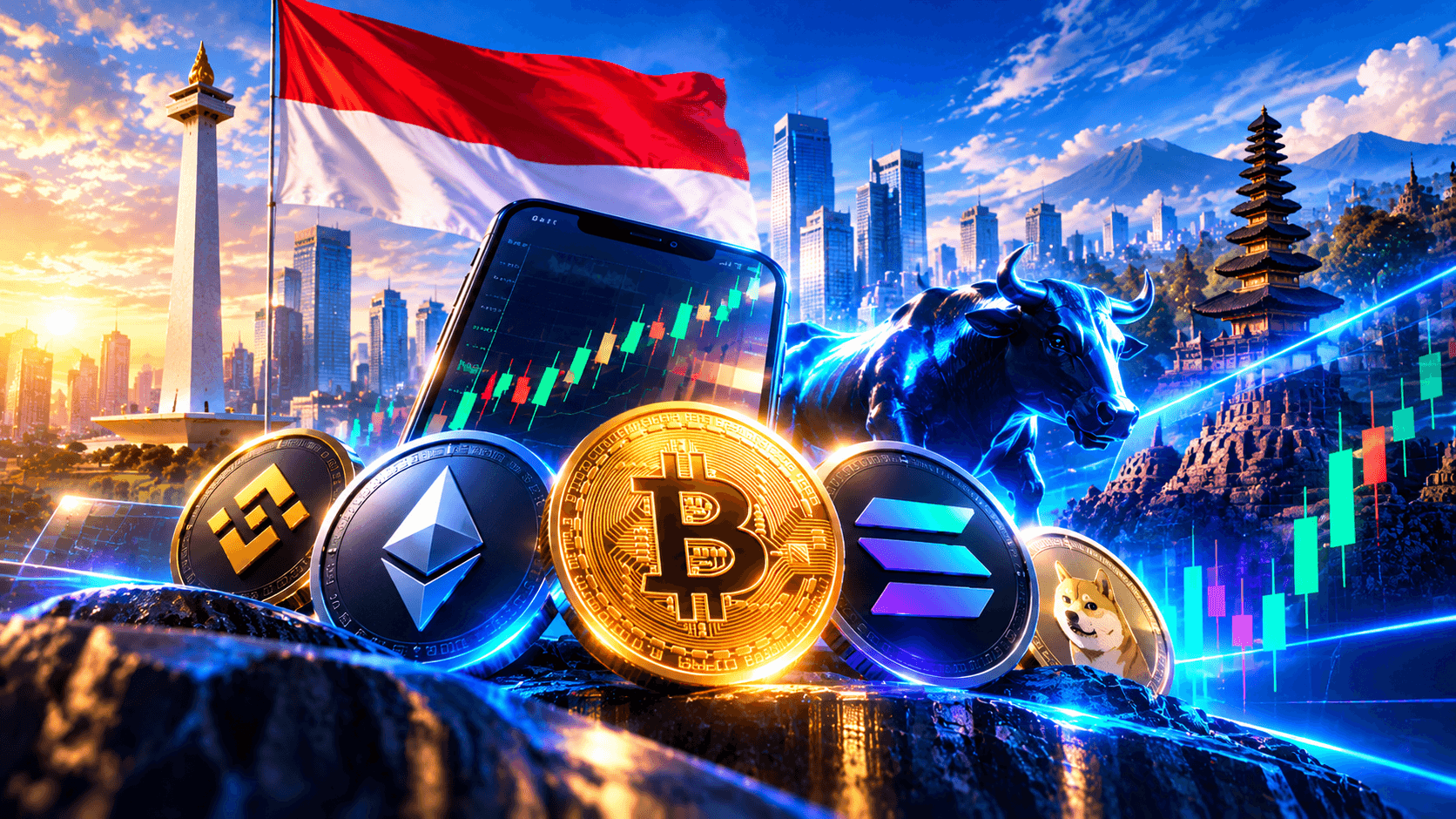
The discussion of crypto futures under OJK has become increasingly relevant after the structure of crypto-asset supervision in Indonesia changed. POJK Number 27 of 2024 became one of the foundations for the operation of digital financial asset trading, including crypto assets, and has been in effect since January 10, 2025.
These rules were subsequently updated through POJK Number 23 of 2025. Under this regulation, the scope of digital financial assets includes crypto assets, other digital financial assets, and digital financial asset derivatives.
This is important because crypto futures regulation is not only about users' buying and selling activities. The framework also covers operators, exchanges, margin, clearing, and consumer protection mechanisms.
What Does OJK Regulate for Crypto Derivatives?
POJK Number 23 of 2025 sets out several important provisions concerning the trading of digital financial asset derivatives. One of them is that an exchange intending to conduct digital financial asset derivative trading must first obtain approval from OJK.
Traders may also execute derivative purchases and sales on behalf of consumers through an exchange that has obtained such approval, subject to the mechanisms and obligations specified in the regulation.
Some key points in the OJK crypto-asset regulatory framework include:
- Digital financial asset derivative exchanges require OJK approval.
- Traders conducting derivative transactions have notification obligations to OJK.
- Operators must have a mechanism for placing margin in a dedicated account.
- Margin may consist of money or digital financial assets in accordance with the applicable provisions.
- Consumers must complete a knowledge test before trading digital financial asset derivatives.
The knowledge test requirement shows that access to derivative products also includes an element of risk awareness. However, passing the test or using a platform operating within the regulatory framework does not mean futures transactions are risk-free.
Read also: How to Protect a Spot Crypto Portfolio with Futures
What Is the Role of PADK Number 3 of 2026?
The development of OJK crypto-asset regulation continued through PADK Number 3 of 2026, which took effect on September 1, 2026. This regulation is an implementing provision related to the operation of digital financial asset trading, including the operator reporting system.
The PADK regulates periodic reports, including monthly, quarterly, and annual reports, as well as incidental reports. It also covers notifications of clearing, guarantee, and settlement activities for digital financial asset derivative transactions.
Therefore, PADK 3/2026 should not be understood as a rule that automatically makes futures “safe.” Its focus is on strengthening reporting mechanisms and operator governance within the digital financial asset ecosystem.
Does OJK Regulation Eliminate Futures Risk?
No. Regulation and supervision establish market governance, operator obligations, and consumer protection, but they do not eliminate market risk.
Crypto prices can still move against a trader's position. Leverage can still magnify losses, and positions can still be liquidated.
Karena itu, keberadaan crypto-asset regulation OJK should not be confused with a guarantee of profit. A platform operating in accordance with regulatory requirements does not make the outcome of every transaction certain.
Read also: Futures Open Interest: How to Read Market Trends and Sentiment
What Should You Check Before Trading Futures?
Before opening a position, use the following simple checklist:
- Check the platform's legality. Make sure the service you use complies with the applicable regulations in Indonesia.
- Understand leverage. Do not look only at the potential profit.
- Check the liquidation price. Know how much price movement the position can withstand.
- Set a stop-loss. Limit risk before the transaction begins.
- Check the funding rate. Especially if the position will be held longer.
- Use position sizing. Do not risk all your capital on a single position.
- Follow regulatory developments. Digital financial asset regulations may evolve with industry conditions.
If you want to learn about futures while keeping up with crypto futures regulations, you can register and check the latest news through Bittime. Be sure to learn the product mechanics first and align each transaction with your risk tolerance.
For users who want to explore trading strategies further, Bittime Futures can also be an option for learning about crypto derivatives trading more flexibly.
Conclusion
Crypto futures risks mainly arise from leverage, liquidation, volatility, funding rates, and undisciplined trading decisions. Greater profit potential cannot be separated from the possibility of greater losses.
In Indonesia, the OJK framework for crypto futures has become clearer through POJK Number 23 of 2025, which covers digital financial asset derivatives, followed by PADK Number 3 of 2026, which strengthens reporting and governance mechanisms.
Understanding regulations is an important step, but risk management remains the trader's responsibility. Before opening a futures position, understand leverage, liquidation prices, and fees, and use a platform that operates in accordance with applicable regulations.
Trading crypto assets and derivatives carries high risks, including the possibility of losing part or all of the capital allocated.

Bittime is a licensed Digital Financial Asset Trader (PAKD) platform authorized and supervised by the Financial Services Authority (OJK) — where you can buy Bitcoin in Indonesia and hundreds of other crypto assets starting from Rp10,000. Registration is fast and secure, and you can get started today.
Monitor the USDT to IDR dan pergerakan harga aset kripto favoritmu secara real-time. Semua tersedia dalam satu crypto investment app that can be downloaded for free from the Play Store.
Ready to get started? Register on Bittime now and execute your investment strategy with a platform trusted by millions of users in Indonesia.
FAQ
What are the main risks of crypto futures?
The main risks include leverage, liquidation, high volatility, funding rates, and poor position management. Leverage can cause losses to grow faster when the market moves against the position.
Is crypto futures trading supervised by OJK?
Digital financial asset derivatives have been incorporated into the OJK regulatory framework through POJK Number 23 of 2025. The regulation governs derivative trading mechanisms, operators, margin, and the knowledge test requirement for consumers.
What is the difference between futures and spot crypto risks?
In spot trading, users purchase assets directly and do not face the leveraged liquidation mechanism found in futures. In futures, the use of margin and leverage means relatively small price changes can have a greater impact on capital.
Are crypto futures safe because they are regulated by OJK?
Regulation does not guarantee profits or eliminate market risk. Traders can still incur losses and face liquidation when prices move against their positions.
What is leverage in futures trading?
Leverage allows traders to control a position value larger than the margin deposited. The higher the leverage, the more sensitive the position is to price changes and liquidation risk.
Disclaimer: The views expressed belong exclusively to the author and do not reflect the views of this platform. This platform and its affiliates disclaim any responsibility for the accuracy or suitability of the information provided. It is for informational purposes only and not intended as financial or investment advice.

.png)