Perpetual Futures vs Regular Futures: What's the Difference and Which One is Right for Traders?
2026-09-02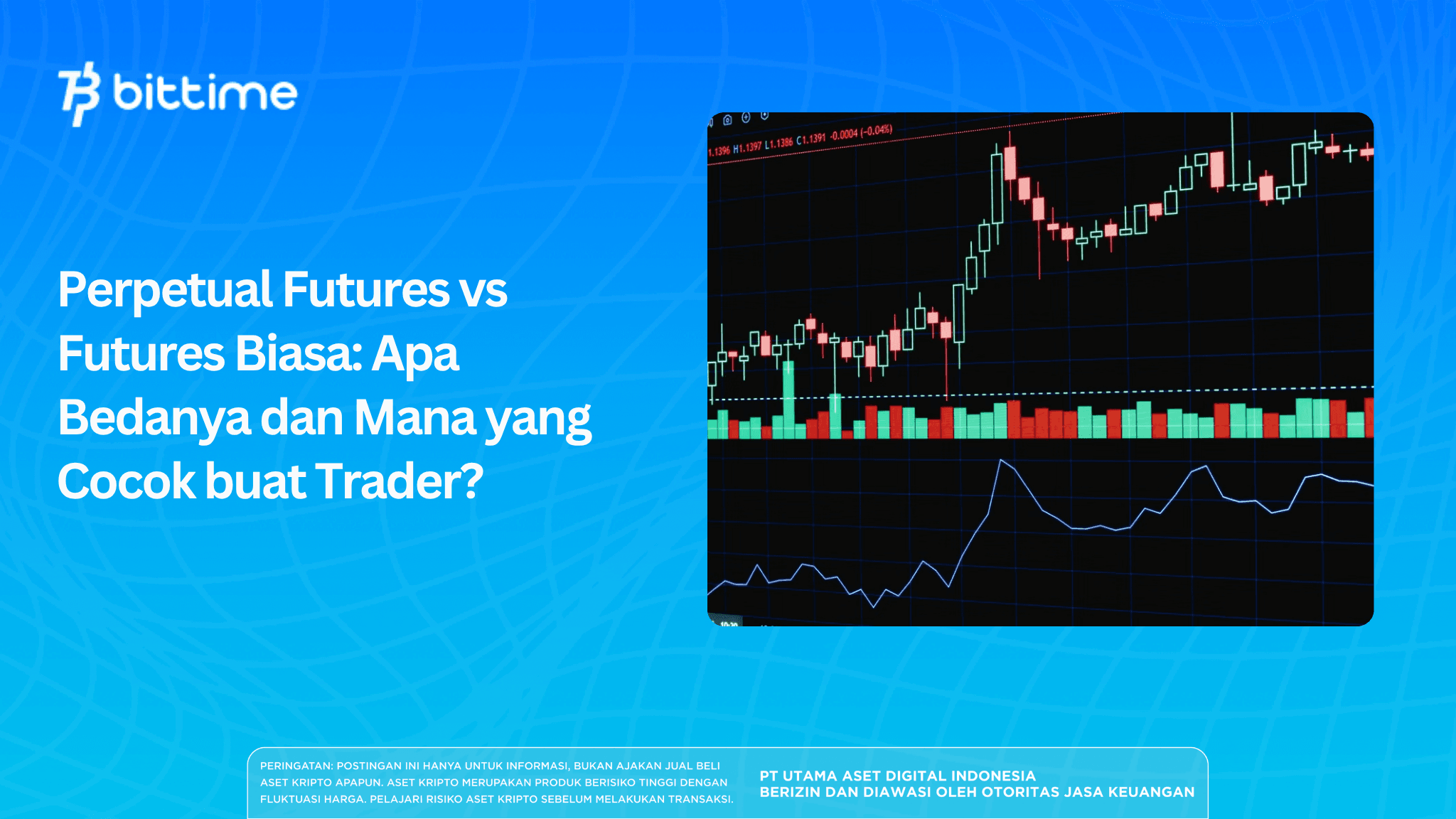
In late May 2026, the U.S. Commodity Futures Trading Commission (CFTC) approved Bitcoin perpetual futures contracts to be traded on a regulated derivatives exchange in the country for the first time.
This decision marks a significant turning point, as an instrument long associated with offshore crypto exchanges is now being recognized within an official regulatory framework. This momentum makes it the perfect time to dive deeper into the differences between perpetual futures and regular futures—two derivative instruments that seem similar at first glance but operate very differently.
The urgency is also reflected in the data. Global perpetual futures trading volume reached $61.8 trillion throughout 2025, accounting for about 78% of total crypto trading volume, according to data from CryptoQuant as cited by Sei Network.
In contrast, futures with fixed expiry dates now account for less than 5% of Bitcoin volume, down significantly from 40% at the start of 2020. This article examines the differences between the two in detail—from price mechanisms and costs to which instrument best fits your trading style.
Key Takeaways
- Perpetual futures have no expiry date and rely on the funding rate to keep prices close to the spot price, while regular futures have a fixed expiry date and converge to the spot price at that time.
- Perpetual futures dominate global crypto trading volume with a 78% market share, but regular futures remain superior for institutional needs that prioritize regulatory certainty and fixed costs.
- The CFTC approved the first Bitcoin perpetual futures contract on a regulated U.S. exchange in May 2026, marking a new chapter for crypto derivatives entering the onshore space.
What Are Perpetual Futures and Regular Futures?
Regular futures, or traditional futures contracts, are agreements between two parties to buy or sell an asset at a specific price and time in the future.
These contracts have a fixed expiry date—typically monthly or quarterly—and can be settled either physically or in cash, according to Coinbase International Exchange. At expiry, the contract price automatically converges with the spot price through a mechanism called basis convergence.
Perpetual futures operate on a different logic. These contracts never expire, so positions can be held indefinitely as long as margin requirements are met.
To keep prices close to the spot market without the aid of an expiry date, perpetual futures use the funding rate mechanism—periodic payments between long and short position traders, as explained by Binance in their educational materials.
This instrument was first introduced by BitMEX in May 2016 through a design by Arthur Hayes, though the underlying concept had been proposed by economist Robert Shiller in the 1990s for illiquid assets like real estate. Since then, perpetual futures have grown into the most heavily traded instrument in the crypto derivatives market.
If you're interested in trying either of these instruments directly, Bittime offers futures trading services that are officially licensed under the oversight of Indonesia's OJK, complete with leverage options and margin modes that can be tailored to your trading style.
Perpetual Futures vs Regular Futures: Price Mechanisms, Expiry, and Leverage
The most fundamental differences between perpetual futures and regular futures lie in three aspects: how prices are kept fair, the presence or absence of an expiry date, and the level of leverage offered.
The way perpetual futures work centers on the funding rate. When the contract price trades higher than the spot price, long positions pay short positions. Conversely, when the contract price is lower than spot, shorts pay longs.
Most exchanges calculate funding every 8 hours, though dYdX and Coinbase do so hourly, according to Sei Network. As an illustration, Bitcoin funding on Binance was positive for 322 out of 365 days throughout 2024, peaking at 0.07% per 8 hours, equivalent to 76.65% annualized.
Exchanges also distinguish between the index price and the mark price to prevent unreasonable liquidations. The index price is a weighted average of spot prices from several major exchanges, while the mark price is used to calculate unrealized profit and loss and to trigger liquidations, so a trader's position is not immediately executed due to a sudden price spike on a single exchange.
Regular futures face a different challenge: rollover. Traders who want to maintain long-term exposure must close their near-expiry contracts and open new ones for the following month.
In contango conditions—when futures prices are higher than spot—this process incurs roll yield losses that can reach 13% per year, according to Sei Network.
Also Read: Futures Trading: Contracts, Leverage, and Long Short Explained
Which One is Right for Traders? Latest Market Data and Regulation
From a volume perspective, perpetual futures clearly dominate. Binance held approximately 29.3% of the perpetual futures market share with $25 trillion in volume throughout 2025, followed by OKX and Bybit, each controlling about 21%, according to a Coinglass report cited by Sei Network.
The decentralization trend is also strengthening, with perpetual futures volume on decentralized exchanges (DEXs) surging from less than 3% to over 25% in just about 18 months, with Hyperliquid recording cumulative volume of more than $2.7 trillion.
On the regulatory front, things are also moving quickly. On May 29, 2026, the CFTC approved the listing of KalshiEX's BTCPERP contract as the first futures contract referencing a perpetual—rather than a swap—on a regulated U.S. exchange.
According to The Defiant, this decision was accompanied by a policy statement on case-by-case reviews for subsequent perpetuals, along with guidance on 24/7 trading and clearing. This move signals that crypto derivatives once associated with offshore exchanges are now gaining a legitimate pathway into regulated markets.
Also Read: Futures Trading for Beginners: How It Works, Tips, and Risks
Even so, regular futures remain relevant for certain needs. Institutions that prioritize regulatory certainty, centralized clearing, and predictable costs still tend to prefer regulated futures like those on the CME.
CME Bitcoin futures, for example, recorded 424,000 contracts worth $13.2 billion in a single day in November 2025, showing that institutional interest remains strong even though overall volume growth is happening more in perpetuals.
For active traders seeking flexibility without the hassle of rollover, perpetual futures are generally more suitable. However, the high leverage on perpetuals also means greater risk—even a small price movement can trigger liquidation if the leverage used is too aggressive.
In Indonesia, Bittime Futures offers this option legally as a Digital Financial Asset Trader (PAKD) with futures licenses through PT Central Finansial X (CFX) under OJK oversight, complete with leverage up to 25x and both Cross Margin and Isolated Margin options to suit each trader's risk tolerance.
Also Read: Tokenized Stocks vs Regular Stocks: Definition, Differences, and How to Buy
Conclusion
Perpetual futures and regular futures both provide exposure to crypto asset price movements without needing to own the assets directly, but they are built on different logic.
Perpetual futures excel in flexibility because they have no expiry and rely on the funding rate, while regular futures offer cost certainty and regulatory clarity that institutional players prefer.
The entry of perpetual futures into regulated exchanges—as just happened in the United States—shows that this instrument is gaining broader recognition. However, the final choice should still be tailored to your trading style, risk tolerance, and understanding of leverage mechanics before you start transacting.
Check prices for Bitcoin (BTC), Ethereum (ETH), XRP, Solana (SOL), GRAM, and BNB as well as top memecoins like DOGE. You can trade directly on Bittime!

Bittime is a licensed Digital Financial Asset Trader (PAKD) platform supervised by the Financial Services Authority (OJK) — where you can buy Bitcoin in Indonesia and hundreds of other crypto assets starting from just Rp10,000. The registration process is fast, secure, and you can get started today.
Monitor USDT to IDR conversions and price movements of your favorite crypto assets in real time. All available in a single crypto investment app that you can download for free on the Play Store.
Ready to start? Sign up now on Bittime and execute your investment strategy on a platform trusted by millions of users in Indonesia.
FAQ
What are perpetual futures?
Perpetual futures are crypto derivative contracts with no expiry date that use a funding rate mechanism to keep their price close to the spot price.
What is the main difference between perpetual futures and regular futures?
Perpetual futures have no expiry date and rely on the funding rate, while regular futures have a fixed expiry date and their price converges to the spot price at expiry.
How do perpetual futures work?
Perpetual futures maintain their price through the funding rate—periodic payments between long and short traders, with the direction determined by the difference between the contract price and the spot price.
Are perpetual futures riskier than regular futures?
Perpetual futures tend to offer higher leverage, making the risk of liquidation greater, while regular futures generally have lower leverage limits and more predictable costs.
Perpetual futures vs regular futures: which is better for beginners?
Beginners should start with low leverage on either instrument and first understand the mechanics of the funding rate or rollover before increasing position size.
Is crypto futures trading legal in Indonesia?
It is legal as long as it is conducted on a licensed platform, such as Bittime, which is a registered PAKD supervised by OJK with futures licenses through CFX.
Disclaimer: The views expressed belong exclusively to the author and do not reflect the views of this platform. This platform and its affiliates disclaim any responsibility for the accuracy or suitability of the information provided. It is for informational purposes only and not intended as financial or investment advice.

.png)