BIS 2026 Warning: Stablecoin Risks for Developing Countries
2026-06-29
The Bank for International Settlements (BIS) has warned that the growth of stablecoins could reshape the structure of the global financial system. The issue goes beyond price risk or issuer failure.
Foreign currency-denominated stablecoins, particularly the US dollar, could reduce the use of local currencies, encourage more volatile capital flows, weaken interest rate transmission, and create a fragmented payments system.
Key Takeaways
- A dollar-based stablecoin could accelerate digital dollarization and reduce the ability of developing country central banks to influence domestic savings, credit, and transactions.
- The BIS considers stablecoins to not fully meet the principle of singleness of money because their value, redemption mechanisms, liquidity, and circulation networks can differ.
- Project Agorá offers an alternative through tokenized deposits and central bank reserves that can be used on an integrated cross-border payments platform.
Register at Bittime now and start trading crypto with a fast, safe, and easy process in the app.
What Does the BIS Annual Economic Report 2026 Warning Mean?
The BIS Annual Economic Report 2026 discusses changes in the monetary system due to tokenization, stablecoins, blockchain, and programmable payment platforms.
The BIS isn't rejecting digital innovation altogether. The agency recognizes that tokenization can speed up transactions, reduce reconciliation processes, and support 24/7 payments.
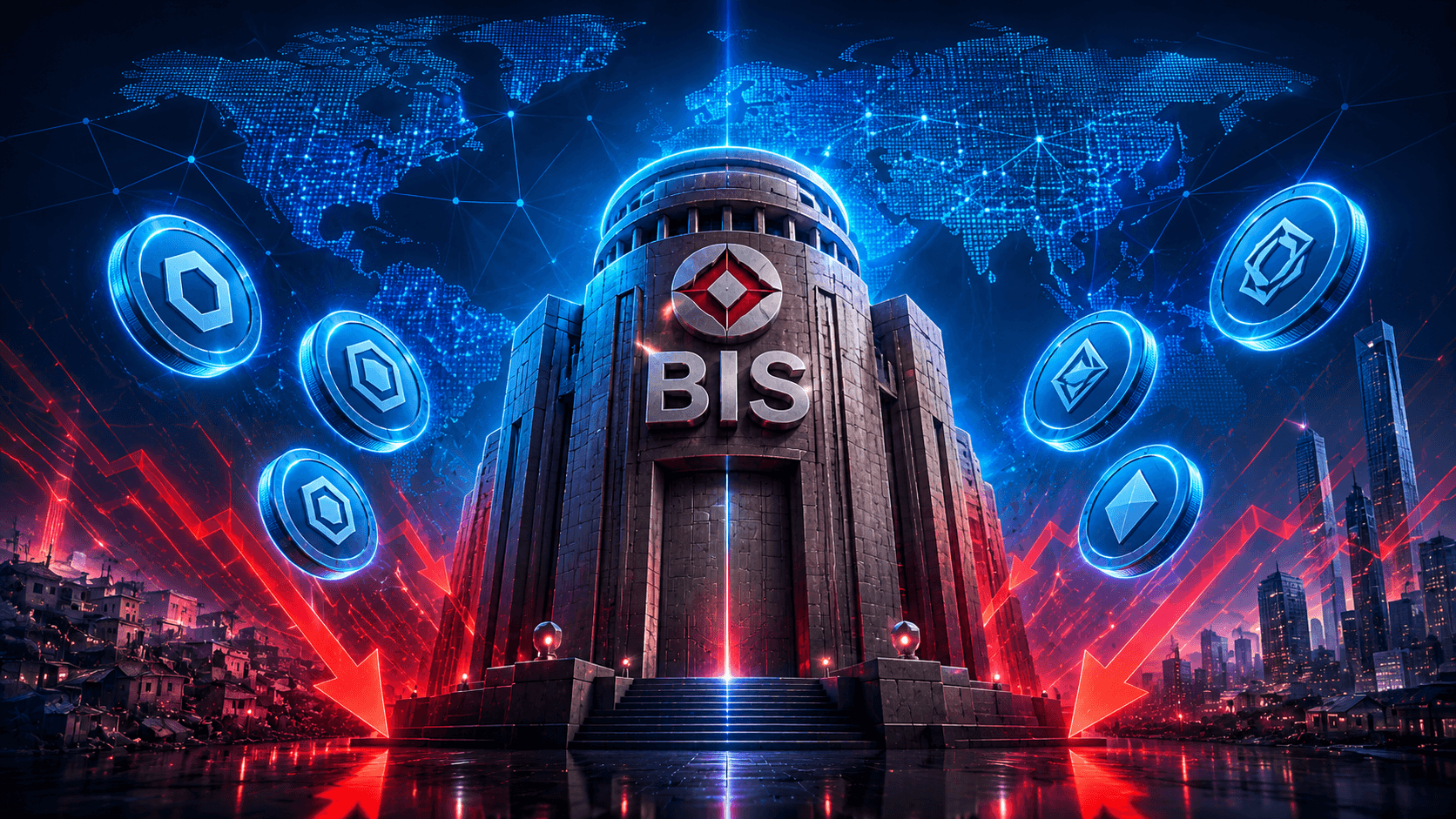
(Image source: AI Image Generated)
However, the BIS believes that the technological benefits are not sufficient to make stablecoins the main foundation of the monetary system.
According to the BIS, a trustworthy monetary system requires several key characteristics. These include a single unit of account, equivalence of value between different forms of money, availability of liquidity when needed, interoperability, and protection against financial crime.
Current stablecoins do not always meet all of these requirements.
The risks increase when stablecoins are used outside the crypto-asset trading ecosystem. If people start using them for savings, salary payments, pricing goods, business transactions, and remittances, the impact of stablecoins on the national economy will increase.
Read also: BI Stablecoin: A Safe Investment in the Crypto Future
What is Stablecoin?
Stablecoins are digital tokens designed to maintain value against a specific asset. Most global stablecoins use the United States dollar as their benchmark.
The most common example is a token that targets the value of one token equal to one US dollar. Issuers typically hold reserve assets in the form of cash, bank deposits, short-term government bonds, or money market instruments.
Stablecoins offer several practical benefits:
- Transactions can take place within 24 hours.
- Cross-country shipping can be done quickly.
- Tokens can be used in blockchain applications.
- Stablecoins can be a bridge between fiat money and crypto assets.
- Transactions can be programmed through smart contracts.
- Users can maintain dollar exposure without opening a dollar bank account.
The final benefit is particularly important for developing countries. Stablecoins make access to foreign currency easier than purchasing cash or opening a foreign currency deposit.
This convenience can help people protect their purchasing power when the local currency weakens. However, widespread use can also reduce the effectiveness of domestic monetary policy.
Read also: What is JPYSC Stablecoin from SBI Group?
Why Are Stablecoins Different from Bank Money?
Both bank account balances and stablecoins can be used for payments, but their legal structures differ.
Bank balances represent commercial banks' obligations to customers. Banks operate within a system linked to the central bank. Banks are also subject to supervision, capital requirements, liquidity regulations, deposit guarantees, and resolution mechanisms.
Stablecoins are an obligation of the token issuer. Users' rights depend on the legal structure, reserve quality, redemption mechanism, and the issuer's jurisdiction.
Not all stablecoin holders have direct redemption rights. In some models, only certain customers or investors with a minimum amount can redeem tokens directly with the issuer.
Retail users ultimately rely on secondary markets. Stablecoin prices can fluctuate slightly above or below their benchmark value.
Small differences may seem insignificant when markets are calm. However, deviations can become magnified during periods of panic, liquidity issues, or uncertainty about reserves.
Read also: SBI Launches Yen-Based Stablecoin JPYSC
What Is the Singleness of Money?
Singleness of money means that every form of money in the same currency can be exchanged at the same value.
One dollar in cash should be worth the same amount in a bank account. Users don't need to check the issuing bank every time they receive a payment.
A similar principle applies to the rupiah. Rp100,000 in a bank account should be equivalent to Rp100,000 in cash.
This equivalence doesn't occur automatically. Central banks, payment systems, banking regulations, deposit insurance, and liquidity facilities ensure that different forms of money are interchangeable at face value.
Stablecoins can undermine the singleness of money for several reasons.
- First, each issuer has a different reserve composition.
- Second, redemption rights can differ between stablecoins.
- Third, the same token can circulate on multiple blockchains that are not directly connected.
- Fourth, market prices may deviate from the reference value.
- Fifth, transaction fees and liquidity differ across networks.
As a result, one dollar token isn't always the practical equivalent of one dollar in a bank account. Its value can depend on the issuer, network, exchange, and market conditions.
Read also: Meta Quietly Launches Stablecoin Payment Service
Why Stablecoins Could Break the Global Financial System?
Stablecoins can be issued on Ethereum, Solana, Tron, BNB Chain, and various other networks. Tokens on one network aren't always directly transferable to another.
Users often require bridges, exchanges, or third-party services. Each interface adds technical and operational risk.
Errors in cross-chain processes can result in delays or loss of assets. Governance issues also arise when there is no single authority responsible for correcting errors.
Fragmentation occurs at several levels:
- Fragmentation between blockchains.
- Fragmentation among stablecoin issuers.
- Fragmentation of redemption standards.
- Fragmentation of regulations between countries.
- Fragmentation of identity and compliance systems.
- Liquidity fragmentation across exchanges.
- Fragmentation between crypto systems and banking systems.
The more disconnected systems are, the harder it is for stablecoins to generate network effects like national currencies.
Read also: Brazil Blocks Stablecoins: Here's What You Need to Know
Why Are Stablecoins Having a Greater Impact in Developing Countries?
Developing countries often face higher inflation, exchange rate fluctuations, shallower financial markets, and lower confidence in their local currencies.
This condition increases demand for the dollar as a store of value.
Before stablecoins could flourish, people needed cash in dollars, foreign exchange accounts, or access to international financial institutions. These processes weren't always easy.

(Image source: AI Image Generated)
Stablecoins reduce these barriers. Users only need a phone, a wallet, internet access, and a token purchase channel.
This convenience could accelerate the shift from local currencies to digital dollars.
The BIS calls this phenomenon stablecoin dollarization. Its impact can be more difficult to control than conventional dollarization because tokens can be stored in unhosted wallets and transferred directly between users.
Read also: Meta Supports USDC Settlements and Polygon's Solana Wallet for Creators
7 Ways Stablecoins Undermine Monetary Policy
1. Reduce the use of local currency
Monetary policy works more effectively when people use the domestic currency to set prices, hold funds, and conduct transactions.
If salaries, rent, goods, or services start to be calculated in dollar stablecoins, the role of local currencies as units of account will decline.
Central banks can still change domestic interest rates, but these decisions have less impact on people using foreign currencies.
2. Weakening interest rate transmission
Central banks raise or lower interest rates to influence savings, consumption, investment, and credit.
The transmission runs through banks and domestic financial markets.
If people hold funds in stablecoins, changes in domestic interest rates don't directly affect those holdings. Zero-yielding stablecoins don't pay interest like deposits.
Some users place stablecoins on DeFi platforms to earn yields. DeFi yields are more influenced by demand for crypto loans and protocol mechanisms than by domestic central bank interest rates.
The relationship between central bank decisions and stablecoin holder behavior is becoming weaker.
3. Importing other countries' monetary policies
Most stablecoins are pegged to the US dollar. When dollar-denominated stablecoins become widely used, the US monetary policy also impacts the economies of the countries using them.
Rising US interest rates could increase the appeal of dollar-based assets. People may shift more funds from local currencies to stablecoins.
Problems arise when the economic cycles of the two countries differ.
Developing countries may need looser policies to stimulate growth. At the same time, the United States could pursue tighter policies.
Stablecoins allow foreign policy influences to penetrate the domestic economy more quickly.
4. Encourage volatile capital flows
Stablecoins can be moved quickly across national borders. This speed benefits payments but can also amplify fluctuations in capital flows.
When economic risks increase, people may buy stablecoins simultaneously. Demand for dollars surges, depreciating local currencies.
When sentiment improves, funds may flow back in. This pattern increases exchange rate volatility and makes it difficult for the central bank to manage liquidity.
5. Helps avoid capital controls
Some countries implement foreign exchange restrictions to maintain exchange rate stability and foreign exchange reserves.
Stablecoins held in private wallets can move outside of domestic financial intermediaries, making oversight more difficult.
A ban on local exchanges may not necessarily stop transactions between users, foreign platforms, or unhosted wallets.
The BIS found that restrictions on stablecoin transactions may not be as effective as restrictions on foreign currency deposits. Their digital and cross-border nature makes them more difficult to enforce.
6. Reduce cheap banking funds
People typically keep money in bank accounts. These funds serve as a source of credit financing.
If customers move their deposits to stablecoins, banks lose a portion of their retail funding source. They must replace it with more expensive funding.
Higher funding costs could push up lending rates. Banks could also reduce lending to households and small businesses.
This impact is called the bank lending channel.
7. Suppressing the exchange rate and foreign exchange reserves
Purchasing dollar stablecoins requires funding. In many cases, users sell their local currency to acquire dollars or dollar-based tokens.
Increased demand can weaken the domestic currency in the spot market.
The central bank may intervene using foreign exchange reserves. Excessive intervention could reduce policy space as pressures persist.
Balso read: USDT/IDR vs USDC/IDR Comparison for Local Arbitrage Strategy
Are Stablecoins Always Losing Money?
No. The BIS does not state that every use of stablecoins is necessarily detrimental to the economy.
Stablecoins can facilitate cross-border payments, digital commerce, and access to dollar assets. This technology can also increase competition in the payment system.
For migrant workers, stablecoins can reduce remittance delivery times. For digital companies, stablecoins can facilitate payments outside of bank operating hours.
However, these benefits need to be calculated comprehensively.
Users still face fees for purchasing tokens, blockchain fees, conversion fees, price differences, and withdrawal fees to local currencies. The total cost of stablecoins isn't always lower than bank transfers.
Risks also depend on usage. Stablecoins used solely for crypto trading have different economic impacts than stablecoins used as primary payment instruments.
Read also: List of 15+ Euro Stablecoins 2026
Stablecoin Risks to Banks and Financial Markets
Stablecoins don't just influence monetary policy. Their growth could change the structure of banking and the bond market.
Stablecoin issuers hold reserve assets to cover redemptions. These reserves can take the form of short-term government bonds and bank deposits.
When demand for stablecoins increases, issuers purchase more reserve assets. This demand can lower the borrowing costs of the benchmark currency-issuing government.
However, the situation turns around when users make large redemptions.
Issuers must sell assets to raise cash. Rapid sales can depress bond prices and disrupt money markets.
The main risks include:
- Simultaneous stablecoin withdrawals.
- Forced sale of reserve assets.
- Pressure on short-term debt markets.
- Decrease in bank deposit funds.
- Increase in banking funding costs.
- Reduction of credit to the real economy.
- Contagion between the crypto market and the financial system.
The scale of the impact depends on the size of the market, the composition of reserves, redemption rights, and the issuer's relationship with the bank.
Why Don't Stablecoins Have Elastic Liquidity?
The banking system has a central bank as the liquidity provider of last resort.
When a healthy bank needs settlement funds, the central bank can provide liquidity through intraday facilities, monetary operations, or lender of last resort.
This mechanism keeps payments flowing during times of stress.
Stablecoin issuers don't always have access to similar facilities. They must meet redemptions using available reserve assets.
If many users request redemptions, the issuer must sell the asset. The liquidity of stablecoins depends on the market's ability to absorb these sales.
This is the difference between reserves that appear liquid under normal conditions and the liquidity that is actually available during a crisis.
What Solutions Does BIS Offer?
BIS proposes two policy paths.
The first path is to tighten protections for stablecoins. The second path is to bring the benefits of tokenization into the existing two-tier monetary system.
Stronger stablecoin regulation
Regulations need to be adapted to the functions of stablecoins.
Stablecoins used as a means of payment require stricter standards than tokens used solely as investment instruments.
Some suggested steps include:
- High quality reserve obligations.
- Right of redemption at face value.
- Strict liquidity rules.
- Capital requirements for issuers.
- Separation of reserve assets.
- Openness of reserve composition.
- Resolution plan when publisher fails.
- Suspicious transaction monitoring.
- Consumer protection.
- Cross-border surveillance cooperation.
Regulation also needs to reduce regulatory arbitrage. Issuers should not relocate their operations to less restrictive jurisdictions to serve global users without adequate oversight.
What Are Tokenized Deposits?
Tokenized deposits are digital representations of commercial bank deposits on a programmable platform.
The token remains a liability of the issuing bank. Its value can be redeemed at face value for central bank currency in the same currency.
Tokenized deposits are different from private stablecoins.
Stablecoins rely on the issuer's reserve assets. Tokenized deposits remain within the banking structure, prudential regulation, and central bank settlement systems.
The benefits of tokenized deposits include:
- Payments can run around the clock.
- Transactions can be completed automatically.
- The reconciliation process can be reduced.
- Compliance can be incorporated into the transaction flow.
- Funds and assets can move simultaneously.
- Banks continue to carry out their credit intermediation function.
- Equivalence with central bank money can be maintained.
The BIS believes that tokenization does not require separating the financial system from the central bank. The technology can be applied to systems that retain a public monetary anchor.
Project Agorá as a Stablecoin Alternative
Project Agorá is a joint project of the BIS, the Institute of International Finance, central banks and private financial institutions.
This project tests cross-border payments using tokenized commercial bank deposits and tokenized central bank reserves.
Project Agorá involves eight central banks and more than 40 regulated financial institutions at the prototype stage.
The architecture doesn't mix all central bank reserves into one seamless system. Each jurisdiction retains control over its currency and reserves.
A shared platform connects multiple ledgers so that cross-border transactions can be completed in a coordinated manner.
How Does Project Agorá Work?
Project Agorá uses an atomic payment or atomic settlement approach.
In traditional systems, cross-border transactions pass through multiple correspondent banks. Each party processes messages, performs compliance checks, currency conversions, and settlements at different times.
This process can cause delays and failures.
Atomic settlement connects all stages of a transaction. All parts of the transaction are either settled or completely canceled.
This approach reduces the risk that one party has transferred funds, but the other party has not fulfilled its obligations.
Project Agorá also maintains privacy by restricting data access. Transaction information is only provided to those who need it.
In May 2026, the BIS declared the Project Agorá prototype successful in demonstrating that cross-currency settlement could be conducted securely and definitively. The next phase is geared towards testing real-value transactions.
Why is Project Agorá Considered Safer?
Project Agorá tries to preserve the benefits of tokenization without eliminating the foundations of the monetary system.
There are several reasons this approach is considered more robust.
- First, the solution uses tokenized central bank reserves.
- Second, tokenized deposits remain a requirement for regulated banks.
- Third, participants must comply with access and compliance rules.
- Fourth, national authorities maintain control over their currencies.
- Fifth, the transaction has a clear legal framework.
- Sixth, the system is designed to operate across jurisdictions.
- Seventh, the settlement mechanism maintains the principle of singleness of money.
However, Project Agorá is still in the development stage. The success of the prototype does not yet prove that the system can be deployed globally.
Legal issues, governance, costs, cybersecurity, interoperability, and division of responsibilities still need to be resolved.
What are the impacts for Indonesia and developing countries?
The BIS warning is relevant for countries with high growth in digital asset users.
A dollar stablecoin could provide access to global payments. However, its use as a savings account and domestic payment instrument could increase dependence on the dollar.
Developing countries need to avoid two extreme approaches.
A blanket ban could push activity onto unregulated platforms. Overly lax regulation could accelerate dollarization and unmonitored capital flows.
A more balanced approach could include:
- Regulate publishers and service providers.
- Strengthening monitoring of cross-border transactions.
- Maintain redemption and reserve obligations.
- Improving the quality of local payment systems.
- Develop financial instruments in domestic currency.
- Accelerate official cross-border payments.
- Improve user data protection.
- Building cooperation between authorities.
- Testing tokenized deposits and central bank money.
- Maintaining inflation and exchange rate stability.
The best defense against dollarization isn't just restrictions. Countries also need to maintain confidence in their domestic currencies.
People will continue to prefer local currencies when inflation is under control, payment systems are efficient, and savings instruments offer adequate protection.
Conclusion
The BIS's warning about stablecoins doesn't focus on rejecting blockchain technology. It highlights the risks when private dollar-backed tokens develop into a parallel monetary system without adequate institutional foundations.
For developing countries, the risks include digital dollarization, more volatile capital flows, exchange rate pressures, reduced bank funding, and weakened monetary policy transmission.
Another problem is the singularity of money. Stablecoins with different issuers, networks, reserves, and redemption mechanisms cannot always be exchanged at the same value under all conditions.
The BIS offers an alternative approach through tokenized deposits, tokenized central bank reserves, and Project Agorá. These systems seek to combine speed and programmability with oversight, final settlement, and trust in central bank money.
Stablecoins can still play a role in the financial system. However, this role requires boundaries, regulation, and cross-border coordination. Developing countries also need to improve their domestic payment systems to prevent people from being pushed into using digital foreign currencies simply because local services are slower or more expensive.

Bittime is a licensed and regulated Digital Financial Asset Trader (PAKD) supervised by Indonesia’s Financial Services Authority (OJK) — where you can buy Bitcoin in Indonesia and hundreds of other crypto assets starting from just Rp10,000. The registration process is fast, secure, and you can get started today.
Track USDT to IDR conversions and monitor your favorite crypto assets in real time. Everything is available in one crypto investment app that you can download for free on the Play Store
Ready to start? Register now on Bittime and execute your investment strategy with a platform trusted by millions of users in Indonesia.
FAQ
Does the BIS want to ban all stablecoins?
No. The BIS proposes regulations tailored to the functions and risks of stablecoins. Stablecoins used as a means of payment require stricter regulations than investment tokens.
How do stablecoins undermine monetary policy?
Stablecoins can reduce the use of local currencies and divert funds from bank accounts. This weakens the influence of domestic interest rates on savings, credit, and transactions.
What does singleness of money mean?
The singleness of money means that every form of money in the same currency can be exchanged at face value. Stablecoins can undermine this principle when their prices or redemption mechanisms differ.
What is Project Agorá?
Project Agorá is a BIS and financial sector project testing cross-border payments using tokenized deposits and tokenized central bank reserves. The project utilizes an atomic settlement mechanism.
Are tokenized deposits the same as stablecoins?
No. Tokenized deposits are obligations of commercial banks and can be redeemed for central bank currency. Stablecoins are obligations of the token issuer backed by a specific reserve asset.
Disclaimer: The views expressed belong exclusively to the author and do not reflect the views of this platform. This platform and its affiliates disclaim any responsibility for the accuracy or suitability of the information provided. It is for informational purposes only and not intended as financial or investment advice.

.png)