Blockchain Without Bridges? Getting to Know Near Protocol Chain Signatures
2026-09-17
Near Protocol Chain Signatures became a topic of discussion again on September 16, 2026, after the official Near account announced that the technology's coverage now reaches more than 30 blockchains and 180 digital assets in a single account.
Many media outlets automatically called it a new launch, even though the foundation of this bridge-free blockchain had actually been built by Near since mid-2024.
For those of you curious about blockchain interoperability and how one account can control assets on dozens of different chains without conventional bridges, this article will thoroughly dissect Near Protocol's Chain Signatures technology, from its history and how it works to its impact on the cross-chain crypto ecosystem.
Key Takeaways
- Near Protocol announced that Chain Signatures now reaches 30+ blockchains and 180+ assets in a single account, but this is an expansion of coverage for technology that has existed since 2024, not an entirely new feature.
- Chain Signatures uses an MPC (Multi-Party Computation) network to sign transactions directly on the destination blockchain, making bridge-free blockchain possible and reducing transaction latency.
- This technology forms the foundation of NEAR Intents, which has processed more than $22 billion in cross-chain crypto swap volume across 35+ blockchains.
What Are These Widely Discussed Near Protocol Chain Signatures?
The September 16, 2026 announcement actually came from a post on Near Protocol's official X account, which was then reported by Coinfomania and Cryptonomist.
Its content: Chain Signatures now connects more than 30 blockchains and 180 assets in a single Near account, allowing transactions to be triggered directly on the destination blockchain without going through third-party bridges.
In fact, Chain Signatures is not new technology. It first went live on the Near testnet in March 2024, then was introduced more broadly to the public in August 2024 through a partnership with EigenLayer for an additional security layer. At that time, its coverage was limited to Bitcoin, Ethereum, Cosmos, Dogecoin, and XRP Ledger.
So, the figure of 30+ blockchains and 180+ assets in September 2026 is more accurately read as a milestone of coverage growth, not a debut launch as implied by a number of news headlines.
Read Also: Purbaya Removed from Finance Ministry, to Become BI Governor? Check the Facts
Regardless of the framing, this growth in coverage remains an important indicator that this latest Near Protocol technology is increasingly trusted by developers to build cross-chain crypto applications without having to rely on bridges, which have long been one of the biggest security weak points in Web3.
Speaking of security and efficiency in crypto transactions, you can start exploring digital assets on a legal platform supervised by OJK by registering a Bittime account right now.

How This Bridge-Free Blockchain Technology Works
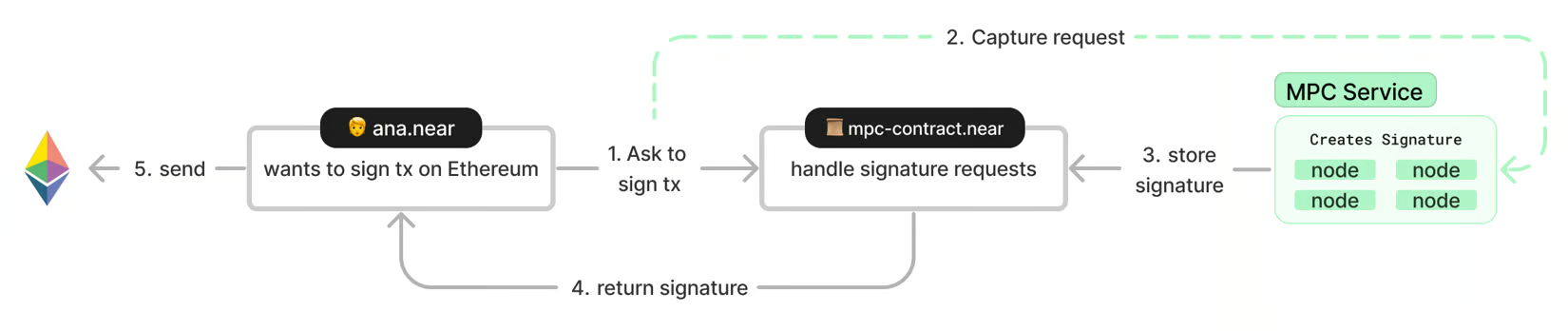
Chain Signatures relies on a decentralized MPC, or Multi-Party Computation, network. The private key is never stored whole in one place; instead, it is split across many nodes.
Each node holds only a small portion of that key, then produces a partial signature. These pieces are then combined into one full signature that is valid for the destination blockchain.
The process is very different from conventional bridges, which usually work by locking assets on the source chain, then minting a wrapped version on the destination chain.
This kind of approach is prone to being an exploitation target, because assets locked in bridge smart contracts are often easy prey for hackers. Chain Signatures avoids that model entirely by signing transactions natively, directly on the destination blockchain.
Read Also: BIS Reveals New Potential of XRP Ledger for Digital Financial Systems
A single Near account can also control many derived addresses across various chains at once. These addresses are calculated deterministically from a combination of the Near address, a specific derivation path, and the MPC network's public key.
This means the same address will always be generated from the same combination of inputs, so developers can build cross-chain crypto applications without needing to manage separate wallets for each network.
NEAR Intents, Tangible Proof of Near Protocol Blockchain Interoperability
Chain Signatures is actually the technical foundation behind a product that has already proven to be widely used, namely NEAR Intents. This cross-chain swap system has been running since late 2024, and according to Nansen's quarterly report for the second quarter of 2026, NEAR Intents has facilitated more than $22 billion in cumulative swap volume across more than 35 blockchains.
This data is far more solid than the viral Chain Signatures milestone claims, because it comes from verifiable on-chain figures, not merely social media posts.
Read Also: Popular Tokenized Stocks 2026: Technology Shares Become Investor Favorites
Near has also just added post-quantum signing based on the FIPS-204/ML-DSA standard, making it one of the first layer 1 blockchains with a quantum-computing-resistant signature scheme approved by NIST.
Third-party adoption also continues to grow. Swap platforms like SimpleSwap, which has more than 10 million users, as well as hardware wallet Ledger through its SwapKit integration, have already utilized NEAR Intents to deliver a cross-chain swap experience without the hassle of bridges and native gas tokens on every network.
Conclusion
Near Protocol Chain Signatures offers a technically solid bridge-free blockchain approach, although its latest announcement about 30+ blockchains and 180+ assets is more accurately understood as an expansion of coverage rather than the launch of a new feature.
What is more convincing is actually the data from NEAR Intents, a Chain Signatures derivative product that has processed tens of billions of dollars in swap volume with real adoption from various platforms.
Going forward, the success of blockchain interoperability technology like this will depend heavily on how many developers and users actually utilize it in daily transactions, not merely coverage figures on paper.
Check the price of Bitcoin (BTC), Ethereum (ETH), XRP, Solana (SOL), GRAM, and BNB as well as leading memecoin DOGE. You can trade directly on Bittime!

Bittime is a licensed Digital Financial Asset Trader (PAKD) platform supervised by the Financial Services Authority — where you can buy Bitcoin in Indonesia and hundreds of other crypto assets starting from Rp10,000. The registration process is fast, secure, and can be started today.
Monitor USDT to IDR conversion and your favorite crypto asset price movements in real time. All available in one crypto investment app that can be downloaded for free on the Play Store.
Ready to start? Register now at Bittime and execute your investment strategy with a platform trusted by millions of users in Indonesia.
FAQ
What are Near Protocol Chain Signatures?
Chain Signatures is a Near Protocol technology that allows one account to sign and execute transactions on many other blockchains without bridges, using a decentralized MPC network. The technology first went live on testnet in March 2024.
Why is it called bridge-free blockchain?
Chain Signatures signs transactions natively directly on the destination blockchain, rather than locking assets and then minting a wrapped version like conventional bridges. This approach reduces the risk of exploits that often target bridge smart contracts.
Is the September 2026 announcement of 30+ blockchains a new feature?
No, this is an expansion of coverage for technology that has existed since 2024, not a first launch as implied by a number of news headlines. Its initial coverage included only five blockchains such as Bitcoin and Ethereum.
What is the relationship between Chain Signatures and NEAR Intents?
NEAR Intents is a cross-chain swap product built on Chain Signatures technology. The product has processed more than $22 billion in cumulative swap volume across 35+ blockchains.
Are Chain Signatures safe to use?
Its security relies on an MPC network secured by Near validators, so no single party holds the private key in full. Near has also added a quantum-resistant signature scheme to strengthen long-term security.
Disclaimer: The views expressed belong exclusively to the author and do not reflect the views of this platform. This platform and its affiliates disclaim any responsibility for the accuracy or suitability of the information provided. It is for informational purposes only and not intended as financial or investment advice.

.png)