What Is OpenGradient (OPG)? Decentralized AI Infrastructure Expected to Be Available on Bittime
2026-07-03
The development of AI technology in recent years has moved very rapidly. AI models are now capable of helping write code, analyze data, and even run autonomous agents that can make decisions independently.
However, there is one challenge that is still frequently questioned: how to ensure that AI results are truly trustworthy.
This is where OpenGradient (OPG) tries to offer a different approach. This project combines blockchain technology with artificial intelligence through the concept of verifiable AI, so that the AI inference process not only produces answers but can also be verified cryptographically.
Key Takeaways
- OpenGradient is a decentralized AI network that provides verifiable AI inference.
- The OPG token has utility as a payment tool for AI services, node incentives, and governance.
- The OpenGradient architecture is designed so that AI computation remains fast without sacrificing blockchain security.
Register at Bittime now and start trading crypto with a fast, secure, and easy process in the app.
What is OpenGradient (OPG)?
OpenGradient is a blockchain project that builds infrastructure to run artificial intelligence (AI) services in a more open and transparent manner. Simply put, OpenGradient wants to make AI results not only fast but also provable that the process is correct and not manipulated.
When we currently use AI services such as chatbots or virtual assistants, we usually only receive the final result without knowing how the process works behind the scenes.
OpenGradient tries to address this by presenting a system that can verify every AI process using blockchain and cryptography technology.
This concept is known as Verifiable AI. This means every answer or result produced by AI can be re-examined so users have a higher level of trust in the generated output.
OpenGradient is not only intended for chatbots. The infrastructure it builds can be used for various needs, ranging from AI Agents, data analysis, decentralized finance applications (DeFi), to enterprise services that require better security and transparency.
In other words, OpenGradient wants to become the "highway" for various AI applications in the Web3 era. Developers can build AI applications on top of its network, while users can enjoy more open, secure, and auditable AI services.
Source: X/@OpenGradient
Read Also: Top 10 AI Cryptocurrencies to Watch in 2026
How Does OpenGradient Work?
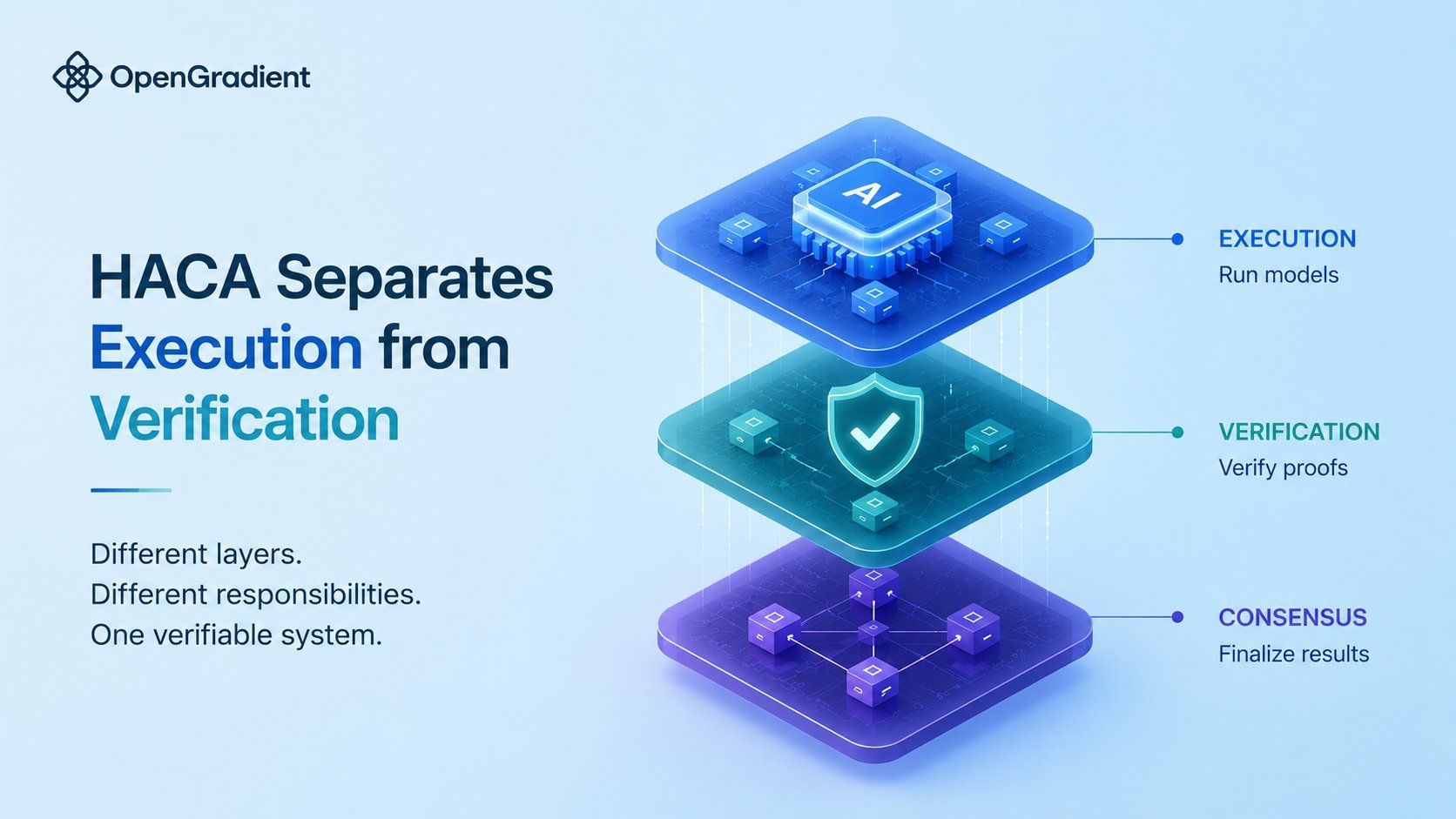
One of OpenGradient’s main technologies is the Hybrid AI Compute Architecture (HACA).
Instead of processing all AI computation on the blockchain which requires high costs, OpenGradient separates the inference and verification processes.
In the first stage, Inference Nodes run AI models using GPUs so the inference process runs quickly and efficiently.
After the results are obtained, the network generates verification proofs using several methods, such as:
- Vanilla Verification
- Trusted Execution Environment (TEE)
- Zero-Knowledge Machine Learning (ZKML)
These proofs are then verified by Full Nodes before being recorded on the blockchain.
In addition, OpenGradient also provides several important components that are interconnected within its ecosystem, including:
- Model Hub for storing and distributing AI models.
- Inference Nodes as AI computation providers.
- Data Nodes that provide external data securely.
- Python SDK so developers can easily build AI applications.
- MemSync, a long-term memory system for AI Agents.
This approach allows AI applications to maintain high performance without losing the transparency that is the main characteristic of blockchain.
Read Also: 10+ Best AI Coins 2026: Here's the List of Artificial Intelligence Themed Cryptos!
OpenGradient (OPG) Tokenomics and Token Utility
In addition to technology, OpenGradient also builds a network economy through the utility token OPG.
According to OpenGradient’s official documentation, the OPG token has a total supply of 1 billion tokens. The OPG token plays an important role in supporting all ecosystem activities, from AI service payments to network governance.
Some of the main utilities of the OPG token include:
- Paying AI inference fees.
- Paying for API usage and OpenGradient AI services.
- Providing incentives to node operators.
- Supporting governance mechanisms.
- Serving as a payment tool in applications built on OpenGradient.
With these functions, OPG has real utility because it is used directly in network activities, not just as a trading asset.
Read Also: 4 Crypto AI Agents Supported by Large Companies, These Are the Top Ones!
OPG Token Data
Based on CoinMarketCap data at the time this article was written, here is an overview of the OPG token:
The data shows that approximately 19.8% of the total OPG supply is already circulating in the market. The rest will be allocated according to the distribution mechanism designed by the project to support long-term ecosystem development.
As the use of AI applications on the OpenGradient network increases, demand for the OPG token also has the potential to grow because it is used as a payment tool for services and incentives for infrastructure providers.
Read Also: 10 Largest Crypto Asset Tokenizations (RWA) in the World
OpenGradient’s Potential in the AI and Web3 Industry
AI is expected to be one of the most widely adopted technologies in the coming years. On the other hand, blockchain offers transparency and security that conventional AI services have not had so far.
OpenGradient tries to bridge these two technologies through infrastructure that allows AI to run efficiently while remaining verifiable.
Several sectors that have the potential to utilize OpenGradient include:
- AI Agents.
- Decentralized Finance (DeFi).
- On-chain data analysis.
- AI Oracles.
- Machine learning deployment.
- Enterprise automation.
- Fraud detection.
- AI-based portfolio management.
If AI adoption continues to grow, the need for infrastructure like OpenGradient also has the potential to increase. However, the project’s prospects still depend on ecosystem growth, developer activity, strategic partnerships, and real network usage levels.
Now that you’ve learnt about the latest AI crypto developments, it’s time to explore others AI-based cryptocurrencies on Bittime, such as the digital assets AI, AGI, RENDER, TAO and many more AI coins.
Conclusion
OpenGradient (OPG) is a blockchain project focused on building decentralized AI infrastructure through the verifiable AI concept.
By utilizing the Hybrid AI Compute Architecture (HACA), this project enables AI inference processes to run more efficiently without losing the transparency and security that are blockchain’s advantages.
On the other hand, the OPG token has clear utility in supporting the network economy, ranging from AI service payments, node operator incentives, to governance.

OpenGradient (OPG) will soon be available on Bittime. Keep an eye on it and trade OPG/IDR exclusively on the Bittime market!
Bittime is a licensed and supervised Digital Financial Asset Merchant (PAKD) platform by the Financial Services Authority — the place where you can buy Bitcoin in Indonesia and hundreds of other crypto assets starting from Rp10,000. The registration process is fast, secure, and can be started today.
Monitor the conversion USDT to IDR and the price movements of your favorite crypto assets in real-time. All are available in one crypto investment app that can be downloaded for free on the Play Store.
Ready to get started? Register now at Bittime and execute your investment strategy with a platform trusted by millions of users in Indonesia.
FAQ
What is OpenGradient (OPG)?
OpenGradient is a decentralized AI infrastructure that enables AI inference processes to be verified using blockchain and cryptography technology.
What is the function of the OPG token?
The OPG token is used to pay for AI services, API usage, node operator incentives, governance, and to support economic activities within the OpenGradient ecosystem.
What is Verifiable AI?
Verifiable AI is a concept that allows AI inference results to be proven cryptographically so they are more transparent and auditable.
How much is the total supply of OPG tokens?
The total supply and maximum supply of OPG tokens is 1 billion OPG, with approximately 197.59 million OPG already in circulation based on CoinMarketCap data at the time this article was written.
What are the advantages of OpenGradient compared to regular AI platforms?
OpenGradient offers transparency through AI result verification mechanisms, so AI output can be trusted and audited, unlike centralized AI services which are black box in nature.
What are the use cases for OpenGradient?
OpenGradient can be utilized for AI Agents, DeFi, AI Oracles, machine learning deployment, on-chain data analysis, and various enterprise applications that require secure and verified AI services.
Disclaimer: The views expressed belong exclusively to the author and do not reflect the views of this platform. This platform and its affiliates disclaim any responsibility for the accuracy or suitability of the information provided. It is for informational purposes only and not intended as financial or investment advice.

.png)