GOIF Coin: Is It Backed by a Legitimate Commodity Asset? Check the Facts
2026-10-09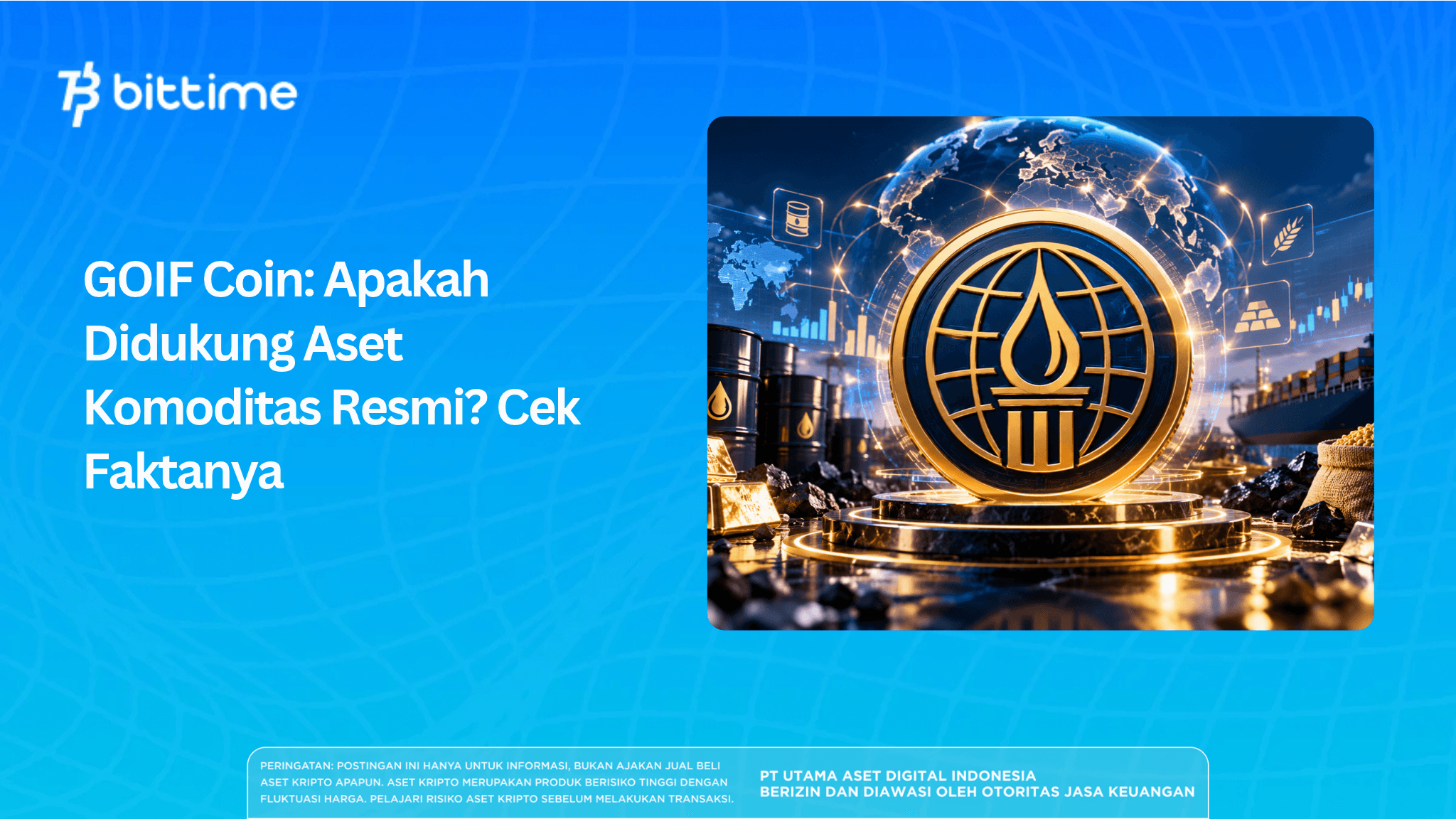
The name Global Oil Institution Fund, or GOIF immediately evokes associations with oil, energy reserves, and institutions. However, the key question is not just what GOIF coin is, but whether the token is genuinely backed by commodity assets that can be independently verified.
A review of the project's information shows that GOIF positions itself as a digital instrument associated with an oil reserve management framework. However, several figures displayed on its website are explicitly labeled as illustrative and therefore cannot be treated as evidence of physical asset ownership.
Key Takeaways
- GOIF claims to be associated with an energy asset management and coordination framework, but its published reserve figures are labeled as illustrative.
- The contract address listed on GOIF's website differs from the Pump.fun address used in one of the sources provided for this analysis.
- GOIF has trading activity on Solana, but the existence of the token and market activity does not automatically prove that it is backed by underlying oil assets.
What Is GOIF Coin?
GOIF is the ticker used by Global Oil Institution Fund, a project that positions its token as a digital instrument for institutional coordination in the energy sector.
The project's website describes GOIF as a digital coordination instrument connecting an institutional framework with on-chain access. It also lists the token as active and operating on-chain.
This concept distinguishes GOIF from crypto tokens built solely around meme or community narratives. The project's name and positioning directly link the token to oil, strategic reserves, and energy infrastructure.
However, a project's name alone is not enough to prove that its token is backed by physical assets.
In the context of crypto, terms such as oil-backed, commodity-backed, or asset-backed carry much more specific implications. Ideally, users should be able to identify the underlying assets, who holds them, how their value is verified, and whether token holders have any rights to those assets.
Read also: USDF and Trump: Is There Really a Connection to the Trump Dividend?
What Does GOIF Claim About Its Oil Assets?
The GOIF website uses language closely associated with the global oil industry. It features terms such as sovereign reserve stewardship, strategic crude, refined products, transit infrastructure, and reserve liquidity.
The website also displays an allocation model consisting of:
- Strategic crude: 48%
- Refined products: 27%
- Transit infrastructure: 16%
- Reserve liquidity: 9%
At first glance, these figures could suggest that GOIF holds a portfolio of oil assets with a specific allocation.
However, there is an important detail that should not be overlooked. The website itself states that this allocation is illustrative and provided for interface demonstration purposes, not as an asset offering.
The same applies to other figures shown in the system overview. The GOIF website lists a modeled fund capacity of US$1.24 trillion and 412 million strategic barrels, but also explicitly states that these figures are illustrative.
This means the figures should not be presented as evidence that GOIF currently controls US$1.24 trillion in assets or owns 412 million barrels of oil.
Read also: Is SARP a US Government Coin? The Facts About Strategic American Protocol
Is GOIF Really Backed by Official Commodity Assets?
The most cautious answer is that the claim cannot yet be independently substantiated based on the available information.
There is an important distinction between “a project using a commodity-asset narrative” and “a token legally or economically backed by commodity assets.”
To substantiate an asset-backed claim, more concrete information is needed about at least the following:
- Underlying assets
The assets underlying the token must be clearly identified. Are they crude oil, refined products, futures contracts, or other assets? - Ownership
It must be possible to determine who owns or controls those assets. - Custodian
If the assets are physical commodities, information about their storage or custodian is important. - Valuation
There should be a verifiable method for measuring the value of the assets. - Audit or attestation
Independent verification can help distinguish project claims from the actual condition of the assets. - Token holder rights
It should be clear whether GOIF holders have the right to redeem tokens for specific assets or merely hold a token associated with an oil-related narrative.
The materials reviewed do not provide sufficient independent evidence to establish that each GOIF token can be redeemed for oil or that the token is legally backed by specific oil reserves.
Read also: Is B22 Legit? Check Its Contract, Liquidity, and Risks
GOIF Contract Address: Which One Should Be Verified?
This is one of the most important findings.
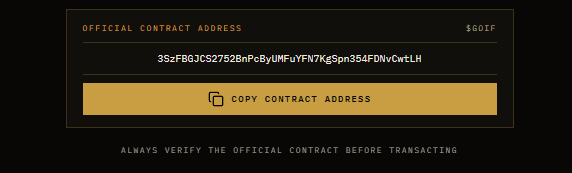
The GOIF website lists the following contract address:
3SzFBGJCS2752BnPcByUMFuYFN7KgSpn354FDNvCwtLH
The address is displayed as the “Official contract address” on the GOIF website. The site also instructs users to always verify the contract before making transactions.
However, the Pump.fun page used as one of the market references in this analysis has a different address:
4snhYFG7412w2PEAH2298UucNwDsc6LafgYXzWwapump
That page does display the GOIF ticker, but its address differs from the contract listed on GOIF's website.
This difference must not be ignored.
There are several possible explanations, including different tokens, a migration, a contract change, or some relationship between the two addresses. However, without a verifiable explanation, it would be inappropriate to assume they represent the same token.
Therefore, do not rely solely on the “GOIF” name or logo.
A contract address is a much more important token identifier than its ticker.
Latest GOIF Market Conditions
The GOIF market on Solana shows extremely high volatility.
The latest available market snapshot for contract 3SzFBGJCS2752BnPcByUMFuYFN7KgSpn354FDNvCwtLH recorded a price of approximately US$0.00008091, a 24-hour increase of around 325%, a market capitalization of roughly US$80,900, and an FDV of approximately US$80,900.
Liquidity in the main GOIF/USDC pool was approximately US$8,700, while 24-hour trading volume was about US$31,100. The data was dated October 8, 2026, at 23:59 UTC.
That activity included approximately 446 transactions, consisting of 281 buys and 165 sells in the same snapshot. These figures confirm that GOIF had trading activity, but the high volume and sharp price movements also reflect a highly speculative market.
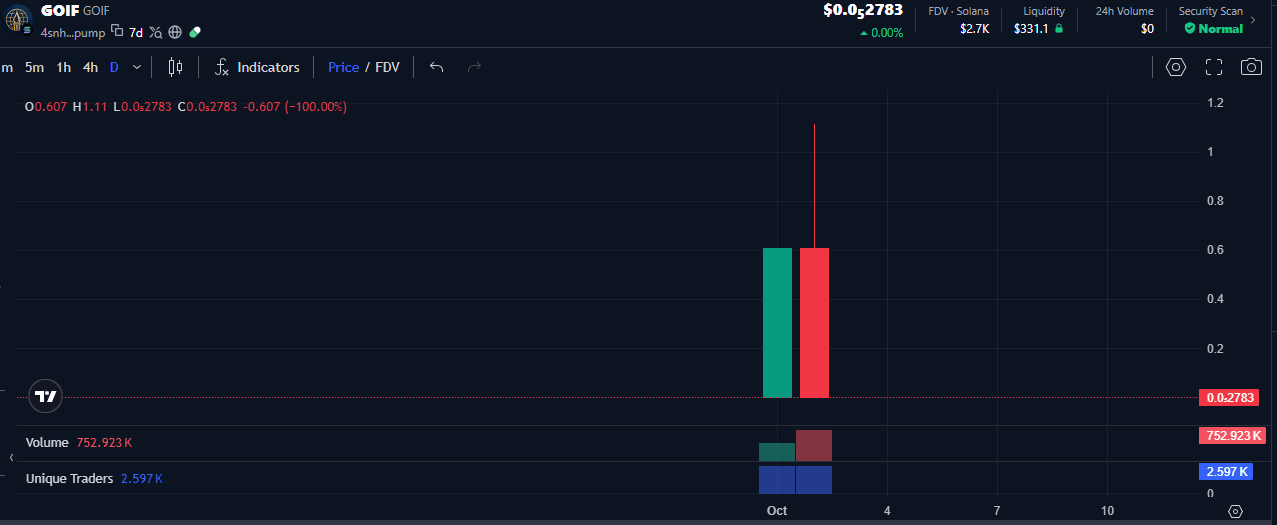
Another important point is the substantial difference between market data for address 4snh...pump and contract 3Sz....
Because these addresses are not identical, price or volume data from one address should not automatically be used to describe the token associated with the other.
What About GOIF Supply and Holders?
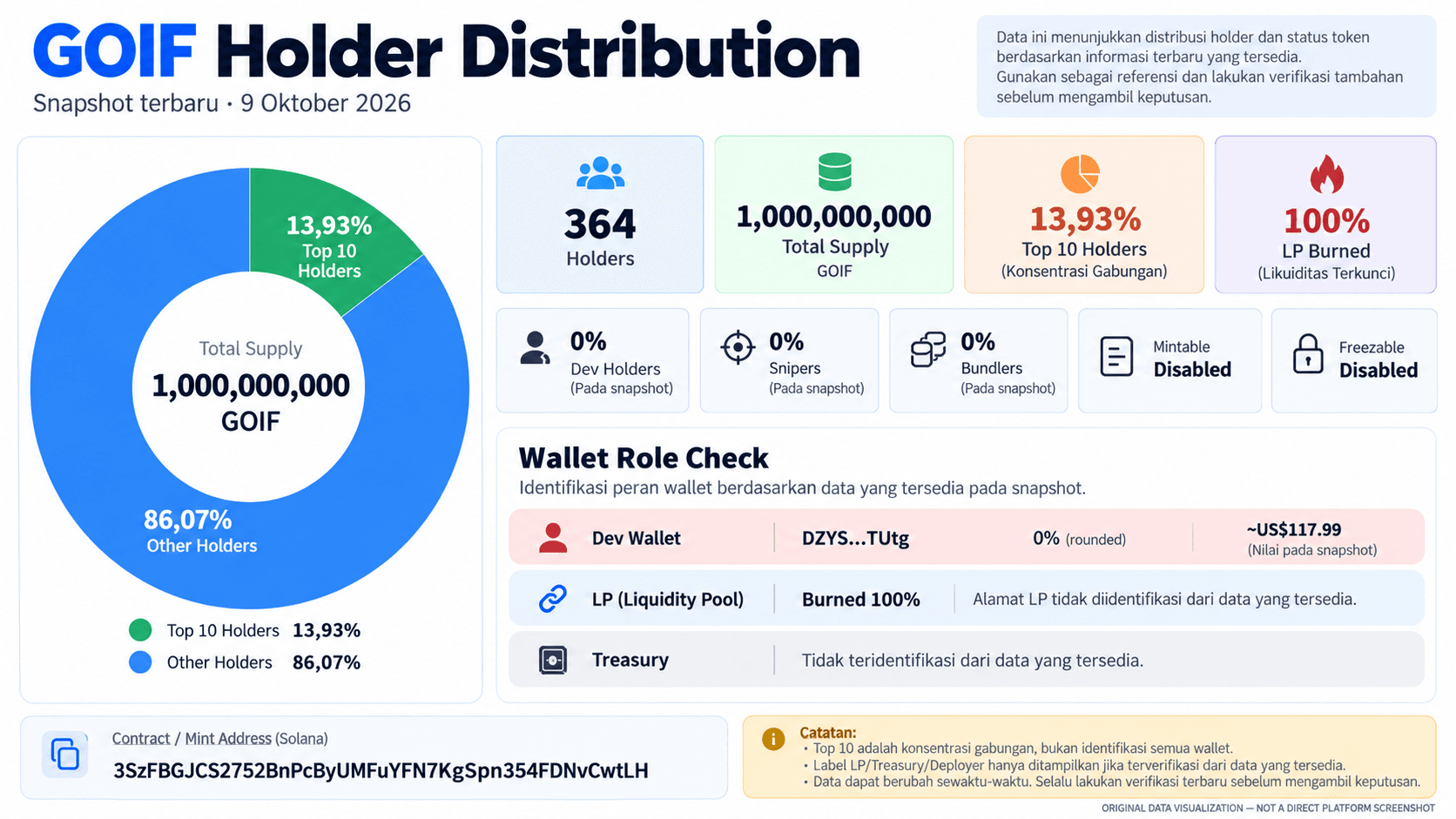
Another snapshot from Phantom for contract 3Sz... recorded a supply of 1 billion GOIF, approximately 364 holders, and about 13.93% held by the top 10 holders. The snapshot also showed 100% LP burned, minting disabled, and freezing disabled at the time of review.
These data can help assess the token's structure, but they should be accompanied by a timestamp because holder counts and token distribution can change.
A top-10 holder share of 13.93% mathematically means that most of the supply was not held by the ten largest identified wallets in that snapshot. However, this is not proof that the token's distribution is fully decentralized.
It is still necessary to assess whether related wallets, liquidity pools, deployer wallets, treasury wallets, or other addresses should be grouped together before drawing conclusions about ownership concentration.
GOIF vs. United States Oil Fund: What's the Difference?
GOIF and the United States Oil Fund (USO) should not be considered the same product simply because both are associated with oil.
USO is a commodity pool structured as a limited partnership that issues shares and trades on NYSE Arca. Its investment objective is to reflect changes in the price of light, sweet crude oil through a benchmark oil futures contract.
USO also explains its investment structure in public documents, including its use of oil futures contracts and other oil-related instruments. That structure differs from a cryptocurrency token traded on-chain.
This distinction matters.
GOIF is an on-chain token positioned around oil, whereas USO is a commodity-market product with a separately documented legal structure, management framework, and investment strategy.
Therefore, calling GOIF a “crypto version of USO” would oversimplify the situation and could be misleading.
Read also: United Dividend Reserve (UDR): What to Check Before Buying
5 Things to Check Before Buying GOIF
If you are considering GOIF, do not base your assessment solely on the project's name or price movements.
1. Match the contract address
Make sure the contract you intend to buy matches the exact address of the token you are looking for.
For the contract listed on GOIF's website, the address is:
3SzFBGJCS2752BnPcByUMFuYFN7KgSpn354FDNvCwtLH
Do not use a different address simply because it carries the GOIF ticker.
2. Check liquidity
A large market capitalization does not necessarily mean a token is easy to sell.
Liquidity affects how strongly transactions can move prices and how easily a position can be closed.
3. Check holder distribution
Examine the concentration of tokens in the largest wallets.
Concentrated ownership can increase risk if large wallets make substantial transactions.
4. Distinguish claims from evidence
Claims such as “oil-backed” or “commodity-backed” require verifiable documentation.
A website, logo, institutional-sounding name, or reserve figures labeled as illustrative are not enough to establish asset ownership.
5. Do not overlook volatility risk
The latest snapshot showed extremely large GOIF price movements over a 24-hour period. Such conditions can increase the risk of substantial losses within a short time.
If you want to follow cryptocurrency price developments and other digital asset news, you can sign up for Bittime to receive regular market information and the latest updates.
What Should You Watch Next?
GOIF still needs to clarify several matters to build greater confidence in its commodity-asset narrative.
The most important is documentation of the underlying assets.
If the project later provides verifiable proof of reserves, independent audits, custodian information, a legal structure, or a redemption mechanism, that information would help clarify the relationship between the GOIF token and oil assets.
Until such information becomes available and can be verified, the most responsible editorial approach is to describe GOIF as a token with an oil-related narrative and positioning, rather than as a token proven to be backed by oil reserves.
Conclusion
GOIF coin is strongly positioned as Global Oil Institution Fund, with a narrative involving oil reserves, institutions, and energy asset coordination. However, figures such as modeled fund capacity and strategic barrels on the project's website are labeled as illustrative and therefore cannot be treated as evidence of physical asset ownership.
Another important finding is the discrepancy between contract addresses. The GOIF website lists 3SzFBGJCS2752BnPcByUMFuYFN7KgSpn354FDNvCwtLH, while the referenced Pump.fun page uses 4snhYFG7412w2PEAH2298UucNwDsc6LafgYXzWwapump. This difference must be clarified before combining data for the two tokens.
So, is GOIF backed by official commodity assets? The information reviewed does not contain enough independent evidence to confirm that claim. Readers should check the contract address, liquidity, holder distribution, asset documentation, and audit evidence before making trading decisions.
Bittime is a licensed Digital Financial Asset Trader (PAKD) regulated and supervised by Indonesia's Financial Services Authority (OJK), where you can buy Bitcoin in Indonesia and hundreds of other crypto assets starting from Rp10,000. Registration is quick and secure, and you can get started today.
Monitor the USDT to IDR conversion rate and real-time price movements of your favorite cryptocurrencies. Everything is available in one crypto investment app that you can download for free from the Play Store.
Ready to get started? Sign up for Bittime now and put your investment strategy into action on a platform already trusted by millions of users in Indonesia.
FAQ
What Is GOIF Coin?
GOIF is the ticker used by Global Oil Institution Fund, a project that positions its token as a digital instrument linked to an institutional framework and the energy sector. The token operates on-chain on Solana, based on the contract listed on the project's website.
Is GOIF Backed by Oil?
This cannot yet be confirmed based on the available independent evidence. The project's website displays various models and figures relating to oil reserves, but some sections are explicitly labeled as illustrative.
Is GOIF Legitimate?
GOIF is a token that can be found and traded on the Solana network. However, the existence of the token does not automatically prove that the project holds oil reserves or commodity assets as backing.
What Is the GOIF Contract Address?
The GOIF website lists 3SzFBGJCS2752BnPcByUMFuYFN7KgSpn354FDNvCwtLH as its contract address. Because another GOIF address appears on a Pump.fun page, users should carefully match the full address before making transactions.
Is GOIF the Same as the United States Oil Fund?
No. USO is a commodity pool that issues shares and primarily uses oil futures to gain exposure to oil price movements, whereas GOIF is an on-chain cryptocurrency token. Their legal structures and operating mechanisms are different.
Disclaimer: The views expressed belong exclusively to the author and do not reflect the views of this platform. This platform and its affiliates disclaim any responsibility for the accuracy or suitability of the information provided. It is for informational purposes only and not intended as financial or investment advice.

.png)