Getting to Know Bless Network (BLESS): Decentralized Computing Platform & Its Tokenomics
2025-10-09
Bittime - In an era where artificial intelligence (AI), large-scale data processing, and cloud computing are increasingly important, a new concept emerges: decentralized computing — leveraging everyday devices like laptops and phones as part of a global computing network.
Bless Network (BLESS) is one of the leading projects in this space.
With a node system run by ordinary users, Bless attempts to connect distributed computing resources into a shared infrastructure.
This article will discuss in depth what Bless Network is, the technology used, the economic model, and its challenges and opportunities.
What is Bless Network (BLESS)?
Bless Network is a decentralized computing platform that allows devices such as laptops, desktops, or phones to contribute their computing capacity to the Bless network.
Applications or services can leverage this capacity as needed. The more nodes that join, the greater the distributed computing power available.
In other words, Bless builds what can be called a global “shared computer”—a computing network made up of independent devices.
The product prepares new infrastructure for AI, data processing, hosting, and various heavy-compute applications without relying on traditional data centers.
Read Also: What is Bless (BLESS)? Technology, Tokenomics, and Airdrop
Founders & Brief History
Bless was founded in 2022 (formerly known as Blockless) in San Francisco by Butian Li, Michael Chen, and Liam Zhang.
The team has expertise in distributed computing, blockchain research, and technology investment.
From the start, they aimed to create a computing network not dependent on large server centers, but powered by community participation.
Technology Behind Bless Network
Bless Network uses several core technologies to keep the network secure, efficient, and scalable:
- Dynamic Resource Matching
Schedules tasks to the best nodes based on capacity and location so computational work is optimal.
- Randomized Distribution
Uses schemes like latin-square to mitigate collusion or malicious activity among nodes.
- WebAssembly (WASM) Secure Runtime
Ensures tasks run in a sandboxed secure environment, isolated from the device’s main system.
- Dynamic Verification
A modular consensus tailored to computational needs, allowing fast failover and verification of task results.
Read Also: How to Play Bless Airdrop: Complete Guide for Beginners
Economic Model & Bless Tokenomics
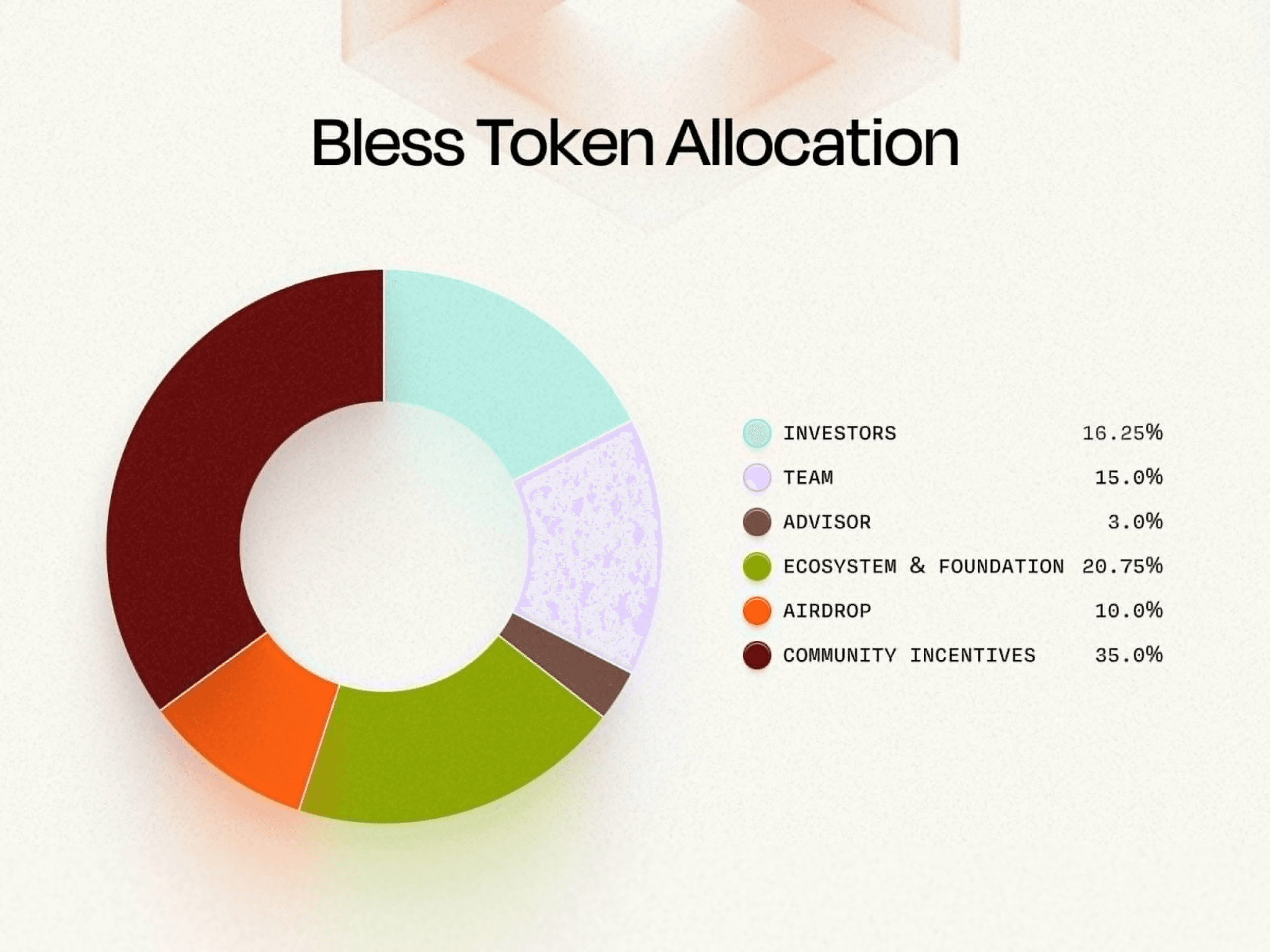
Bless uses a dual-token system: TIME and BLESS.
- TIME is a point token earned by participants running nodes on the testnet. TIME points will be converted into BLESS tokens when the network goes live/mainnet.
- 10% of the total BLESS supply is allocated to an airdrop program for early contributors (via TIME) at mainnet launch.
- BLESS tokens function for governance, staking, and network ownership.
- According to reviews, revenues from services (computing) will be used to buy back and burn BLESS tokens (buyback & burn) to support long-term token value.
BLESS distribution also includes community incentives and allocations for developers/network supporters.
Advantages & Challenges of Bless Network
Advantages
- Decentralized Computing Infrastructure — offers an alternative to conventional cloud services.
- Broad Participation — ordinary devices can join as nodes, not just expensive servers.
- Innovative Tokenomics Model — conversion of TIME to BLESS and buyback & burn mechanisms are attractive to the community.
- Potential for AI / DeFi / Web3 Ecosystem — distributed computing networks can support various decentralized applications.
Challenges
- Security & Verification — ensuring computation results are correct and not abused.
- Token Liquidity — without listing on major exchanges, maintaining initial liquidity is difficult.
- Infrastructure Competition — competing with large clouds like AWS, Google, and other DePIN projects.
- Regulation & Trust — new projects are often viewed with suspicion, so transparency is crucial.
Read Also: 5 Best Crypto AI & Big Data Projects 2025 Available on Bittime
Prospects & Recent Activities
- Bless has run an airdrop program of TIME for testnet contributors, with conversion to BLESS upon mainnet launch.
- 10% of total BLESS supply is set aside for the main airdrop phase.
- The network has attracted interest from the crypto and DePIN community and is highlighted as an innovative shared computing project.
- However, there is no record of BLESS being listed on major exchanges like Binance as of the latest reports (September 2025), which poses a liquidity challenge.
Potential Price Movement Ahead
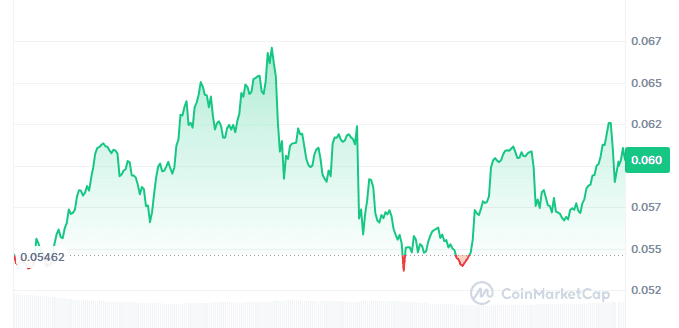
Based on the latest chart, BLESS is currently around $0.060, with strong support near $0.054 and resistance in the $0.065–$0.067 area.
After a consolidation period, the token shows a moderate recovery pattern indicating renewed buying interest from the market.
If positive momentum in the global crypto market continues, BLESS could break the $0.065 level in the short term.
However, if selling pressure increases around that resistance, the price may return to the $0.055–$0.057 zone before attempting another rebound.
Technically, volume indicators show increased trader activity, which could strengthen volatility in the coming days.
For the medium term, if BLESS can maintain positive sentiment and deliver significant ecosystem developments, a price target of $0.07–$0.075 remains possible by the end of this quarter.
Read Also: BNB Price Prediction: Skyrocket to #3 and Future Prospects?
Conclusion
Bless Network is an interesting project that seeks to bring decentralized computing through community participation.
With a dual-token model of TIME and BLESS, and a buyback & burn mechanism, the project offers long-term potential.
However, the project’s success heavily depends on mainnet launch, user adoption, and token listings on major exchanges.
For those interested in following blockchain infrastructure innovation, Bless is worth monitoring closely.
How to Buy Crypto on Bittime
Want to trade or sell buy Bitcoin and invest in crypto easily? Bittime is ready to help! As an Indonesian crypto exchange officially registered with Bappebti, Bittime ensures transactions are safe and fast.
Start by registering and verifying your identity, then deposit a minimum of IDR10,000. After that you can immediately buy your favorite digital assets!
Check rates BTC to IDR, ETH to IDR, SOL to IDR and other crypto assets to follow market trends in real time on Bittime.
Also visit Bittime Blog for updates and educational content about crypto. Find trusted articles about Web3, blockchain technology, and investment tips designed to enrich your crypto knowledge.
FAQ
What is Bless Network (BLESS)?
Bless Network is a decentralized computing platform that enables everyday devices (laptops, phones) to become nodes and provide computing capacity for applications.
What is the difference between TIME and BLESS?
TIME is a testnet “point” token that converts into BLESS tokens when mainnet launches. BLESS is the long-term utility & governance token.
What percentage is allocated for airdrop?
About 10% of total BLESS supply is allocated for the airdrop to early contributors.
How does BLESS tokenomics support token value?
BLESS tokenomics includes buyback & burn (90% of service revenue) which helps maintain token scarcity.
Is BLESS listed on major exchanges?
There is no confirmation that BLESS is listed on Binance as of the September 2025 report.
Disclaimer: The views expressed belong exclusively to the author and do not reflect the views of this platform. This platform and its affiliates disclaim any responsibility for the accuracy or suitability of the information provided. It is for informational purposes only and not intended as financial or investment advice.

.png)