Maker vs Taker Fee Futures: How to Calculate Trading Costs
2026-08-19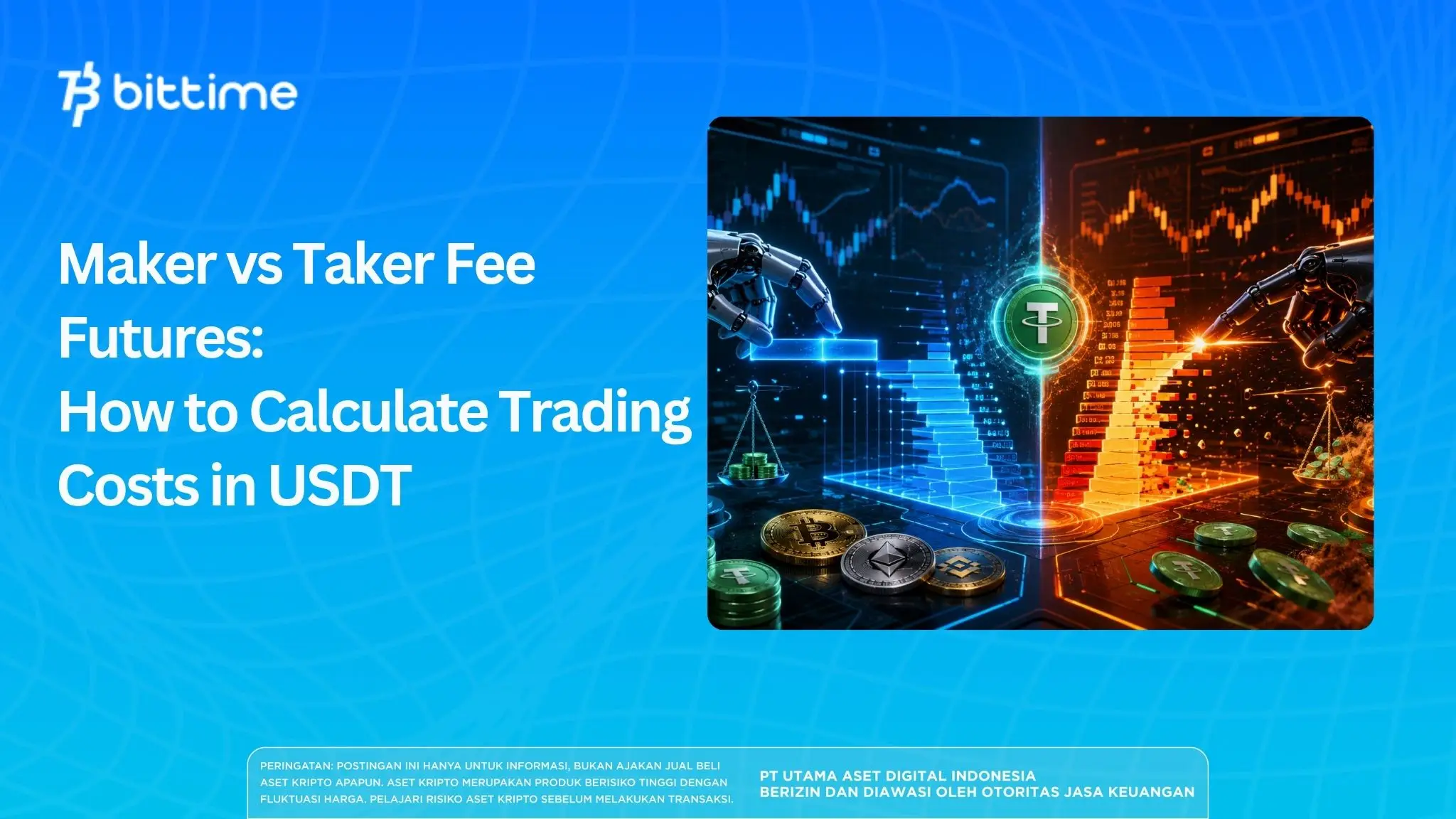
Profit in futures trading is not only determined by the difference between entry and exit prices.
Every time an order is executed, traders also need to take into account fee futures crypto because these costs directly reduce the final results of the transaction.
Two terms that appear quite frequently are maker fee futures And taker fee futures.
Makers relate to orders that add liquidity to the order book, while takers occur when orders directly take liquidity that is already available.
On many futures platforms, maker fees are usually lower than taker fees.
The percentage difference does seem small.
However, for traders who use high leverage or make many transactions in a day, accumulation of trading fees futures can be quite large.
Key Takeaways
Maker taker futures differentiated based on whether the order is additive or direct taking liquidity from the order book.
Trading fees are generally calculated from the position value or notional value, not just the margin deposited.
Fees can arise when opening and closing positions, so traders need to calculate the total cost of one transaction individually.round trip.
What Are Makers and Takers in Futures?

Image Source: AI
A maker is a trader who enters an order into the order book and waits for another party to execute it.
The most common example is a Limit Order that is placed at a specific price and is not filled immediately.
It is called maker because these orders help “create” or provide market liquidity.
The platform usually provides maker fee futures slower as an incentive for liquidity providers.
Takers work the opposite way. A trader becomes a taker when an order directly matches an existing order in the order book.
Market Orders almost always act as takers because their priority is to obtain immediate execution.
However, a Limit Order can also be a taker if the set price causes the order to be executed immediately.
Bittime explains the features Post-Only as an order type that ensures the order enters the order book as a maker, so that traders can avoid execution as a taker.
Why Are Taker Fees Usually More Expensive?
Takers gain the advantage of speed of execution.
Traders do not need to wait for the price to reach the Limit Order because positions can be opened or closed using the available liquidity.
As compensation, taker fee futures usually above the maker fee.
As an example of industry structure, Exchange “A” as of August 2026 displays non-VIP rates of 0.02% for makers and 0.055% for takers on certain perpetual contracts.
Rates for each platform, product, and user level may vary, so actual figures should still be checked before trading.
A difference of a few basis points may seem small, but the effect increases as the position value and frequency of transactions increase.
Formula for Calculating Futures Trading Fees
For USDT-based perpetual contracts, the commonly used calculation pattern is:
Trading Fee = Position Value × Fee Rate
Position value or notional value can be calculated from:
Position Value = Amount of Assets × Execution Price
This formula is used on various derivatives platforms to calculate fees based on the value of the contract actually traded.
This is important because leverage makes the value of the position greater than the margin used.
Example of Calculating Maker Fee in USDT
Assume the trader uses margin 500 USDTwith leverage 10x.
The position value becomes:
500 USDT × 10 = 5.000 USDT
For illustration, assume a platform charges a maker fee 0,02%.
For:
5,000 × 0.02% = 1 USDT
So, futures position opening costs as a maker is 1 USDT.
If the trader then closes the entire position as a maker and the position value at exit remains around 5,000 USDT, the closing fee is approximately 1 USDT again.
Total round-trip fee become:
1 USDT + 1 USDT = 2 USDT
The 0.02% figure above is just an example calculation.
The actual rate will need to follow the platform's fee schedule.
Example of Calculating Taker Fee in USDT
Use the same position values, namely 5,000 USDT.
Suppose the taker fee on the platform is 0,05%.
Cost of opening a position:
5,000 × 0.05% = 2.5 USDT
If the position is then closed using a Market Order at a position value of approximately 5,000 USDT:
Closing fee = 5,000 × 0.05% = 2.5 USDT
Total futures trading costs to be approximately:
2.5 + 2.5 = 5 USDT
If entry uses maker but exit uses taker, the total is approximately 3.5 USDT based on the same assumptions.
Leverage Can Make Fees Feel Bigger
One of the common mistakes of beginner traders is to calculate fees based on margin alone.
For example, if the capital used is only 100 USDT with 20x leverage, the actual position value would be 2,000 USDT.
If the taker fee is 0.05%, the fee is not:
100 × 0.05% = 0.05 USDT
But:
2,000 × 0.05% = 1 USDT
Exchange “B” provides a similar example: a $20,000 BTC/USDT position with 10x leverage still calculates the fee based on the $20,000 contract value, not the $2,000 margin used.
That is why leverage can increaseimpact sartrading fee futuresagainst capital current traders.
Read Also: How to Calculate Futures PnL to Avoid Misreading
The Costs of Opening and Closing Positions Both Need to be Calculated
Profit calculation should not stop at gross PnL.
Positions are usually executed when opened and re-executed when closed.
Simply:
Net PnL = Gross PnL − Fee Entry − Fee Exit − Biaya Lain
If the position is subject to funding, that component also needs to be included.
Bittime explains funding rate as a periodic payment between the Long and Short parties which aims to keep the perpetual contract price close to the spot market.
So, futures position opening costs And futures position closing costs are not the only costs that may affect trading results.
For those of you who want to learn crypto derivatives trading directly, you can register on Bittime and explore Bittime Futures.
Makers Are Not Always Better Than Takers
Makers do tend to be cheaper, but prices don't always wait for trader's Limit Orders.
Imagine Bitcoin is rapidly falling and a trader needs to close a long position to limit losses. Enforcing a limit order just to save a few basis points could result in a larger loss if the order isn't filled quickly.
On the other hand, when entry is not urgent and the trader has already determined a specific price level, a Limit or Post-Only Order can be a more efficient option.
Therefore, the decision maker or taker needs to consider fees, slippage, chance of order being filled, and execution speed.
Read Also:A Complete Guide to OTC USDT IDR Transactions on Bittime
How to Save on Futures Fees Without Sacrificing Strategy
One of how to save on futures fees is to reduce transactions that do not have a setupIt's clear. The more frequently positions are opened and closed, the greater the accumulated trading fees.
Traders can also use Limit or Post-Only Orders when they do not require instant execution.
However, fee savings should not trump risk management.
Position size also needs to be considered.
Excessively large positions due to high leverage not only increase the potential for profit and loss, but also increase the nominal fee because the fee is calculated from the position value.
Read Also: Mark Price vs Last Price vs Index Price: Differences and Their Impact

Bittime is a licensed and regulated Digital Financial Asset Trader (PAKD) supervised by Indonesia’s Financial Services Authority (OJK) — where you can buy Bitcoin in Indonesia and hundreds of other crypto assets starting from just Rp10,000. The registration process is fast, secure, and you can get started today.
Track USDT to IDR conversions and monitor your favorite crypto assets in real time. Everything is available in one crypto investment app that you can download for free on the Play Store
Ready to start? Register now on Bittime and execute your investment strategy with a platform trusted by millions of users in Indonesia.
FAQ
What is the difference between maker and taker futures?
Makers place orders that add liquidity to the order book, while takers execute existing liquidity. Makers typically earn lower fees than takers.
Are Limit Orders always subject to maker fees?
Not always. Limit orders that directly match orders in the order book can be executed as a taker. The Post-Only feature is used when a trader wants to ensure an order is entered as a maker.
How to calculate futures fees?
The simple formula is position value × trading fee rate for USDT contracts, the position value is typically calculated based on the asset quantity multiplied by the strike price.
Does leverage affect the cost of futures trading?
Leverage increases the value of a position that can be controlled with a smaller margin. Because fees are generally calculated based on the notional value, leveraged positions can incur significantly higher costs than if fees were incorrectly calculated based on margin alone.
Are there fees for opening and closing positions?
Generally, yes. A fee is charged when an entry order is executed and again when an order to close a position is executed.
Is the funding rate the same as the trading fee?
No. Trading fees arise from order execution, while funding rates are periodic payments between long and short traders on perpetual contracts.
Disclaimer: The views expressed belong exclusively to the author and do not reflect the views of this platform. This platform and its affiliates disclaim any responsibility for the accuracy or suitability of the information provided. It is for informational purposes only and not intended as financial or investment advice.

.png)