NEAR Coin to Burn 100% Gas Fees, Inflation Also Proposed to Drop
2026-10-05
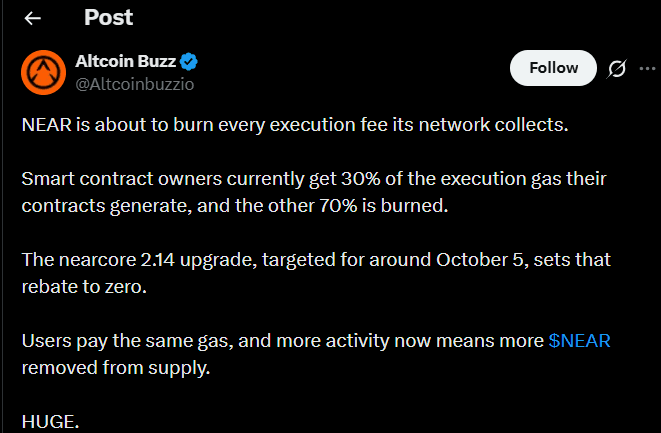
Of every gas fee charged when a smart contract is called on NEAR, 70% has so far been burned and 30% returned to the contract owner. That 30% share is targeted to become zero through the nearcore 2.14 upgrade, which is said to arrive around October 5, 2026, so that near burn applies to all execution gas.
At the same time, the NEAR crypto community is discussing a proposal to lower the annual inflation cap from 2.5% to 1.6%. Both touch the NEAR coin supply, but they work in different ways.
Key Takeaways
- The 30% gas rebate for smart contract owners is removed through nearcore 2.14, so 100% of execution gas is burned. The target is around October 5, 2026, and it is not a firm deadline.
- The proposal to cut the NEAR issuance cap from 2.5% to 1.6% over 24 months is still a proposal and awaiting a vote.
- User gas fees do not change, and the impact on price cannot be determined.
What Changes in NEAR Burn in nearcore 2.14?
Gas is the computation cost for every transaction on NEAR, paid with the NEAR token. Until now, 70% has been burned and 30% sent to the account of the smart contract owner being called. After nearcore 2.14, that 30% share becomes zero, so near burn token applies in full. Users still pay the same gas.
This change comes from proposal HSP-027 in the House of Stake, NEAR's governance body. CryptoTicker notes that the proposal was approved on July 8, 2026, with 46 votes in favor (weight of 4.66 million veNEAR) against two votes against (weight of 1,819 veNEAR).
Co-founder Illia Polosukhin said this step aims to keep the protocol simpler, as reported by The Defiant.
As for the schedule, a mid-year report once mentioned August 2026. Now the target is around October 5, according to a Crypto Banter tweet cited by Blockonomi. The nearcore 2.14 release notes on GitHub do list the removal of gas rewards in the protocol change list.
CryptoTicker cautions that the date is not final. The new rule takes effect only after enough validators install version 2.14, so the timing is better read as a range, not a single day.
To monitor NEAR coin movements after the upgrade, you can start with Bittime, a crypto asset platform supervised by OJK.
How Big Is the Burn's Effect on NEAR Crypto Supply?
The size of the burn follows network activity. The more transactions there are, the more gas fees are burned. Crypto Banter says the growing number of applications and the flow of NEAR Intents will draw more NEAR out of supply, as cited by Parameter.
However, burn is only half of the equation. According to CryptoTicker, about 1.308 billion NEAR are in circulation currently, and there is no fixed maximum cap. Supply is determined by the difference between newly issued tokens and burned tokens. This upgrade only changes the burn side.
The removed rebate also does not affect stakers. CryptoTicker explains that the 30% share was received by smart contract operators, not validators or delegators. Staking rewards come from token issuance, so they do not decrease because of this rule. What needs to recalculate are application developers who have relied on the rebate.
Read Also: BIS Reveals New Potential for XRP Ledger in the Digital Financial System
NEAR Inflation Proposal to Drop to 1.6%: How Far Along Is the Process?
This proposal comes from Sal Ternullo, CEO of SVRN, a NEAR treasury company. The discussion was opened on the NEAR governance forum around September 30, according to Blockonomi. The term "inflation" here refers to the maximum annual token issuance cap, which is lowered gradually each epoch over 24 months.
Several key figures in the proposal:
- Staking yield is estimated to fall from around 5.4% to 3.5%, while the 90/10 split between stakers and the treasury remains (Blockonomi).
- A staker with 1,000 NEAR is estimated to receive about 21 NEAR less over two years compared with the 2.5% scheme, according to Crypto Times.
- About 66 million NEAR (equivalent to around US$329 million at the September 30 price) will not be issued over six years, according to calculations cited by Blockonomi.
It should be noted that the NEAR issuance cap was previously cut from 5% to 2.5% in October 2025, as mentioned by KuCoin News. Ternullo also revealed that SVRN holds more than 55 million NEAR, most of which is staked, so this proposal also cuts into its own staking revenue.
The process is not finished. The proposal must pass a House of Stake vote, then be adopted by validators through a network upgrade. Crypto Briefing says the vote is expected by October 11, 2026, at the latest, while crypto.news writes that the proposal will go to a vote this week.
The long-term fixed supply plan is still only a direction and is not part of this vote.
Read Also: Popular Tokenized Stocks 2026: Tech Stocks Become Investors' Favorite
What NEAR Coin Holders Should Watch
First, NEAR's recent price movement has been influenced by many factors. Blockonomi reports that NEAR rose about 10% after the debut of Bitwise's NEAR ETF, with US$35.5 million in inflows on the first day. The burn effect is hard to separate from those factors.
Second, the nearcore 2.14 schedule and the inflation vote may still shift. Third, the burn mechanism does not guarantee a price increase. The crypto market moves fast, so make sure your decisions are based on your own research and a suitable risk tolerance.
Read Also: How to Buy NEAR at Bittime
Conclusion
NEAR is moving along two tracks at once. The first track is burning 100% of execution gas through nearcore 2.14, targeted for around October 5, 2026. The second track is the proposal to cut the issuance cap to 1.6%, which is still awaiting a vote and validator adoption.
Both have the potential to tighten the NEAR coin supply, but the final outcome depends on network activity and market demand. Monitor NEAR's official announcements before concluding anything.
This article is for informational purposes and is not investment advice. Crypto assets are high-risk and their value can change at any time. Data updated as of October 5, 2026.
Check the prices of Bitcoin (BTC), Ethereum (ETH), XRP, Solana (SOL), GRAM, and BNB as well as leading memecoin DOGE. You can trade directly on Bittime!
Bittime is a licensed Digital Financial Asset Trader (PAKD) platform supervised by the Financial Services Authority — where you can buy Bitcoin in Indonesia and hundreds of other crypto assets starting from IDR 10,000. The registration process is fast, secure, and can be started today.
Track the conversion USDT to IDR and the price movements of your favorite crypto assets in real time. Everything is available in one crypto investment app that can be downloaded for free on the Play Store.
Ready to start? Register now at Bittime and execute your investment strategy with a platform trusted by millions of users in Indonesia.
FAQ
What is NEAR burn?
NEAR burn is the burning of part of gas fees so that those tokens leave circulation. Currently 70% of gas is burned, and the target is to increase it to 100% through nearcore 2.14.
When will NEAR coin burn 100% of gas?
The target is around October 5, 2026, but that date is not final. The new rule takes effect after enough validators install nearcore 2.14.
Does burning NEAR coin make the price rise?
There is no guarantee. Burning reduces supply, but price is also influenced by demand and overall market conditions.
Will NEAR staking rewards fall because the gas rebate is removed?
No, because the rebate is received by smart contract owners, not stakers. However, the inflation-cut proposal, if approved, is expected to lower staking yield.
What is the NEAR 1.6% inflation proposal?
It is a proposal to lower NEAR's annual token issuance cap from 2.5% to 1.6% gradually over 24 months. The proposal is still awaiting a House of Stake vote and validator adoption.
Disclaimer: The views expressed belong exclusively to the author and do not reflect the views of this platform. This platform and its affiliates disclaim any responsibility for the accuracy or suitability of the information provided. It is for informational purposes only and not intended as financial or investment advice.

.png)