Why Does TRX Remain Strong During a Bear Market? 5 Factors at play in TRON
2026-11-06
Why has TRX remained resilient during the bear market? Amid the pressure that has eroded the value of many altcoins, TRON (TRX) has continued to show relative resilience. On November 6, 2026, TRX was trading at around $0.318, with a market capitalization of approximately $30 billion. One of TRON's strengths comes from sustained USDT transfer activity, even as sentiment across the crypto market deteriorates.
However, another aspect deserves attention. The TRON network recorded trillions of dollars in stablecoin transactions, yet the TRX supply actually increased throughout the third quarter of 2026. This raises an important question: how much do network usage, staking, and institutional interest contribute to TRX's price resilience?
Key Takeaways
- TRON processed approximately $2.21 trillion in stablecoin settlement volume in Q3 2026, driven by extensive USDT activity on the network.
- Blockchain usage, TRX staking, and expanding institutional access are among the factors supporting TRON's fundamentals.
- Despite its token-burning mechanism, the TRX supply continues to grow when newly issued tokens outnumber those burned.
TRX Price Today: How Strong Is It Compared With Bitcoin?
TRON often attracts attention because TRX does not always follow the downturns experienced by other altcoins.
During certain periods of crypto market corrections, TRX has delivered relatively better performance. However, that does not mean its price never falls.
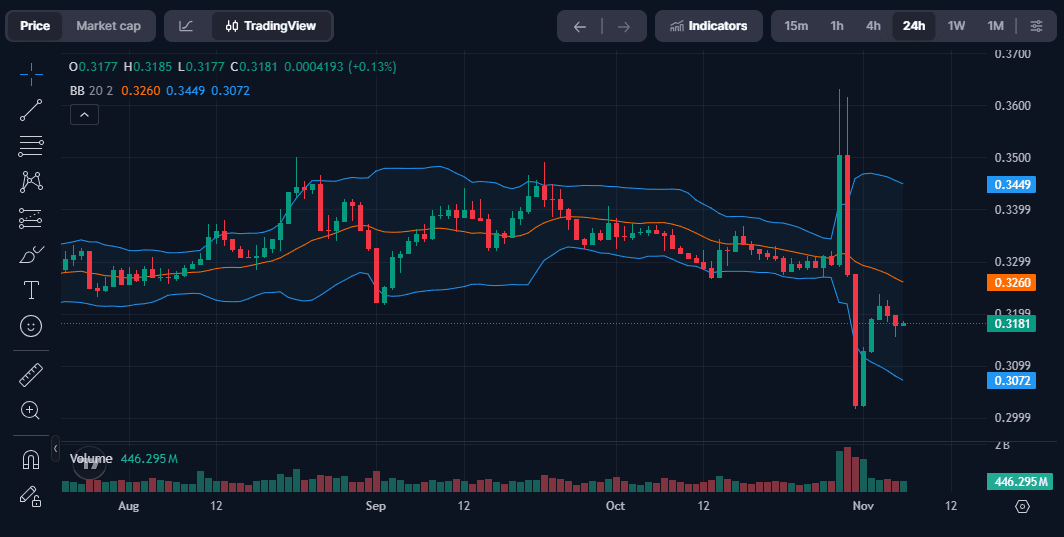
On November 6, 2026, TRX was trading at approximately $0.318 after previously approaching $0.33.
Like other crypto assets, the token has still faced selling pressure over various weekly and monthly periods.
For example, over the seven days ending October 20, 2026, TRX gained approximately 0.75%. Over the same period, Bitcoin fell around 2.21%, while Ethereum declined 4.58%.
This comparison shows that TRX has, at times, outperformed the two largest cryptocurrencies.
However, one week's performance is not enough to conclude that TRX is always more stable than Bitcoin.
Price performance can change with liquidity conditions, investor sentiment, and broader market developments.
What is more noteworthy is the activity underlying the TRON network, especially its use in transferring large amounts of stablecoins.
Read also: Why Is Justin Sun Calling for Sanctions Against World Liberty Financial?
Why Does TRX Remain Strong During a Bear Market? Here Are Five Factors
There are several reasons TRON continues to attract investor attention even when market conditions are unfavorable.
Some relate to users' need for blockchain services. Others stem from TRX's token economics and the increasing availability of ways to invest in the asset.
1. TRON Is One of the Leading Networks for USDT Transfers
One of TRON's best-known use cases is transferring USDT through the TRC20 network.
For many crypto users, USDT is more than just an asset to trade. The stablecoin is also used to hold value denominated in U.S. dollars and transfer funds between platforms.
That need remains even when Bitcoin or altcoin prices are falling.
In fact, when markets become volatile, some users choose to move their assets into stablecoins to reduce exposure to price swings.
In the third quarter of 2026, TRON recorded approximately $2.21 trillion in stablecoin settlements. By the end of September, the combined supply of USDT and USDD on the network had reached around $93.88 billion.
These figures illustrate how widely TRON is used as infrastructure for stablecoin transactions. However, that transfer volume does not mean all of it translates into TRX purchases.
Users can transact using network resources they already have, so higher USDT transfer volume does not necessarily generate a proportional increase in demand for the token.
This is the distinction between a heavily used blockchain and an asset whose price is rising.
2. Network Activity Remains High Even as Markets Weaken
Beyond stablecoin transfers, TRON continues to record substantial user activity. Throughout Q3 2026, the network processed more than one billion transactions.
The rolling average of monthly active addresses also reached approximately 18 million, up 9.8% from the previous quarter. These figures indicate that TRON's usage does not depend solely on investor interest in buying TRX.
The network continues to be used to send digital assets, access blockchain applications, and carry out various transactions. Such needs do not simply disappear during a bear market.
Even so, active address counts must be interpreted carefully. One user may control multiple wallets, and some transactions may be carried out by automated systems.
Therefore, 18 million active addresses does not mean exactly 18 million different people are using TRON. The figure is better understood as an indicator of the scale of network activity.
Read also: TRUMP and WLFI Fall After the 2026 U.S. Elections: What Does It Mean for Crypto?
3. The Network Fee Model Gives TRX Practical Utility
TRON has a resource model that differs from those of some other blockchains. The network uses two main components, Energy and Bandwidth, to process user activity.
Bandwidth is used for transaction data, while Energy is required when users execute smart contracts. TRX holders can stake their tokens to obtain allocations of these resources.
For users who regularly make transfers or interact with blockchain applications, this mechanism can help manage transaction costs.
If the available resources are insufficient, users may still incur fees under the network's rules. These transactions are one source of fees recorded within the TRON ecosystem.
In Q3 2026, total network fees reached approximately $701.4 million, averaging around $7.62 million per day. These figures show that activity on TRON has a meaningful economic dimension.
However, one point deserves attention: network fees actually declined by approximately 4% compared with the previous quarter. This means higher transaction activity does not always produce a proportional increase in fees.
These fees also should not be treated as dividends automatically distributed to all TRX holders. Their effect on the token's value depends on the resource model, TRX usage, and the burns occurring on the network.
4. Staking Gives TRX a Function Within the Network
TRX is not merely a token traded on exchanges. It is also used for staking and governance on TRON, which operates a Delegated Proof-of-Stake or DPoS system.
Through this system, TRX holders can participate in electing Super Representatives, who perform important functions on the network.
Staking also provides access to resources such as Energy and Bandwidth. For people who actively use TRON, holding TRX can help meet transaction needs.
This function gives the token a use beyond buying and selling it for price gains. Nevertheless, staking does not make TRX risk-free.
Rewards received by token holders may come from newly issued TRX under the protocol's rules. If supply grows faster than tokens are burned, TRX holdings remain exposed to economic dilution.
Therefore, the benefits of staking should be assessed alongside changes in supply and market price.
Read also: UAI Coin Drops Ahead of November 6 Token Unlock: What to Watch
5. Institutions Are Expanding Access to TRX
TRON is also drawing attention through developments in digital asset investment and custody services. One important milestone in 2026 was the launch of the Canary Staked TRX ETF (TRXS) on September 9.
The product expands the ways investors can gain exposure to TRX through an investment fund structure. Meanwhile, developments in institutional custody and staking services are helping broaden access to the TRON ecosystem.
Corporate treasury activity has also attracted attention. TRON Inc. reportedly purchased approximately 155,372 TRX on November 5, 2026.
Following that purchase, its holdings reportedly exceeded 722 million TRX. This figure refers to the number of tokens held, not a holding valued at $722 million.
At a price of approximately $0.32, 722 million TRX would have an indicative value of around $231 million. However, these treasury figures still need to be checked against corporate disclosures or verifiable on-chain records.
It is also important to remember that more investment products do not automatically drive TRX prices higher. Their impact on the market depends on actual demand, capital flows, and trading conditions.
Read also: These Crypto Projects Are Shutting Down: Withdraw Your Assets Before It's Too Late
TRON Has Strong Fundamentals, So Why Can the TRX Price Still Fall?
This is where the TRON discussion becomes particularly interesting. A network can process high-value transactions without its token price rising at the same time.
For example, a user may send USDT over TRON because they need a transfer service. That transaction does not necessarily involve buying new TRX, especially if the user already has an allocation of Energy and Bandwidth.
At the same time, the TRX price is still determined by buying and selling activity in the market. When investors reduce portfolio risk, selling pressure may increase even if the TRON network remains heavily used.
Changes in supply also affect the market balance. TRON's strong fundamentals should therefore be seen as one supporting factor, not a guarantee that the TRX price will keep rising.
To assess the token's outlook, network activity needs to be considered alongside market demand and the amount of TRX in circulation.
Is TRX Really Deflationary?
TRON is known for a token-burning mechanism that reduces the TRX supply. However, burning tokens is only one side of the equation.
The network also issues new TRX as part of protocol rewards. During Q3 2026, approximately 360.2 million new TRX tokens were issued.
Over the same period, the network burned around 234.5 million TRX. The difference resulted in a net supply increase of approximately 125.8 million TRX.
As a result, TRX experienced net inflation during the quarter even though token burning continued. A similar pattern was still apparent in observations from early October.
From October 1 to 16, 2026, approximately 62.65 million TRX were issued, while 39.78 million TRX were burned. This means supply increased by around 22.87 million tokens.
The observations also recorded 108 consecutive days of supply growth through October 16. However, that does not mean the pattern will necessarily continue forever.
The number of tokens issued can be influenced by network parameters, while token burns depend on activity and resource consumption mechanisms.
If the number of tokens burned exceeds new issuance at some point, the net supply can decrease.
For investors, the most relevant measure is the net change in supply, not simply how much TRX is burned each day.
Read also: November 2026 Token Unlocks: Understanding the Risks of EIGEN, ENA, and KITE
TRX Technical Analysis: Support and Resistance
Alongside fundamentals, price movements remain important for understanding TRX's position in the market cycle. On November 6, 2026, TRX was trading at approximately $0.318 after previously approaching $0.33.
Several weekly-chart analyses still highlight a long-term upward structure that has developed over the preceding years. Even so, a longer-term trend cannot always prevent short-term corrections.
TRX Support Levels
Based on price observations from late October through early November, $0.314 is one of the nearest support reference levels.
If selling pressure continues, the psychological $0.30 level could once again attract market attention.
A break below support accompanied by rising volume would signal that bearish pressure has not yet subsided.
These levels are references based on the observation period, not permanent support levels that always apply.
TRX Resistance Levels
On the upside, TRX must once again contend with the $0.325–$0.331 range. If the price breaks through and holds above it, the prospects for a short-term recovery could improve.
However, a rise toward resistance is not enough to prove that a new bullish trend has begun. Some longer-term projections have even discussed the possibility of TRX reaching $0.65 to $1.
Those targets remain speculative and would require much stronger market demand.
Price levels should therefore be reassessed using the latest charts rather than relying solely on widely circulated targets.
Can TRON Stay Resilient if the Bear Market Continues?
TRON has substantial network activity, but TRX's ability to hold its price still depends on market conditions.
There are three possible scenarios worth monitoring.
Bullish Scenario: Demand for TRX Strengthens
The potential for an increase would improve if TRON usage remains high and sentiment across the crypto market starts to recover.
The expansion of institutional services and demand for network resources could provide additional support.
However, a price recovery requires sufficient demand for TRX to overcome selling pressure.
Neutral Scenario: High Network Activity, Sideways Price Movement
TRON can continue processing large transaction volumes even while the TRX price trades within a narrow range.
This situation may occur when blockchain activity increases but token demand is not strong enough to move the price significantly.
While these conditions persist, traders are likely to focus more closely on support and resistance levels.
Bearish Scenario: Market Pressure Dominates
If Bitcoin and altcoins experience another major decline, TRX remains at risk of falling alongside them.
Pressure could intensify if demand for the token weakens while net supply continues to expand.
Under this scenario, network strength may not be sufficient to offset selling in the market.
These three scenarios are not guaranteed price outcomes; they describe conditions that could influence TRX's direction.
Read also: Exploring Bitcoin's November Trends: History, Sentiment, and Price Outlook
Three Risks TRX Holders Should Watch
Despite strong network activity, several risks should not be overlooked.
First, crypto market volatility. TRX remains sensitive to changes in investor sentiment, particularly when Bitcoin experiences a major correction.
Second, supply growth. If token issuance continues to exceed burns, additional supply could affect the balance between supply and demand.
Third, changes in ecosystem conditions. Network policies, governance, stablecoin regulations, and competition among payment blockchains can all affect TRON activity.
These risks do not automatically undermine TRON's prospects, but they are important considerations when evaluating TRX's long-term resilience.
TRX Outlook for 2026: What Should Investors Monitor?
TRON holds a relatively strong position as a stablecoin transfer network.
However, evaluating TRX's price outlook requires more than looking at transaction counts or the amount of USDT in circulation.
Five indicators are worth monitoring through the end of 2026:
- Stablecoin growth on TRON. Changes in USDT and USDD supply can indicate how network usage is developing.
- Transaction counts and active addresses. These metrics help show whether blockchain activity is increasing or beginning to weaken.
- TRX issuance and burns. Changes in net supply offer insight into the supply-side pressure on the token.
- Institutional developments. Corporate treasury holdings, custody services, and investment product activity can provide additional indicators.
- TRX performance relative to Bitcoin. Comparing performance over the same period helps determine whether TRX continues to show relative strength.
Together, these indicators provide a more complete picture than daily price movements alone.
If you want to track TRX, Bitcoin, and developments in the wider crypto market, you can sign up for Bittime to access market information and read the latest news and analysis.
Conclusion
Why does TRX remain resilient during bear markets? One of the main reasons is TRON's real-world use in USDT transfers, stablecoin transactions, and other blockchain activities.
Its Energy and Bandwidth model, staking, and expanding institutional access also help support the network's relevance.
However, high activity does not automatically mean the TRX price will continue rising. Supply growth, changes in token demand, and market conditions can still weigh on its value.
For investors, TRON's prospects are easier to assess by considering network usage and token economics together, rather than relying solely on the narrative that TRX is more resistant to bear markets.

Bittime is a licensed Digital Financial Asset Trader (PAKD) regulated and supervised by Indonesia's Financial Services Authority (OJK) — where you can buy Bitcoin in Indonesia and hundreds of other cryptocurrencies starting from IDR 10,000. Registration is fast and secure, and you can get started today.
Track the conversion rate of USDT to IDR and monitor real-time price movements of your favorite cryptocurrencies. Everything is available in one crypto investment app that you can download for free from the Play Store.
Ready to get started? Sign up for Bittime now and put your investment strategy into action on a platform trusted by millions of users in Indonesia.
FAQ
Why Does TRON (TRX) Remain Strong During a Bear Market?
TRON is widely used for USDT transfers and stablecoin payments. The network can continue operating even when cryptocurrency prices are falling. However, resilient network activity does not mean the TRX price will always rise.
Does USDT Usage on TRON Affect the TRX Price?
USDT usage can increase demand for TRON's infrastructure and network resources. However, stablecoin transactions do not always require users to purchase new TRX. The effect on price still depends on demand, supply, and market conditions.
Is TRX a Deflationary Cryptocurrency?
TRX has a token-burning mechanism, but the network also issues new tokens for rewards. In Q3 2026, issuance exceeded burns, resulting in a net supply increase of approximately 125.8 million TRX. This can change depending on network activity and parameters.
Is TRX More Stable Than Bitcoin?
TRX has outperformed Bitcoin during certain periods of bear market conditions. However, this does not hold true at all times, and TRX can still experience corrections. Comparisons should use the same observation period.
Does TRON Still Have Good Prospects in 2026?
TRON has significant network activity, particularly within the stablecoin ecosystem. The TRX price outlook still depends on token demand, changes in supply, market conditions, and institutional developments. Strong fundamentals can provide support, but they do not guarantee price appreciation.
Disclaimer: The views expressed belong exclusively to the author and do not reflect the views of this platform. This platform and its affiliates disclaim any responsibility for the accuracy or suitability of the information provided. It is for informational purposes only and not intended as financial or investment advice.

.png)