Today's KOSPI Index: Domestic Pension Fund Investments Take Center Stage
2026-08-06
The KOSPI index again showed high volatility in early August 2026.
After surging 3.76% to 6,598.26 in trading on August 5, the South Korean stock market benchmark index fell again by more than 4% on the morning of August 6, 2026, when this article was written.
This rapid change in direction suggests that the Korean stock rally is not yet fully supported by a stable cash flow balance.
Amidst these extreme movements, the investment strategy of the National Pension Service or NPS has also become a concern.
Korea's largest pension fund had increased its domestic stock holdings during the KOSPI rally, but then had limited room to add to its purchases when foreign investors engaged in heavy selling.
Key Takeaways
The KOSPI surged 3.76% on August 5, 2026, but fell sharply again in the following session.
NPS' domestic stock exposure reached 543.6 trillion won, or 29.4% of its total portfolio, at the end of May 2026.
Concentrating domestic investment can improve returns when the market is rising, but reduces the flexibility of institutional funds when KOSPI volatility increases.
How is the KOSPI Index Moving Today?
Source: Google Finance
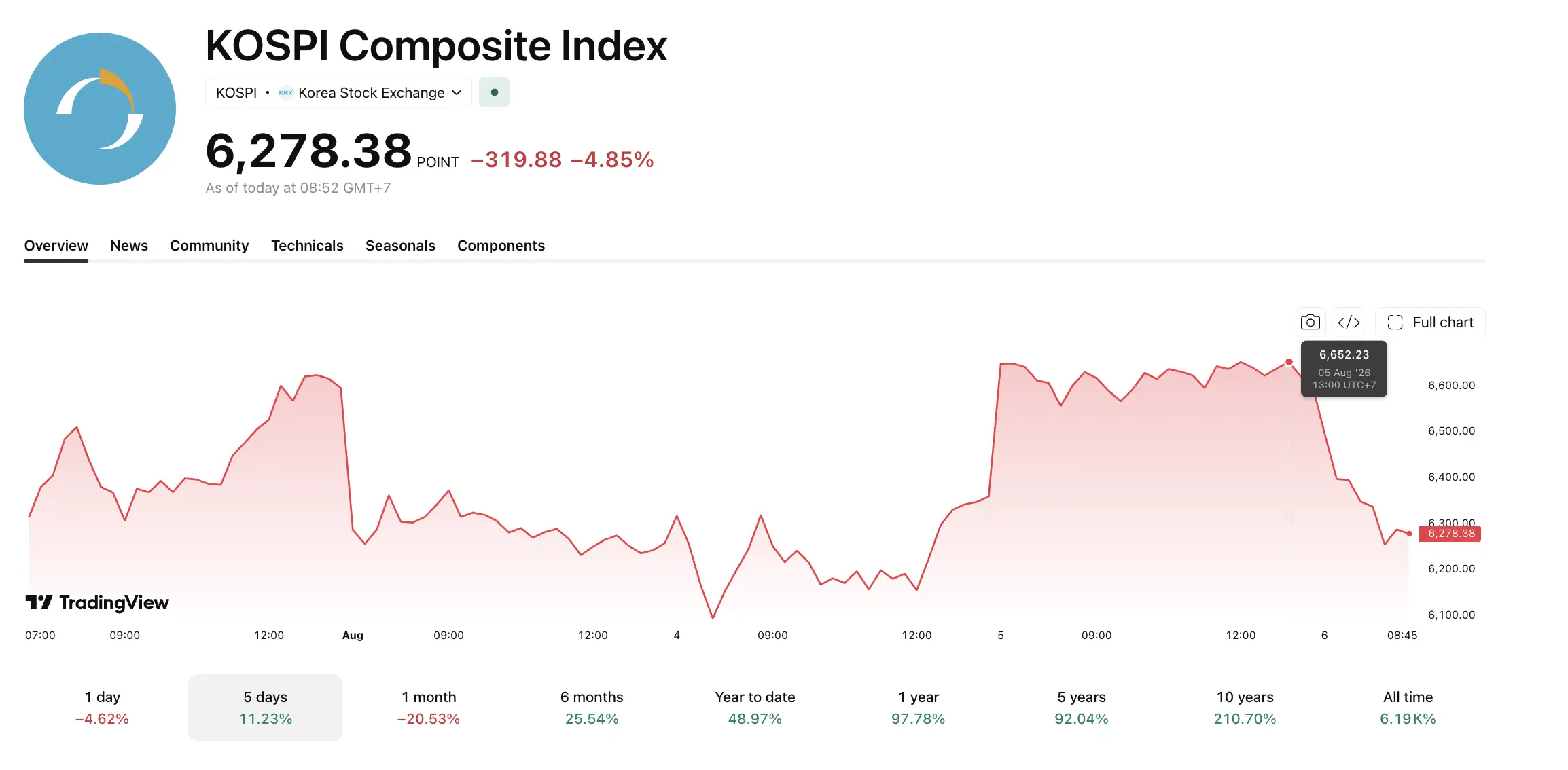
On August 5, 2026, the KOSPI rose 239.31 points to 6,598.26.
The rally was supported by easing concerns about overinvestment in AI infrastructure, improving sentiment toward US technology companies, and easing geopolitical tensions between the US and Iran.
Foreign investors booked net buying of around 1.45 trillion won during the session. Institutional investors, on the other hand, sold net 283.5 billion won, and retail investors sold around 1.18 trillion won.
Technology stocks were the main movers, with Samsung Electronics rising 2.5% and SK Hynix gaining 5.77%.
The surge in openings even prompted the Korea Exchange to activate buy-side sidecar, namely the temporary suspension of trading programs to reduce excessively rapid movements.
However, real-time data on the morning of August 6 showed the KOSPI moving back to around 6,305, or down approximately 4.44% from its previous close.
The wide daily range of movements confirms that the Korean stock market remains highly sensitive to foreign investor inflows and changes in global tech stock sentiment.
Read Also: Asian Market Opening Analysis: Why the KOSPI is Under Pressure Again
What Causes KOSPI to Fluctuate?
The reason KOSPI fluctuates is not only changes in economic news within a day.
The Korean index structure has large exposure to technology companies, semiconductors, automotive companies, and exporters that are sensitive to global demand.
As AI optimism grows, stocks like Samsung Electronics and SK Hynix could push the index up quickly.
Conversely, concerns about tech valuations, AI capital spending, or Wall Street weakness could trigger a sell-off.
Foreign investor inflows also played a significant role. In July 2026, foreign investors sold a net 9.89 trillion won worth of KOSPI shares.
Retail investors absorbed some of the pressure with net buying of 5.37 trillion won, while pension funds recorded net buying of only about 995.48 billion won.
Read Also: Leveraged ETFs in the Spotlight After KOSPI Plunge
Why is Korea's Pension Fund in the Spotlight?
NPS is one of the world's largest pension funds with assets under management of approximately 1,848.7 trillion won at the end of May 2026.
The value of its domestic stock investments reached 543.6 trillion won, equivalent to 29.4% of the entire portfolio.
This figure is more than double the 263.7 trillion won position at the end of 2025.
The increase occurred when the KOSPI experienced a major rally in the first half of 2026.
The problem is, when the market turns down, NPS no longer has the capacity to add as much domestic stock as before.
The already high position makes it difficult for the pension fund to function as a balancing buyer without further increasing the concentration of its portfolio.
Want to expand your monitoring from global stock markets to digital assets? Register at Bittime and explore crypto opportunities that suit your risk profile.
Is NPS's Domestic Investment Strategy Too Aggressive?
Pension fund investment strategies need to be assessed based on long-term objectives, not just their ability to withstand index declines. The NPS is obligated to generate sustainable returns to meet pension payments, not specifically to maintain Korean stock prices.
The decision to hold domestic stocks during the rally also paid off big.
NPS recorded an interim return of 26.18% during January–May 2026, with investment income of approximately 385.5 trillion won.
However, these benefits come with concentration risk. When the domestic stock portion reaches 29.4%, rebalancing flexibility becomes less, and portfolio performance becomes increasingly tied to the direction of the KOSPI.
The NPS previously sought to expand global investments to reduce dependence on the Korean economy.
However, the share of global stocks fell to 35.2% in 2026 from 37.8% a year earlier, while domestic stock ownership increased sharply.
Read Also: Buy US Stocks via Crypto, Get 7% Daily Rewards at Bittime
Should Pension Funds Be a Buffer for the KOSPI?
Institutional funds in the KOSPI are often seen as a buffer when foreign investors sell.
However, the use of pension funds to stabilize the market can create a conflict between short-term market interests and long-term participant obligations.
NPS Chairman Kim Sung-joo explained that selling shares to return to allocation targets during a rally can create significant pressure.
According to his calculations, the rebalancing could potentially require NPS to sell more than 400 billion won worth of shares every day.
On the other hand, observers believe that changes in allocation limits and delays in rebalancing have left NPS with no room to buy when prices fall.
This condition is what makes the NPS domestic investment strategy considered to have the potential to increase, rather than reduce, KOSPI volatility.
Read Also: What Is the Yen Carry Trade? Here's How It Works and Its Impact
What Does This Mean for Korean Stock Investors?
Investors should not interpret the purchase of NPS as a guarantee that the stock price will always be supported.
Pension funds can rebalance, reduce exposure, or shift investments to global markets as portfolio needs dictate.
The performance of the Korean capital market is also still influenced by the movement of the won, the condition of the semiconductor industry, global trade policies, and foreign capital flows.
On August 5, the won actually weakened to around 1,424.5 per US dollar despite the KOSPI rising sharply.
Investors need to monitor whether the index's strengthening is supported by corporate profit growth or simply a short-term recovery in sentiment.
A rally that relies too heavily on a few large tech stocks will be more vulnerable to a correction.
Read Also: BACH Shares After Djarum Acquisition: Price Trends and Prospects
Korean Domestic Stock Risks
Risks facing Korean domestic stocks include technology sector concentration, dependence on exports, changes in foreign investor flows, and exchange rate volatility. The index's nearly 4% rise and subsequent more than 4% decline in two sessions demonstrates the magnitude of these risks.
Investors also need to pay attention to the limitations of institutional support.
When the share of Korean stocks in the NPS portfolio is already high, a market downturn does not automatically lead to large purchases by pension funds.
Keep tracking other stock tokens such as AMZON, AMDON, and NFLXON as well as MSFTON, then you can start trading on the trusted exchange, only on Bittime.
Conclusion
KOSPI volatility in early August 2026 shows that the Korean stock market is still driven by rapid changes in sentiment regarding AI, technology stocks, geopolitics, and foreign capital flows.
NPS's domestic investment strategy yielded substantial returns during rallies, but its 29.4% exposure to Korean stocks reduced its flexibility when the market turned down. NPS cannot be viewed as a limitless buyer who always rescues the index.
For investors, the primary focus should not be simply tracking institutional funds in the KOSPI, but rather assessing company fundamentals, valuations, currency risk, and portfolio concentration levels.

Gain exposure to shares in leading technology companies through tokenised stocks like TSLAX, MSFTON or GOOGLX only on Bittime!
Bittime is a licensed and regulated Digital Financial Asset Trader (PAKD) supervised by Indonesia’s Financial Services Authority (OJK) — where you can buy Bitcoin in Indonesia and hundreds of other crypto assets starting from just Rp10,000. The registration process is fast, secure, and you can get started today.
Track USDT to IDR conversions and monitor your favorite crypto assets in real time. Everything is available in one crypto investment app that you can download for free on the Play Store
Ready to start? Register now on Bittime and execute your investment strategy with a platform trusted by millions of users in Indonesia.
FAQ
What is the KOSPI Index?
The KOSPI is a major index that measures the performance of stocks listed on the Korea Exchange, including Samsung Electronics, SK Hynix, Hyundai Motor, and other major Korean companies.
Why is KOSPI so volatile in August 2026?
Volatility is influenced by changes in sentiment towards AI shares, foreign investor flows, geopolitical developments, and limited additional support from domestic institutional investors.
What is the relationship between NPS and the Korean stock market?
The NPS manages Korea's national pension fund and has significant investments in domestic stocks. At the end of May 2026, its holdings reached 543.6 trillion won.
Is NPS obliged to keep KOSPI from falling?
No. The primary objective of the NPS is to generate long-term returns and maintain the sustainability of pension funds, not to maintain a specific level on the KOSPI.
Is high NPS domestic investment risky?
Yes. Domestic concentration can increase returns when the KOSPI rises, but it also increases portfolio volatility and reduces the ability to make purchases during market downturns.
What do KOSPI investors need to monitor?
Investors need to monitor technology company earnings, foreign investor flows, the won exchange rate, NPS policies, global economic conditions, and the direction of US stock indexes.
Disclaimer: The views expressed belong exclusively to the author and do not reflect the views of this platform. This platform and its affiliates disclaim any responsibility for the accuracy or suitability of the information provided. It is for informational purposes only and not intended as financial or investment advice.

.png)