Bitcoin Rises After Fed Raises Interest Rates? Here's Why
2026-09-21
Tuesday, September 16, 2026, The Fed officially raised its benchmark interest rate by 25 basis points to the 3.75%–4% range, the first hike in more than three years. In theory, a Fed rate hike is usually considered negative sentiment for risk assets like Bitcoin.
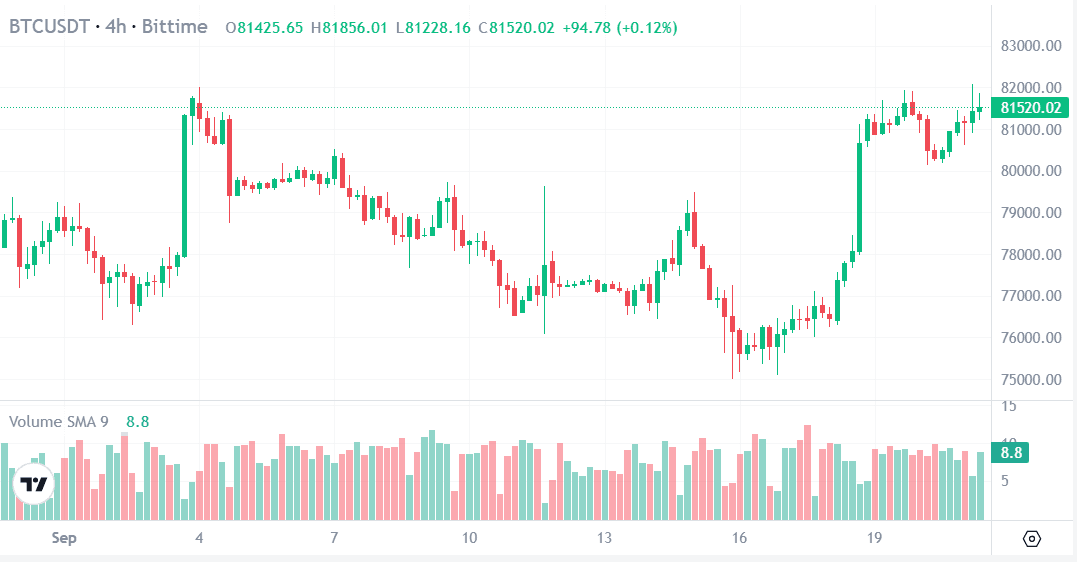
But the opposite happened: Bitcoin's price corrected briefly, then reversed upward and traded above $81,700 just three days after the decision was announced.
The question of why Bitcoin rose after the Fed raised interest rates has a more complicated answer than just the rate increase itself—there is a combination of market expectations, the tone of the Fed's communication, and forward monetary policy projections that helped shape Bitcoin's price response after the announcement.
It is important to note from the outset: Bitcoin price movements are volatile and influenced by many factors at once. This article purely discusses the context and mechanisms behind those movements, not a signal or invitation to make any particular transaction decision.
Key Takeaways
- Bitcoin briefly corrected to the $75,000–76,000 range after The Fed raised interest rates by 25 basis points on September 16, 2026, before reversing upward above $81,700 within three days.
- The rate hike that the market had already anticipated (priced in) from the start limited its shock impact, while the tone of the Fed's communication and regulatory signals also influenced the direction of movement.
- Bitcoin's movement after the Fed decision should still be viewed alongside other macro indicators such as inflation data, Treasury yields, and ETF fund flows, not read as a signal of future price direction.
What Did The Fed Decide and Why Did Bitcoin Still Rise?
FOMC Decision September 16, 2026
According to reporting by CoinMarketCap Academy, the Federal Open Market Committee (FOMC) raised the benchmark interest rate by 25 basis points through a unanimous 12-0 vote—the first hike since July 2023, also marking the end of the hold/cut cycle that had previously brought rates to the 3.50%–3.75% range.
This decision was made a day after the CLARITY Act bill failed to pass a procedural vote in the U.S. Senate, which had briefly pushed Bitcoin's price to its lowest monthly level.
What needs to be understood is that the Fed's actual decision and prior market expectations are two different things.
Based on CME FedWatch data, the probability of a rate hike had already been priced by the market at 92.9%–94% before the official announcement came out. This means most market participants had already factored in this scenario well in advance.
Read Also: Purbaya Removed from Finance Ministry, Becomes BI Governor? Check the Facts
Why Was the Market Response Different from General Expectations?
This is the key to why Bitcoin rose after the Fed rate hike, instead of immediately plunging:
- Already priced in. Because the probability of a hike was already very high before the announcement, the Fed's official decision no longer carried a major surprise element for the market.
- The tone of the Fed's communication. Nansen Senior Research Analyst Nicolai Sondergaard, as quoted by CryptoPotato, explained that the turmoil from the CLARITY Act failure actually had a greater impact on Bitcoin than the Fed decision itself, and Bitcoin held up better than higher-beta assets such as ETH and SOL.
- Easing uncertainty. Nexo Dispatch Analyst Iliya Kalchev, quoted by CryptoPotato, noted that Bitcoin actually rose on the day the decision was announced—a pattern that commonly occurs when the period of uncertainty before a major decision ends and investors begin repositioning.
- Additional catalyst from regulation. Based on reporting by CoinMarketCap Academy, within 48 hours after the CLARITY Act failure, the CFTC submitted a crypto market rules framework to the White House and the SEC announced a five-year "innovation exemption" for limited trading of tokenized U.S. stocks. Both signals were said to help drive the price recovery.
Understanding dynamics like this—that Bitcoin's movement is shaped by many macro and sentiment factors at once, not just one interest rate decision—is important preparation before observing the crypto market further.
If you want to monitor price data and explore the market independently, readers can register an account on Bittime, a crypto exchange platform operating with an OJK license in Indonesia.
Interest Rates, Post-Fed Recovery, and Indicators to Watch
Why Can Interest Rates Affect Bitcoin?
In general, higher interest rates make low-risk interest-bearing instruments—such as deposits, money market funds, or government bonds—more attractive compared with non-yielding assets like Bitcoin.
As reported by KuCoin, this condition was clearly visible during the 2022 tightening cycle, when interest rates rose from near zero to more than 5% in about a year, giving investors far more competitive low-risk yield options compared with holding crypto assets.
However, this relationship does not always run one way or instantly. Market liquidity conditions, investor risk appetite, and the scale of the rate hike itself also determine how large the impact is.
Grayscale, through its head of research Zach Pandl, called the 25 basis point hike in September 2026 a "mid-cycle correction, not a cycle change"—very different from 2022 when The Fed raised rates 11 times in a row with a total increase of 5.25 percentage points.
Read Also: BIS Reveals New Potential for XRP Ledger for the Digital Financial System
What Is Post-Fed Recovery?
The term post-Fed recovery refers to a pattern in which the market is turbulent before and immediately after a central bank decision is announced, then gradually recovers as uncertainty eases.
Based on data from SoSoValue cited by CryptoPotato and KuCoin, spot Bitcoin ETFs recorded net outflows of about $450 million on September 15 and $296 million on September 16—two days full of pressure due to the combination of the CLARITY Act failure and the rate hike.
Once that uncertainty passed, the direction of fund flows reversed: a net inflow of $159 million was recorded on September 17, with BlackRock's IBIT contributing $184 million.
This kind of recovery pattern should be read as part of the overall market reaction to a series of events, not an indication that the future price direction is certain. Factors such as the next Fed decision and new economic data will still influence how this pattern continues.
Read Also: Popular Tokenized Stocks 2026: Technology Stocks Become Investor Favorites
Indicators Investors Should Watch After the Fed Decision
Some things that are educationally worth monitoring after a central bank decision:
- The Fed's forward guidance. Official statements and post-FOMC press conferences often signal the direction of the next policy move, sometimes having more influence on the market than the day's decision itself.
- Future interest rate projections. According to KuCoin reporting, Fed officials project interest rates ending around 4.1% at the end of 2026, holding at that level throughout 2027, with new cuts expected to appear in 2028–2029.
- U.S. inflation and labor data. U.S. annual inflation was recorded at 3.4%, with core inflation rising 0.3% month-over-month—data like this becomes a key reference for the next monetary policy direction.
- Movement of the U.S. dollar index and Treasury yields. According to KuCoin reporting, the 10-year Treasury yield briefly touched the 5% level, making this low-risk instrument increasingly competitive compared with non-yielding assets like Bitcoin.
- Broad risk asset market sentiment. Changes in risk appetite in the stock and bond markets usually spill over into the crypto market, so it cannot be viewed separately from overall macro conditions.
Read Also: 10+ Best AI Coins 2026: Here Is the List of Artificial Intelligence-Themed Crypto!
Conclusion
Bitcoin's response to The Fed's interest rate hike on September 16, 2026 shows that crypto asset price movements are not determined solely by one central bank decision, but by a combination of prior market expectations, the tone of the Fed's communication, regulatory signals, and investor reaction after uncertainty eased.
The phenomenon of Bitcoin rising after the Fed raised interest rates is important to understand as part of broader macroeconomic dynamics, not as a signal of future price direction.
Because crypto asset prices remain volatile and can change due to various other factors, the next Fed decision, inflation data, and ETF fund flows remain worth monitoring continuously before drawing any conclusions.
Check prices Bitcoin (BTC), Ethereum (ETH), XRP, Solana (SOL), GRAM, and BNB, as well as the leading memecoin DOGE. You can trade directly on Bittime!

Bittime is a Digital Financial Asset Trader (PAKD) platform licensed and supervised by the Financial Services Authority — where you can buy Bitcoin in Indonesia and hundreds of other crypto assets starting from IDR 10,000. The registration process is fast, secure, and can be started today.
Monitor the conversion USDT to IDR and your favorite crypto asset price movements in real time. Everything is available in one crypto investment app that can be downloaded for free on the Play Store.
Ready to start? Register now on Bittime and execute your investment strategy with a platform trusted by millions of users in Indonesia.
FAQ
Why did Bitcoin rise after the Fed raised interest rates, even though it is usually considered negative sentiment?
This 25 basis point rate hike had already been anticipated by the market well before the official announcement (priced in), so its shock impact was limited. The tone of the Fed's communication and additional regulatory signals from the SEC and CFTC also influenced the direction of the subsequent price recovery.
Does a rate hike always have a negative impact on Bitcoin's price?
Not always. The impact depends on whether the hike was already anticipated by the market, the scale and speed of the tightening cycle, and overall liquidity conditions and risk sentiment at the time.
What is post-Fed recovery in the context of the crypto market?
Post-Fed recovery is a price recovery pattern that occurs after uncertainty around a central bank decision eases, usually marked by the return of fund inflows into instruments such as ETFs. This pattern should be read as the market's reaction to reduced uncertainty, not a guarantee of the next price direction.
What indicators should investors pay attention to after the Fed decision is announced?
Some important indicators include the Fed's forward guidance and interest rate projections, U.S. inflation and labor data, Treasury yield movements, and broad risk asset market sentiment. All these factors are interconnected in shaping future market direction.
Does this article recommend buying or selling Bitcoin?
No. This article is educational in nature to explain the context behind Bitcoin's price movement after the Fed decision, not an investment recommendation or price prediction.
Disclaimer: The views expressed belong exclusively to the author and do not reflect the views of this platform. This platform and its affiliates disclaim any responsibility for the accuracy or suitability of the information provided. It is for informational purposes only and not intended as financial or investment advice.

.png)