Free AI Checker Tools: How to Check Crypto News with AI
2026-09-29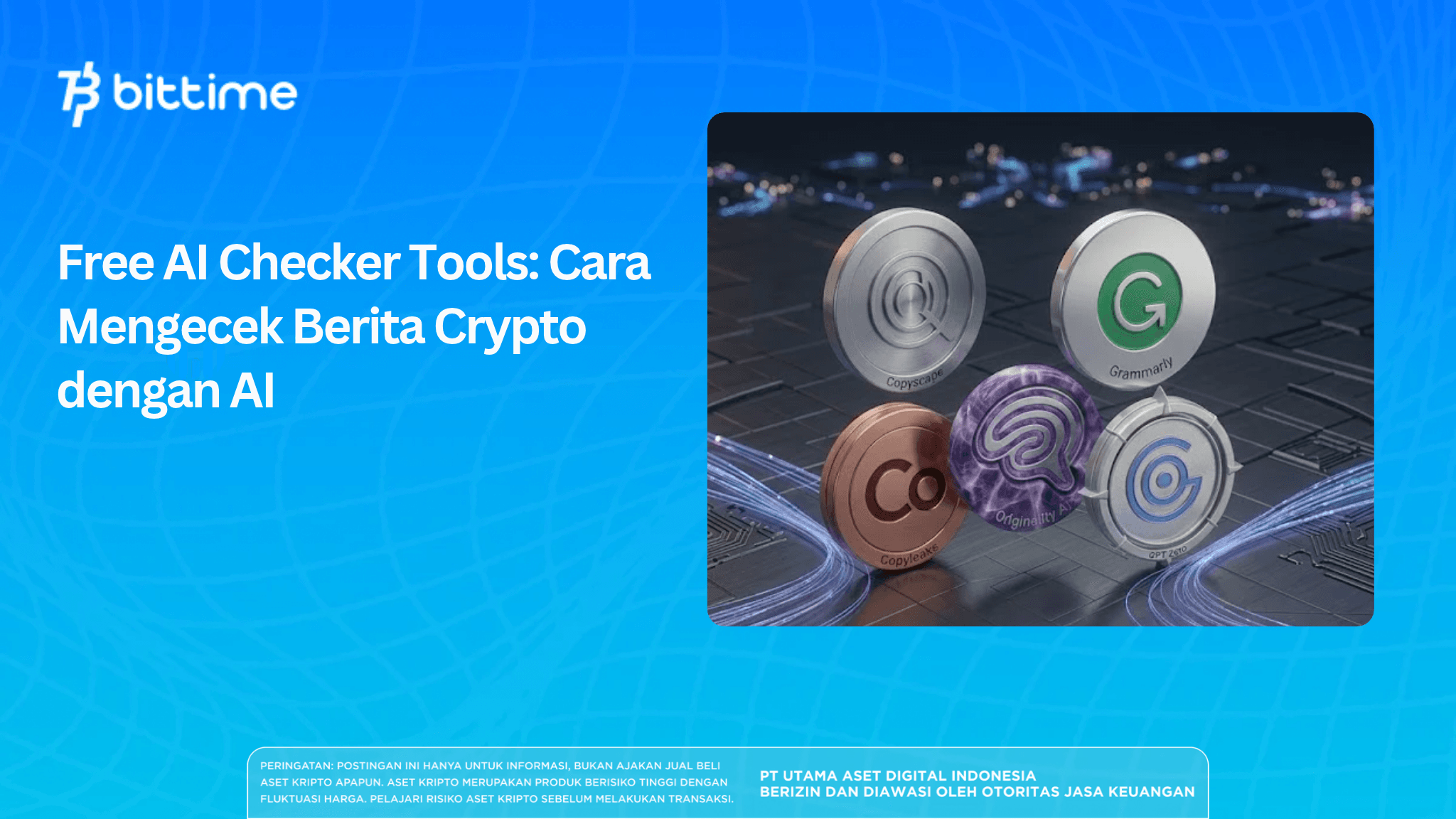
A single fake post can spread quickly in the crypto community and influence investor decisions. Therefore, AI checker tools and free AI detectors can help writers, editors, and readers assess writing patterns, source similarity, and manuscript quality before trusting or publishing them.
Although practical, these tools cannot replace fact-checking. AI checkers read language patterns and text similarity, while the truth of news still needs to be tested through official sources, on-chain data, exchange announcements, and project documents.
Key Takeaways
- AI checkers can help detect AI writing patterns, plagiarism, and language issues.
- AI detector results are estimates and should not be treated as absolute proof.
- Crypto news still requires verification of sources, numbers, dates, and market context.
What Is an AI Checker?
AI checker is a general term for tools that examine writing from several angles. Available features may include AI detector, plagiarism checker, grammar checker, readability analysis, and article structure evaluation.

AI detector
An AI detector estimates whether a text has characteristics of writing created or assisted by an AI model. This tool can assess sentence patterns, word choice, structural variation, and the level of predictability in the language.
The result is usually a percentage or label such as “likely AI-generated” and “likely human-written”. Grammarly, for example, provides a free AI detector that allows users to paste text or upload a document to obtain a scan result.
However, the result is still probabilistic. Very formal, short, translated, or heavily edited human text can trigger false positives.
Read Also: BIS Reveals New Potential for XRP Ledger for Digital Financial Systems
Plagiarism checker
A plagiarism checker compares a manuscript with web pages, documents, or available databases. Its main goal is to find text similarity, not to determine whether an article was written by a human or AI.
This distinction is important in crypto journalism. An article can be human-written but still have high similarity if it stays too close to a press release, project report, or another media article.
Grammar and style checker
Grammar checkers help find spelling, punctuation, sentence structure, and word usage errors. Tools such as Grammarly and LanguageTool can also help improve clarity and consistency of writing style.
This feature is useful when an article contains technical terms such as staking, token unlock, market cap, liquidity, and smart contract. Editors still need to ensure those terms fit the news context.
Read Also: Popular Tokenized Stocks 2026: Technology Stocks Become Investor Favorites
Structure checker
A structure checker helps examine the flow of writing, the order of arguments, repetition, and information gaps. Mapify explains that mind maps can help writers see relationships between sections visually before the manuscript is published.
For crypto news, a good structure usually includes the main event, sources, supporting data, market context, risks, and the impact on readers.
If you want to follow developments in digital assets after conducting research and checking the news, you can register on Bittime.

Free AI Checkers for Crypto News
Each tool has different functions and limitations. Use the following table as an initial guide.
The list summarizes the functions of tools discussed by Mapify, as well as tools widely used for writing checks. Features, usage limits, and free plan policies may change, so users need to check each platform's official page.
Read Also: 10+ Best AI Coins 2026: Here Is the List of Artificial Intelligence-Themed Cryptos!
GPTZero
GPTZero is designed to identify parts of writing that have characteristics of AI-generated text. The platform also claims it can help check writing from a number of large language models and assess manuscript quality.
In crypto news writing, GPTZero can be used as an additional check after the article is finished. If the result shows a high likelihood of AI writing, editors can recheck sections that are too repetitive or have uniform sentence patterns.
Grammarly AI Detector
Grammarly provides a free AI detector that can be used without registration according to its official page. Users simply paste text or upload a document, then run a scan to see the estimated proportion of writing considered AI-generated.
Grammarly's advantage lies in a workflow integrated with grammar, clarity, and style checks. This tool is suitable for initial checks, but its detection results still need to be read together with the writing history and article sources.
Read Also: 10 Largest RWA Crypto Asset Tokenizations in the World
Originality.ai
Originality.ai combines AI and plagiarism checks. This feature is relevant for publishers, content agencies, and editorial teams that need to review many articles.
For crypto news, this tool can help check whether writing is too close to other media articles or project press releases. Editors still need to manually verify numbers, quotes, and market claims.
Copyleaks
Copyleaks combines writing analysis with similarity checks. A tool like this is useful when editors want to separate two questions: whether the text shows AI patterns and whether the text is similar to a particular source.
The check results should not be read in isolation. Technical terms, token names, and official quotes can indeed make several articles look similar without indicating direct copying.
Copyscape
Copyscape focuses on web-based duplication searches. This tool can help site managers and SEO teams find out whether certain parts of an article have appeared on other pages.
Copyscape is not an AI detector. The platform cannot determine whether an article was created by AI, but it can help find public similarities that editors need to review.
LanguageTool and Hemingway Editor
LanguageTool can help check grammar and spelling in various languages. Hemingway Editor focuses more on readability, including sentences that are too long, passive voice, and hard-to-understand parts.
Both are useful for making crypto news more mobile-reader friendly. However, do not remove technical terms just because the tool considers them difficult to read; explain those terms with simple context.
QuillBot
QuillBot helps with paraphrasing and summarizing. This feature can be used when a writer wants to simplify sentences that are too long.
Recheck every paraphrase result, especially parts containing numbers, dates, project names, or quotes. Automatic changes can shift sentence meaning and make crypto information inaccurate.
Read Also: 9 Advantages of Profitable Digital Gold Investment 2026 (XAUT & PAXG)
How to Check Crypto News with AI
An AI checker will be more useful if placed in a clear checking workflow.
1. Separate facts from opinions
Mark sentences that contain numbers, prices, dates, names of figures, project names, and official statements. Each fact needs a traceable source.
For example, the claim “the token price rose 20%” must include the measurement period, price source, and data retrieval time.
2. Check primary sources
Use official project sites, governance documents, company reports, exchange announcements, blockchain data, and direct statements from relevant parties.
Media articles can help provide context, but do not make them the sole basis for important claims. If the news discusses hacks, tokenomics changes, or regulatory decisions, look for original documents or statements.
3. Check article similarity
Enter the manuscript into a plagiarism checker to see whether any parts are too close to other sources. If using quotes, maintain clear attribution and quotation marks.
Similarity in token names, technical terms, or announcement titles does not automatically mean plagiarism. Editors need to assess the length of the identical part, sentence arrangement, and context of use.
4. Use AI detector as a signal
Run the AI detector after the article has been edited. Use the result to find sections that sound too uniform, repetitive, or inconsistent with the writer's style.
Do not accuse a writer based only on one score. A number of tool tests and reviews show that false positives remain a problem in AI writing detection.
5. Check language and readability
Use a grammar checker to find technical errors, then reread the article manually. Make sure sentence structure follows natural Indonesian language patterns, including modifier-head relationships.
Crypto articles also need to use short paragraphs, clear subheadings, and bullet lists so they are comfortable to read on a phone.
6. Check information structure
Make sure the article answers the reader's basic questions:
- What is the event?
- When did the event happen?
- Who are the parties involved?
- What is the value or amount?
- Where does the data come from?
- What is the impact on the market?
- What is still uncertain?
If one of the questions has not been answered, the article may need additional research.
7. Keep a record of the process
Keep the initial draft, source links, data captures, and revision history. These records can help explain the writing process if the AI detector result does not match reality.
Limitations of AI Detectors
An AI detector does not read the writer's intent. This tool estimates likelihood based on language patterns found in the text.
The result can change due to several factors:
- Manuscript length.
- Language used.
- Writing style.
- Level of editing.
- Use of technical terms.
- Translation process.
- Paraphrasing from other sources.
- Mixture of human and AI text.
Very formal human text can be considered to have AI characteristics. Conversely, AI text that has been edited many times can escape detection. Therefore, an AI detector score is not worthy of being the sole basis for rejecting an article or accusing someone.
In the context of crypto news, evidence of process and source accuracy is more important than a detector score. An article with a natural style is still problematic if its numbers and quotes are wrong, while an AI-assisted article can still be accurate if it goes through responsible verification and editing.
Read Also: Legal Crypto Apps in Indonesia 2026: How to Check OJK-Licensed Platforms
Privacy When Using AI Checkers
Before uploading documents to a free AI checker, check the platform's privacy policy. Some things to pay attention to are:
- Document retention period.
- Use of text for model training.
- Option to delete documents.
- Third-party access.
- Data encryption.
- Terms for commercial documents.
Do not upload personal information, client contracts, exclusive reports, or unpublished news without understanding the terms of service. If possible, remove sensitive data before conducting checks.
Conclusion
AI checker tools can help writers and editors check crypto news from various angles. AI detectors assess writing patterns, plagiarism checkers look for similarity, while grammar and structure checkers help improve article quality.
These tools should be used as part of the editorial process, not as a replacement for journalism. Primary sources, market data, dates, numbers, quotes, and context still need to be verified manually before news is published.
Check the prices of Bitcoin (BTC), Ethereum (ETH), XRP, Solana (SOL), GRAM, and BNB as well as leading memecoin DOGE. You can trade directly on Bittime!

Bittime is a licensed Digital Financial Asset Trader (PAKD) platform supervised by the Financial Services Authority — where you can buy Bitcoin in Indonesia and hundreds of other crypto assets starting from Rp10,000. The registration process is fast, secure, and can be started today.
Monitor USDT to IDR conversion and the price movements of your favorite crypto assets in real time. Everything is available in one crypto investment app that can be downloaded for free on the Play Store.
Ready to start? Register now on Bittime and execute your investment strategy with a platform trusted by millions of users in Indonesia.
FAQ
What is an AI checker?
An AI checker is a tool for examining writing in terms of AI detection, plagiarism, grammar, style, readability, or structure. Each platform has different functions and usage limits.
What is the difference between an AI checker and an AI detector?
An AI detector specifically estimates the likelihood that a text was created or assisted by AI. An AI checker has a broader scope and may include similarity and grammar checks.
Are there free AI checkers?
There are several platforms that provide free features or limited access, including Grammarly AI Detector, GPTZero, LanguageTool, QuillBot, and a number of similarity checker services. Usage limits and features may change according to platform policy.
Can an AI detector confirm that writing was created by AI?
No. An AI detector only produces an estimate based on language patterns and can give false positives.
How do you check crypto news with AI?
Check primary sources, separate facts from opinions, use a plagiarism checker, run an AI detector as a signal, then check the grammar and structure of the article. Manual verification is still needed for numbers, dates, quotes, and market claims.
Can an AI checker verify the truth of news?
An AI checker can help assess writing, but it cannot confirm that all facts in the news are true. Truth verification requires official sources, blockchain data, project documents, and editorial judgment.
Which AI checker is suitable for crypto writers?
GPTZero or Grammarly can be used for initial writing checks, while Originality.ai, Copyleaks, or Copyscape are more relevant for similarity checks and content team needs. The final choice depends on the type of document, budget, and privacy requirements.
Disclaimer: The views expressed belong exclusively to the author and do not reflect the views of this platform. This platform and its affiliates disclaim any responsibility for the accuracy or suitability of the information provided. It is for informational purposes only and not intended as financial or investment advice.

.png)