US Dollar Breaks Rp17,900: Rupiah Weakens, Causes and Impact
2026-06-03
United States dollar price today the rupiah weakened to Rp17,900 per US dollar, marking a new low for the rupiah against the greenback. This weakening occurred amid various pressures, both domestic and international.
Many people are starting to wonder what is really happening with the rupiah exchange rate and how it impacts their daily lives.
Key Takeaways
- The rupiah hit a new low of Rp17,900 per US dollar due to a combination of external factors such as geopolitical tensions and a strengthening US dollar.
- Bank Indonesia has tightened regulations on cash dollar purchases without supporting documents to a maximum of US$25,000 per month through PADG Number 11 of 2026.
- The weakening of the rupiah could push up the prices of imported goods and affect people's purchasing power and foreign exchange investment decisions.
Register at Bittime now and start trading crypto with a fast, safe, and easy process in the app.
Today's Rupiah Exchange Rate: Latest Data and All-Time Low
Rupiah exchange rate against the US dollar today, the rupiah weakened to Rp17,900 per US dollar, setting a new all-time low for the Indonesian currency. At the opening of trading, the rupiah was already hovering around Rp17,870 and continued to decline throughout the day.
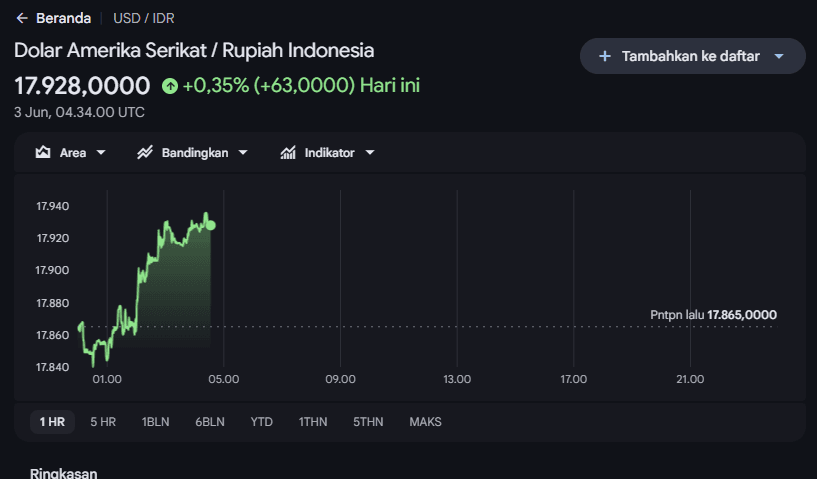
Market data shows the rupiah has weakened by around 0.39 percent intraday. This figure is approaching the psychological level of Rp18,000 per US dollar, which is often a concern for market participants.
If the rupiah continues to weaken and breaks through Rp18,000, the pressure on the economy could become even more pronounced.
To understand the current situation, let's look at some important data:
- The rupiah opened at Rp17,870 per US dollar in the morning.
- Throughout May 2026, the rupiah had weakened by almost 3 percent overall.
- The Rp17,900 level is lower than the end-May position of around Rp17,863 based on Bank Indonesia's Jisdor data.
- Trading volumes in the spot market remain active, indicating that many market players are adjusting their positions.
This situation didn't happen overnight. The rupiah has been facing sustained pressure for the past few weeks. For the general public, this weakening can be felt immediately when purchasing imported goods or planning trips abroad.
Meanwhile, business actors who use a lot of imported components are also starting to recalculate their production costs.
Read also: How to Deposit Rupiah and Crypto Assets on Bittime: It's So Easy!
Reasons for the Rupiah's Weakening: External and Domestic Factors
There are several main reasons why the rupiah has continued to weaken, reaching Rp 17,900 per US dollar. These factors can be divided into two broad categories: external and domestic.
External factors include:
- Geopolitical uncertainty in the Middle East has global investors seeking safe havens such as the US dollar.
- The US dollar index (DXY) strengthened after US employment data showed a still-resilient economy.
- Expectations are that the Fed will keep interest rates higher for longer because inflation is not yet fully under control.
New to crypto investing? Bitcoin (BTC) and Ethereum (ETH) are among the most popular starter cryptocurrencies to explore and trade on Bittime.
Meanwhile, domestic factors that contributed to the weakening include:
- The seasonal pattern of returns and interest payments on domestic financial assets and foreign debt typically increases in June.
- The decline in the trade surplus was due to pro-growth policies that encouraged higher imports.
- Disruptions in the global supply chain have caused the price of imported goods to rise, thus increasing the need for US dollars for imports.
This combination of factors creates selling pressure on the rupiah in the market. Foreign investors tend to hold or reduce their holdings of rupiah-denominated assets when global uncertainty increases. Consequently, demand for the US dollar increases, depreciating the rupiah exchange rate.
It's important to note that the rupiah's depreciation isn't solely driven by a single factor. There's usually an interplay between global conditions and domestic policies, mutually reinforcing each other.
Read also: Analysis of the Rupiah Exchange Rate against BTC Today
BI Policy: PADG Number 11 of 2026 and Dollar Purchase Restrictions
Bank Indonesia has taken steps to maintain foreign exchange market stability. Through Board of Governors Regulation (PADG) No. 11 of 2026, BI tightened regulations on cash purchases of US dollars without supporting documents.
These new rules come into effect on June 2, 2026. Here are the main points:
- The limit for cash dollar purchases without supporting documents has been reduced from US$50,000 to US$25,000 per month per customer.
- Purchases above this limit must be accompanied by documents showing a clear need, for example for imports or debt payments.
- The main objective of this policy is to maintain the stability of the rupiah exchange rate amid high external pressure.
This policy represents a change from the previous PADG issued in 2024. By tightening the regulations, BI hopes to reduce speculation and unfounded demand for US dollars.
For people who genuinely need US dollars for legitimate purposes, such as travel or education abroad, the process may be a bit more complicated. However, for those who simply want to store US dollars for no apparent reason, access is limited.
This move by BI demonstrates that the monetary authorities are vigilant about the risk of continued rupiah depreciation. Similar policies have been implemented in the past when pressure on the rupiah increased.
Read also: How to Cash Out USDT to Rupiah on Bittime: A Complete Guide 2026
The Impact of the Weakening Rupiah on the Economy and Investors
The rupiah's depreciation to Rp 17,900 per US dollar has several noteworthy impacts. These impacts can be felt by various parties, from the general public to businesses and investors.
Here are some of the main impacts:
- The prices of imported goods tend to rise because it takes more rupiah to buy one US dollar. This can drive inflation, especially for goods with a high import content.
- The trade surplus has the potential to narrow as imports become more expensive, while exports in US dollars do not necessarily increase.
- Investors holding assets in rupiah could see their investment value eroded if converted to US dollars. Conversely, investors who have held foreign currency from the start actually benefit.
- Business owners who have debts in foreign currencies will face heavier installment burdens because they have to pay more rupiah.
- Domestic stock markets, such as the JCI, could be affected because foreign investors tend to sell rupiah assets when the exchange rate weakens.
For those planning to invest in foreign exchange, the current situation does offer opportunities due to the high US dollar exchange rate. However, the risk of fluctuation remains. Exchange rates can fluctuate depending on global developments and domestic policies.
It's important to always consider your investment objectives and risk tolerance before deciding to buy or sell foreign exchange. Consulting with a financial planner can help you make a more informed decision.
Convert 1 BTC to IDR - Indonesian Rupiah Exchange Rate
Conclusion
The Rupiah's weakening to Rp 17,900 per US dollar is a development that warrants close attention.
This is due to a combination of external factors, such as geopolitical tensions and a strengthening US dollar, as well as domestic factors, such as debt repayment season and a declining trade surplus.
Bank Indonesia has taken steps to tighten regulations on cash dollar purchases through PADG Number 11 of 2026. This policy aims to maintain exchange rate stability amidst persistent pressure.
It's crucial for the public and investors to understand the impact of the rupiah's depreciation on purchasing power, import costs, and investment value. Continue to monitor market developments and consider diversification to minimize exposure to the risk of exchange rate fluctuations.

Interested in getting started with crypto investing? Learn how to buy Bitcoin (BTC) or Ethereum (ETH), some of the most popular coins for beginners!
Bittime is a licensed and regulated Digital Financial Asset Trader (PAKD) supervised by Indonesia’s Financial Services Authority (OJK) — where you can buy Bitcoin in Indonesia and hundreds of other crypto assets starting from just Rp10,000. The registration process is fast, secure, and you can get started today.
Track USDT to IDR conversions and monitor your favorite crypto assets in real time. Everything is available in one crypto investment app that you can download for free on the Play Store
Ready to start? Register now on Bittime and execute your investment strategy with a platform trusted by millions of users in Indonesia.
FAQ
Why can the US dollar break through Rp. 17,900?
The rupiah's depreciation to Rp17,900 per US dollar was caused by external pressures such as geopolitical uncertainty and the strengthening of the US dollar, as well as domestic factors such as the debt repayment season and a declining trade surplus.
What is Bank Indonesia doing to hold back the rupiah?
Bank Indonesia (BI) has tightened regulations on cash dollar purchases without supporting documents to a maximum of US$25,000 per month through PADG Number 11 of 2026, with the aim of maintaining foreign exchange market stability.
Will the rupiah continue to weaken to Rp. 18,000?
According to several analysts, the rupiah is unlikely to break through Rp 18,000 if global conditions are stable. However, the risk of further weakening remains if external pressures increase.
How does the weakening rupiah impact ordinary people?
The impact could be rising prices of imported goods, higher costs of traveling abroad, and potential inflation that could impact daily purchasing power.
Is now a good time to invest in forex?
While foreign exchange investments can offer opportunities when the US dollar is strong, they also carry the risk of fluctuation. Always conduct your own research and align them with your risk profile and financial goals.
Disclaimer: The views expressed belong exclusively to the author and do not reflect the views of this platform. This platform and its affiliates disclaim any responsibility for the accuracy or suitability of the information provided. It is for informational purposes only and not intended as financial or investment advice.

.png)