The Safest Countries If World War 3 Happens: Why Indonesia Makes the List
2026-03-03
In an era where global geopolitical dynamics are increasingly volatile, speculations regarding a potential large-scale conflict or World War 3 (WW3) often resurface. While we all hope for lasting peace, considering which locations might offer the best refuge is not entirely far-fetched.
A country’s safety in a global war scenario isn't just about its military might; it is defined by its geographical isolation, resource self-sufficiency, and political neutrality.
Interestingly, international research institutions and analysts often point toward countries that might not be the most obvious choices.
One that has captured the attention of many is Indonesia’s inclusion in the list of relatively safe zones. But what exactly makes a nation a "safe haven" in the face of nuclear threats or major power struggles?
Key Takeaways
- Isolation and Self-Sufficiency: Countries far from conflict centers (such as the poles or remote islands) with independent food production have higher survival rates.
- Political Neutrality: Nations with a history of non-aligned or neutral diplomacy are less likely to be primary targets.
- Indonesia’s Strategic Position: A "Free and Active" foreign policy combined with vast natural resources places Indonesia in a relatively stable position.
Core Criteria for Safety During a Global Conflict
Determining a country’s safety level during World War 3 involves a multidimensional analysis. Experts generally look at three primary factors:
Distance from Nuclear Targets: Countries located far from NATO members or major military alliances have a lower risk of direct nuclear impact or radioactive fallout.
Food and Energy Security: When global trade routes are severed by war, nations capable of producing their own food and energy will be better equipped to survive systemic famine.
- Natural Topography: Countries with difficult-to-penetrate mountain ranges or vast archipelagic geography provide natural protection against large-scale ground invasions.
A List of the Safest Countries if WW3 Occurs
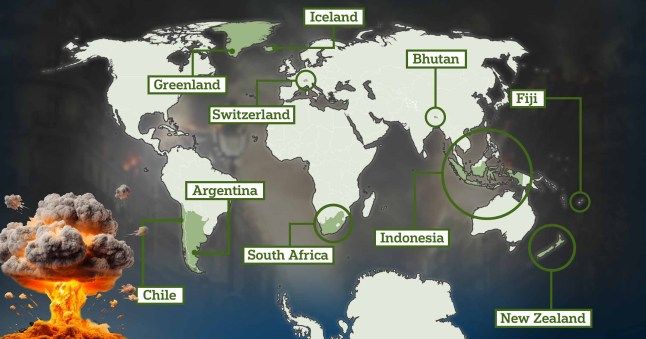
Based on various analyses, including data from Bloomberg and the Global Peace Index, the following countries are considered the safest:
Iceland: Located far out in the North Atlantic, Iceland consistently ranks #1 on the Global Peace Index. Besides its isolation, it possesses abundant geothermal resources for energy.
New Zealand: Often cited as a favorite location for billionaire bunkers, New Zealand is geographically remote and features highly fertile agricultural land.
Switzerland: Despite being in the heart of Europe, Switzerland has a deep-rooted tradition of neutrality and civil defense infrastructure (bunkers) capable of housing its entire population.
Bhutan: Nestled in the Himalayan mountains, Bhutan is a landlocked, isolated nation with a non-interventionalist political stance, making it a non-strategic target.
Fiji and Tuvalu: These Pacific island nations are incredibly far from any major landmass. Their focus on local fishing and agriculture makes them quite self-sufficient on a small scale.
Other regions like Antarctica (though not a formal country) are often mentioned due to distance, although the extreme climate makes it a difficult choice for ordinary civilians.
Why is Indonesia Considered Safe if WW3 Breaks Out?
Indonesia’s inclusion in the safety list might surprise some, but there are logical reasons behind it. First is the "Free and Active" Foreign Policy. Historically, Indonesia refuses to align with any specific military bloc, meaning it is unlikely to be a primary target for strategic strikes.
Second is its Archipelagic Geography. Comprising over 17,000 islands with diverse terrains, Indonesia is difficult to occupy fully. If a conflict occurs in one region, other islands separated by vast seas have a chance to remain stable.
Furthermore, Indonesia is a significant producer of food and energy. In a global emergency, the ability to produce commodities locally—such as rice, corn, and biofuels—is a vital survival asset.
Lastly, Indonesia’s role as a leader in the ASEAN region provides strong diplomatic leverage to maintain regional stability, allowing potential conflicts to be mitigated early through negotiation.
Conclusion
Discussing World War 3 is undeniably anxiety-inducing, yet analyzing the safest countries provides a crucial perspective on the value of peace and national resilience.
While nations like Iceland and New Zealand offer safety through distance, Indonesia offers safety through diplomatic neutrality and natural resource wealth.
Ultimately, a country’s true security lies not just in how far it is from the battlefield, but in its domestic solidarity and food security when the world is in turmoil. Maintaining good international relations remains the best solution so that these "safety lists" never have to be put to the test.
FAQ (Frequently Asked Questions)
1. Is Indonesia truly safe from nuclear radiation if a war happens in the North?
Geographically, Indonesia is on the equator. Global wind patterns (the Intertropical Convergence Zone) tend to keep radioactive fallout within the hemisphere where the explosion occurred. Therefore, nuclear fallout from the Northern Hemisphere is expected to be significantly weaker by the time it reaches the equator.
2. Why aren't developed countries like the US or UK on the list?
NATO members and major military powers are considered "primary targets" in a nuclear war scenario. Their infrastructure would likely be the first targeted in an escalation.
3. What should be prepared if a global conflict actually happens?
The keys are access to clean water, non-perishable food, and accurate information. On a national level, food sovereignty is the highest priority.
4. Is Switzerland still neutral today?
Yes, Switzerland maintains its policy of armed neutrality. They have a strong military, but it is strictly for self-defense, not for attacking or siding with others in international conflicts.
How to Buy Crypto on Bittime?

Want to trade sell buy Bitcoins and crypto investment easily? Bittime is here to help! As an Indonesian crypto exchange officially registered with Bappebti, Bittime ensures every transaction is safe and fast.
Start with registration and identity verification, then make a minimum deposit of IDR 10,000. After that, you can immediately buy your favorite digital assets!
Check the exchange rate BTC to IDR, ETH to IDR, SOL to IDR and other crypto assets to find out today's crypto market trends in real-time on Bittime.
Also, visit the Bittime Blog for interesting updates and educational information about the crypto world. Find reliable articles about Web3, blockchain technology, and digital asset investment tips designed to enrich your crypto knowledge.
Disclaimer: The views expressed belong exclusively to the author and do not reflect the views of this platform. This platform and its affiliates disclaim any responsibility for the accuracy or suitability of the information provided. It is for informational purposes only and not intended as financial or investment advice.

.png)