Coldcard Hack: 1,367 BTC Stolen—What Caused It and What Are the Consequences?
2026-08-05
Coldcard hack 2026 has drawn the attention of the Bitcoin community following reports that approximately 1,367 BTC was stolen from several wallets. The case has raised concerns because Coldcard is known as a self-custody hardware wallet with a strong focus on Bitcoin security.
Even so, the exact cause of the incident should not be reduced to “the hardware wallet was successfully breached” until a technical investigation identifies the actual attack vector.
Key Takeaways
- Reports of the theft of 1,367 BTC do not automatically prove that all Coldcard devices are vulnerable.
- The main suspected causes include weak entropy, a leaked seed phrase, faulty firmware, or errors during the wallet setup process.
- The greatest impact is likely to be on trust in self-custody rather than on the fundamentals of the Bitcoin network.
What Happened in the 2026 Coldcard Hack?
The Coldcard Bitcoin theft case emerged after a large amount of BTC was detected moving from several addresses associated with use of the hardware wallet. The reported amount reached approximately 1,367 BTC, immediately drawing the attention of on-chain analysts and the security community.
Some reports also linked the incident to a pattern of balances being moved from smaller wallets. This type of activity raised concerns that the attack may not have been limited to a single victim or transaction.
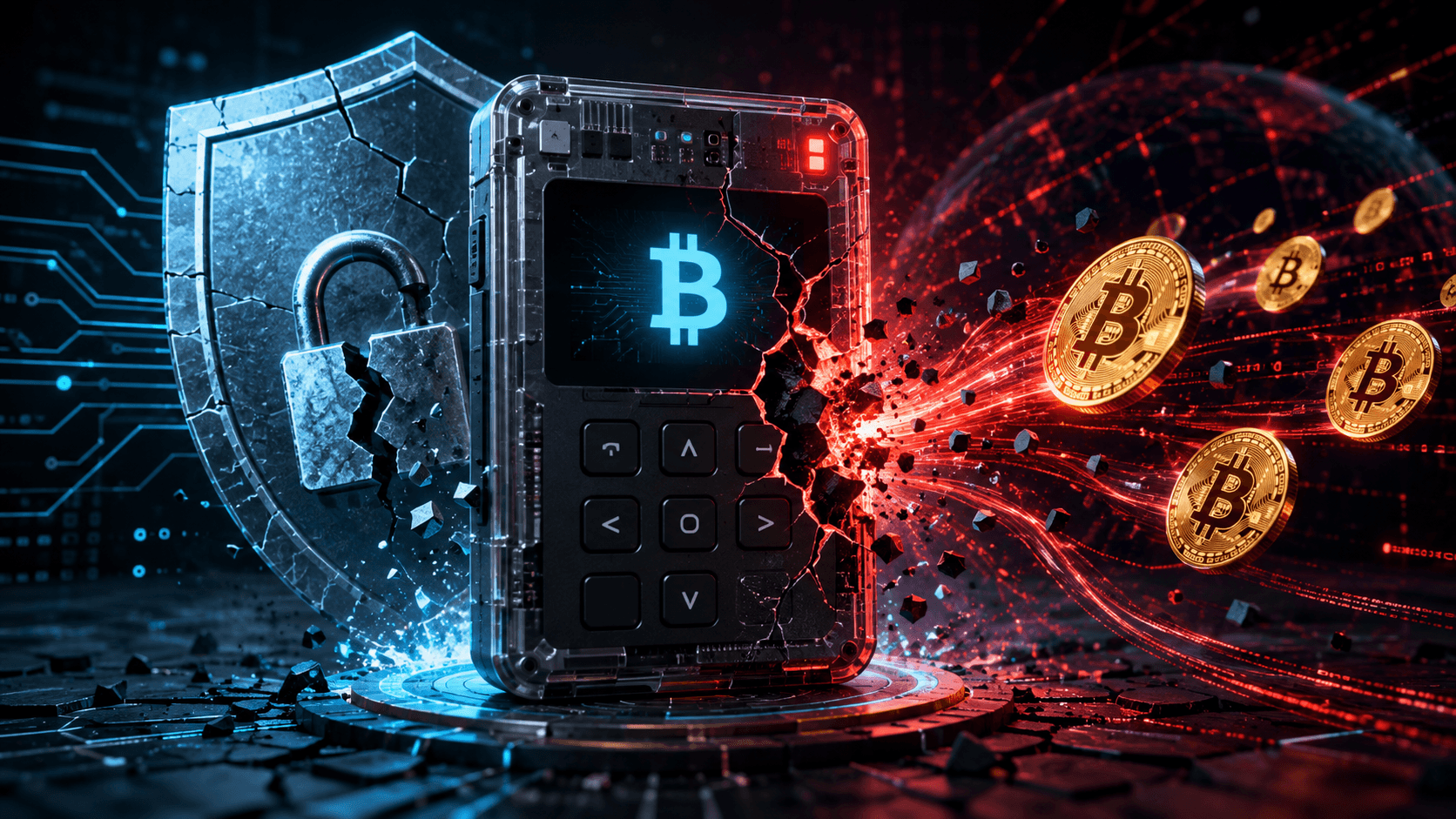
However, there is an important distinction between “the victims used Coldcard wallets” and “the Coldcard system was hacked.” Assets can be stolen even when the hardware itself remains secure—for example, if a seed phrase is photographed, typed into an internet-connected device, stored in the cloud, or entered into a fake application.
AI-Generated Image Source
Was Coldcard Really Hacked?
Not necessarily. The term Coldcard hack may suggest that attackers breached the secure element or extracted private keys directly from the device. In reality, several other scenarios could also explain the missing Bitcoin.
The investigation needs to answer several questions:
- Did the victims use the same model and firmware version?
- Was the seed generated entirely on the device?
- Did users add their own entropy?
- Was the seed backup ever stored digitally?
- Were the devices purchased from an authorized seller?
- Was the wallet ever restored in another application?
- Was malware present on the users’ computers or phones?
Without answers to these questions, it is too early to conclude that all Coldcard devices are vulnerable.
To follow Bitcoin security news and developments in the crypto market, you can register with Bittime and read the latest updates before making decisions about digital assets. Continue verifying information through several trusted channels.
Suspected Coldcard Firmware Bug
One theory being discussed is a possible Coldcard firmware bug. Firmware is the internal software that controls how a hardware wallet generates keys, displays addresses, processes transactions, and signs data.
If a bug affects a critical process, several risks may arise. The device could generate insufficiently random entropy, display the wrong address, or process transactions in an unexpected way.
Even so, a suspected firmware bug must be proven through code audits, device testing, attack reproduction, and confirmation from the developers. The fact that victims used the same wallet brand is not enough to establish firmware as the primary cause.
Read Also: Using Multiple Crypto Wallets: A Safer Strategy to Avoid Losing Assets
What Are RNG Vulnerabilities and Weak Entropy?
An RNG, or random number generator, is used to create the random values that form the basis of private keys and seed phrases. In cryptographic security, the quality of randomness is critical.
If entropy is weak, a seed phrase may look random to a person but actually come from a much smaller set of possibilities. An attacker could test many combinations until finding a seed that matches the victim’s address.
For illustration, a seed phrase generated with strong entropy is extremely difficult to guess. However, if the generation process uses predictable patterns, repeated random values, or a flawed source of randomness, its security can decline dramatically.
A Coldcard RNG vulnerability still needs to be proven. Another possibility is that users created their own seeds using unsafe methods, such as manually selecting words or using dice rolls that were not sufficiently random.
Read Also: ZachXBT Calls All Hardware Wallets “Trash” and Recommends a Dedicated iPhone Instead
Was the Coldcard Seed Phrase Hacked?
The phrase seed phrase hacked can refer to several different situations. A seed phrase may be guessed because of weak entropy, stolen through malware, seen by another person, or entered into a phishing site.
An attack on a seed phrase does not always require physical access to the hardware wallet. An attacker only needs the correct sequence of words to restore the wallet on another device.
Risky practices include:
- Storing a seed phrase in a photo or screenshot
- Typing a seed phrase on a computer or phone
- Saving a backup in email or cloud storage
- Entering a seed phrase into a website claiming to provide recovery services
- Buying a hardware wallet from an unauthorized seller
- Reusing a seed that has been used before
- Giving a seed phrase to someone claiming to be from a support team
A hardware wallet cannot protect funds once an attacker knows the seed phrase.
Read Also: Phantom Wallet: A Guide to Creating a Crypto Wallet Account
Impact of the Coldcard Hack on Self-Custody
This case could undermine confidence in self-custody. Many investors choose hardware wallets to avoid exchange risk, account freezes, and third-party failures.
However, self-custody is not risk-free. It shifts security responsibility from a company to the user. Backup mistakes, counterfeit devices, phishing, or weak setup procedures can lead to permanent losses.
The incident may also encourage users to:
- Update firmware through official channels
- Move funds to a new seed
- Use multisignature
- Separate the main wallet from the transaction wallet
- Test the recovery process offline
- Verify that the device is authentic
- Avoid digital backups
Read Also: 4 Best Physical Crypto Wallets for Storing Coins Securely
What Is the Impact on the Crypto Market?
The direct impact on Bitcoin’s price is likely to be more limited than the impact on security sentiment. While 1,367 BTC is a significant amount for the victims, it remains relatively small compared with global Bitcoin market liquidity.
Market pressure could emerge if the stolen BTC is moved to exchanges and sold quickly. However, on-chain analysts typically monitor suspicious addresses, making fund movements detectable.
The broader impact may instead be felt across the hardware wallet industry. Users may begin questioning RNG quality, firmware audits, secure-element transparency, and supply-chain processes.
The case could also increase interest in multisignature setups. In a multisig arrangement, one compromised seed may not be enough to move funds because transactions require multiple signatures from different devices or locations.
Read Also: What Is a Tether Wallet? A Complete Guide to Tether’s Official Crypto Wallet
What Should Coldcard Users Do?
Do not panic or immediately enter your seed phrase into another application. The first step is to review official announcements, check the firmware version, and look for confirmed indicators of compromise.
Users may consider the following steps:
- Check the firmware version directly on the device.
- Verify updates only through official channels.
- Never type a seed phrase into an online device.
- Review transaction history and wallet addresses.
- Prepare a new wallet with an entirely new seed if there is a risk of compromise.
- Move funds with a small test transaction first.
- Consider multisig for high-value assets.
Do not update firmware through links sent in private messages. Attackers often exploit news of hacks to distribute fake recovery websites.
Read Also: 3 Best Factom Crypto Wallets in 2026
Are Hardware Wallets Still Safe?
Hardware wallets remain useful tools for keeping private keys separate from online devices. However, security is not determined by the device alone.
Self-custody security consists of several layers:
- Hardware authenticity
- Firmware quality
- Entropy strength
- Seed phrase security
- Backup procedures
- Address verification
- User practices
Even the best device cannot protect a seed that has been photographed or shared. Conversely, strong procedures can reduce risk even when users face phishing attempts or an infected computer.
Read Also: Best Crypto Wallets of 2026 to Keep Your Assets Secure!
Conclusion
The Coldcard hack linked to the theft of 1,367 BTC is a reminder that Bitcoin security does not depend solely on a hardware wallet’s reputation. The cause could involve firmware, weak entropy, a leaked seed phrase, supply-chain issues, or user operational errors.
It is premature to claim that all Coldcard devices are vulnerable without reproducible technical evidence. Users should wait for the investigation results, check their firmware, keep seeds offline, and consider multisignature for high-value funds.
The impact on Bitcoin’s price may be limited, but the effect on confidence in self-custody could be greater. Follow the investigation and avoid taking hasty action based on rumors.

Let’s start trading crypto safely with the largest assets, such as BTC/IDR and ETH/IDR, right in the Bittime app.
Bittime is a licensed Digital Financial Asset Trader (PAKD) platform supervised by Indonesia’s Financial Services Authority (OJK)— where you can buy Bitcoin in Indonesia and hundreds of other crypto assets starting from IDR 10,000. Registration is fast and secure, and you can get started today.
Track the USDT to IDR conversion rate and the real-time price movements of your favorite crypto assets. Everything is available in one crypto investment app that can be downloaded free from the Play Store.
Ready to get started? Register with Bittime now and put your investment strategy into action on a platform trusted by millions of users in Indonesia.
FAQ
What is the 2026 Coldcard hack?
The 2026 Coldcard hack refers to reports that approximately 1,367 BTC was stolen from wallets associated with Coldcard use. The technical cause still needs to be established through investigation.
Are all Coldcard devices unsafe?
There is currently no basis for concluding that every device is affected. The risk may depend on the model, firmware, seed-generation process, and user practices.
What is weak entropy in a hardware wallet?
Weak entropy means the source of randomness used to create a private key is not sufficiently strong or may be predictable. This could make the seed easier to guess through computational attacks.
Can a seed phrase be hacked?
A seed phrase can be stolen through phishing, malware, digital backups, or physical exposure. A seed may also be guessable if it was created with extremely weak entropy.
What should Coldcard users do?
Check official announcements and the firmware version, and make sure the seed has never been stored digitally. High-risk users may consider migrating to a new seed or a multisignature setup.
Disclaimer: The views expressed belong exclusively to the author and do not reflect the views of this platform. This platform and its affiliates disclaim any responsibility for the accuracy or suitability of the information provided. It is for informational purposes only and not intended as financial or investment advice.

.png)