Cerebras Becomes Nvidia's Rival, AI Hardware Business Down 23%
2026-08-13
Cerebras AI has long been known as one of Nvidia's boldest challengers in the artificial intelligence computing market.
Instead of following the industry pattern of combining multiple GPUs, Cerebras built processors measuring almost a full wafer through technologyWafer Scale Engine.
However, the second quarter 2026 financial report reveals an interesting paradox.
Amidst high demand for AI infrastructure, Cerebras' hardware revenue actually fell by around 23% year-on-year to US$54.1 million.
In the same period the previous year, the segment generated approximately US$70.3 million.
This condition does not automatically mean that Cerebras technology has lost its appeal.
In fact, the latest figures show that the AI semiconductor company's business model is shifting from selling machines directly to providing AI computing capacity through the cloud.
Key Takeaways
For this purpose Cerebras' AI hardware business fell 23% YoY to US$54.1 million in Q2 2026, but cloud and services revenue jumped to around US$126 million.
Wafer Scale Engine remains the main differentiator between Cerebras vs Nvidia kThe arena uses a single large silicon wafer as an integrated AI processor.
Cerebras' biggest challenge is not producing the latest AI chip, but turning tens of billions of dollars worth of demand and backlog into real revenue.
Cerebras Hardware Is Down, But AI Computing Demand Isn't Weakening
Source : Google Finance
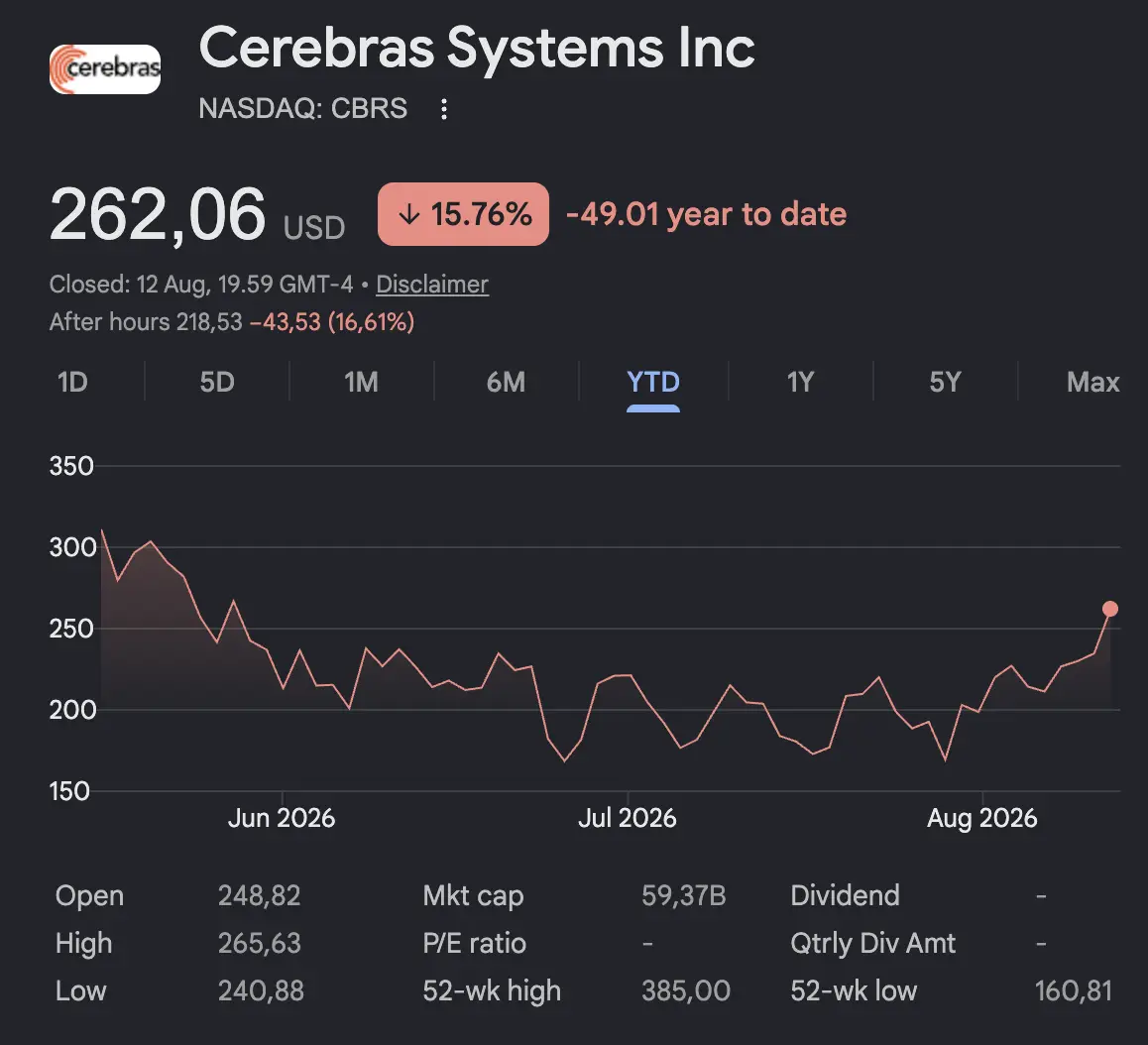
Cerebras' AI chip sales decline contrasts with the company's overall performance.
Cerebras' GAAP revenue reached approximately US$180.1 million in Q2 2026, up 74% compared to the same period last year.
Meanwhile, core revenue reached US$209.9 million, or grew 103% year-on-year. The main growth engine is not physical hardware, but the cloud.
GAAP cloud and other services revenue reached US$126 million, a 281% year-on-year increase, while core cloud revenue rose 287% to approximately US$127.7 million.
Cerebras CEO Andrew Feldman explains that the hardware business tends to be uneven because delivery times and revenue recognition are highly dependent on customer readiness.
One practical obstacle is the availability of data center space and infrastructure to accommodate a company's wafer-scale computing systems.
That is, the 23% decline is more accurately read as a matter of timing and character of large-scale system sales than evidence that overall AI demand is collapsing.
Read Also: 5 Best AI Tokens for Crypto Futures Trading
What Makes Wafer Scale Engine Different from GPU?
Main strength Cerebras AIto be on the verge of architecture.
Nvidia and most of the industry use individual GPUs that are then assembled into large clusters, whereas Cerebras maintains a 300 mm diameter silicon wafer as a giant processor.
The WSE-3 generation used in the CS-3 system is built on a 5 nanometer process and carries over 4 trillion transistors.
Cerebras designed this architecture to reduce data movement, which is usually a bottleneck in training and inferencing large-scale AI models.
This approach is what makesWafer Scale Engine technology be an attractive alternative for companies that require high throughput and low latency inference.
However, superior technology does not always mean a product is easier to sell.
Wafer-scale systems require a different data center ecosystem, power supply, cooling, and deployment capacity than conventional accelerator purchases.
Read Also: Nvidia's $500 Billion AI Funding, Will Crypto AI Tokens Benefit?
Cerebras vs Nvidia: Technology Rivals, but Not Yet Scale Rivals
Label Nvidia's rival against Cerebras needs to be seen in context technology, not business size.
Nvidia recorded Data Center revenue of US$62.3 billion in the fourth quarter of fiscal 2026 alone.
Full-year Data Center revenue even reached US$193.7 billion.
This scale is still far superior to Cerebras. Nvidia's advantages also come from its software ecosystem, developer network, cloud integration, and much broader customer base.
Cerebras took a different path.
Instead of trying to be a second GPU, the company offers a wafer-scale architecture specifically designed for large-scale AI workloads and high-speed inference.
Therefore, the fightCerebras vs NvidiaProbability is not only determined by who has the fastest chip.
The ability to consistently provide capacity and make technology easy for customers to consume through the cloud can be equally important factors.
The development of AI, semiconductors, and blockchain are increasingly interconnected in the digital economy. If you're interested in the crypto asset market, you can Register at Bittime.
A $25.4 Billion Backlog Brings Both Opportunities and Pressures
One of the biggest numbers from Cerebras' report actually comes outside of quarterly earnings.
The company reported remaining performance obligations of approximatelyUS$25.4 billion, which describes the value of contractual obligations that are expected to become revenue in future periods.
The size of the backlog indicates strong demand, but contracts have not yet equaled realized revenue.
Cerebras now has to build capacity to meet that demand.
The company said it has contracts for approximately 600 MW of data center capacity and plans to increase its manufacturing capacity more than tenfold by 2026.
That's why investors' attention is shifting from mere sophistication of Cerebras AI chip going to the company's ability to execute infrastructure development.
Read Also:NVIDIA Stock vs. NVDAX: The Advantage of Tokenized Stock on Bittime
Cerebras' 23% AI Hardware Business Drop Doesn't Mean It's Losing Momentum
The hardware decline figures do look negative on their own.
However, the nearly fourfold growth in cloud suggests that customers may increasingly prefer to access Cerebras' computing capabilities as a service rather than purchasing systems outright.
This change has the potential to make Cerebras evolve from justAI semiconductor companybecome an AI computing infrastructure provider.
The company also raised its 2026 core revenue projection to US$880 million-US$890 million and is targeting 2027 revenue to grow more than threefold.
Thus, the main question is not whether Cerebras is capable of making fast AI chips.
The question is whether the technology can be converted into cloud capacity, margins, and revenue at scale enough to challenge the incumbents.
Read Also:The 6 Most Popular Tokenized Stocks in 2026, Including Tesla and NVIDIA

Interested in investing in global stocks? Check out tokenized stocks like AAPLX and TSLAX on the Bittime market.
Bittime is a licensed and regulated Digital Financial Asset Trader (PAKD) supervised by Indonesia’s Financial Services Authority (OJK) — where you can buy Bitcoin in Indonesia and hundreds of other crypto assets starting from just Rp10,000. The registration process is fast, secure, and you can get started today.
Track USDT to IDR conversions and monitor your favorite crypto assets in real time. Everything is available in one crypto investment app that you can download for free on the Play Store
Ready to start? Register now on Bittime and execute your investment strategy with a platform trusted by millions of users in Indonesia.
FAQ
What is Cerebras AI?
Cerebras Systems is an AI computing company developing a Wafer Scale Engine-based system. This technology is designed to handle large-scale AI model training and inference using an architecture different from conventional GPUs.
Why did Cerebras' AI hardware business fall 23%?
Q2 2026 hardware revenue fell from approximately US$70.3 million to US$54.1 million. Management attributed the nature of hardware sales to uneven deployment schedules and customer data center capacity availability.
Is Cerebras really a rival to Nvidia?
Cerebras could be considered Nvidia's rival in AI accelerator technology, but the size of their businesses and ecosystems are still very different. Nvidia has a much larger data center revenue scale, while Cerebras is trying to differentiate itself through wafer-scale architecture.
What are the advantages of Wafer Scale Engine technology?
The Wafer Scale Engine integrates computing power onto a single large silicon wafer, reducing the need for inter-chip data transfer. The WSE-3 contains over 4 trillion transistors and is the core of the Cerebras CS-3 system.
Does declining hardware revenue mean Cerebras' business is weakening?
Not necessarily. Hardware revenue is down, but Cerebras' cloud and services revenue grew more than 280% year-over-year in Q2 2026. This indicates that Cerebras' business growth focus is shifting toward providing compute AI as a service.
Disclaimer: The views expressed belong exclusively to the author and do not reflect the views of this platform. This platform and its affiliates disclaim any responsibility for the accuracy or suitability of the information provided. It is for informational purposes only and not intended as financial or investment advice.

.png)